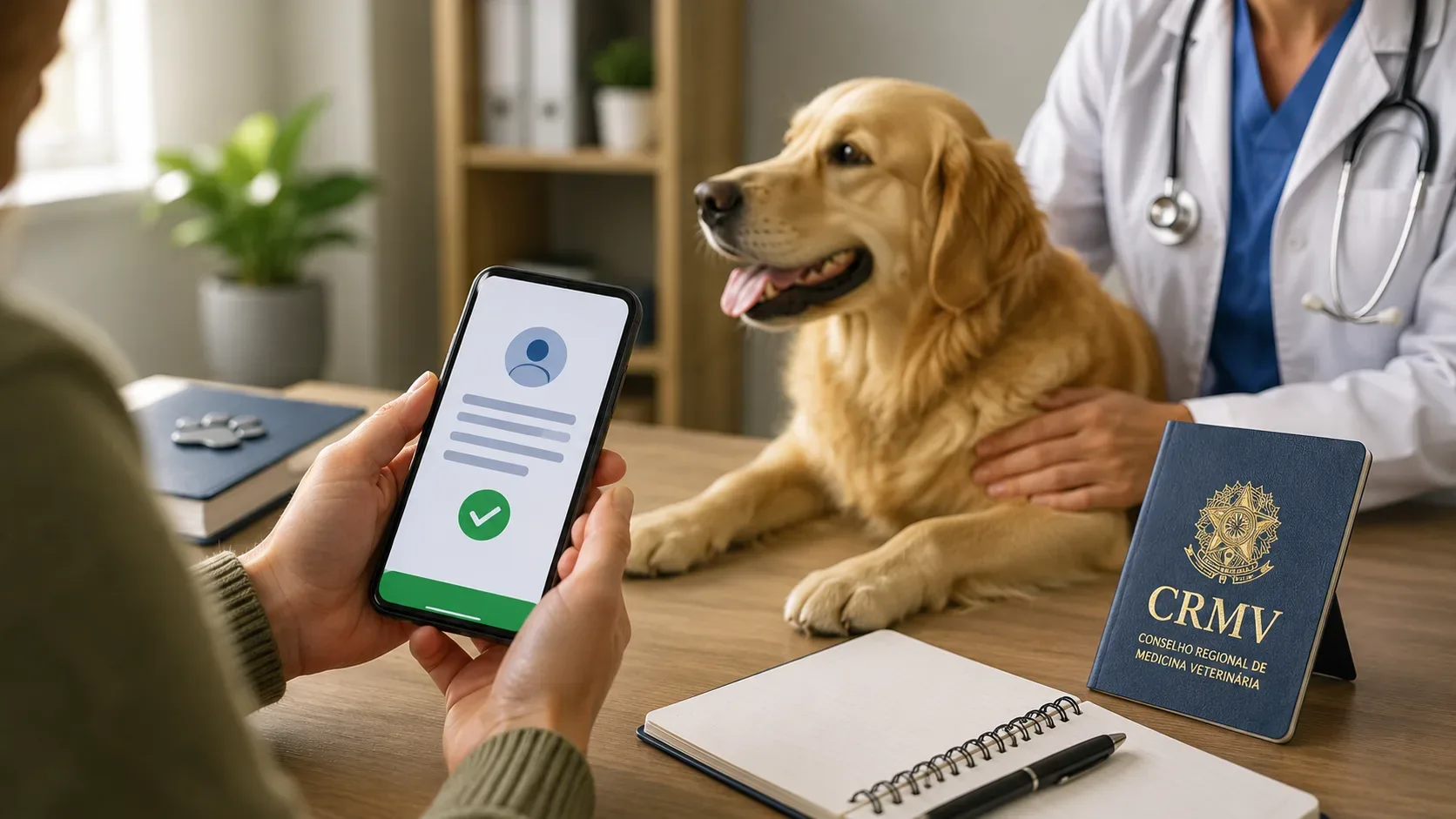
Before authorizing a consultation, vaccination, prescription, surgery or other clinical care, ask the full name, CRMV number and the federative unit of registration of the person who will care for the animal. Then, compare this information with the public consultation of the CFMV/CRMVs System.
The essential checklist has three steps: identify the person, confirm that the registration is active and check whether the professional really matches the service offered. The guidance from the Federal Council of Veterinary Medicine is that those responsible for animals do this check before entrusting their care to someone.
What does it mean to be a qualified veterinarian
Having studied Veterinary Medicine is not, in isolation, what authorizes someone to practice the profession. Law No. 5,517, of October 23, 1968, requires recognized training and professional registration. The same law establishes that clinical practice and technical and sanitary assistance to animals are among the private activities of the veterinarian.
In practice, the qualification must include:
- valid training in Veterinary Medicine;
- registration with the Regional Council of Veterinary Medicine;
- registration status compatible with professional practice;
- acting within the legal and ethical limits of the profession.
The record is usually presented in the format CRMV-UF number, such as “CRMV-AL 0000” or “CRMV-SP 00000”. The acronym identifies the Regional Council and the state to which the registration is linked.
The alert gained new legal weight in 2026
The CFMV campaign on illegal practice advises the population to check whether the professional has an active registration. The initial material made reference to the then Bill nº 4,560/2025, but the scenario changed: Law nº 15,425/2026 was published on June 8, 2026 and expressly included Veterinary Medicine in article 282 of the Penal Code.
The new rule provides for detention of six months to two years for anyone who practices the profession without legal authorization or beyond the limits of qualification, including when the service is provided free of charge. More serious consequences may generate other forms of liability, depending on the damage caused. This information is general and does not replace legal analysis of a specific case.
Checklist: three checks before handing over the animal
1. Confirm the identity of the person providing the service
Don't limit yourself to the name of the clinic, platform or social media profile. Ask directly:
- What is the veterinarian's full name?
- What is the CRMV number?
- In which state was the registration made?
- Will this person perform the service or did they just make the appointment?
The most accurate data for the search is the combination registration number and UF. Searches by name alone may return homonyms or fail due to differences in spelling, social name, abbreviated surnames or registration updates.
When there is a team, confirm who will be responsible for the consultation, the procedure and any prescriptions. The registration of the company or clinic does not replace the individual registration of the professional who performs the medical-veterinary act.
2. Check the situation on the official system
The CFMV maintains a public consultation page for professionals and companies on Siscad. The service allows you to select an individual or legal entity, state and search method. The results present fields such as name, CRMV, situation, State, area and date of registration.
To consult CRMV veterinarian:
- Access the official tool Consultation of professionals and companies of the CFMV/CRMVs System.
- Select Individual.
- Choose the federative unit informed by the professional.
- Search preferably by registration number.
- Compare the full name, number, UF and the situation shown.
- Check if the situation is active before elective care.
Write down the date of the consultation or keep the result for your records. Professional registrations are changeable: someone who was regular months ago may have transferred, canceled or been restricted later.
3. Check if the registration corresponds to the service offered
Finding an active name in the system is the main registration check, but it is still necessary to confirm that this record belongs to the person who will actually care for the animal.
Please note:
- the name entered matches the result;
- the number and UF are the same;
- recipes, exam requests and documents identify the professional;
- the clinic, hospital or platform informs who is responsible for the service;
- the type of online service respects the rules of veterinary telemedicine.
When the service is provided by a clinic, hospital or telemedicine company, it is also possible to repeat the search by choosing Legal entity. Law No. 5,517/1968 provides for registration of companies that carry out Veterinary Medicine activities and the presence of a qualified professional when necessary. As obligations may vary depending on the establishment's activity and decisions applicable to the sector, the absence of a company in the survey must be clarified with the competent CRMV, and not automatically treated as proof of illegality.
What to check in each type of service
| Modality | Main check | Additional care |
|---|---|---|
| In-person consultation | Name, CRMV-UF, number and active status of the professional | Also consult the legal entity when the service takes place in a clinic or hospital |
| Home care | Individual record of who will go to the address | Request the details before the visit and confirm who will issue prescriptions, reports or test requests |
| Online service | Active registration and identification of the telemedicine modality | Check whether it is teleconsultation, telescreening or teleguidance and whether there are requirements for each modality |
| Procedure promoted by campaign or entity | Identification of professionals and technical manager | Consult the regional CRMV when there is doubt about the regularity of the action |
In-person consultation
When providing services in an office, clinic or hospital, the facade and registration of the establishment are not enough. The person responsible for the animal must be able to identify the veterinarian in charge of the case.
Prescriptions and other clinical documents must also allow professional identification. In veterinary prescriptions, for example, the veterinarian's registration number is part of the prescriber's identification data.
Team participants can perform support tasks within their roles. Therefore, the most useful question is not just “who works here?”, but “which veterinarian is responsible for this consultation or procedure?”
Home veterinary care
The fact that the service takes place at home does not reduce the need for a license. Request name and CRMV before confirming the visit, especially when contact began via an app, advertisement, informal referral or social network.
At the time of service, check whether the person matches the data searched. If there is a prescription, test order or other document, check that the professional's name and CRMV appear correctly.
Uniform, briefcase, lab coat, personalized vehicle or recommendation from third parties do not replace official consultation.
Online guidance and support
CFMV Resolution No. 1,465/2022 allows veterinary telemedicine only to veterinarians with active registration. Companies that provide this service must be registered with the CRMV of the federative unit where they are located and have a Technical Responsibility Note.
It is also important to know which modality is being offered:
- Teleorientation: offers general and initial information, without defining diagnosis or treatment.
- Telescreening: assesses the need for teleconsultation or immediate or scheduled in-person care.
- Teleconsultation: may involve diagnosis, request for exams, therapeutic conduct and prescription, but requires a prior relationship between the veterinarian, animal and guardian, established in person and recorded in the medical record.
- Telemonitoring: monitors the evolution of a patient in situations provided for by regulation.
Teleconsultation should not be used in urgencies or emergencies. In these situations, in-person service should be prioritized. Furthermore, a message conversation does not automatically turn into a teleconsultation just because payment has been made or photos of the animal have been sent.
When there is a remote prescription, the document must identify the veterinarian, the patient and the person responsible, record the date and time and use the electronic signature required for the type of document.
How to interpret the query result
Registration is active and all data matches
This result confirms the existence of active professional registration with the data researched. Even so, registration is not a guarantee of clinical results, does not prove experience in any type or procedure and does not replace the evaluation of the service conditions.
For complex treatments, ask about experience, available structure, risks, alternatives and follow-up. Seeking a second opinion is a legitimate option when doubts persist.
The name appears, but the UF is different
A registration in another state does not allow us to conclude, alone, that there is an irregularity. Law No. 5,517/1968 determines secondary registration or transfer when the professional starts to work permanently in another state for more than 90 days. Any assistance, transfers in processing and other registration situations must be confirmed with the Regional Council.
Ask the professional if there is secondary registration and consult the CRMV of the state where the service will be provided.
Registration was not found
The absence of a result does not automatically prove that the person is misrepresenting themselves. Before concluding:
- check the spelling of the name;
- remove incorrectly inserted periods, hyphens or zeros;
- search in another informed UF;
- request the full number;
- see social name, when applicable;
- contact CRMV.
Until the information is clarified, it is prudent not to authorize an elective procedure.
The situation does not appear as active
Do not proceed with elective care until you obtain official clarification. Ask the professional and consult the competent Regional Council.
In a situation of urgency or immediate risk to the animal, look for another in-person service whose professional can be verified, without delaying the care necessary just to complete a complaint.
The company appears, but the professional does not
Registering a clinic or platform does not “lend” qualifications to its employees, providers or partners. It is necessary to verify individually who will perform the medical-veterinary act.
Signs that warrant additional conference
None of the signs below prove, in isolation, illegal exercise. They indicate that identity and registration need to be clarified:
- refusal to provide full name or CRMV;
- disclosure only of the name of a clinic or brand;
- CRMV number that leads to another person;
- use of a record belonging to another professional;
- promise of online diagnosis or prescription without prior in-person care;
- attempt to conduct urgency or emergency exclusively through messages;
- documents without prescriber identification;
- explanation that “the clinic's CRMV is for the entire team.”
Popularity, price, followers, testimonials, photographed diploma and indication of acquaintances also do not replace the registration consultation.
What to do when there is doubt or suspicion
First, don't turn doubt into public accusation. A divergent result may result from a typing error, registration change, transfer or other situation that only the Council can clarify.
Record available objective elements, such as:
- name used in the advertisement or service;
- CRMV number entered;
- messages and receipts;
- date and location of service;
- documents issued;
- identification of the clinic or company.
Then, look for the CRMV of the federative unit related to the service. The CFMV/CRMVs System has a Regional Council in each state and the Federal District, and information about professionals and companies must be clarified by the corresponding region. Inspection, reporting and protocol channels may vary between Councils.
When reporting the situation, describe verifiable facts: what was announced, who came forward, what number was used, and what divergence appeared in the consultation. Avoid attributing crime, fraud, mistreatment or guilt before investigation by the competent authorities.
Frequently Asked Questions
Can I request the veterinarian's professional card?
Yes. The legislation recognizes the professional identity card issued by the CFMV/CRMVs System as a document with public faith. The online consultation, however, helps to check the registration status at the time of verification.
Can a veterinarian registered in another state treat my animal?
There may be regular situations of occasional attendance, transfer or secondary enrollment. When working in another state becomes permanent for more than 90 days, the law provides for transfer or secondary registration. Confirm the case with the CRMV at the service location.
Does WhatsApp guidance need to be provided by a veterinarian?
When the service is a form of veterinary telemedicine, it is subject to CFMV rules and must be carried out by a professional with active registration. Teleguidance and telescreening do not authorize diagnosis, treatment or prescription.
Does not finding the name in the system mean that the person is fake?
Not necessarily. The search may fail due to spelling, incorrect UF, social name or registration change. The lack of results is a reason to suspend an elective procedure and ask CRMV for confirmation, but it should not be used in isolation to accuse someone.
Does the active CRMV guarantee that the service will be good?
No. Active registration confirms the registration qualification to practice the profession. Clinical quality also depends on experience, structure, communication, professional updating and adequacy of care to the animal's needs.
Before the consultation, do the full conference
Before handing over the animal to someone's care, confirm three points:
- Who is the person: full name, CRMV, number and UF.
- What is the situation: active registration and matching data in the official system.
- What service will be provided: compatible professional, establishment and type of service.
When any information remains inconclusive, consult the competent Regional Council. Checking the registration is not unjustified suspicion: it is a simple measure to protect the animal, the person responsible and the professionals who work legally.