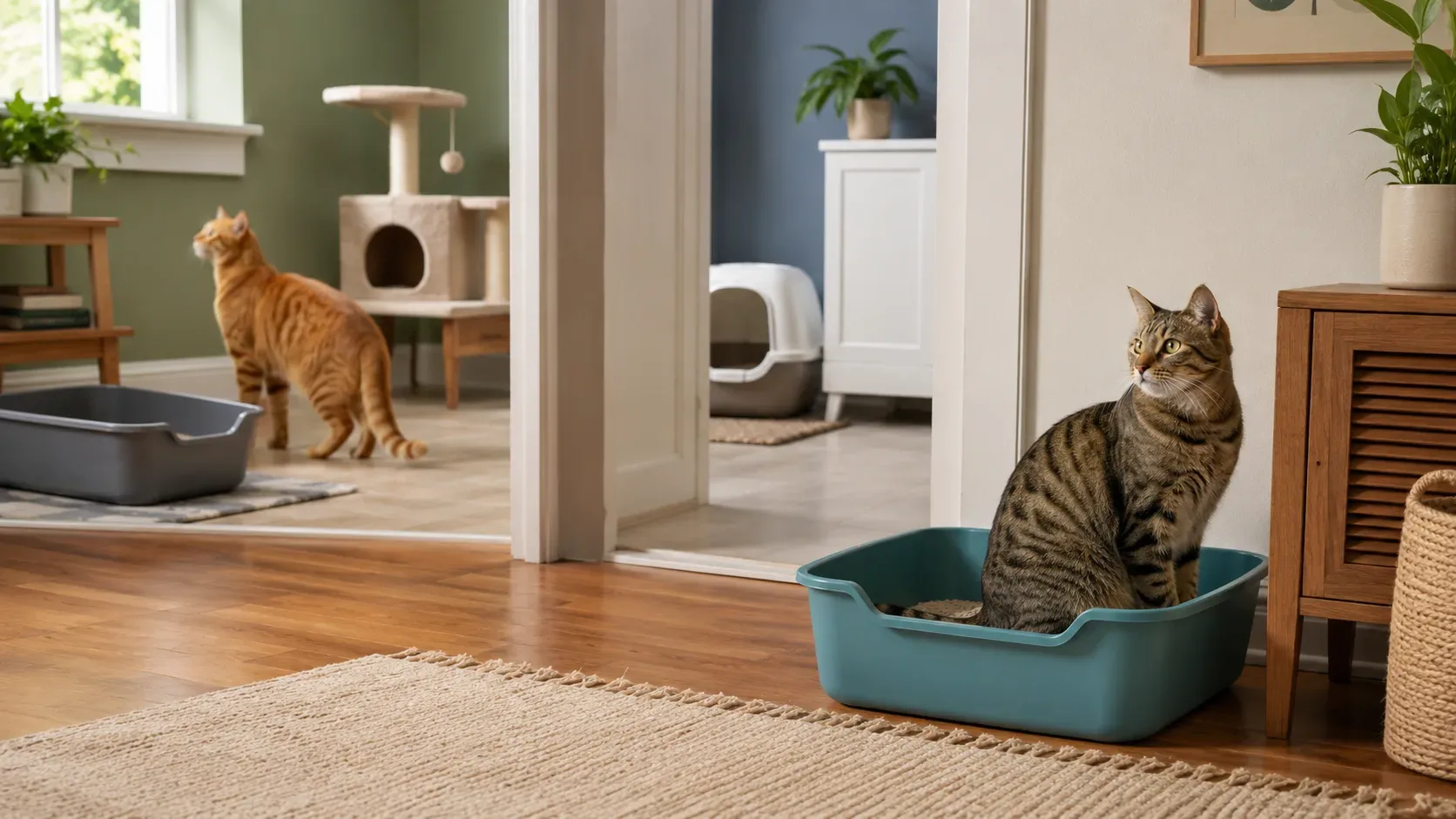
For a two-cat household, starting with three litter boxes is a practical guideline. With three cats, four boxes; with four, five. This is the well-known rule of one box per cat plus one extra, maintained in the Feline Veterinary Medical Association (FelineVMA) guidelines for caregivers in 2026.
But the account alone does not solve the problem. Three boxes lined up in the same room may offer fewer real options than three boxes spread across safe spots in the house. The relationships between the cats, the routes to each box and the possibility of one animal blocking the other's passage need to be included in the planning. Feline elimination guidelines treat “cats + 1” as a general rule rather than an absolute requirement for all homes.
The “cats + 1” rule is the beginning, not the entire project
The recommendation is easy to remember, so it works well as a starting point. FelineVMA's own current guidance gives the example of three boxes for a household with two cats.
The AAFP/ISFM guideline on out-of-box elimination, however, adds important information: cats that are socially bonded may accept sharing some resources more easily, while cats that do not belong to the same social group need separate litter stations. Depending on the social composition of the house, even more boxes may be needed than the initial formula suggests.
This changes the question from “how many boxes do I have?” for “can each cat reach a suitable box without depending on the tolerance of another cat?”
A house can mathematically comply with the rule and still have an access problem.
Tile boxes do not work as independent locations
Placing two or three boxes next to each other seems to increase the supply, but does not necessarily create alternative access. FelineVMA's guidance is to keep the boxes in different locations and, preferably, out of each other's line of sight. Cats may perceive very close boxes as a single large litter station.
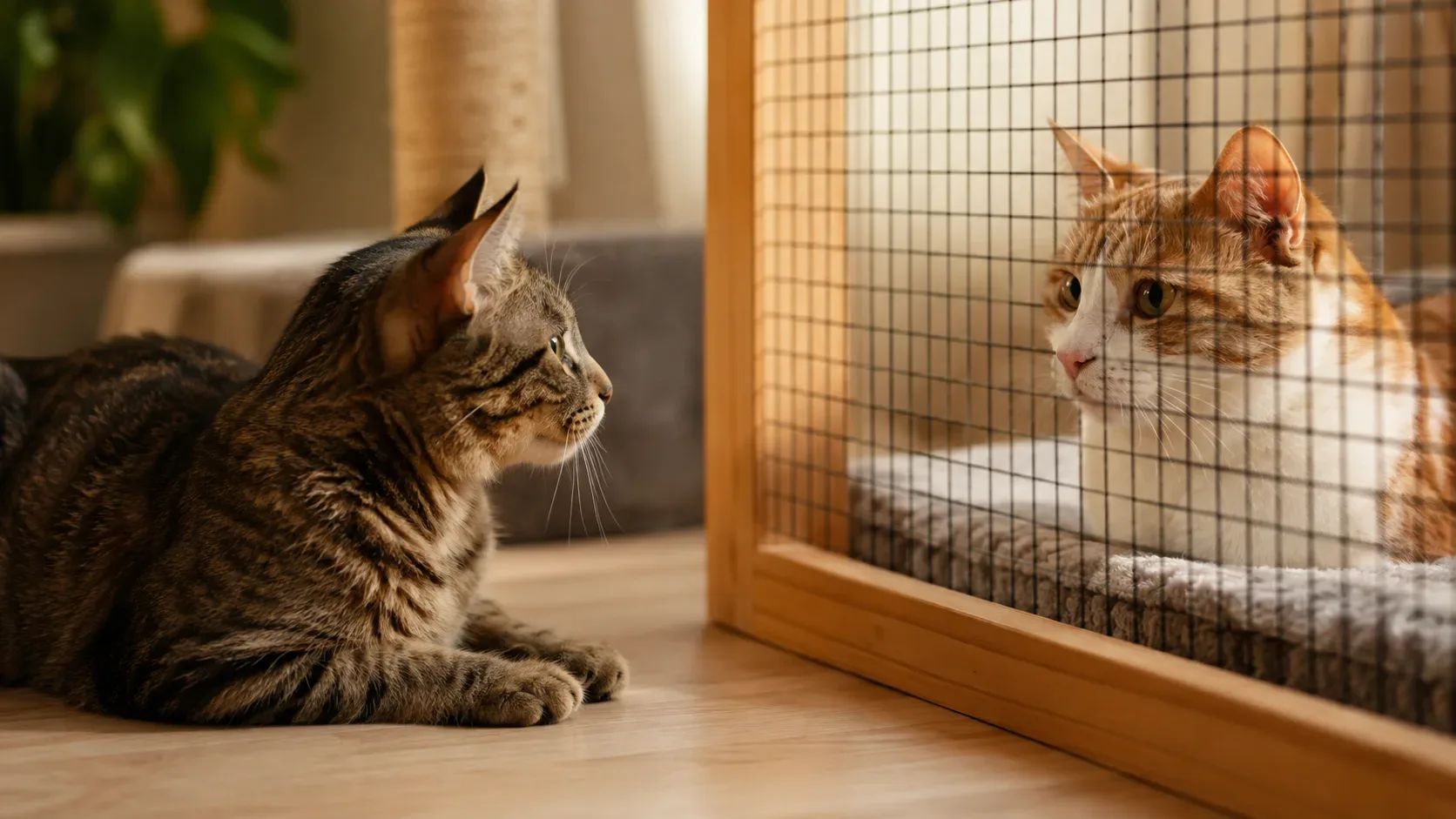
This is especially relevant when there is tension between animals. If one cat controls the entrance to a room, a hallway, or the path to that set of boxes, all of them may be functionally unavailable to the other.
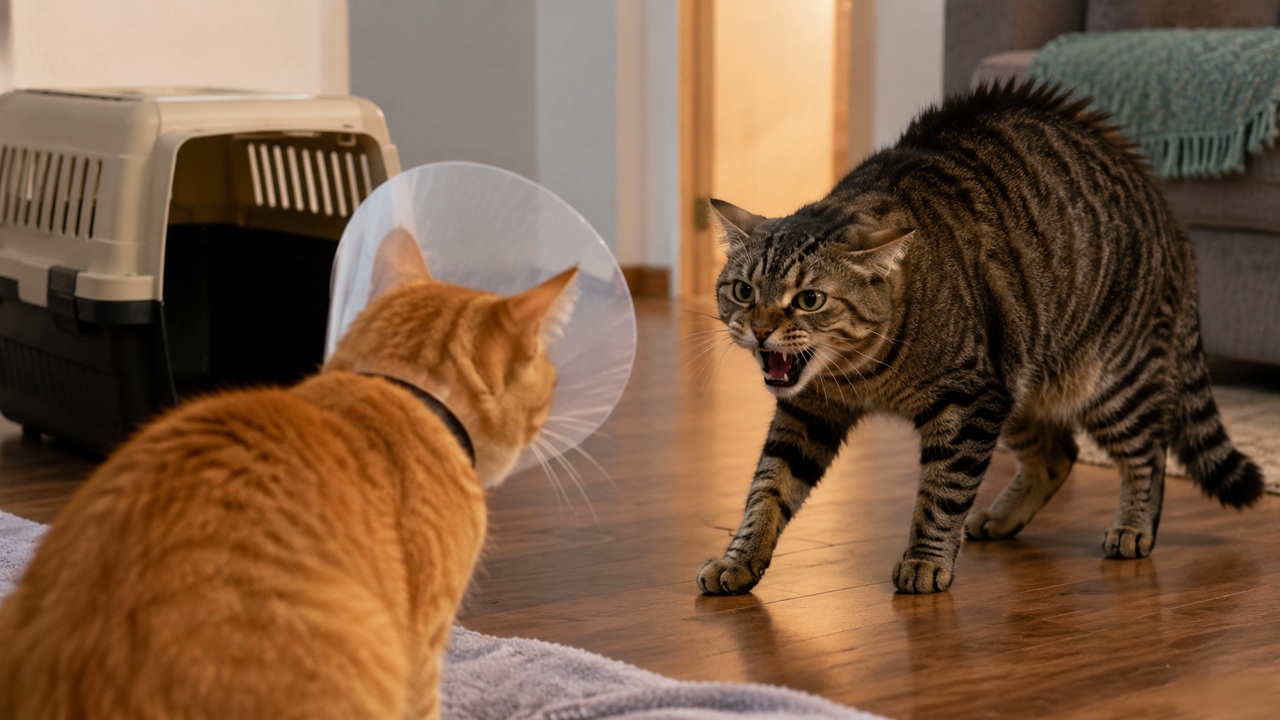
The 2024 guideline on tension between cats precisely describes blocking as a behavior that can be discreet. There is not always fighting, growling or chasing. In one of the examples presented, a cat remained in corridors and stairs in a way that prevented another from reaching the rooms where the boxes were.
So distributing boxes doesn't just mean moving them a few centimeters apart. It means creating really different routes and locations.
How to distribute boxes in a multi-cat household
A practical way to organize the environment is to first look at the house and the cats, and then choose where each box will be located.
- Identify where each cat spends the most time. Observe resting spots, hiding places, favorite rooms and areas that an animal seems to avoid. Current guidelines recommend distributing resources according to the territories used by cats, rather than concentrating them in a single point convenient for humans.
- Spread the boxes in different locations. Avoid turning the laundry room, bathroom or other room into a “box center”. An alternative in another part of the house remains available if a certain path is occupied or creates insecurity.
- Avoid dead ends. A box at the back of a narrow space can leave the cat without a good route to get away if another animal appears at the entrance. FelineVMA recommends avoiding points where the cat could be cornered, blocked or prevented from leaving.
- In homes with more than one floor, provide a box on each floor used by cats. Both current guidance for caregivers and AAFP/ISFM guidelines recommend at least one option on each level of the home. For elderly cats or those with limited mobility, having a box on the floor where they spend most of their time deserves special attention.
- Separate the food and water box. Feeding and elimination areas must be physically separated. This organization is part of the environmental resource recommendations for cats.
In a small apartment, there is no need to imagine that each box needs an exclusive room. The objective is to prevent them all from relying on the same passage or being grouped together at the same point. One box in a bathroom, another in a quiet area of a bedroom or office, and a third in another accessible location can offer more useful alternatives than three boxes in a row.
Observe social groups, not a supposed “hierarchy”
Living at the same address does not mean that all cats form a single social group. Some rest together, clean each other, play reciprocally and seek each other's company. Others just share the house and try to keep their distance whenever they can.
The latest FelineVMA guidelines reject the simplified idea that the domestic social organization of cats depends on a rigid hierarchy or an “alpha cat.” Relationships are more individual and flexible. Instead of looking for which animal is “in charge”, it is more useful to observe who can access resources calmly and who changes their behavior in the presence of another cat.
Some signs that deserve attention are:
- one cat stares at the other near the box;
- stay in doors, corridors or passages used to reach resources;
- one of the cats avoids a certain room when the other is present;
- pursuits or approaches that make the other person abandon the route;
- change in the use of boxes, urinary marking or elimination in other locations.
Resource blocking, staring, chasing, and avoidance are among the signs FelineVMA describes for tension between cats. The recommendation is to offer multiple and separate resources to reduce the need for competition.
If there is more than one social group in the household, the 2024 AAFP guideline recommends that these groups have separate core territories and resources. For litter boxes, this means preventing all animals from relying on the same litter box.
Quantity does not make up for a bad box
Adding boxes helps little if they are all too small, dirty, or placed in places cats avoid.
FelineVMA guidance recommends boxes large enough for the cat to comfortably enter, turn, dig, and eliminate; as a reference, he cites approximately one and a half times the length of the cat, measured from the snout to the base of the tail. Maintenance must include removing waste at least once a day.
The same reasoning applies to the location. A spotless box installed near noisy equipment, in a busy walkway, or in a spot where another cat might block the exit may still be a poor option.
So when reviewing home organization, evaluate number, size, cleanliness, access, and location together.
When adding another box may be necessary
The initial formula does not need to be treated as a ceiling. If one of the cats avoids certain boxes, if there are different social groups or if there is conflict in access routes, an additional option in another territory can solve a problem that simple redistribution cannot solve.
The cat tension guidelines note that more resources may be needed when conflict behaviors exist. They also show cases where repositioning resources and adding new options helped reduce competition between animals that were not socially bonded.
Before removing a rarely used box, try to understand why it is ignored. It could be location, size, substrate, difficulty of access or simply individual preference. An apparently “spare” box can also function as an alternative route at times when another is not accessible.
If a cat has started peeing outside the box, don't assume it's just competition
Organizing the environment helps with prevention, but a change in the elimination pattern should not automatically be explained as a behavioral problem.
FelineVMA recommends seeking a veterinary evaluation when a cat starts urinating or defecating outside the box, because illness, pain and urinary changes can also cause this behavior. Signs such as frequent trips to the crate, straining or pain when urinating, and blood in the urine require veterinary attention.
If the problem has already appeared, the content Cat peed outside the box: how to differentiate elimination, marking and clinical signs complements this preventive organization by helping to interpret what has changed and when to investigate a medical cause.
The logic between the two themes is simple: this article helps you assemble resources before competition becomes an issue; the article about peeing outside the box comes in when there is already an elimination change that needs to be understood.
A good test: does every cat really have a choice?
After positioning the boxes, observe the house for a few days. Don't just evaluate whether they were all used. See how each cat gets to them.
A distribution works best when the animal can choose between truly independent locations, enter and exit without being trapped, and does not need to cross the preferred area of a cat with whom it has a tense relationship.
For two or more cats, therefore, “one box per cat plus one” remains a useful reference in 2026, but it is no substitute for reading the environment. Quantity must be accompanied by physical separation, easy access and attention to social relationships.