Introducing a new cat to the cat that already lives in the house should not be an experience of “putting the two together and hoping they get used to each other”. The current recommendation from the Feline Veterinary Medical Association (FelineVMA, formerly AAFP) is to make a gradual introduction and only move on to the next stage when both are comfortable in the current stage. The process can take anywhere from a few days to a few months, and in some cases even longer.
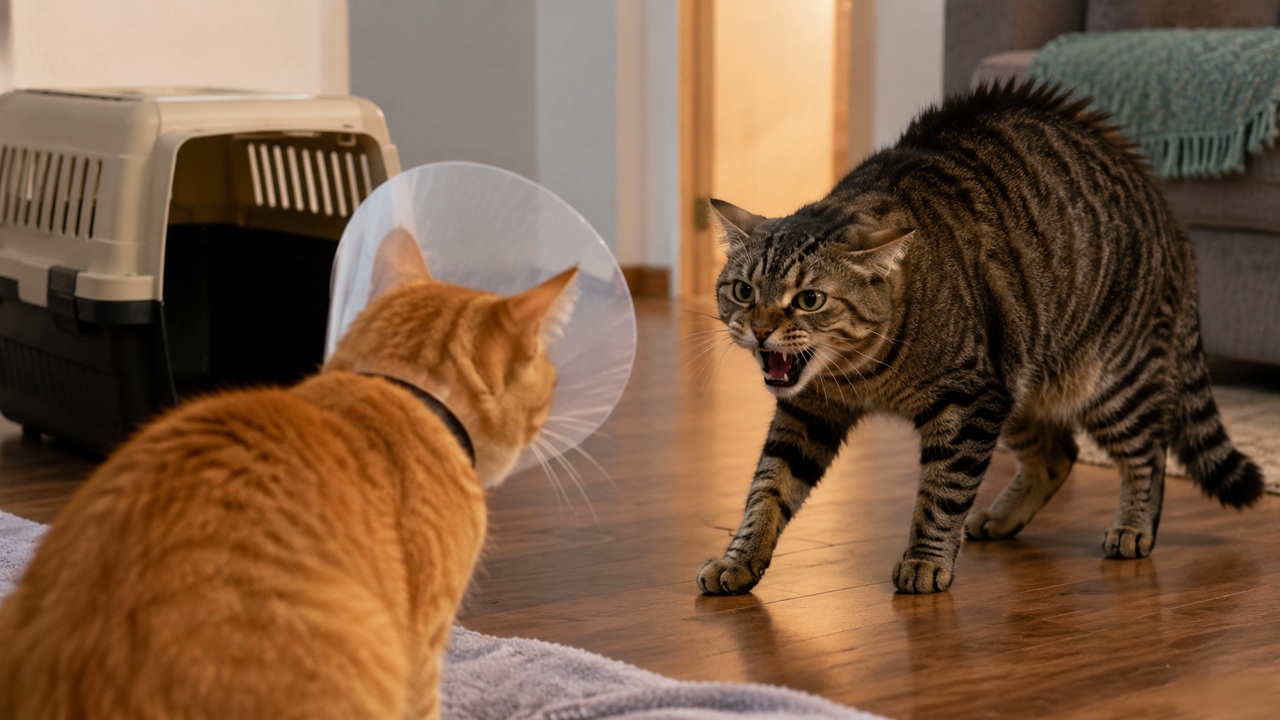
This changes the more useful question. Instead of “how many days should I wait?” look at “what are the two cats showing now?” Staring, blocking, chasing, hiding and tail wagging can indicate tension even when there is no obvious fight.
Before the first date, prepare the house
The newly arrived cat needs a quiet transition room, initially separate from the resident cat. This space must have water, food, litter box, hiding places, elevated places, sleeping area, scratching post and toys. FelineVMA also recommends that cats have recent veterinary evaluations and that factors such as health, age, activity level and sociability be considered before introduction.
The entire house also needs to accommodate two cats without forcing them to compete for resources. FelineVMA's guidance for households with multiple cats is to offer separate resources and, as a reference, one unit per cat plus an additional one for items such as litter box, food, water, resting place and scratching post, distributed so that one cat cannot easily control access to the other.
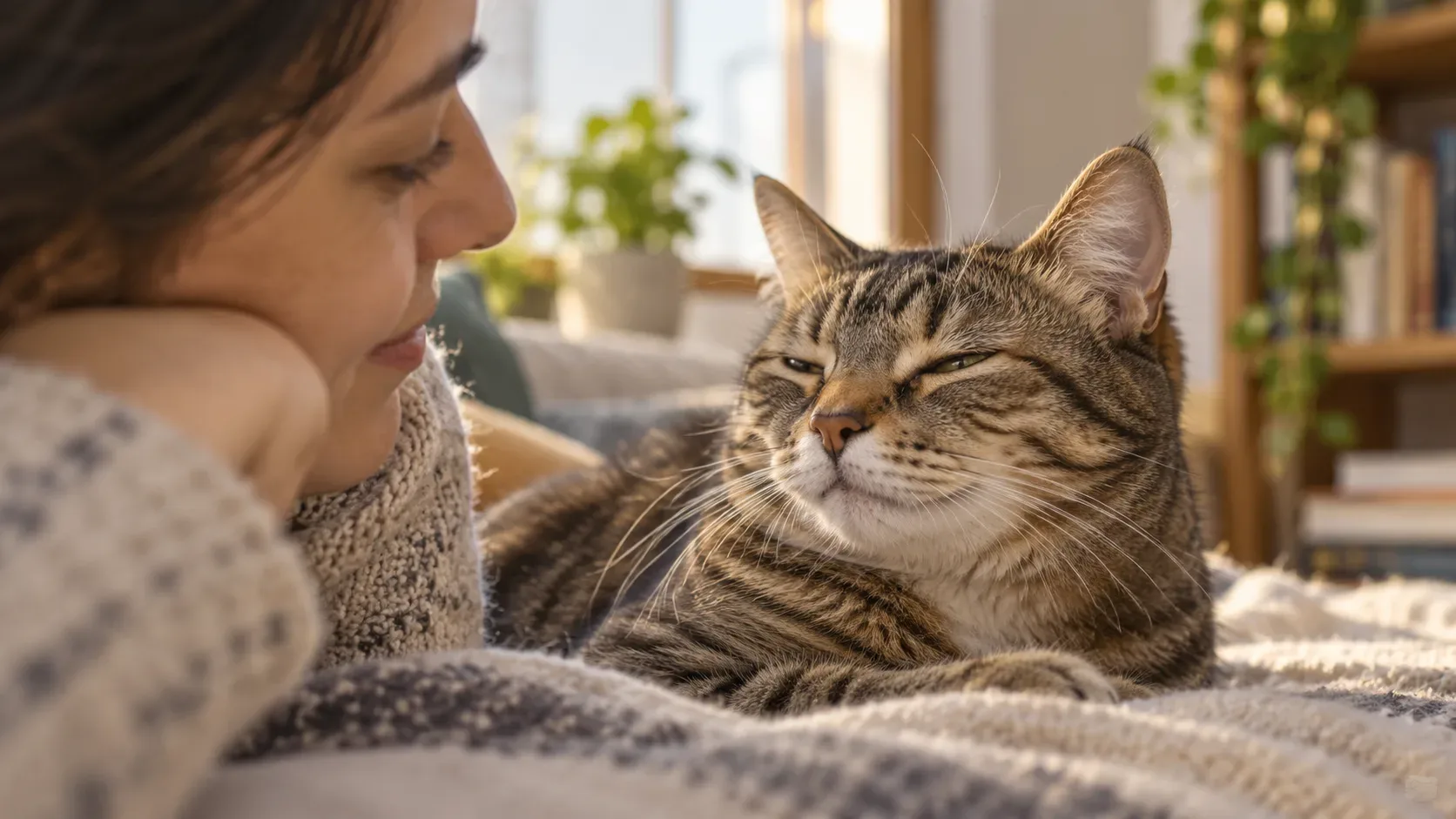
It is not necessary for the two to become inseparable companions to consider the adaptation successful. Some cats form bonds; others simply learn to share the environment with tolerance. FelineVMA itself highlights that you cannot force friendship between cats. The practical goal is a coexistence in which they can move around, rest and access resources without persistent tension.
The introduction steps and what to observe in each one
The sequence below summarizes the current FelineVMA protocol and compares it with Cats Protection's gradual introduction guidelines. The decisive point is not to stick to a predetermined number of days, but to observe how each cat reacts.
| Step | Objective | Signal to go | Signal to wait or retreat | When to stop and ask for help |
|---|---|---|---|---|
| 1. Transition room | Make the new cat feel safe before handling the resident. | The new cat explores, eats, plays, uses the litter box and shows growing confidence. | Remains very hidden, avoids exploring or shows stress without improvement. | Prolonged stress or persistent changes in feeding, elimination or behavior warrant contact with your veterinarian. |
| 2. Exchange of smells | Allow each cat to know the other's scent without direct contact. | They can investigate or ignore blankets, beds or fabrics with the other person's scent without significant tension. | Growling, hissing or strong vigilance remain associated with the smell. Keep your distance and repeat the step. | If the reaction remains severe or worsens despite gradual exposure, talk to your veterinarian. |
| 3. Interaction through the closed door | Associate the presence of the other cat with pleasant activities without eye contact. | The two can play or receive rewards near the door without showing tension. | Hissing or growling at the door indicates that the distance needs to increase; don't punish the cat. | Repeated climbing, chasing near the door or inability to relax even from greater distance calls for reevaluation. |
| 4. Alternate Exploration | Make the new cat discover the common areas without meeting the resident. | The new cat briefly explores the rest of the house and then both return to their areas and routines calmly. | One of the cats starts to watch doors, block paths, hide or show a strong reaction to new odors. | Tension that continues or increases despite returning to previous steps should be discussed with your veterinarian. |
| 5. Eye contact with barrier | Allow them to see each other without the possibility of physical confrontation. | They can look and then look away, explore, play or remain relatively relaxed. | Very rigid body, prolonged stare, ears back, wagging tail, growls or hisses. Return to the step without eye contact. | If the encounters become progressively more intense, stop the exposure and seek professional guidance. |
| 6. Supervised physical proximity | Allow brief meetings in an environment with exit routes and supervision. | Cats can share the environment without chasing, blocking, constant surveillance or trying to expel the other. | Hissing, growling, wagging tail or other signs of fear and frustration call for ending the session and returning to a previous step. | Physical fights, increasingly intense episodes or a cat starting to hide justify veterinary evaluation and, in difficult cases, support from a behavior professional. |
| 7. Progressive coexistence | Gradually increase time together, reducing supervision only as stability increases. | The two circulate and use their resources without significant tension for increasingly longer periods. | Chasing, blocking, hiding, out-of-box elimination or frequent conflicts reappear. Reduce contact again. | Persistent tension should be evaluated by the veterinarian, including to investigate pain or illness that may be altering behavior. |
Exchanging smells comes before promoting meetings
Once the new cat is reasonably settled in the transition room, begin swapping blankets, beds, or other soft items between rooms. FelineVMA recommends repeating exposure to the smell until cats demonstrate comfort before increasing the interaction. Cats Protection follows a similar logic: first the odors, then the visual contact and only later the direct encounter.
Do not place the fabric directly against a cat that is trying to avoid it. The aim is to allow voluntary investigation. If the cat smells the object and follows its own routine, this ability to disconnect from the stimulus is more useful than trying to bring the two closer together.
When the odors no longer cause significant tension, FelineVMA proposes activities on opposite sides of a closed door, without visual contact. If there is hissing or growling at this stage, do not scold. The recommendation is to increase the distance and make exposure easier again.
Alternating exploration reduces the pressure of the first date
Before the cats see each other, the newcomer can briefly explore common areas while the resident remains comfortable in another room. Afterwards, the new cat returns to the transition room and the resident returns to circulation. This alternate exploration allows contact with the other's territory and odors without requiring social interaction at the same time.
It is also an opportunity to notice less obvious signs. A cat that starts watching hallways, blocking doors or chasing another cat is not simply “showing who is boss”. Current FelineVMA guidelines reject the idea of a rigid dominance hierarchy as a general explanation for these conflicts and highlight factors such as abrupt introductions, contested resources, environmental changes, health, and individual characteristics.
Eye contact is still not a free encounter
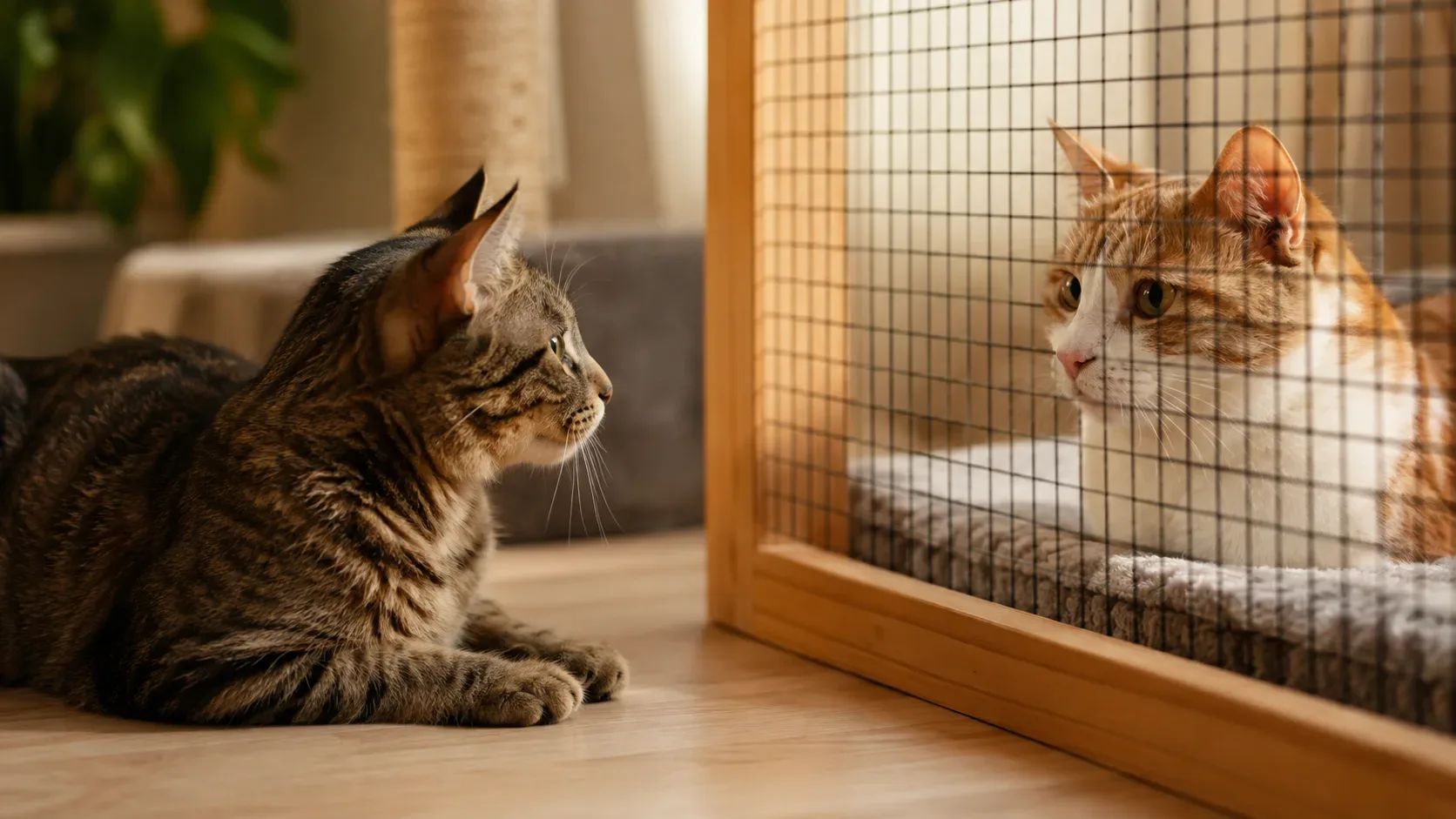
The first time cats see each other should be with a safe physical barrier, such as a screen, glass door or suitable gate. Keep sessions short and allow them to choose to move closer or further away. If cats become uncomfortable, FelineVMA advises returning to the previous phase for a longer period of time before trying again.
A good sign is not necessarily that one cat sniffs the other's nose. Being able to look and then return to explore, play or simply walk away without being chased shows that the presence of the other does not require continuous vigilance. On the other hand, staring, tense body, chasing, blocking and hiding are signs to reduce the difficulty of the session.
Does hissing or growling mean the introduction failed?
Not necessarily. Hissing and growling are part of cat communication and can be used to increase distance or end an interaction. FelineVMA notes that occasional manifestations do not automatically mean a relationship is lost. However, during an introduction, these signals are also not authorization to speed up.
If a cat hisses at the door, increase the distance. If the behavior arises on eye contact, temporarily return to the phase without direct vision. If it appears during physical proximity, safely end the exposure and return to a previous step. Punishing your cat for growling or hissing does not resolve the cause of the tension and can increase stress.
The frequency, intensity and set of behaviors matter more than an isolated signal. A brief hiss followed by withdrawal is different from persistent staring, chasing, cornering, or physical conflict. If episodes become more frequent or intense, especially if one of the cats begins to hide, FelineVMA recommends veterinary evaluation and behavioral support.
How to make the first contact without barriers
Physical proximity should only begin when cats are comfortable with eye contact. FelineVMA recommends supervised sessions, initially short, in a space where it is possible to control the situation and interrupt the vision between them if tension increases. Toys and rewards can help build positive associations.
If intense tension arises, do not try to insist on petting or handling overly excited cats. Official guidance warns that frustration can be redirected towards people or objects. A towel, cushion or piece of cardboard can be used as a visual barrier; When the animals are calmer, separate them and return to a previous phase of the process.
As sessions become repeatedly quiet, gradually increase the duration of contact. Supervision should decrease in the same way: because of observed behavior, not because a certain number of days have passed.
How long does it take for a cat to accept another?
There is no reliable deadline that fits all. Current FelineVMA guidance states that introduction can take anywhere from a few days to a few months, and sometimes even longer. Cats Protection also recommends following your own pace and going back a step whenever behavior indicates that progression has been too fast.
Therefore, quickly completing all phases is not an indicator of success. An apparently slow introduction, but in which the cats are able to remain relaxed, tends to be more consistent with the protocol than advancing despite signs of discomfort.
It is also possible that two cats may never form a close social bond. The presence of a second cat is not a universal need: some get along very well with others, while others prefer to live without feline company. Considering temperament, health, age, activity, and social experiences before adoption reduces the expectation that any pair will necessarily become friends.
When to stop homemade attempts and seek help
If tension persists despite taking steps and reducing exposure, contact your veterinarian. This is especially important when repeated physical conflicts, intense chasing, one cat preventing the other from accessing resources, persistent hiding, out-of-box elimination, or major changes in behavior. Pain and other health conditions can also change the way one cat reacts to another.
More difficult cases may require monitoring by a veterinarian with behavioral training or a qualified veterinary behaviorist. There is no advantage in continuing to have encounters that repeatedly end in fear or conflict with the expectation that the cats will “work it out on their own.”
In practice, moving slowly does not mean starting from scratch with every hiss. It means using behavior as a traffic light: consistent comfort allows you to increase difficulty; soft signals ask for more time or distance; Growing tension calls for retreat. It is this adjustment, not a “day 1, day 2, day 3” calendar, that turns introduction into a manageable process.