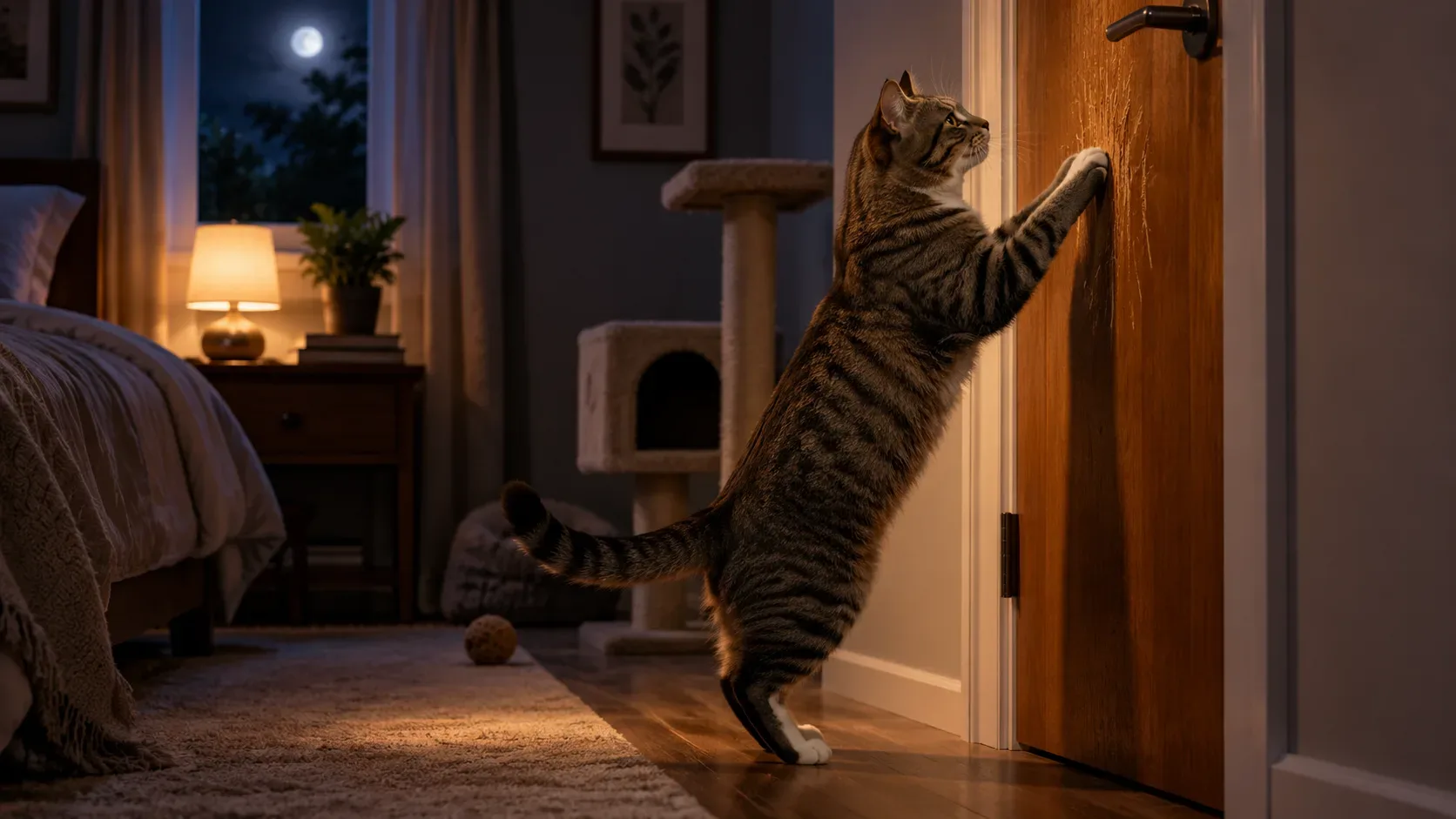
If a cat scratches the bedroom door at night and the door then opens, someone talks to the cat, offers food, or starts a play session, the behavior may persist because it has come to produce a predictable consequence. That does not mean the cat is “manipulating” anyone: scratching is a normal feline behavior, and the sequence between asking and gaining access can be learned.
The goal, therefore, is not simply to “put up with the noise,” but to separate two things: the cat’s needs should continue to be met, while scratching the door stops being the button that activates attention, food, or access. At the same time, it is important to recognize when the pattern deserves veterinary evaluation before being treated only as a habit problem.
Start with an ABC map: what happens before, during, and after
A simple log can help reveal why the behavior keeps repeating. In behavior analysis, the ABC framework organizes observation into antecedent, behavior, and consequence. It is not a diagnosis; it is a way to spot patterns that are easy to miss in the middle of the night.
| Part | What to record | Example |
|---|---|---|
| A — antecedent | What happened immediately before | The home became quiet, the caregiver turned off the light, or it was close to the usual breakfast time. |
| B — behavior | What the cat did, objectively | Scratched the door for 20 seconds, meowed, and returned after a pause. |
| C — consequence | What changed afterward | The door opened, someone spoke, got up, offered food, or played. |
For a few days, record the time, approximate duration, and what happened next. If scratching appears consistently just before someone feeds the cat, for example, food may be maintaining the cycle. If it starts when the door closes, access to the person or room may be the main reinforcer. In other cases, nighttime activity increases because there are not enough appropriate opportunities to play, explore, or scratch during the rest of the day.
To break the cycle, the response has to be consistent
The San Francisco SPCA advises that when a caregiver chooses to sleep with the door closed, opening the door during attention-seeking behavior tends to teach the cat to keep trying. The same logic applies to talking, getting up, petting, giving a treat, or starting play immediately after the scratching. For some cats, even scolding functions as attention.
- Set the rule before bedtime. If the door will remain closed, it should not open while the cat is scratching to gain access.
- Avoid intermittent responses. Ignoring the behavior for several nights and giving in on one difficult night can make the request more persistent because the cat learns that persistence sometimes works.
- Wait for a calm pause. If the door can open in the morning, do it at the planned time and after a brief calm moment, not in the middle of scratching.
- Do not turn the doorway into a conflict zone. Yelling, spraying water, or physical punishment can increase fear and stress and does not teach the replacement behavior. The Feline Veterinary Medical Association (FelineVMA) recommends environmental management and positive reinforcement rather than punishment.
During the first few days, the cat may test the routine more often or more intensely. This does not happen in every case, but it is a reason to agree on the rule with everyone in the household before starting. Consistency matters more than trying a different technique every night.
Build a pre-bed routine that reduces the need to “call” someone
Cats are often more active in the early morning and late in the day. The San Francisco SPCA suggests scheduled play sessions, including before bedtime, and the FelineVMA emphasizes predictable positive interactions and opportunities for play and predatory behavior.
- Have a short interactive play session late in the evening, using toys the cat can chase and “catch.”
- Schedule play at other times as well instead of concentrating all activity around the moment the cat wakes someone.
- Keep outside the bedroom the resources the cat genuinely needs overnight: water, an accessible litter box, comfortable resting places, hiding or elevated spots, and appropriate scratching surfaces.
- If early-morning food is the trigger, an automatic feeder programmed for before the usual wake-up time can take the caregiver out of the equation. Use part of the cat’s daily food allowance and adjust diet or quantities with veterinary guidance when needed.
The key is for food, play, and social contact to appear on a predictable routine, not as immediate payment for scratching the door.
Provide an appropriate scratching option near the problem area
Scratching is not a “bad habit” that needs to disappear. It is a normal activity used for claw maintenance, stretching, and marking. The San Francisco SPCA and the FelineVMA recommend offering appropriate surfaces and rewarding their use.
- Place a tall, sturdy vertical scratching post near the door if the cat prefers to stretch upward.
- Also offer a horizontal or angled option if you do not yet know the cat’s preference.
- Reward the cat immediately for using the appropriate scratcher with something the individual cat values, such as a treat, play, or attention.
- To protect the door while the new pattern is being learned, use a removable, pet-safe physical protector. The barrier limits damage, but it does not replace the routine and training.
Because doors and passageways are visually important areas of a home, a scratcher placed right there may compete more effectively with the surface the cat has already chosen than another scratcher hidden far away.
What to do at the exact moment the scratching starts
If the cat is healthy, the pattern has already been observed, and the most likely explanation is access- or attention-seeking, the most useful response is usually simple: do not provide the desired consequence while the scratching is happening. Do not talk through the door, open it “just to make it stop,” or serve breakfast at that moment.
White noise or ear protection can help the caregiver stay consistent when safe to use in the home. During the day, reinforce behaviors that are incompatible with scratching: resting on a bed, using the scratcher near the door, or waiting calmly for interaction. This way, the cat learns not only what no longer works, but what works instead.
When nighttime scratching should prompt investigation of another cause
Not every nighttime behavior should be treated as attention-seeking. New or intense changes can accompany pain, disease, sensory changes, stress, or cognitive changes. The Cornell Feline Health Center advises that behavior changes, especially in older cats, should be discussed with a veterinarian; the center also lists altered sleep-wake cycles, disorientation, and nighttime vocalization among signs that may occur with feline cognitive dysfunction.
Seek veterinary evaluation if the scratching:
- started suddenly or increased sharply without an obvious environmental change;
- comes with unusual vocalization, aimless wandering, disorientation, or a marked change in sleep;
- appears together with weight loss or gain, appetite changes, increased thirst, or urinary changes;
- coincides with difficulty jumping, stiffness, sensitivity to touch, or other clues of pain;
- appears with house-soiling, overgrooming, increased hiding, aggression, or reduced interest in normal activities;
- occurs in a senior cat that has developed several new nighttime behaviors.
These signs do not point to a specific diagnosis on their own. They are reasons to avoid dismissing a potentially medical issue as “stubbornness.”
A practical plan for the next seven nights
- Nights 1 and 2: log the ABC pattern without changing many things at once. Confirm basic resources, note timing, and identify what usually happens right after scratching.
- Night 3: establish the pre-bed routine, place the scratcher near the door, and agree on the same response with everyone in the household.
- Nights 4 to 7: keep the door and human attention out of the scratching consequence; provide access, food, and interaction at planned times, and reinforce calm behavior and use of alternatives.
- At the end: compare frequency, duration, and intensity with the first logs. If there is no improvement, the behavior is worsening substantially, or any clinical sign is present, contact the veterinarian and, when needed, a feline behavior professional who uses positive-reinforcement-based methods.
The most sustainable result does not come from “winning” against the cat at 4 a.m. It comes from making the routine predictable, meeting the cat’s needs outside the problem episode, and making scratching the door no longer the most efficient way to get what the cat wants.