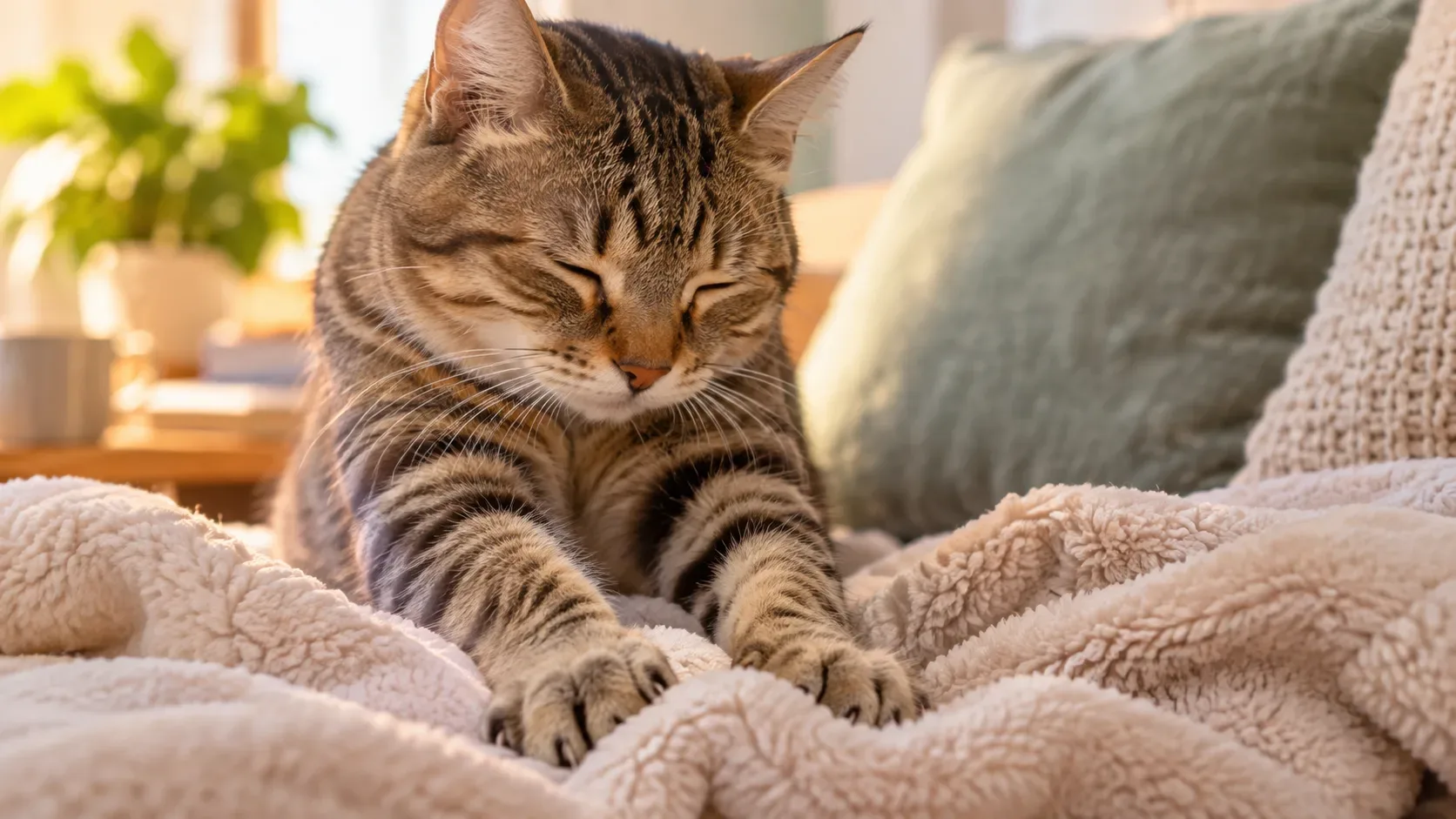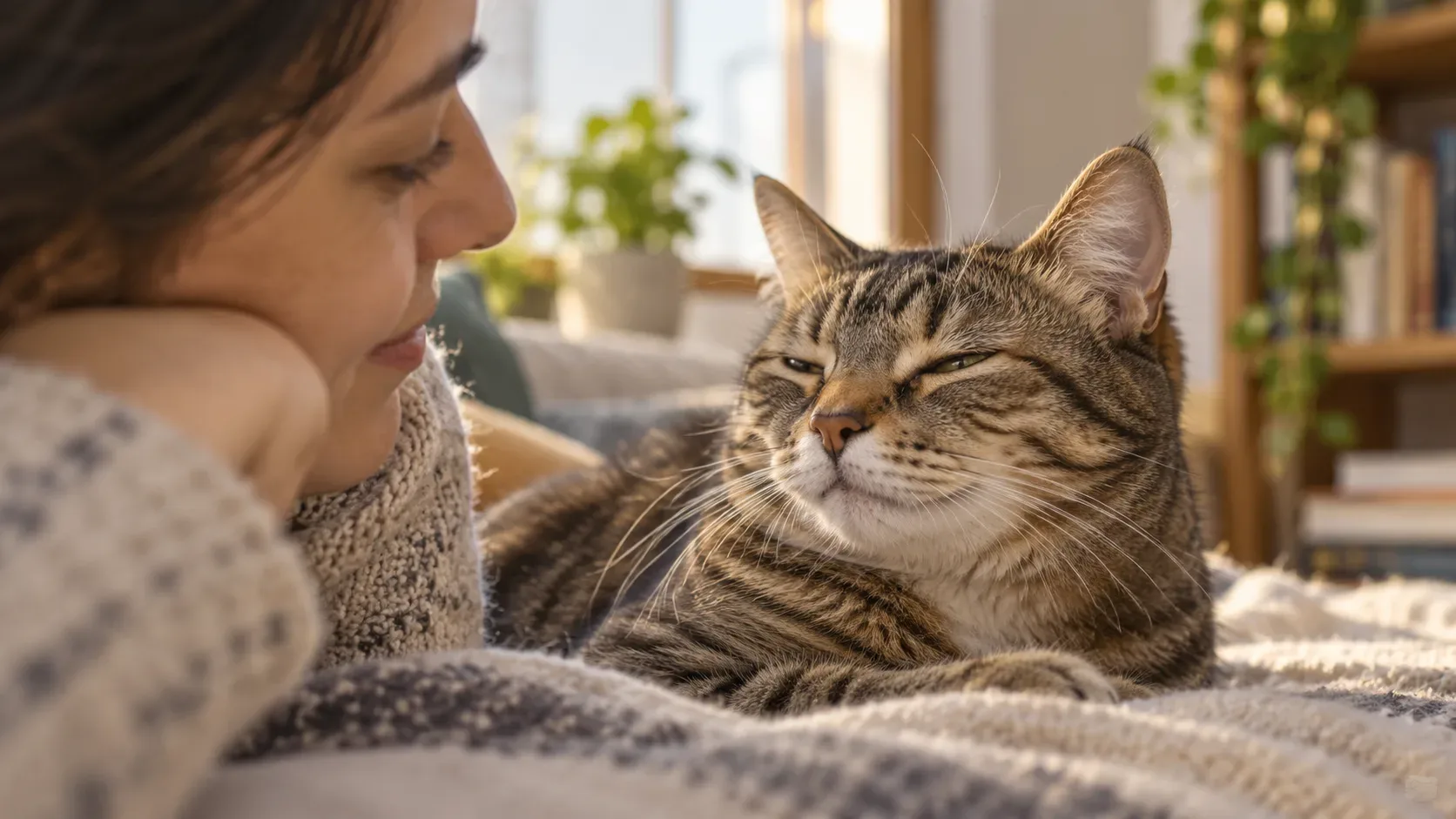
Yes: there is experimental evidence that the “slow blink” plays a role in interactions between cats and humans. In the study published in 2020 in Scientific Reports, cats produced more eye-narrowing movements when humans performed slow-blink sequences and, in a second experiment, showed a greater tendency to approach an unfamiliar researcher after that interaction. That is more informative than an anecdote — but it is not the same as proving that every slow blink means “I love you,” “I trust you,” or any other fixed emotional translation.
The most useful way to read the evidence is to separate three levels: the behavior that was observed, the effect produced under the experimental conditions, and the emotional interpretation. The first two were measured. The third is a plausible interpretation consistent with the results, but it was not read directly from the cats’ minds.
What the researchers called a slow blink
In the paper “The role of cat eye narrowing movements in cat–human communication”, the slow-blink sequence is described as a combination of movements in which the eyes move from a more neutral position into half-blinks, prolonged narrowing and, at times, closure. It is therefore not simply a count of ordinary reflexive blinks.
The videos were analyzed using CatFACS, an anatomically based system for coding feline facial movements. The researchers also added an “eye narrowing” category for cases in which the eye opening remained partially reduced for at least a few video frames. This distinction matters because, in the first experiment, ordinary reflexive blinking did not change significantly between conditions.
How the two experiments were set up
| Experiment | Who interacted | Slow-blink condition | Control | Main result |
|---|---|---|---|---|
| 1 | Familiar owner | The owner sat in front of the cat and performed the slow-blink sequence | The owner remained in the room but did not interact with the cat | More eye narrowing and more half-blinking during the slow-blink condition |
| 2 | Unfamiliar researcher | The researcher performed the slow-blink sequence | Neutral expression without direct eye contact | More half-blinking and eye narrowing; higher approach score after the interaction |
In Experiment 1, 21 cats from 14 households initially took part. After three dyads classified as statistical outliers under the study’s criterion were excluded, the final analyses included 18 cat–human dyads. Each cat experienced both conditions, in counterbalanced order, at home. Owners were instructed on how to perform the slow blink and repeated it when the cat was attentive.
In Experiment 2, 24 different cats that had not taken part in the first experiment were recruited. Six were excluded from the analyses as outliers, again leaving 18 cats in the final analyses. This time, the person was unfamiliar to the animal. The researcher offered an open hand before and after each condition to measure the cat’s tendency to approach.
There is an important methodological detail in the second experiment: pilot trials suggested that a control involving direct staring could be perceived as threatening by some cats. The final control was therefore a neutral face without direct eye contact. This reduces the risk of calling something a “positive slow-blink effect” when it might merely reflect avoidance of a fixed stare.
What the study actually found
1. Cats responded to human slow blinking with more narrowing of their own eyes
When owners slow-blinked, cats showed a higher rate of eye narrowing than in the no-interaction condition. Half-blinking also increased, although in the first experiment there was a sex-by-condition interaction: the effect was more evident in the males in that sample. Because the second experiment did not find a sex effect for these movements and the samples were small, this detail is not enough to conclude that male cats “respond better” to slow blinking.
In the second experiment, with an unfamiliar person and a more standardized presentation, cats also produced significantly more half-blinks and eye narrowing during the slow-blink condition than during the neutral-face condition.
2. After the slow blink, approach toward the unfamiliar person was greater
At the end of each condition, the researcher extended her hand and the cat’s response was classified as approach, neutral or avoid. The mean score was higher after the slow blink than after the neutral expression. This does not mean every cat walked up to the person on every trial; it means that, in the paired comparison between conditions, responses shifted more toward approach after the slow blink.
3. Not every eye movement counted as the response
In the first experiment, ordinary reflexive blinks did not differ between conditions. Full eye closures were too rare for statistical analysis in that experiment. In the second, age was related to the number of full eye closures, while the most consistent condition effects appeared in half-blinking and eye narrowing. In other words, the result is not “cats blink more when they like someone”; it is more specific than that.
Why the authors discuss positive communication — and why that still requires caution
The authors concluded that, taken together, the findings suggest that slow-blink sequences may function as a form of positive emotional communication between cats and humans. There are reasons for that interpretation: cats change their eye movements in response to the human stimulus and, in the unfamiliar-person experiment, they are more inclined to approach after the interaction.
But “positive emotional communication” is a more cautious phrase than the popular translations often found online. The study did not directly measure a subjective experience such as love, trust, happiness or affection. Nor did it test whether the cat consciously intended to “say” something specific. What was measured was facial movement and approach behavior under controlled conditions.
What the experiment does not prove
- It does not prove that a slow blink means “I love you.” That phrase is a human interpretation, not a tested variable.
- It does not prove that every squint is social. A cat may narrow its eyes because of relaxation, light levels, sleepiness or ocular discomfort.
- It does not prove that absence of slow blinking means a weak bond. Cats differ individually, and relationships are expressed through many behaviors.
- It does not establish a universal rule for every context. The final analyses involved 18 dyads in the first experiment and 18 cats in the second, after outlier exclusions.
- It does not perfectly isolate every human cue. In the first home-based experiment, owners varied in talking, distance, glasses and exactly how they performed the movement. The second experiment reduced some of that variation by using one researcher.
- It does not turn the experimental cadence into a household recipe. Owners repeated the movements several times per minute because the protocol needed observations; that does not mean people should reproduce that frequency at home.
How to read a slow blink in the context of the whole body
Feline welfare and handling organizations recommend interpreting a cat’s state from the combination of posture, ears, eyes, whiskers, tail, movement and situation rather than from one isolated signal. The AAFP/ISFM Cat Friendly Veterinary Interaction Guidelines emphasize responding to the cat’s current emotional state and preserving choice and a sense of control.
A slow blink fits a calm context better when it appears alongside a loose posture, relaxed ears, neutral whiskers, voluntary proximity or an unhurried approach. The Cats Protection body-language guide likewise associates relaxed or half-closed eyes, comfortably forward ears and relaxed whiskers with relaxation.
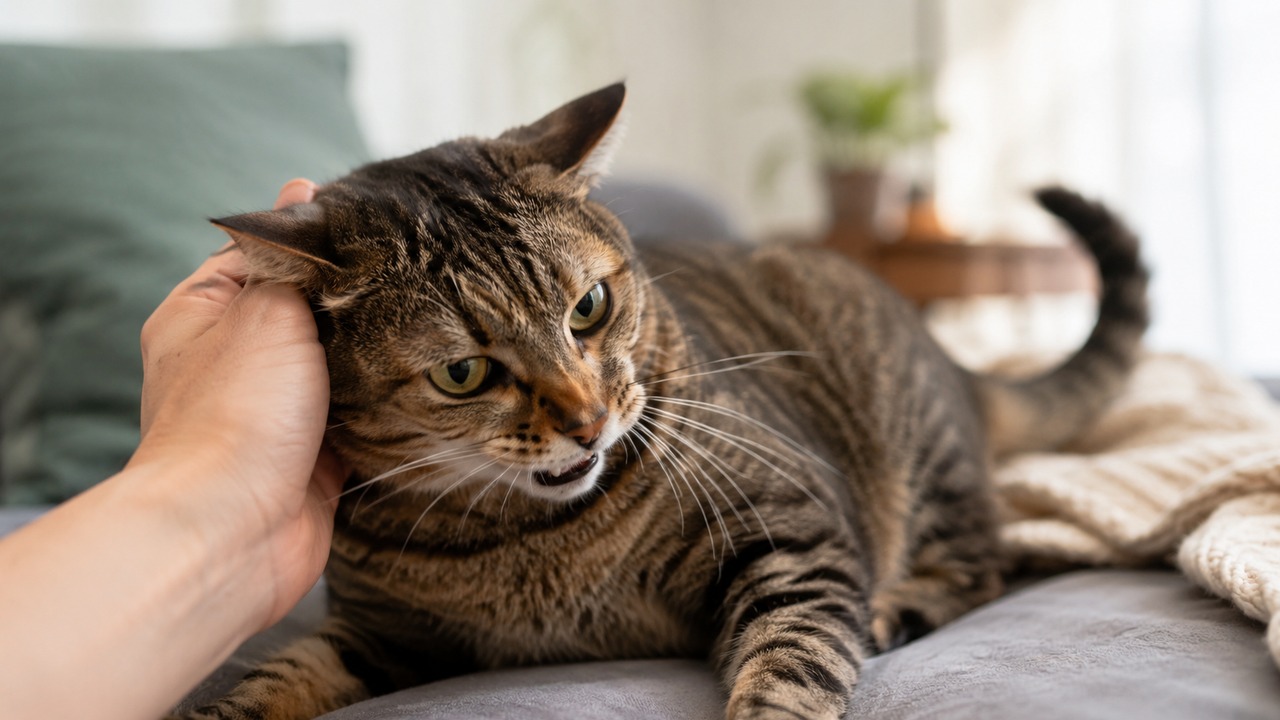
By contrast, flattened or sideways/backward ears, a crouched body, attempts to flee or hide, tail lashing, raised fur, growling, hissing or swatting indicate a different context. Dilated pupils can accompany stress or arousal, but they also change with light levels; on their own, they do not settle an emotional interpretation.
How to try slow blinking without turning it into an affection test
- Choose a calm moment. Do not try it when the cat is cornered, intensely playing, eating or trying to leave.
- Avoid a fixed stare. Stay at a comfortable distance and keep your expression soft.
- Close or narrow your eyes slowly. Make the movement naturally; there is no need to copy the laboratory frequency.
- Give space after the gesture. Looking slightly to the side can reduce the intensity of the interaction.
- Observe without demanding reciprocity. The cat may narrow its eyes, stay put, approach, look away or leave. All of those responses should be respected.
The most practical use of the study is to think of slow blinking as a low-pressure option for interaction, not a “test” of whether the cat likes you. The logic of feline-friendly interaction itself favors giving the animal control over whether contact continues or ends.
When a “squint” may be a medical problem
There is a difference between a brief social gesture and a cat that keeps one or both eyes narrowed. The Cornell Feline Health Center lists squinting, frequent blinking and eye discharge among possible signs of conjunctivitis; other eye disorders can also cause discomfort.
If the behavior is persistent, asymmetric, accompanied by redness, discharge, cloudiness, a visible third eyelid, light sensitivity or a sudden change, it should not be interpreted as a social slow blink: veterinary assessment is appropriate.
In short: the finding is interesting precisely because it is more modest than the myth
The study provides experimental evidence of a specific behavioral exchange: humans slow-blink, cats tend to respond with more eye narrowing; after this kind of interaction with an unfamiliar person, approach responses are also higher. That supports the idea that the gesture can be part of positive interactions between the species.
The next step — saying exactly what the cat “meant” — was not demonstrated. The most defensible reading is: slow blinking is a useful signal when it matches the rest of the cat’s body language and the cat’s choice to stay or approach. Context remains part of the message.