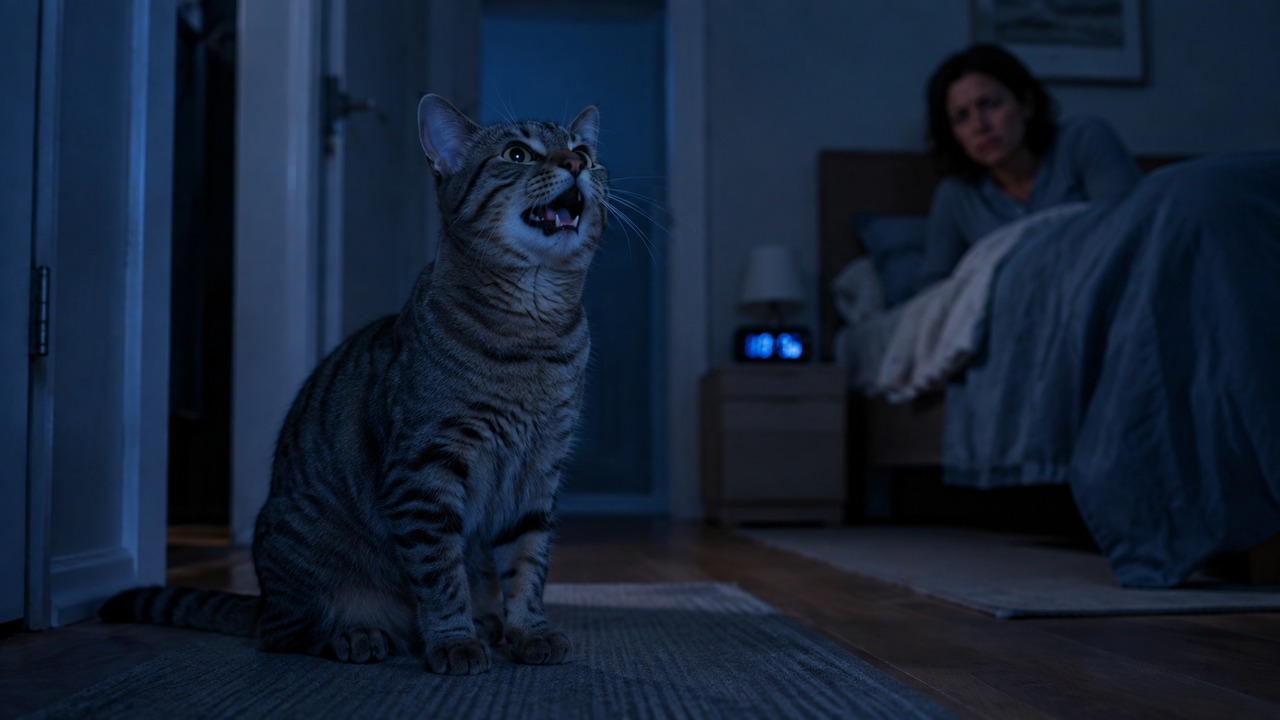
If the cat meows at dawn, wakes up the house and asks for food or attention, it's tempting to sum it all up as “nocturnal mania”. Sometimes it really is a learned and predictable behavior. But the same complaint can have a different weight when it starts suddenly, especially in a mature or elderly cat, or when it appears along with changes in appetite, thirst, mobility, orientation or use of the litter box. The first question, therefore, is not “how to make it stop?”, but rather “has this always been like this or has something changed?”.
This precaution avoids a common mistake: applying a behavioral technique to a signal that has not yet been evaluated. Veterinary guidelines on feline behavior make it clear that ignoring a nighttime meow may make sense when it is maintained for a reward such as food or attention, but this strategy assumes that relevant medical causes have been ruled out or treated.
The starting point is change, not the volume of the meow
A cat that has been waking up the family at 4am for months, walks to the food bowl and goes back to sleep after receiving a meal presents a very different pattern to a cat that never did this and, within a few days, began to vocalize without a clear trigger. The sound may be equally loud, but the clinical significance is not the same.
When the behavior is old, stable and closely linked to a predictable consequence, such as receiving food, opening a door or gaining attention, the learned habit hypothesis gains strength. Cats quickly learn which actions produce results. If meowing makes someone get up, talk, offer a snack or serve food, the human response can reinforce the behavior without the family noticing.
When the behavior is new, the priority changes. Behavioral changes can be one of the first clues to pain, illness, sensory loss or cognitive change, especially in older animals. This does not mean that every new meow is an illness. It just means that “ignore it until it passes” is no longer a good first rule.
Age changes how much you should suspect a clinical cause
In young and adult cats, context and routine matter a lot
Cats don't organize food and activity exactly like people. Feline behavior guidelines describe a natural pattern of several small meals distributed throughout the day and night. At home, eating times, long periods without stimulation, games and the residents' routine can shift part of the activity to the early hours of the morning.
Therefore, in a young or adult cat, healthy and with an old pattern, it is worth observing whether the meowing always appears close to feeding time, in front of a closed door, when someone moves in bed or in the face of external stimuli visible through the window. The more predictable the sequence, the more useful it is to test routine adjustments after confirming that signs of health have not emerged along with the behavior.
Still, young age is not a free pass to treat all vocalization as habit. Abrupt change, apparent pain, urinary changes, loss of appetite, weakness or difficulty breathing continue to be reasons for evaluation.
In mature and elderly cats, a new behavior deserves more attention
The AAHA/AAFP guidelines for mature and senior cats recommend specifically asking about increased nocturnal activity, vocalization, and changes in usual habits. They relate these signs to possibilities such as pain, reduced mobility due to illness, loss of vision and cognitive dysfunction. In specific guidelines for senior cats, hyperthyroidism, hypertension and decline in hearing or vision also appear among the conditions that may accompany nocturnal vocalization.
Feline cognitive dysfunction is a diagnosis of exclusion. Vocalization for no apparent reason, changes in the sleep and wake cycle, disorientation, changes in interaction, accidents outside the box and changes in activity can compose the picture, but similar signs also appear in other diseases. Cornell and the Merck Veterinary Manual highlight this need to investigate physical causes before attributing behavior to brain aging.
This is important because “getting old” does not, in itself, explain a change. An elderly cat that has started calling at night may be disoriented, in pain when moving, seeing worse, hearing less or having a systemic condition. Age increases the need for context and examination, not certainty of a specific diagnosis.
The place and time of the meow help organize hypotheses
The meowing directed at the owner close to the usual feeding time suggests a different dynamic than a vocalization that occurs while the cat walks around the house apparently without purpose. Likewise, a cat that always positions itself in front of the same door or window may be reacting to access, routine or environmental stimuli.
Also observe what happens immediately before and after. Does the cat wake up when the owner moves? Does it go straight to the pot? Looking for a window? Do you walk around the house and can't seem to find your room? Does it stop vocalizing when the light comes on? Feels restless when going up or down
of furniture? These sequences do not confirm the diagnosis, but they make the report much more useful.
The location of the vocalization can also reveal situations that should not be treated as a “trick”. Meowing or screaming near the litter box, accompanied by repeated attempts to urinate, straining and little or no urine require special attention. Urethral obstruction, more common in males, is a veterinary emergency. In this situation, do not wait to see if behavior improves overnight.
The signs that accompany the meow matter more than a “list of causes”
Instead of trying to fit the cat into a generic list of seven or ten causes, compare its current behavior with its pattern. Has your appetite changed? Does the amount of water you drink seem more? Was there any perceived weight loss or gain? Has the cat started vomiting, avoiding jumping, hesitating on stairs or abandoning high places it used to use? Is the litter box being used differently? Is there more urine, less urine, straining or accidents outside the crate?
It is also worth observing orientation and interaction. A cat that meows and looks for a specific person for attention is not presenting the same scenario as an animal that stands in front of a wall, enters a room and doesn't seem to know how to get out, repeatedly paces around the house, or shows difficulty locating known resources. Changes in vision and hearing can contribute to anxiety and confusion, especially at night.
These associations help decide the speed of evaluation. Old behavior, without any other changes and clearly linked to a routine, allows for a calmer environmental approach. A new behavior with changes in appetite, thirst, weight, elimination, mobility, sleep, apparent vision or orientation deserves contact with the veterinarian even if the cat seems fine during the day.
When it makes sense to change your routine
Environmental adjustments work best when the pattern has already been recognized as behavioral or when a professional has evaluated relevant clinical causes. The idea is not to tire the cat to exhaustion, but rather to better distribute opportunities for activity, simulated hunting, feeding and interaction.
Interactive play at predictable times, especially with toys that allow chasing and catching, can increase mental and physical stimulation. Feeders that require searching or handling also help turn some of the feeding into activity. For cats that wake the family specifically to eat, a larger meal before bed is a strategy cited in feline behavior guidelines, as long as the total daily amount of food is kept under control.
If the family identifies that getting up to serve food is the reward that keeps the meowing going, the objective is to break this association without leaving basic needs unmet. In some homes, separating meal times from the guardian's presence can help. The main point is consistency: if on some nights the meow yields food and on others it doesn't, the association can remain strong.
It is also worth reviewing the environment. Does the cat have easy access to water, a litter box, safe places to rest and observation points? There's a cat outside that appears
always at dawn? Has a door become closed? Has anyone changed work shifts? Has there been a change of house, the arrival of a pet, a baby, construction work or a change in schedules? For behavior that began after a concrete change, the context can be as important as the dawn itself.
Ignoring may work, but it is not the first step to new behavior
The recommendation to “pay no attention” has a real behavioral basis when the meow has been learned because it produces reward. FelineVMA's own guidelines describe the classic example of the cat that meows at 3am and gets food. If this human response maintains the habit, removing the reward may reduce the behavior over time.
But the same source places a condition before that: medical problems that could cause the behavior must have been ruled out or treated. This detail changes everything. An elderly cat that has begun to vocalize, an animal that shows pain, a cat that drinks a lot more water, or a cat that tries to urinate repeatedly should not simply be subjected to a behavior extinction strategy.
Punishing is also not a good solution. Yelling, scaring, spraying water or chasing the cat can increase fear and stress and does not teach the desired behavior. Management based on positive reinforcement, predictability and redirection is preferable when the issue is one of learning and routine.
When to seek veterinary evaluation without testing adjustments at home
Schedule an evaluation when nocturnal vocalization is new or has clearly increased, especially in a mature or elderly cat, or when it is accompanied by changes in appetite, thirst, weight, mobility, sleep, orientation, apparent vision or litter box use. The veterinarian can decide, based on age, history and physical examination, whether tests are needed to investigate pain, blood pressure, thyroid, kidney function, urinary changes, sensory problems or other conditions.
The urgency is greater when the cat has difficulty breathing, faints, has convulsions, severe weakness or difficulty urinating. Frequent attempts to urinate with little or no urine, especially in males, may indicate urethral obstruction and require immediate attention.
It's also not worth waiting indefinitely when faced with a loss of appetite. FelineVMA recommends seeking veterinary attention if your cat goes 24 hours or more without eating. In either scenario, intense signs or rapid worsening warrant earlier contact.
What to register before the consultation
A short video of the episode may be more informative than trying to reproduce the meow by description. For a few days, take note of the approximate time, where the cat was, what happened before, what caused the episode to end and whether it was related to food, people, the window, the litter box or movement around the house. Also record recent changes in routine and any noticed changes in appetite, thirst, weight, vomiting, elimination, mobility and orientation.
This record is not useful for diagnosing at home. It helps the professional understand whether the vocalization is part of a predictable pattern, whether there are signs of pain or illness and what tests to take.
make sense. In older cats, seemingly small details can be especially helpful because several conditions can coexist and produce similar signs.
The rule of thumb is simple: old habits are managed, new changes are investigated
Nocturnal meowing is not automatically a behavior problem and it is also not automatically an illness. The safest way is to compare the cat with itself. If the pattern is long-standing, predictable, linked to food, attention, or stimuli and there are no other changes, routine adjustments and reinforcement may be appropriate. If it started suddenly, became much more intense or was accompanied by other signs, veterinary evaluation should come before trying to “teach the cat to stop”.
This criterion avoids two extremes: transforming every busy morning into an emergency and, in the opposite sense, attributing to “morning” a change that deserves investigation. Better management begins when you know which of these two situations is before you.