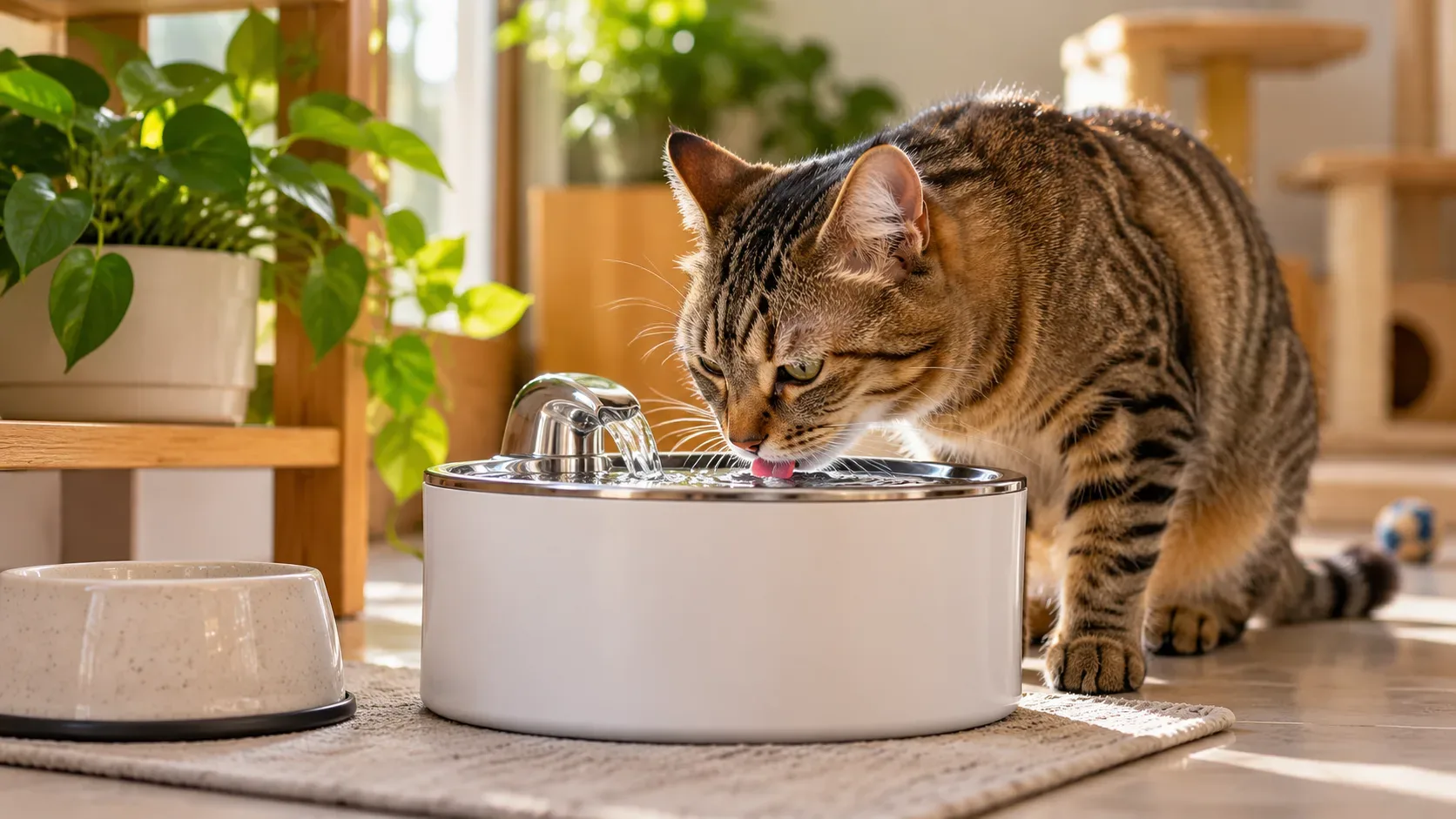
If your cat seeks out the tap and ignores its bowl, offer running water from a pet fountain, but also keep bowls of clean, still water available and easy to reach. Changing the drinking station's location, trying a wide bowl and maintaining a cleaning routine may help. A preference for moving water alone is not a diagnosis of disease; what matters is a recent change in thirst, urine output or the cat's general condition.
Why does your cat seek out the tap?
Some cats enjoy moving water, while others choose still water. Smell, temperature, bowl shape, noise and location can all influence acceptance. Do not assume that all running water is safer than clean water in a bowl: water quality also depends on its source and the container's hygiene.
The preference is not universal. In a controlled study involving 14 cats that completed the protocol, still, circulating and free-falling water bowls produced no significant overall difference in water intake, although three cats showed individual preferences. A fountain is therefore an option to test, not a guarantee that your cat will drink more or that urinary problems will be prevented.
Start by adjusting where water is offered
The AAFP/ISFM guidelines recommend multiple, separated resources around a cat's environment. For drinking water, this means placing options in different locations, away from the litter box and preferably apart from food. The aim is to make access easy without forcing a cat to cross a busy area or compete with another animal for the route.
- Place at least one bowl in a quiet, stable spot with an unobstructed approach; check whether the cat can come and go without being cornered.
- Provide more than one drinking station around the home. In multi-cat households, avoid grouping every option in the same corner.
- Do not put the only fountain where people, dogs or other cats may block it. Keep a bowl accessible even when the fountain is switched off.
Wide bowl, material and fresh water: what to compare
Try a stable, relatively wide and shallow vessel that lets the cat drink without pressing its whiskers against the rim. Undamaged glazed ceramic, glass and stainless steel are options recommended by cat-care organizations; replace any vessel with cracks, chips or a surface that is difficult to clean. Let your individual cat's response guide the trial.
Offer water that is safe to drink and refresh it frequently. Wash and rinse bowls daily to remove residue and avoid bacterial buildup, as advised by VCA. If your cat rejects the usual water's taste or smell, trying another suitable source of drinking water may be worthwhile, without assuming that filtered water is mandatory for every cat.
Fountain: safe introduction and upkeep
Choose a stable fountain with a gentle flow and parts that can be dismantled and washed according to its manual. Set it on a flat, dry surface, keep the cable protected from chewing and pulling, and keep the outlet clear of splashes. Unplug the appliance before taking it apart or cleaning it. Do not make improvised electrical modifications.
- Introduce the fountain near a familiar drinking station without removing the old bowl. Let the cat investigate at its own pace rather than forcing it to drink.
- Check whether noise, vibration, rim height or flow strength puts the cat off. If needed, change the location or use a quieter model.
- Check the water level every day, top up with drinking water, and clean the tank, drinking surface and pump according to the manufacturer's instructions. Clean or replace the filter at the specified interval; a filter does not replace cleaning.
- If you notice slime, odour, visible debris, leakage or pump failure, stop using the fountain until it has been cleaned or serviced, and leave water available in a bowl.
Do not leave a tap running as the cat's only source of water. A fountain can reduce dependence on the tap, but it can stop because of a power cut, malfunction or dirt. A backup bowl is a simple safety measure.
How to tell whether the change helped
Keep feeding and other routines as consistent as possible while testing drinking stations. For several days, note where the cat drinks, how often it seeks the tap, whether it accepts the fountain, and any change in the amount or frequency of urination. Track appetite, activity and weight as well. In a multi-pet home, the reservoir level does not reveal how much each cat drank; spills and evaporation also complicate interpretation.
Account for the water in food. According to the Cornell Feline Health Center, cats eating wet food may drink less directly from a bowl, while cats eating dry food usually rely more on drinking water. Do not interpret reduced bowl use alone as dehydration, or use a fountain instead of clinical guidance for cats with kidney or urinary disease.
When to see a veterinarian
A longstanding preference for the tap in an active cat that eats and urinates as usual may be managed as an environmental choice. But a sudden increase or decrease in thirst or drinking warrants veterinary assessment, especially when other signs occur. Kidney disease, diabetes and hyperthyroidism are among the conditions that can affect water balance, but only a clinical assessment can investigate the cause.
- Arrange an assessment if you notice persistently increased thirst or urination, weight loss, a change in appetite or vomiting.
- Seek prompt care if your cat is lethargic, weak, not eating, has dry mucous membranes or may be dehydrated.
- Watch for repeated litter-box visits, painful urination, vocalizing or blood in the urine. These signs should not be addressed by changing bowls alone.
- If your cat strains to urinate and produces little or no urine, seek emergency veterinary care immediately: urethral obstruction is an emergency.
When deciding between a bowl and a fountain, the most useful criterion is your cat's behaviour while safe drinking options remain available. Environmental changes can help, but they cannot replace an examination when habits change or clinical signs appear.
Sources and references
- Cats Protection: Advice on cats' drinking habits and water
- AAFP/ISFM: Guidelines on feline environmental needs
- VCA Animal Hospitals: How to encourage cats to drink water
- Cornell Feline Health Center: Hydration in cats
- Robbins et al., Journal of Feline Medicine and Surgery: Study of still, circulating and free-falling water
- Cornell Feline Health Center: Feline lower urinary tract disease