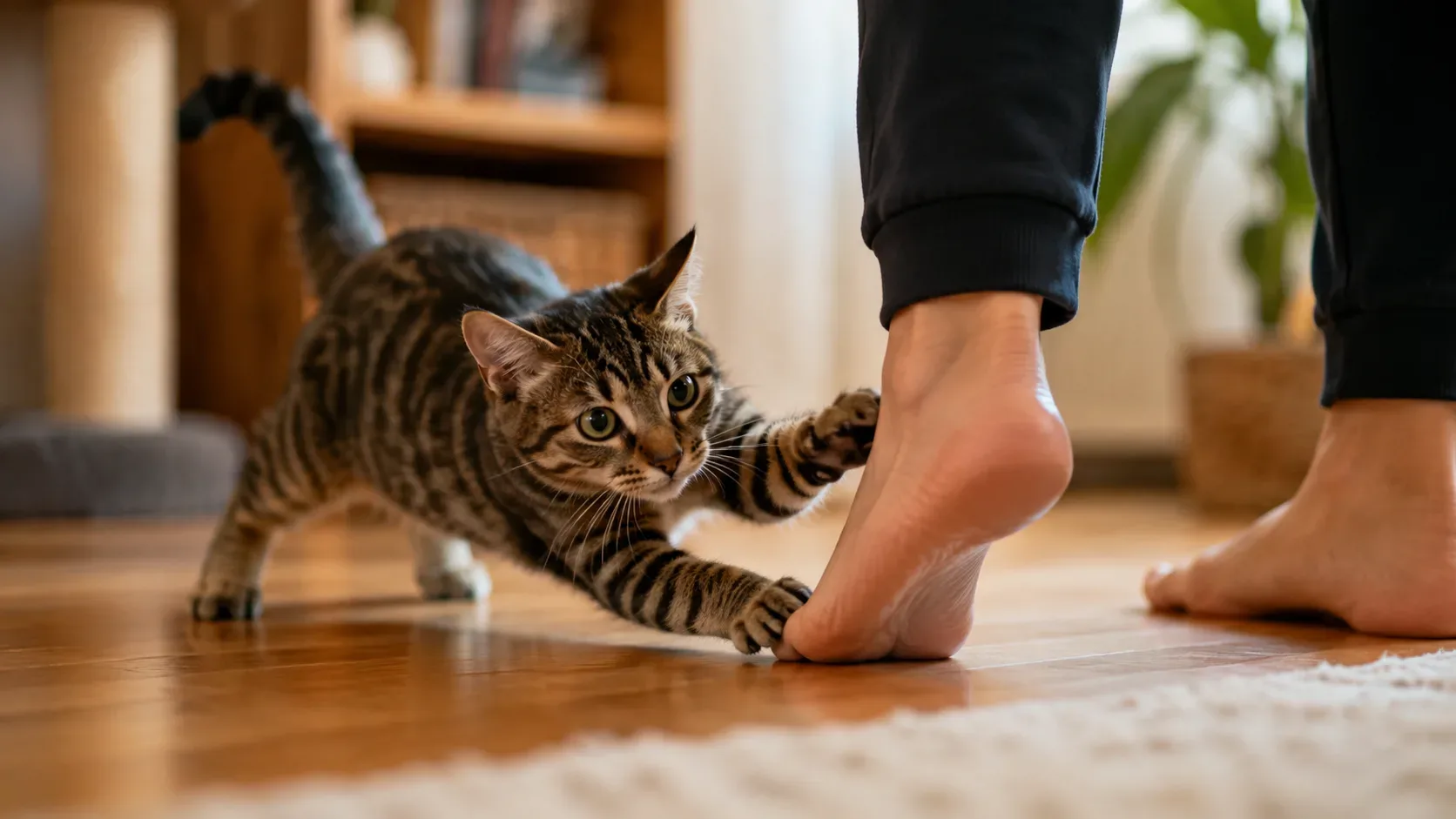
When a cat waits for you to walk past and jumps at your feet or ankles, the movement of your leg can work as a perfect target for a pursuit sequence: watch, stalk, rush, grab, and bite. This is common in play with a predatory component, especially in young cats or cats with few opportunities for simulated hunting. But not every attack on feet is “just hunting instinct.” Fear, pain, and redirected aggression can produce similar attacks, and the right response changes with the motivation.
The best approach is to look at what happens before, during, and after the episode. A single sign—dilated pupils, a lashing tail, or ears held back—does not establish a diagnosis. Context and the sequence of behavior are more useful.
Quick triage: what the attack pattern may suggest
| Observed pattern | What it may suggest | Most useful clue |
|---|---|---|
| Ambush when feet or legs pass by, with chasing, pouncing, grabbing, or biting | Misdirected play/predation | The main target is movement, and the episode resembles a hunting or play sequence |
| Attack when a person approaches, corners the cat, tries to pick the cat up, or enters a situation the cat avoids | Fear | There is an attempt to increase distance, flee, freeze, or adopt a defensive posture |
| New biting or attacking, especially when touched, moved, picked up, or when someone passes close to a body area | Pain or discomfort | The behavior started or worsened along with sensitivity, lower activity, or other physical changes |
| Intense attack after the cat sees another cat through a window, hears a loud noise, or becomes highly aroused by something it cannot reach | Redirected aggression | The true trigger is elsewhere; the nearby person becomes the secondary target |
These categories can overlap. A cat may, for example, show intense play most of the time and react because of pain in one specific episode. That is why new changes or increasing intensity deserve closer attention.
When it looks like predatory play
In play with a predatory component, feet enter the scene because they move, disappear behind furniture, and reappear. The cat may hide under a bed, sofa, or chair, watch someone approach, lower its body, chase, and pounce. Cornell specifically describes stalking and pouncing as common patterns in play aggression. The Merck Veterinary Manual also groups misdirected play and predatory behavior among motivations for aggression toward people.
Some clues favor this explanation: episodes clustered at the times when the cat is usually most active; attacks triggered mainly by movement; repetition at ambush locations; a relatively quick return to normal posture; and willingness to chase appropriate toys when they are offered. Young cats may show this more often, but adults can retain the pattern too.
This does not mean a person has to accept bites or scratches. The behavior can be normal in origin and still be inappropriate or dangerous when directed at the human body.
When fear, pain, or redirected aggression become more likely
Fear
Fear-related aggression usually functions to increase distance from something the cat perceives as a threat. Context matters greatly: an approaching visitor, an attempt to pick the cat up, a blocked escape route, unwanted handling, or a history of punishment. A low, tense body, ears held back, attempts to escape, vocalizations, and attacking when the cat cannot get away may appear. If fear is the problem, chasing, cornering, or physically correcting the cat tends to worsen the association with people.
Pain or discomfort
Pain can trigger a defensive reaction, especially when the cat anticipates touch or movement. Suspicion increases when the attack is new, when a previously tolerant cat begins reacting, when there is sensitivity to touch or being picked up, or when other changes appear: fewer jumps, difficulty climbing, changes in appetite, grooming, sleep, litter-box use, or activity level. Because cats can hide pain, it is not safe to conclude that the cause is behavioral simply because there is no obvious limping or vocalization.
Redirected aggression
With redirected aggression, the cat becomes intensely aroused by a stimulus it cannot reach—for example, another cat outside, an animal seen through a window, or a sudden noise—and attacks whoever is nearby. The key point is that the foot was not the original target. These episodes can be more intense, and the cat may remain aroused for some time. In that situation, do not try to touch, pick up, or “calm with petting” while the cat is still highly activated; increase distance and give the cat room to recover safely.
What to do at the moment of an ambush
- Stop turning hands and feet into toys. Do not invite pouncing by wiggling fingers, moving feet under blankets, or teasing ankles to “burn off energy.” That teaches the cat that body parts are acceptable targets.
- End the interaction without physical punishment. If it is safe, stay still for a moment, move away, and withdraw attention. Hitting, pushing, yelling, or chasing can increase fear or arousal, or may even reinforce play.
- Redirect before the attack when the pattern is predictable. The Feline Veterinary Medical Association recommends replacing the human target with toys, including carrying a suitable wand toy while walking through areas where the cat commonly hunts feet.
- If there are signs of high arousal or redirection, prioritize distance. Do not handle the cat until it has returned to a calm state.
How to reduce episodes without punishing the cat
The most useful strategy for misdirected play/predation is to provide a predictable outlet for the hunting sequence while also reducing opportunities to rehearse attacks on the human body.
- Map the time and place. For several days, note when it happens, where the cat was hiding, who was walking by, what happened in the minutes beforehand, and how long the cat took to settle. The pattern helps distinguish “hunting feet” from fear, pain, or redirection.
- Get ahead of peak activity periods. Schedule interactive play before the time when ambushes usually occur. Wand toys and other toys that keep hands at a distance allow the cat to chase, pounce, and grab an appropriate target.
- Let the cat catch the toy. Feline environmental guidelines recommend opportunities for play and predatory behavior and emphasize that being able to capture the “prey” at least some of the time helps complete the sequence and reduce frustration.
- Use feeding as part of enrichment. Treat-dispensing toys, searching for small food portions, and food puzzles can add exploration and foraging to the day.
- Reduce ambush points when necessary. If the cat always rushes out from under a bed or from a narrow hallway to grab ankles, temporarily change access or foot traffic while teaching an alternative.
- Reinforce incompatible behaviors. Reward the cat for following a toy, going to a perch, responding to a cue, or staying relaxed while someone walks by. The goal is to create a behavioral route that is more rewarding than attacking feet.
Enrichment is not simply about “tiring the cat out.” An appropriate feline environment includes safe places, distributed resources, and opportunities to climb, hide, scratch, explore, play, and simulate hunting. When those needs are met predictably, it becomes easier to redirect normal behaviors toward appropriate targets.
What not to do
- Do not use physical punishment, slapping, kicking, pushing, or forced restraint as a correction.
- Do not turn removing the cat from the situation into a chase through the house.
- Do not use hands or feet to start play, even if the cat only “nibbles.”
- Do not assume every ankle attack is boredom or hunting; new, intense attacks or attacks linked to touch may have a medical component.
- Do not try to touch a highly aroused cat after an external trigger; wait for arousal to subside.
When to contact a veterinarian or behavior professional
Seek veterinary evaluation when the behavior appeared suddenly, worsened without explanation, is accompanied by signs of pain or illness, occurs in an older cat along with a change in routine, or causes meaningful injuries. A clinical assessment matters because pain and other medical conditions can change tolerance of touch, irritability, and defensive responses.
Professional help is also worthwhile when attacks are frequent or unpredictable, when children or vulnerable people live in the home, when the cat stays highly aroused for long periods, when redirected aggression recurs, or when management changes do not reduce the episodes. Treatment may combine environmental adjustments, behavior modification, and, in some cases, specific veterinary intervention.
In summary
If a cat mainly targets feet and ankles when they move, stages ambushes, and readily switches to appropriate toys, misdirected play/predation is a strong possibility. If attacks occur during approach or cornering, consider fear; if the behavior is new and linked to touch or body movement, investigate pain; if it follows an external stimulus that leaves the cat highly aroused, consider redirected aggression. The answer is not punishment, but identifying the trigger, protecting people, providing appropriate hunting targets, and seeking veterinary evaluation when the pattern does not fit predictable play.
Sources consulted
- Merck Veterinary Manual — Behavior Problems of Cats
- Merck Veterinary Manual — Behavior Problems in Cats
- Cornell Feline Health Center — Feline Behavior Problems: Aggression
- Feline Veterinary Medical Association — Training Techniques for Addressing Undesirable Behaviors
- Feline Veterinary Medical Association — Setting Up the Environment for Success