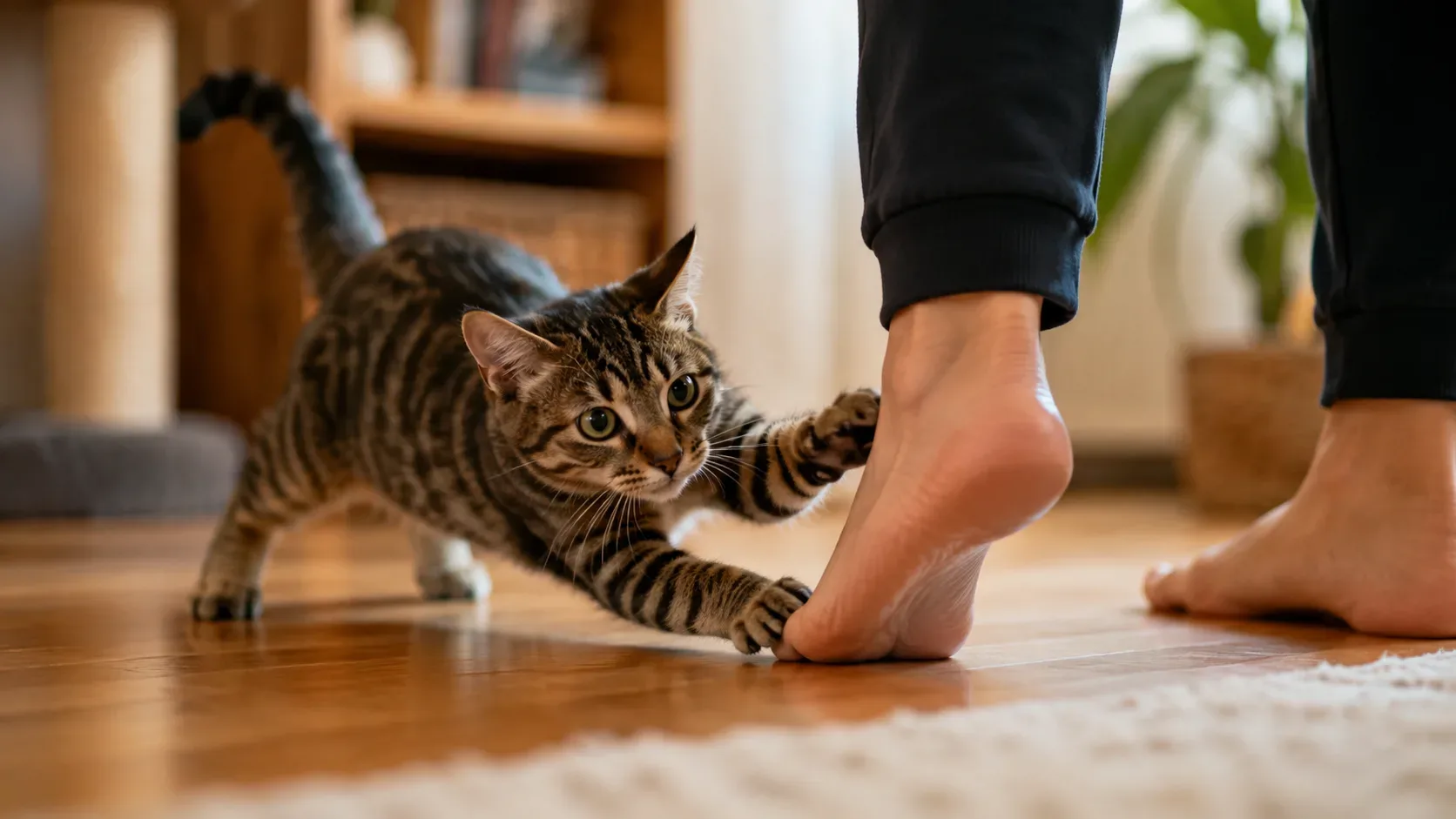
A cat may look for your hand, rub its head, climb onto your lap and, a few seconds later, turn its face and bite. This is not necessarily a contradiction. The animal may want closeness and social contact without wanting continuous touch, on any part of the body and for an indefinite period of time. The most useful point for the owner is not to try to guess a single cause for every bite, but to observe the context, duration of affection, area touched and the signs that appear before the reaction.
In practice, the safest strategy is simple: let the cat initiate or approve the contact, focus the affection on the areas he usually likes, do short sessions and stop for a few seconds to see if he asks to continue. If there is a sudden change in tolerance, a strong reaction when touching a specific area or other signs of discomfort, the question stops being just behavioral and starts to include pain or illness.
Why a cat might ask for affection and then bite
Wanting interaction does not mean wanting a long sequence of caresses. Cats have individual preferences about when, where and for how long they accept to be touched. The Feline Veterinary Medical Association advises that many cats prefer contact on the head and neck and that some become increasingly excited or uncomfortable when the affection continues, and may use a bite or claws as a warning when they reach their limit.
The research on human-cat interaction itself reinforces this reading. In a study published in 2021, people were trained to give the cat choice and control, observe body language, and restrict touch mainly to the temporal regions of the head. After training, cats showed more affiliative behaviors and less aggression toward people and signs of conflict than in the control condition.
This helps dismantle the idea that the cat necessarily “changed its mood out of nowhere”. Often, what changed was the state of the interaction. The same cat may accept three seconds of cheek petting, refuse thirty seconds of repetitive back touching, and react differently if it is tired, scared, playing or in pain.
A survey of 107 owners in the São Paulo region, published in 2009, found reports of aggression directed towards humans in 49.5% of the cats in the sample, with affection and play among the most frequent contexts. The number should not be treated as national prevalence, because the sample was regional and relatively small. The data is most useful in showing that affection and play are recognized contexts in which biting and other aggressive behaviors may appear.
The most useful method: letting the cat “vote” several times
One of the most practical points of the CAT guidelines, tested in the 2021 study, is to transform affection into an interaction with small confirmations, and not into continuous contact decided only by the person. The cat is given the opportunity to enter, remain in, and leave the interaction.
Start by offering your hand without advancing on the animal. If he approaches, rubs his face or touches his body, give him a short caress, preferably on the cheeks, base of the ears, forehead or below the chin, depending on individual preference. After about three to five seconds, stop.
The break is the test. If the cat rubs its face again, pushes its head against your hand, or moves closer to resume contact, you have a sign that it can continue for another short stretch.. If he stands still, turns his head, walks away, or simply doesn't ask for more, treat that as a sufficient response and end it at that point.
This mechanism seems almost too simple, but it changes who controls the duration of the contact. Instead of waiting for the bite to discover that the limit has passed, you create multiple exit points before it.
In August 2026, a new study evaluated an educational intervention based on these principles with shelter staff and volunteers. The interactions observed were more aligned with good practices after training, and the improvement was maintained at the six-month follow-up. The context is that of a shelter, not of domestic cats at home, so it does not prove that every owner will have the same result. Still, it reinforces the usefulness of changing human behavior to give the cat more choice and control.
A body traffic light to stop before the bite
The “traffic light” below is a practical way of organizing signals, not a veterinary diagnosis. The most important thing is to observe changes in relation to the state the cat presented a few seconds before. An isolated signal may have more than one explanation; multiple signs appearing in sequence make the message clearer.
Green: the cat continues to participate
The contact tends to be in a comfortable zone when the cat approaches on its own, rubs its head or body, keeps its muscles relatively loose and returns to looking for the hand after a pause. Behavior is worth more than the idea that “he always likes this kind of affection”. Confirmation needs to happen in that concrete interaction.
Even here, there is no reason to extend the affection until it tests the limit. Short sessions reduce the chance of turning a pleasant interaction into a nuisance just because the person continued after the cat was satisfied.
Yellow: time to pause
The CAT guidelines describe subtle signs that may appear before a more intense reaction: the cat turns its head or moves away, the ears flatten or roll back, the tail begins to whip or twitch, the skin on the back ripples, the body becomes still or tense, the animal licks its nose, stops rubbing against the person, turns its head quickly toward the hand, or begins a brief session of licking its own fur.
If one of these signs appears while you pet, stop your hands. Don't turn the break into another invasive test by poking or moving to a different part of the body. Wait. If the cat asks for contact again, keep it shorter. If you don't return, the interaction is over.
Red: interaction has passed the limit
Growling, hissing, pawing, lunging or trying to bite are signs to terminate. Don’t hold the cat so “it can learn”, don’t insist on one last affection and don’t punish it. In addition to increasing conflict, punishment does not teach what form of contact would be comfortable for that animal.
If he is on your lap and clearly tense, it may be safer to allow an easy exit than to try to pick him up with both hands at the height of his reaction. When the cat is already very excited or scared, the immediate goal is to reduce the interaction and let him move away.
Limit of affection, play or excitement: how to differentiate
Not every bite that happens near the hand is a bite due to pet intolerance. The context usually separates three useful situations for the tutor.
In touch intolerance, the sequence begins with relatively calm social contact. The cat accepts or requests affection and, as the touch continues, signs of discomfort appear. The reaction is linked to the duration, the region touched or the intensity of the contact. The most direct solution is to shorten the affection and use frequent breaks to check if he still wants to participate.
In play, the sequence tends to look more like hunting: chasing movement, jumping, grabbing, biting and, sometimes, using the hind legs against the target. Moving hands and feet can become “prey” if used as a toy. FelineVMA's guidance is not to play directly with hands or feet and to use interactive toys that maintain distance, such as wands and objects that imitate prey.
There are also situations of intense excitement or redirected aggression. A cat that is highly activated by another animal outside, by fright or by conflict may react against the closest person, even if that person did not cause the original stimulus. In this condition, touching or trying to restrain the cat may increase the risk. Wait for the activation to drop before resuming contact.
When the bite can be related to pain
Pain deserves special attention because it can reduce tolerance to handling and make previously acceptable touch become unpleasant. FelineVMA includes pain and illness among the reasons a cat may react aggressively to being handled. Feline behavior guidelines also describe pain-associated aggression when touch reaches a painful region or when pre-existing discomfort decreases overall tolerance.
The signal that changes priority the most is a change in pattern. If a cat that always accepted affection suddenly starts biting, if it reacts mainly when you touch a specific area, if it no longer tolerates brushing or being held, or if the change comes along with difficulty jumping, climbing stairs, moving around, cleaning itself, eating or using the litter box
sand, don't just treat the problem as “bad behavior”.
Cats can hide signs of pain, and behavioral changes are sometimes one of the few visible clues in the home. In mature or elderly animals, problems such as degenerative joint disease can make previously neutral regions more sensitive to touch. Oral pain, injuries and other conditions can also alter the response to management.
Do not try to localize the pain by repeatedly squeezing the point that causes the reaction. Record when it happens, which part of the body was being touched, what the cat did before, if there was a change in appetite, mobility, sleep, hygiene or use of the box and take this information to the veterinarian. A sudden or localized change is grounds for clinical evaluation.
How to adjust affection without pushing the cat away
The goal is not to stop touching the cat, but to make the contact more predictable and respect the point at which it prefers to stop. For many animals, this means swapping one long session for several short interactions throughout the day.
Prioritize areas where the cat shows comfort, especially the cheeks, forehead, base of the ears and, for some, the area under the chin. Be extra cautious with the back, flanks, legs, tail, base of the tail, and belly, as preferences vary and some of these regions elicit negative responses in more individuals.
Pause three to five seconds before any clear signs of irritation. If the cat asks for more, continue. If you don't ask, stop. Over time, you learn not only the “favorite place” but also the approximate duration it accepts in each context.
If the bite appears during play, remove hands and feet from the toy paper and start using appropriate objects. If the reaction occurs when the cat is already very excited by another stimulus, wait for it to calm down. If it appeared suddenly or seems linked to a painful area, seek veterinary evaluation before trying to “train” more tolerance to touch.
What does it mean when it seems like he bites “out of nowhere”
Sometimes the warning really comes too quickly. In others, the owner has not yet learned to recognize discrete signs such as an ear that turns back, a tail tip that starts to beat or a body that remains still. And there are cases where the trigger is not the affection itself, but fear, pain or excitement about something that happened around.
So the better question is not “why does my cat always do this?”, but rather “what happened in the previous five or ten seconds?”. Where was the hand? How long did the affection last? Has the tail changed? Have the ears changed? Did the cat try to get out? Was there another animal at the window? Does the bite only appear when touching one side of the body?
This short history usually separates a predictable contact limit from a change that merits investigation. The goal is to stop using the bite as the first perceived warning and start reading the signs that come before it.