When a cat stops using the litter box soon after a litter change, the timing is a useful clue, but it does not prove that the litter is the only cause. Texture, fragrance, dust, litter depth, and an abrupt change can create aversion; at the same time, urinary pain, gastrointestinal disease, arthritis, and other conditions can also change elimination behavior. The best approach is therefore a controlled preference test without delaying veterinary assessment when clinical signs are present.
First: treat the change as both a behavior issue and a possible health sign
The Cornell Feline Health Center notes that urinating or defecating outside the litter box can be related to medical problems, aversion to the box or substrate, and preference for another location or surface. The same source recommends veterinary examination for cats that begin house-soiling because some illnesses may not produce obvious signs.
If the problem began after a litter change, you do not need to dismiss that clue; the key is not to turn it into a diagnosis. A cat may have experienced pain while urinating and then associated the litter box with the unpleasant experience. It may also simply reject a new substrate because of its smell or texture. Both situations can even occur together.
Signs that should stop the test and prompt veterinary care
A home preference test is appropriate only when the cat is stable. Seek veterinary guidance for a new elimination change and accelerate care if there are signs of discomfort. According to Cornell's guidance on feline lower urinary tract disease, urethral obstruction is an emergency.
- repeated straining to urinate with little or no urine produced;
- very frequent trips to the litter box, vocalizing, or pain while urinating;
- blood in the urine or excessive licking of the genital area;
- rapid worsening, marked restlessness, lethargy, or other signs of distress;
- pain or difficulty defecating, persistent diarrhea, or constipation;
- mobility changes, especially in older cats, that can make it difficult to enter or reach the box.
In male cats, suspected urinary blockage requires immediate attention because the urethra is narrower and obstruction risk is higher. Do not wait for a litter test result when a cat is straining and unable to urinate.
How to set up a litter A/B test at home
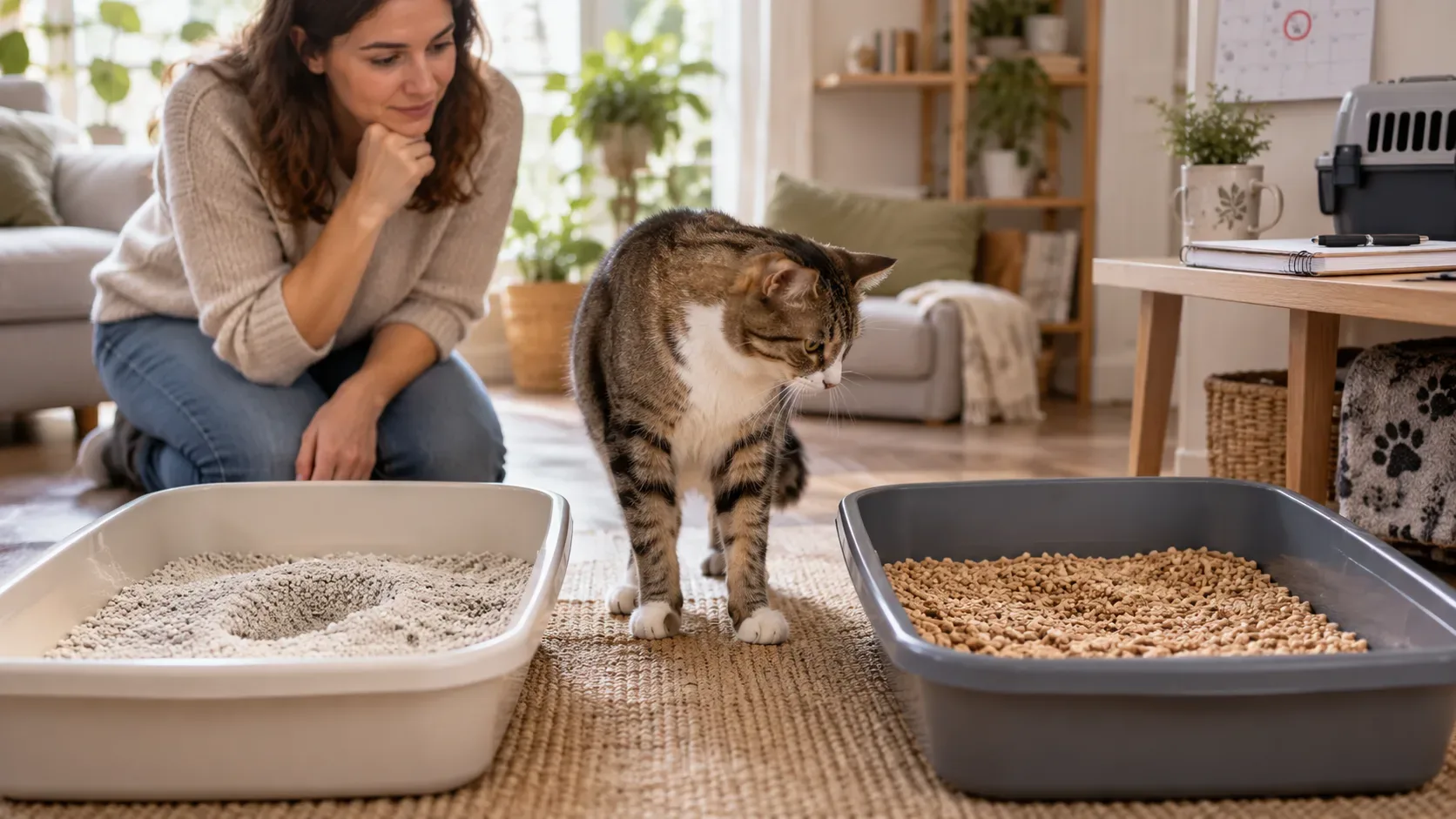
The principle is simple: offer two options at the same time and change only one variable. VCA Animal Hospitals describes a preference test using two or more identical boxes containing different litters. Guidelines from the Feline Veterinary Medical Association and ISFM also recommend offering choices to identify substrate preferences.
- Use two identical boxes. Keep the same size, shape, entry height, and covered or uncovered design. If you are testing litter, the box itself should not be another variable.
- Place the boxes in the same area. During the test, keep access, distance from food and water, and level of privacy as similar as possible.
- Put the old litter in one and the new litter in the other. Start with equivalent depths so the comparison is about substrate, not volume.
- Keep the routine the same. Use the same cleaning frequency and do not add new deodorizers, sprays, liners, or a simultaneous location change.
- Record use. Track urine, feces, and behaviors such as approach, digging, and time spent in the box. A single use is not enough to establish preference.
- Control for side bias. If only one box is used consistently, switch the positions while keeping the contents the same. If the cat follows the preferred litter rather than the side of the room, the interpretation becomes stronger.
How long to observe and what counts as a preference
A test needs to run long enough to provide several opportunities to choose. VCA clinical guidance describes paired tests lasting about 10 to 14 days. In practice, the most important point is not to stop after a single event and to look for a repeated pattern.
Consider a preference more likely when, under comparable conditions, the cat repeatedly uses one option for urination and/or defecation, enters it with less hesitation, and shows normal behaviors such as digging and covering. Some cats may prefer different substrates for urine and feces, so track the two forms of elimination separately.
If neither box is used reliably, the test did not answer the question. Location, cleanliness, box design, conflict with another animal, or a medical cause may be influencing behavior. In that situation, focusing only on litter changes can delay the real investigation.
How to reduce factors that can confuse the result
| Variable | During the litter test | Why it matters |
|---|---|---|
| Box | Use identical models | Prevents substrate preference from being confused with size, cover, or entry-height preference |
| Location | Keep options together or under equivalent conditions | Reduces the effects of noise, foot traffic, escape routes, and privacy |
| Depth | Start with the same amount of litter | Some cats have litter-depth preferences |
| Cleaning | Remove waste at least daily | A dirtier box may be avoided regardless of litter type |
| Fragrance and additives | Do not add deodorizers during the test | Strong odors can become an additional variable |
| Other animals | Watch for blocking, chasing, or ambushing | Social conflict can make a cat avoid an otherwise accessible box |
In multi-cat homes, two side-by-side boxes can function as a test station, but they do not necessarily replace resources distributed throughout the home. Veterinary sources commonly recommend enough boxes in more than one location to reduce competition and blocked access.
If the old litter wins, do not switch abruptly again
If the cat consistently chooses the old litter, the hypothesis of aversion to the new substrate becomes stronger. Cornell recommends making brand changes gradually by adding small amounts of the new litter to the old. Many cats also prefer fine-textured, unscented substrates, although individual preference matters more than the species average.
Make the transition in small steps and move backward if litter-box use worsens. The goal is not to force a cat to accept a particular litter but to find a setup the cat uses reliably.
If the new litter wins, the problem is not automatically solved
Preferring the new litter does not rule out disease. If the cat continues to urinate or defecate outside the box, investigate other variables and speak with a veterinarian. The same applies if the cat alternates between the box and other locations, strains, changes urine volume, loses appetite, hides more, or shows any physical change.
It is also useful to distinguish elimination from urine marking. In marking, a cat often deposits a small amount of urine, frequently on a vertical surface, with a posture different from normal urination. The causes and management can differ.
After substrate, test one variable at a time
If the test suggests that litter is not the only factor, keep the preferred option and evaluate other elements sequentially: litter depth, box size, covered versus uncovered design, entry height, and location. Changing everything at once may improve the problem but makes it impossible to know what actually mattered.
Cleaning is also part of the experiment. Remove urine and feces frequently and wash the box with mild soap and water; veterinary sources advise against harsh products and ammonia-based cleaners. Avoid punishment: scolding can increase fear and stress and does not explain the cause of the behavior.
What an A/B test can — and cannot — answer
A well-controlled test can answer one specific question: between these two litters, with everything else kept as similar as possible, which one does the cat choose? It cannot confirm that the litter change is the only cause, cannot rule out disease, and does not replace veterinary evaluation.
When the behavior begins soon after a litter change, the test is useful because it gives the cat a choice and turns a suspicion into an observation. The real value, however, comes from running two lines of investigation together: control the environment to identify preferences while taking any sign of pain, urinary difficulty, or physical change seriously.