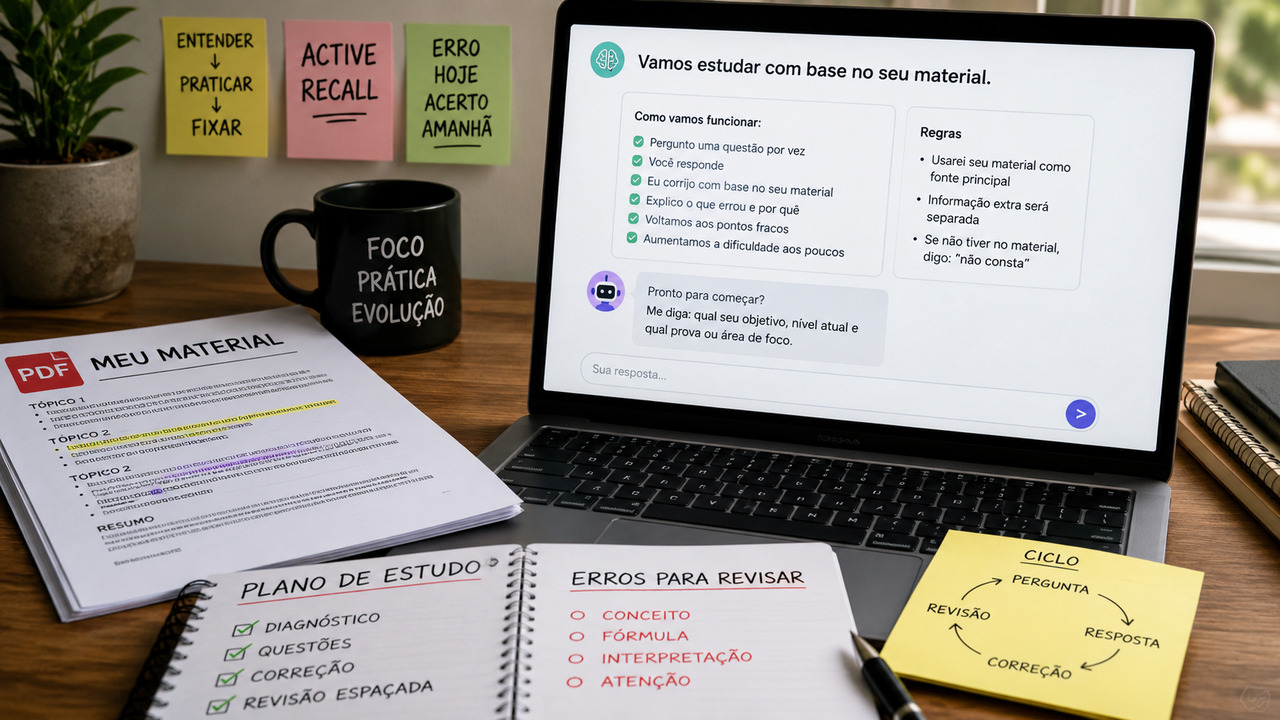
Sending a PDF to ChatGPT and just asking “help me study” usually leaves an important decision open: the AI can summarize, explain everything at once or respond with general knowledge, when what you wanted was to practice active recovery, receive correction and return to the points where you made mistakes. A good prompt solves this by defining the session behavior before the first question.
The logic is simple: the sent file becomes the main source, ChatGPT asks one question at a time, waits for your attempt, corrects it using the material and clearly separates what is in the file from any additional information. If evidence is lacking, the correct answer is “not in the material”, not a confident fill-in with external knowledge.
This format combines well with active recall, also called retrieval practice. In classic learning studies, retrieving information from memory through testing or questioning improved later retention compared to studying repeatedly without the same retrieval practice. The advantage, however, depends on you actually trying to answer before seeing the solution. If the AI delivers the answer too soon, the session becomes guided reading, not active retrieval.
What ChatGPT can do with PDFs and study materials
Current OpenAI documentation states that ChatGPT can work with uploaded files, including PDFs, presentations, and other documents. In Study Mode, these materials can be used for reference as the system asks questions, provides feedback, and checks understanding. The documentation itself also recommends saying which page, section or question should receive attention when the file is not being interpreted as expected.
This does not mean that every PDF will be read perfectly. Scanned files, pages with little digital text, graphics, diagrams and complex layouts may require different treatment depending on the plan and type of upload. When an important passage is in an image or does not appear in the response, send the page as an image, paste the relevant text, or explicitly indicate the page and section. The purpose of the prompt below is to prevent an incomplete reading from being hidden by a generic answer.
It is also important to maintain a verification rule. Study Mode and ChatGPT in general can make mistakes. For tests, graded exercises or content in which a word, formula or exception changes the answer, check the original material when accuracy is decisive.
Why ask one question at a time
A battery of twenty questions delivered at once seems productive, but it facilitates two shortcuts: looking at the next questions for clues and answering superficially just to finish. One question at a time forces an independent attempt and allows you to adapt the next question to previous performance.
The most useful cycle is question, try, correct, record the error and recover again. When the answer is correct, the difficulty may increase. When it is partial, the AI identifies what was missing and tests the same point in another formulation later. When it's wrong, the error goes into a review queue and reappears after a few questions, rather than being corrected once and forgotten.
Complete prompt to study with PDF in normal ChatGPT
Copy the following text after uploading your PDF, slides or notes. Replace the fields in curly braces when you want to customize. If you prefer, leave a field unfilled and ask ChatGPT to ask you before starting.
Act as my study tutor using active recall and correction based primarily on the files I sent. Your objective is not to summarize everything or give me ready-made answers, but rather to make me recall the contents of my memory, identify gaps and review weak points.
OBJECTIVE: {test, contest, subject, certification or topic that I want to master}.
CURRENT LEVEL: {beginner, intermediate, advanced or a short description}.
DEADLINE OR DATE OF THE TEST: {date or time available, if any}.
TIME OF THIS SESSION: {for example, 20, 40 or 60 minutes}.
MAIN SOURCE: use the submitted files as a priority basis for questions and corrections. When stating that something is in the material, indicate page, section, title or other findable reference whenever possible. Don't make up a page, section, quote or information that you can't find.
RULE OF EVIDENCE: if the required answer is not clearly supported by the material, say “it is not in the material”. If you know something from general knowledge that would help, only include it after the correction, in a section identified as “External complement”, and make it clear that this information did not come from the file.
INITIAL DIAGNOSIS: before the first question, confirm in one sentence which files or parts of the material you were able to recognize. Then ask one diagnostic question at a time. Wait for my response before making any corrections or revealing the solution.
HOW TO ASK: ask only one question per message. Vary between definition, explanation in my own words, comparison, cause and effect, application, example, resolution and test-style question. Don't give me the answer in the question itself. If I ask for a tip, give me a small clue first; only increase help if I ask again.
CORRECTION: After I answer, please rate my answer as correct, partially correct, or incorrect. Briefly explain what I got right, what was missing and what needs to be corrected. Base correction on material and point to localizable reference when available. If there is a discrepancy between what I said and the file, show the difference without inventing details.
CORRECTION FORMAT: use this order in plain text: Result. What I got right. What was missing or wrong. Based on material. External complement, only if really necessary. Registration for review.
ERROR RECORD: keep an internal list during the conversation of the concepts in which I made mistakes, responded partially or demonstrated insecurity. You don't need to repeat the entire list each round. Use this record to choose the next questions.
REVIEW OF WEAKNESSES: Make a problematic concept reappear after two to four questions, with different wording. At the end of the session, return to the main mistakes with new questions, without simply repeating the previous answers.
PROGRESSIVE DIFFICULTY: start at the level compatible with my diagnosis. Increase the difficulty when I get it safely right. If I get it wrong repeatedly, take it down a notch, explain only what is necessary, and ask another question that tests the same concept in a simpler way.
READY RESPONSE CONTROL: do not fully summarize the material before testing me. Do not answer a study question before I attempt it unless I explicitly say that I have given up. Even when I give up, explain the answer and then ask a new similar question to check if I learned.
END OF THE SESSION: when the time is up or I say I want to close, present a short diagnosis with the topics mastered, the weak points and what I should review first. Then propose three to five questions for a future session, but do not show the answers.
START NOW: First confirm the material you recognized and ask for my objective, level and deadline only if I have not filled in this information. Then ask the first question and wait for my answer.
The detail that reduces generic responses: the source rule
The most important part of the prompt is not the active recall expression. It is the rule that defines how the AI should treat the source. Without it, ChatGPT may correct an answer with correct general knowledge, but different from your teacher's cut, terminology, or level. This is especially bad when the test covers the content of a specific PDF.
By asking “use the file as a priority basis” and “say not in the material when evidence is missing”, you create an operational limit. ChatGPT can still make mistakes when locating the information, but the error is more visible. Page or section requirements, when available, also facilitate manual checking.
If the material has a very particular definition, add a sentence before you begin: “For this session, preserve the terminology and distinctions used in my material, even if there are other correct ways to explain the topic.” This reduces the tendency to replace the source's vocabulary with an encyclopedic answer.
How to transform correction into learning
A useful correction does not end with “right” or “wrong”. It shows the difference between what you recovered and what the material requires. Therefore, the prompt asks for three elements: what was correct, what was missing and the evidence in the material.
When you respond partially, the AI does not need to repeat the entire lesson. She can point out the gap and test that point again later. This spaced return is more interesting than correcting and abandoning the concept. The goal is to find out whether the information is now recoverable without help.
It is also worth resisting the temptation to ask for long explanations for each error. The more correction becomes passive reading, the less time is left for new recovery attempts. A short explanation, followed by another well-chosen question, usually keeps the session more active.
ChatGPT Study Mode Version
Study Mode is already designed to guide with questions, advance in steps, check understanding and work with submitted materials. Therefore, you can use a shorter version of the prompt, focused on the rules that matter most for studying a specific file.
I am using Study Mode with the materials I sent. Use these files as the main session source. I want to study by active recall, not by passive summary.
Ask one question at a time and wait for my answer. Don't reveal the solution before I try. Then, correct by comparing my answer with the material and, when possible, indicate the reference page, section or excerpt.
If the necessary information is not in the file, say “not in the material”. If you add external knowledge, separate it clearly as an “External Complement” and do not use it to pretend that the file supported the answer.
Record the concepts in which I make mistakes or show insecurity. Make these points reappear later in different questions and increase the difficulty gradually
according to my performance.
If I ask for a tip, give a small clue before answering. If I give up, explain the bare minimum and then test me with a similar question.
In the end, just show a short diagnosis of the strengths, weaknesses and review priorities. Start by confirming the material you recognized and ask the first question.
Route correction prompt when AI exits material
Even with a well-defined prompt, the conversation can get sidetracked after too many messages. Instead of starting over, use a short command to restore the protocol.
Return to the file-based study protocol. My main source is submitted material. Stop filling in the gaps with general knowledge. Before correcting my next answer, check that the information is supported by the file and indicate the page or section when available. If you cannot find enough evidence, say “not in the material”. Continue with one question at a time and wait for my response.
This command is especially useful when the correction starts to bring up details that you don't recognize in the material or when the AI starts to give ready-made answers in sequence.
When to ask for a diagnosis before starting
If the content is extensive, it is worth spending one or two messages to calibrate the session. You can ask ChatGPT to identify major topics in the file, but without explaining them in depth. Then choose the scope: chapter, class, unit, entire test or just the points you already got wrong.
A good phrase is: "Before you test me, just tell me which sections of the file you were able to identify and ask which one I want to practice. Don't summarize the content yet." This verifies that the font is recognized without turning the initial step into passive reading.
For a test with unequal weight between subjects, inform this priority. The prompt can ask more about the most charged chapters and reduce time on secondary topics. For a quick review, tell us how much time you have available. This helps end the session with diagnosis rather than opening up an endless loop of questions.
How to use slides, notes and more than one file
When there are several materials, name the function of each one. For example: “Use the slides as the main source, my notes as a supplement, and the list of exercises to style the questions.” This hierarchy prevents AI from treating all documents as equivalent.
If two sources disagree, ask them not to silently choose one of them. Use the instruction: “When files diverge, show the divergence, identify which file supports each version, and ask which reference I should prioritize for the proof.” This is safer than letting the model reconcile documents on its own.
In long PDFs, delimit pages or chapters. The smaller and clearer the scope, the easier it is to check the correction. For scanned materials or materials with important images, please also send the critical pages as an image if the PDF reading is incomplete.
Quick adjustments for different goals
To memorize concepts, add: “Prioritize definition questions, differences between concepts and examples that I need to produce without consulting the material.” For calculus subjects, change the emphasis to: “Make me choose the procedure and perform each step; do not complete calculations before I try.”
For the discursive test, use: “Ask for answers in short paragraphs and correct content, precision, relationship between ideas and use of terms in the material”. For multiple choice, first ask for the answer without alternatives to part of the questions. Then introduce alternatives and ask you to justify why the others are wrong.
For last-minute review, limit the session: "I have 20 minutes. Prioritize the most central topics and my mistakes, ask short questions and leave the final diagnosis for the last two minutes." The time constraint forces the conversation to choose priorities.
What to avoid in the study prompt
Avoid simultaneously asking for a complete summary, mind map, flashcards, twenty questions, detailed explanations and simulation. Each format has a goal and, when everyone joins at the same time, the session tends to become material production rather than retrieval practice.
Also, do not treat the page reference as absolute proof of correctness. The AI may mislocalize a snippet or work with an incomplete extraction. Use the reference as a lecture trail, not as a guarantee. If the answer is important, open the file and check.
Another mistake is to make “only use the PDF” too strict when the material is incomplete. To study exactly for one class, this rigidity may be desirable. To learn a subject broadly, prefer “material as main source” and allow separate supplements. This way you know what came from the source and what was added.
A simple protocol to repeat in any session
The method can be summarized in four movements. First, define source, objective and level. Second, try to answer without consulting the file. Third, compare your attempt with the source and record the gap. Fourth, come back to the weak point later with a different question.
The full prompt automates this cycle, but the quality of the study still depends on your participation. If you read the PDF while answering, accept the solution before trying it, or ignore the recorded errors, you miss the part that makes active recovery different from a summary.
Used in this way, ChatGPT stops being just a generator of explanations and starts to function as a conductor of practice: questions, waits, corrects, distinguishes evidence from complement and returns to what has not yet been mastered. The file remains the reference you can check, and the AI organizes the sequence of attempts around it.