The choice between RAG and long context should not start with the question “how many tokens fit in the model?”. The context window defines how much material can be sent at once, but it does not alone decide which architecture is most suitable. The corpus format, update frequency, question type, need to track sources, repetition of queries, and cost per call all change the answer.
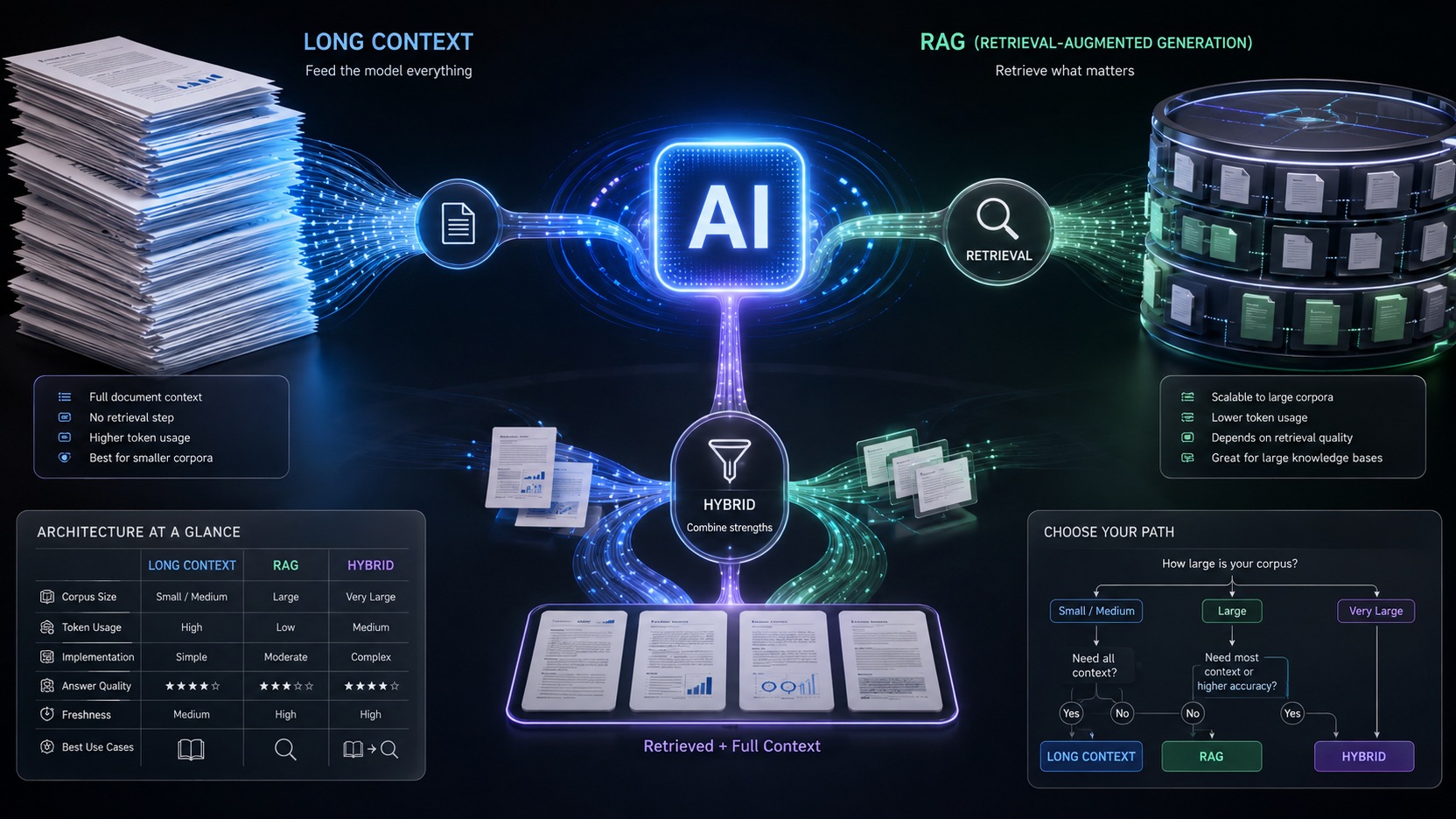
The rule of thumb is this: long context tends to be more attractive when the set of documents is limited, coherent and needs to be read as a whole; RAG tends to win when the base is extensive, grows or changes frequently and each question depends on a small fraction of it; hybrid comes in when some questions require a global view and others require selective retrieval, or when you want to use search to reduce the universe and still give the model complete documents to reason with.
The important point is to treat this as a testable decision. Instead of declaring RAG “obsolete” because a model accepts hundreds of thousands or millions of tokens, compare the three strategies with the same questions, the same documents, and metrics that represent their actual usage.
Long context is not just “RAG without vector bank”
In the long context, you directly put all the relevant documents, or a sufficiently large part of them, into the prompt and ask the model to work on that material. The current Gemini documentation describes models with windows of 1 million tokens or more and presents uses such as synthesizing large sets of text and asking questions and answers about extensive material. This makes viable a path that, years ago, would necessarily require external filtering or recovery.
The architectural advantage is simplicity. There is no chunking step, generation of embeddings, indexing, searching, reranking or logic to decide which snippets are included in the call. Relationships that span multiple pages or documents also remain available to the model without relying on a retriever having selected all the necessary pieces.
But “it fits in the window” does not mean “it is free, fast and infallible”. Google's own long context guide recommends avoiding unnecessary tokens, notes that larger inputs tend to increase the time to the first token, and highlights that tasks with multiple relevant elements spread across the context may have less consistent behavior than simple tests to find a single piece of information.
For this reason, long context is especially interesting when the question requires a global vision. Summarizing a dossier, comparing arguments distributed across several chapters, detecting contradictions between documents or interpreting a set that makes sense as a unit are tasks in which cutting the material before inference can eliminate important relationships.
RAG is a selection architecture, not just a solution for small windows
RAG, for retrieval-augmented generation, adds a recovery step before generation. In a typical implementation, the corpus is split, indexed, and queried; the excerpts considered most relevant to the question enter the context of the model. The architecture reduces the amount of material processed in each call and allows working with much larger databases than what would be reasonable to send in full.
This selection remains useful even when the model has a huge window. Anthropic's documentation for supporting applications, for example, warns that placing large amounts of static and dynamic context into every request can increase cost, latency, and risk of hitting limits, and recommends RAG when selective recovery improves efficiency and responsiveness.
The price of this efficiency is dependence on recovery. If the right snippet is not fetched, the generator will not be able to use it. If a fact depends on two separate snippets and only one is retrieved, the answer may seem plausible and still be incomplete. If chunking breaks a definition at the wrong point, if the index is out of date, or if semantic search doesn't capture an exact identifier, the problem occurs before the model begins to respond.
Anthropic itself published a “Contextual Retrieval” approach to reduce these flaws, combining additional context in chunks, embeddings, lexical search and reranking. The detail is revealing: RAG is not a single algorithm. It is a chain of recovery decisions that needs to be designed and evaluated.
The hybrid path avoids a false binary
There are at least two common ways of combining strategies. The first is to retrieve a smaller set of documents and, instead of sending just small chunks, send complete documents or large snippets to the model to preserve local relationships. The second is to create a router: specific questions go through RAG, while global questions receive a much larger context.
A 2024 study by Li and colleagues compared RAG and long context models on several datasets. In the benchmarks used by the authors, the long context had better average performance when there were sufficient resources, while RAG maintained a cost advantage. The work proposed a routing method between the two options to reduce cost without losing much of the long context performance.
Another preprint, published in 2025 by Li and collaborators, found an even less binary picture: long context was generally better in question-and-answer tasks evaluated by the authors, but RAG showed advantages in certain dialogue scenarios and general questions; Summary-based retrieval strategies also approximated the long context in some tests. These results do not produce a universal rule. They reinforce that the type of task and retrieval design matter as much as the size of the window.
Decision matrix: corpus size and coherence
When you have a single document, a small set of closely related documents, or a package that needs to be interpreted as a unit, start with long context testing. The cost of building and maintaining a recovery layer may not be paid for, and prior selection may remove precisely the information that connects distant parts of the material.
When the corpus is already too large to be sent comfortably, grows continuously, or contains thousands of independent items, RAG becomes more natural. The user's question usually requires some documents, not the entire collection.
In between these extremes, the hybrid is usually the most flexible option. Retrieval reduces the search universe and long context works on a richer final set. Instead of retrieving five isolated paragraphs, for example, the system can retrieve the three most relevant documents and deliver full versions or extended sections of them to the model.
Decision matrix: static or frequently updated corpus
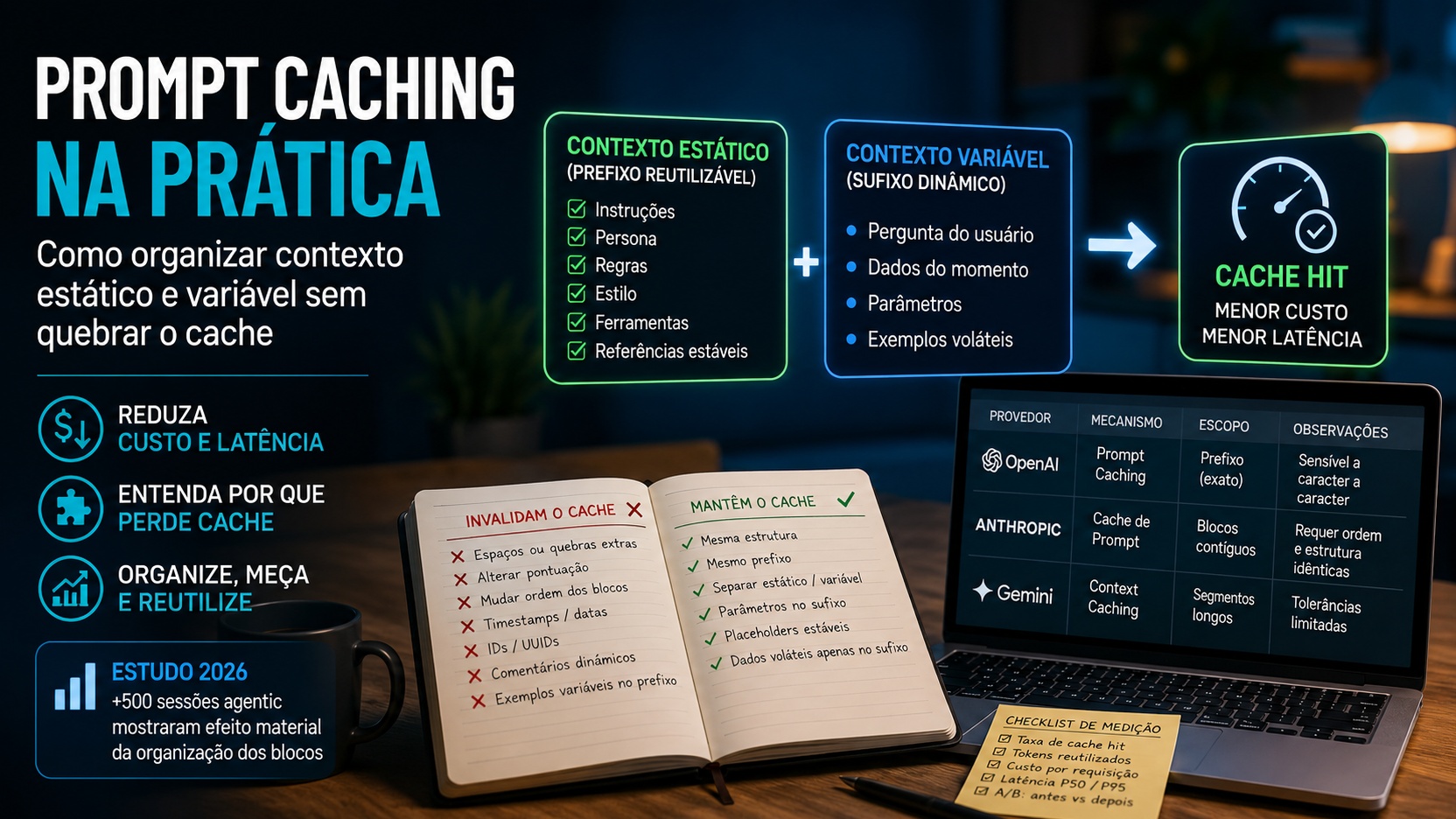
A static corpus favors long context more than it might seem, especially when the same information is queried repeatedly. Caching mechanisms change the economics of this choice. Gemini offers context caching to reuse input tokens, and Anthropic also documents prompt caching to reuse stable prefixes and reduce cost and latency in repetitive tasks.
If the documents change little and the questions are repeated, it is worth testing long context with cache before assuming that RAG will be cheaper. The critical detail is measuring the actual pattern of reuse: a cache only helps when the material remains stable enough and calls can reuse the common part.
On a basis that changes all the time, the logic is reversed. Products, policies, tickets, internal news, catalogs and operational records may require continuous updating. Updating a retrieval index or querying a live source is often more efficient than rebuilding a giant context with each change. For truly real-time data, source system query tools may be better suited than static embeddings.
Decision matrix: global question or specific search
Global questions pull the decision into long context. “What are the main divergences between these reports?”, “summarize the evolution of the argument throughout the document” and “which premises appear repeatedly throughout the set?” require a broad vision. A very aggressive RAG may return only snippets that already appear to answer the query and hide the rest of the pattern.
Particular questions encourage RAG. “What is the refund policy for plan X?”, “in which document does code Y appear?” or “what is the deadline associated with this rule?” tend to depend on a small part of the collection. Sending everything can add cost and latency without improving response.
The most useful test is to separate your actual questions into these two groups and look at the ratio. If almost everything is spot search, RAG will probably be the main path. If most of it requires transversal reading, long context deserves more weight. If both types are frequent, a hybrid router can prevent all queries from paying for the worst case.
Decision matrix: citations and traceability
Needing a font does not automatically mean “use RAG”. Current APIs can also provide citations when documents are sent directly. Anthropic documentation, for example, allows citations in documents provided to the model and also in search results used by RAG applications.
The difference is in the provenance architecture. In RAG, each retrieved result can carry an identifier, title and origin even before generation, which makes it easier to audit what entered the context. In a long context, you need to preserve the identity and segmentation of the documents so that the response can correctly point to the source.
If citation is a product requirement, test two things separately: whether the answer is correct and whether the source indicated actually supports the statement. An architecture can get the content right and get the attribution wrong, or retrieve the correct source and still formulate an excessive conclusion.
Decision matrix: cost, latency and query repetition
RAG tends to reduce input tokens per call because it only sends a fraction of the corpus. This advantage grows when the database is huge and each question uses few excerpts. In
in return, you pay for the ingestion infrastructure, embeddings, storage, search, reranking and maintenance.
Long context eliminates some of this infrastructure, but each call can carry much more input. If the same corpus is queried repeatedly, caching can greatly reduce this difference. If each user brings a different corpus and asks a single question, there may not be time to amortize the cache.
Latency also needs to be measured end-to-end. RAG adds a fetch step, but may decrease the size of the prompt. Long context removes searching, but longer prompts typically increase processing time. The fastest architecture is not obvious without measuring the entire chain in your environment.
Decision matrix: maintaining recovery
RAG transfers part of the complexity of the model to the information system. You need to decide how to break down documents, what metadata to keep, which embedding model to use, whether there will be lexical search along with semantics, how many results to retrieve, whether there is reranking and how to evaluate recall.
This maintenance is justifiable when the database is large, alive and reused by many queries. In a small, stable set, it can be complexity without return.
Long context reduces this layer, but does not eliminate engineering. You still need to control document order, instructions, formats, cache, limits, costs and accuracy assessments throughout the window. The common mistake is to compare a production RAG, full of visible components, with a long prompt treated as if it has no operation and no failures.
How to test the three architectures with your own corpus
Assemble a set of representative questions before choosing. Include specific questions with a localized answer, questions that require combining two or more sources, global questions about the set, and cases in which the correct answer is to say that the information is not in the documents. If the corpus changes, also include questions about newly updated content.
Run the same set in three variants. First, send as much relevant context directly. In the second, use RAG with your recovery configuration. In the third, use a hybrid version, such as retrieving candidate documents and then providing the model with broader context of those candidates, or routing the query between RAG and long context.
Separately evaluate response quality, evidence coverage, citation accuracy, correct source retrieval rate, latency, tokens processed, and cost. Also record operational failures: query that did not find the right document, cache that was not reused, new document that did not enter the index, or prompt that exceeded a limit.
Take the test in sufficient volume to represent the distribution of questions. A benchmark composed only of specific searches will favor RAG; a benchmark composed only of global syntheses will favor long context. The matrix is only useful if it reflects the traffic that the application will actually receive.
Signs that you chose long context too soon
The first sign is repeatedly paying for thousands of tokens that almost never influence the response. The second is that latency grows as the corpus grows, even when questions remain local. The third is to realize that most queries are always
concentrates in a small region of the base.
Another sign appears when the update becomes an operational problem. If a document changes and you need to reassemble or resubmit a large package for almost every query, a recovery layer can give better granularity to the update.
Signs that you chose RAG too soon
If users ask cross-cutting questions and the answer depends on relationships that cross many documents, a very selective retriever may cut out important context. If the team spends more time tuning chunking, top-k, and reranking than solving the product problem, perhaps the corpus is still small enough for a direct approach.
It is also a warning when the dominant error is not in generation, but in “the right source did not appear”. In this case, increasing the model does not necessarily solve the problem; it is necessary to improve recovery or expand the context delivered after it.
When the hybrid stops being sophistication and becomes the simplest option
Hybrid is worthwhile when there is a clear boundary between cheap, local queries and rare but global queries. A router can keep most queries in RAG and scale to long context when the query requires broad synthesis.
It also makes sense when recovery can find which documents matter, but small chunks lose internal relationships. In this design, RAG selects documents and the long context preserves the structure within the retrieved set.
The disadvantage is operational: you now have two routes to observe, evaluate and debug. Therefore, the hybrid should not be adopted just because it appears technically complete. It should resolve a real difference between query types.
The context window is a technical limit, not a product strategy
Windows of 1 million tokens or more have changed the architectural starting point. They made it possible to send volumes that previously required a recovery layer. But they have not eliminated the economic, operational, and informational reasons for selecting context.
RAG should also not be maintained out of habit. If the entire corpus is small, stable, and needs to be read together, a pile of embeddings, vector banks, and rerankers may just create more places for information to get lost.
The most defensible decision is to measure three things: how much of the corpus each question really needs, how much that corpus changes and how many times the same material will be consulted. Then, test long context, RAG and a hybrid alternative with real questions. The right architecture is the one that delivers sufficient quality and traceability within the cost, latency and maintenance that the product can sustain.