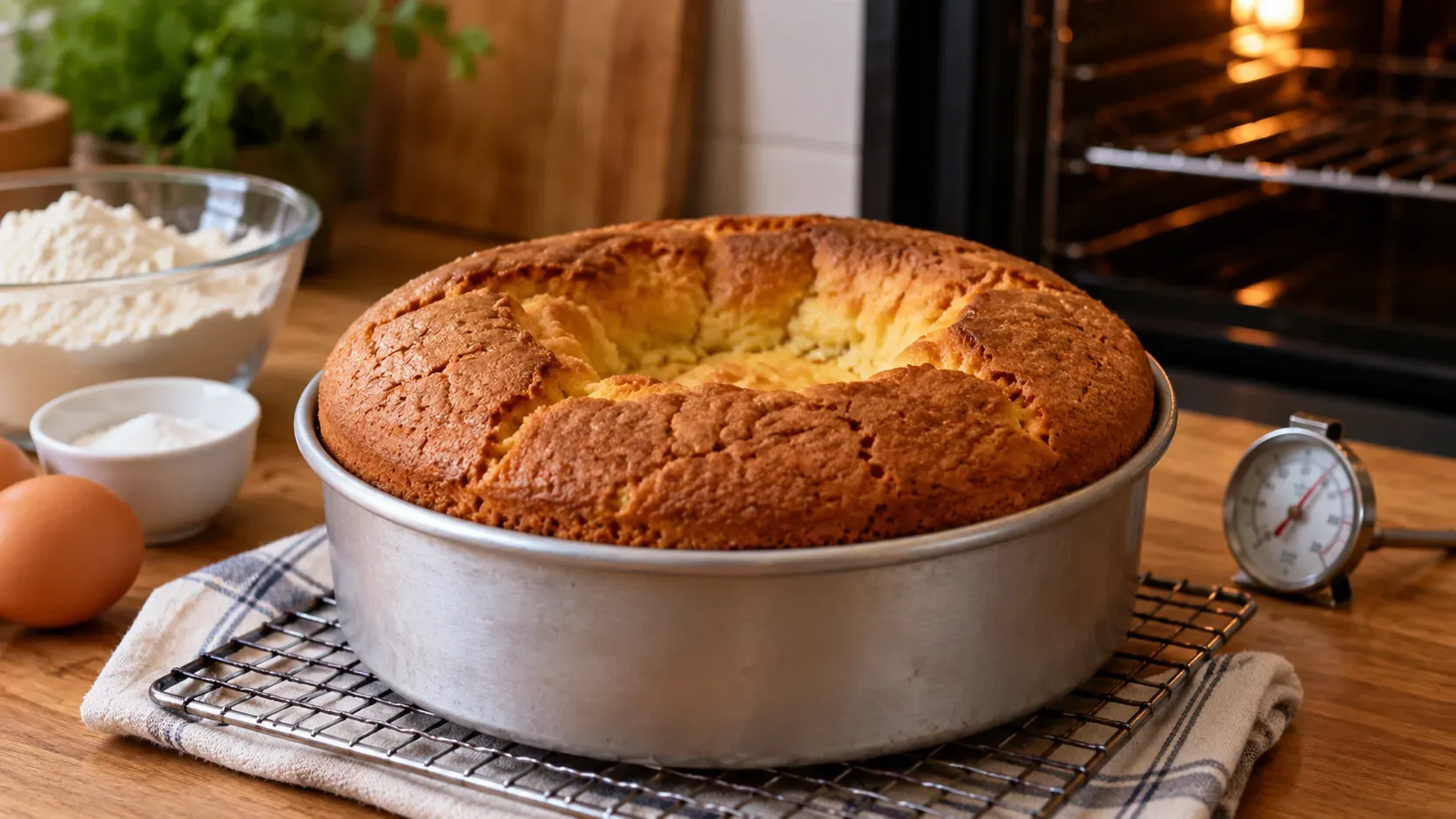
If a cake rises and then sinks, the final shape alone does not identify the cause. The best diagnosis combines when the collapse happened, the texture of the center, the rise pattern, and the oven's actual behavior. In practical terms, a wet, gummy center that gives way after the cake leaves the oven points first to underbaking; a very fast rise followed by collapse while the cake is still baking makes excess chemical leavener more suspicious; and inconsistent timing, color, or doneness calls for an independent check of oven temperature.
Collapse is a symptom, not a diagnosis
During baking, incorporated air, steam, and gases produced by leaveners expand the batter. At the same time, proteins and starches must form a structure strong enough to support that volume. A cake sinks when that expansion is no longer supported: because the center has not set yet, because there was more gas than the structure could hold, or because the actual heat did not let the batter expand and set at the pace intended by the recipe.
That is why two cakes can end with a similar depression in the middle and still have different causes. Appearance helps, but it needs to be read together with what happened before and after the pan left the oven.
First question: when did the cake sink?
| Observed sign | Most useful suspicion | What to look for next |
|---|---|---|
| It rose, came out looking tall, and sank during the next few minutes | The center was still underbaked | Wet, sticky, or gummy crumb; center that does not spring back; raw batter on a tester |
| It rose very high and began to fall while still in the oven | Excess chemical leavener or excessive aeration | Very inflated top before the fall; coarse crumb, large or irregular cells; questionable leavener amount or measurement |
| It sinks often and also browns too early, takes too long, or bakes unevenly | Actual oven temperature or heat distribution | Independent thermometer disagrees with the control panel; hot spots; edges done well before the center |
| The problem appeared after changing pans | Pan depth, area, or material changed the bake | A deeper or shallower batter layer than the recipe intended; a major change in required baking time |
These clues are not exclusive. A cool oven can leave the center underbaked; a smaller pan can make the batter deeper and produce the same effect. The purpose of the decision tree is to choose the first hypothesis to test, not to issue a verdict from a photo.
Underbaked center: when the outside looks ready but the structure is not set
The classic underbaking pattern is a cake that holds good height in the oven but loses support as it cools. The outside has already formed a crust and may even be well browned, while the center still contains batter that has not cooked enough to support the cake's own weight.
The most useful signs work together: the center remains very soft or sinks when touched, the cut cake shows a wet or gummy band, a tester brings up liquid batter, and the surface still feels unstable. King Arthur Baking recommends not relying on a single test: edges beginning to pull from the pan, a set top, spring-back, and a cake tester are more informative when combined.
An instant-read thermometer can provide another data point, but it should not become a magic number. Final internal temperature varies by formula. King Arthur notes that many classic cakes finish roughly between 200 and 210 °F, about 93 to 99 °C, while also warning that this is not a universal threshold. For a specific recipe, the author's own doneness cues remain the primary reference.
If underbaking is the leading suspicion, the correct test is not to add more leavener. Repeat the recipe under the same conditions and give the center enough time to set, using several doneness cues instead of following the printed minute blindly.
Too much chemical leavener: excess gas can create a rise the batter cannot support
Baking powder and baking soda help expand bubbles already present in the batter. More leavener, however, does not automatically mean a taller cake. If gas production is excessive, the cake can rise too quickly, stretch its internal walls, and then lose volume before the structure is stable. Utah State University baking materials list too much baking powder or baking soda among possible causes of fallen cakes, and King Arthur describes the same pattern of excessive rise followed by collapse.
This hypothesis becomes stronger when the cake inflates dramatically and begins to fall while it is still in the oven, especially if the crumb is coarse or has large, irregular cells. Very high amounts may also produce an unpleasant flavor, depending on the leavener and formula.
Before reducing a trusted recipe, verify the measurement. Confusing teaspoons and tablespoons, using heavily heaped measures, scaling the leavener incorrectly when multiplying a recipe, or confusing baking soda with baking powder can create large errors. In diagnostic tests, measure ingredients as consistently as possible and change only one variable at a time.
Wrong oven temperature: the control panel may not tell the whole story
Cake structure depends on the relationship between expansion and setting. If the oven runs below the required temperature, the center may need longer to set and the recipe's stated time becomes unreliable. If the oven runs too hot, the outside may brown or firm too early while the center lags behind. Hot spots can also make one side rise, dry, or brown more than the other.
An independent oven thermometer is the most useful tool for this hypothesis. Place it where the cake normally bakes, preheat fully, and compare its reading with the selected temperature. King Arthur recommends an independent thermometer because the oven's built-in system may not represent the temperature well during preheating and because cycling and hot spots are common.
If the thermometer shows a persistent difference, the next step is to learn the appliance's behavior and, where applicable, follow the manufacturer's calibration procedure or seek service. This diagnostic guide does not replace model-specific appliance instructions.
The pan can imitate an oven problem
Switching to a pan that seems “almost the same” changes batter depth and the distance heat must travel to reach the center. A smaller pan creates a deeper layer and tends to require more time; a larger pan creates a thinner layer and usually bakes faster. Material and color also affect heat transfer and browning.
This matters because a cake that used to work can begin sinking after a pan change even though the recipe itself has not changed. For diagnosis, use the same pan, with the same size and material for every repeat.
Practical decision tree: which hypothesis should you test first?
- Did it sink mainly after leaving the oven? Cut the cake and inspect the center. If it is wet, gummy, or contains raw batter, test underbaking first.
- Did it rise very aggressively and fall while still baking? Check the amount and type of chemical leavener as well as the mixing method. Excess gas or incorporated air becomes a strong hypothesis.
- Does the timing never match, do the edges finish well before the center, or does browning vary? Check the oven with an independent thermometer and look for hot spots.
- Did the defect start after a pan change? Return to the specified pan or deliberately adjust batter volume and baking time.
- Do several clues appear at once? Do not fix everything at the same time. Standardize the test and change one variable per batch.
The controlled test that separates the causes
When a cake sinks repeatedly, the most efficient way to identify the reason is to turn the next batch into a small kitchen experiment.
- Use the same recipe, with no substitutions.
- Weigh flour, sugar, fat, and liquids when possible; measure chemical leavener carefully.
- Use the same pan on the same oven rack.
- Place an independent oven thermometer inside and let the oven stabilize before baking.
- Write down when the cake started rising, when it reached its peak, and whether the collapse happened inside or outside the oven.
- At the end, use several doneness cues: appearance, spring-back, a tester without raw batter, and, when appropriate for that formula, internal temperature as a secondary data point.
- If the oven temperature is correct, keep that variable fixed on the next repeat and investigate leavener, time, or technique. If it is wrong, resolve that discrepancy before reformulating the cake.
This method is more informative than adding flour, reducing liquid, increasing leavener, and changing pans all at once. When many things change, a better cake does not reveal which correction actually worked.
Diagnostic mistakes that often make the problem worse
- Adding more leavener to “give it strength.” If the problem is already excess gas, this can intensify the rise and fall.
- Trusting recipe time alone. Pan, oven, and batter change the real time required.
- Opening the door repeatedly and early. Before the structure has set, temperature drops and movement do not help the test and add another variable.
- Using only a toothpick. It is a useful sign, but very moist cakes, melted chocolate, or fruit can complicate the reading; combine methods.
- Changing pans on every attempt. That changes batter depth and makes results harder to compare.
In short
A cake that rises and sinks should be treated as a diagnostic problem, not a defect with one universal cause. Collapse after leaving the oven + a gummy center points first to underbaking. A very high rise + collapse while still in the oven makes excess chemical leavener a meaningful suspect. Inconsistent timing, edges that race ahead, and uneven browning call for an independent oven-temperature check. And any comparison is only useful if the pan and other conditions stay the same.
The cleanest test is simple: same recipe, same pan, careful measurements, and an oven thermometer. Then change one variable at a time. That turns the cake's shape from a guess into evidence.