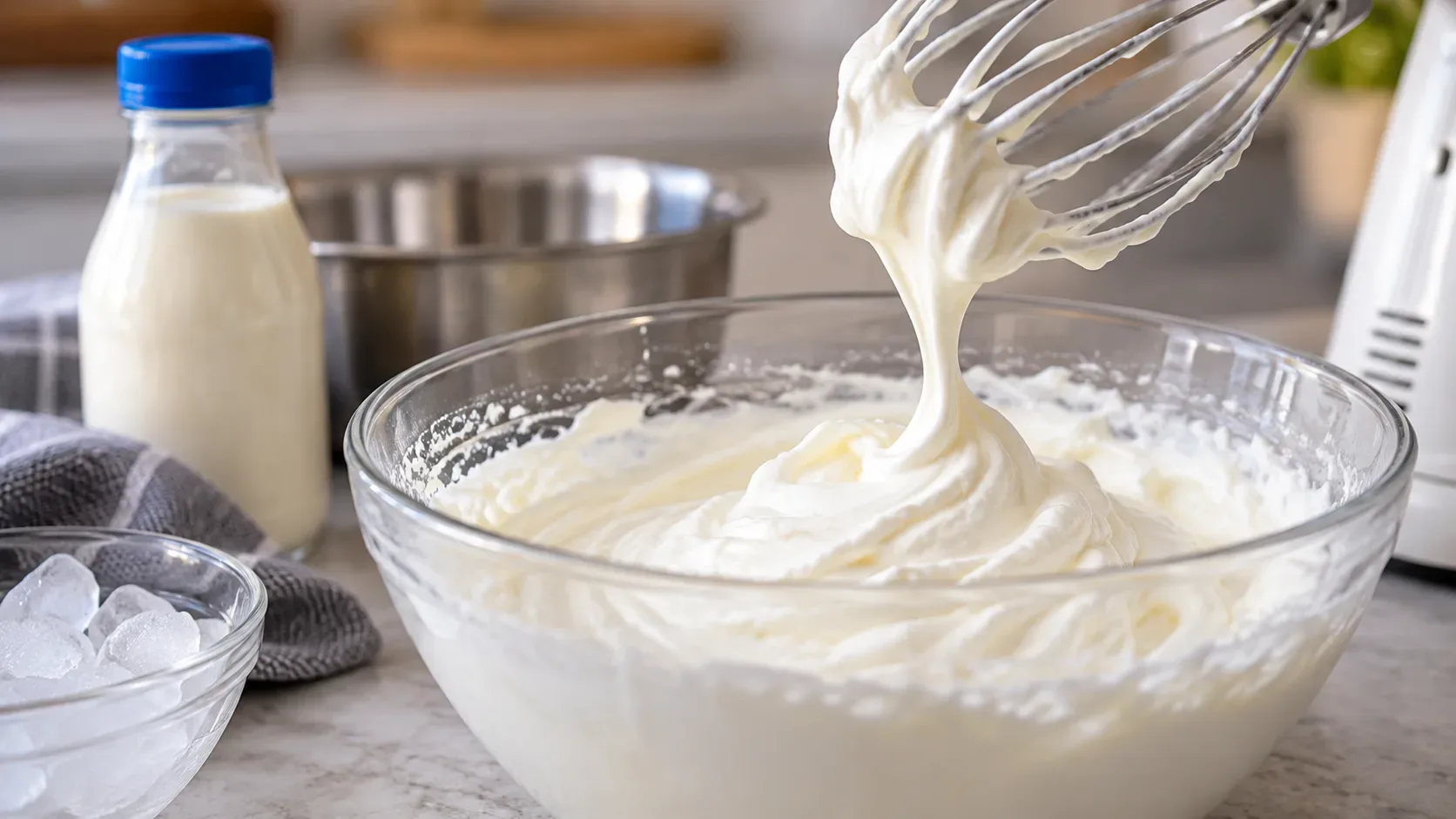
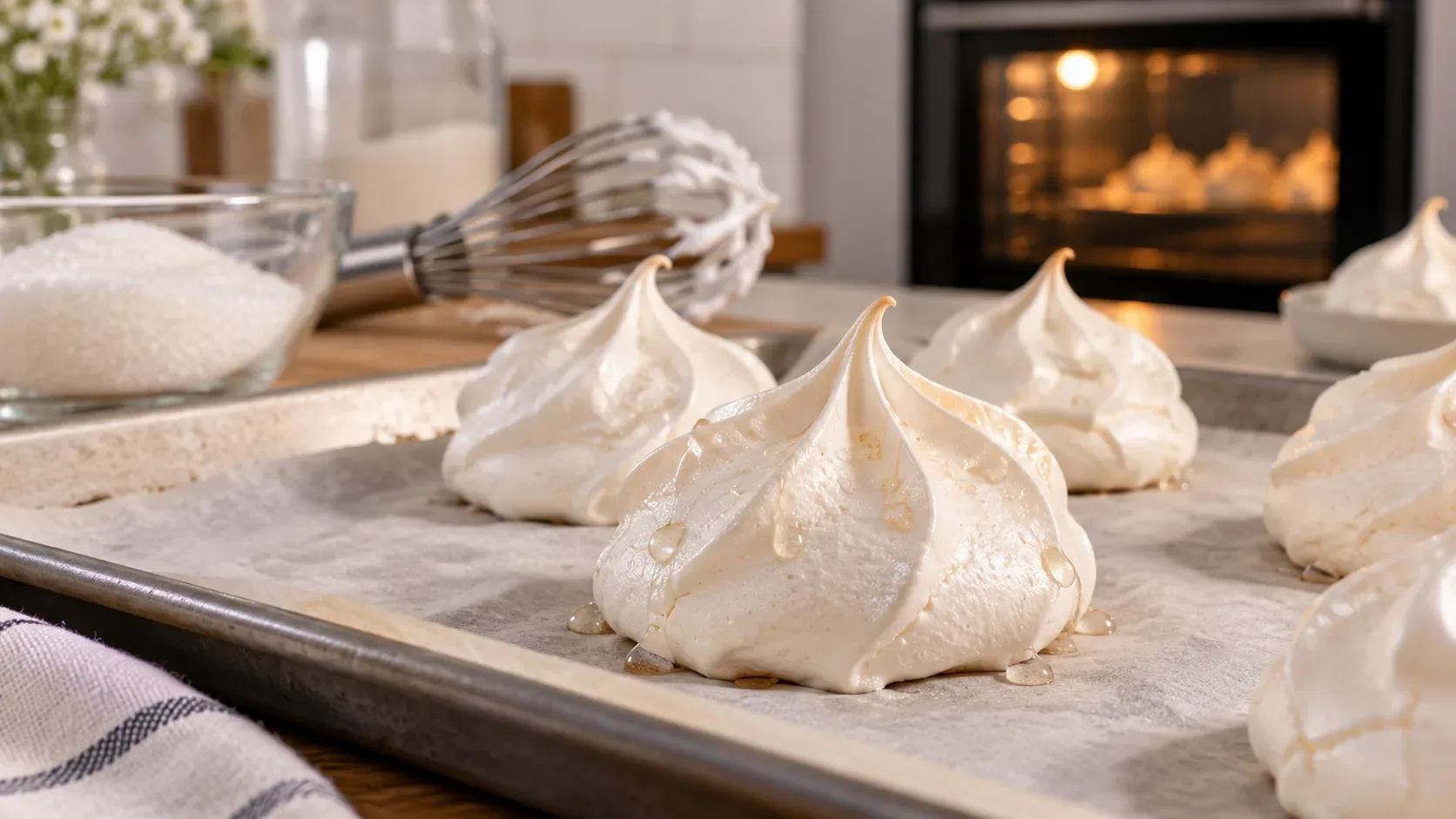
When meringue turns sticky or starts forming droplets, the best approach is not to look for one universal “trick.” The meaning of the problem changes depending on when it appears. Before baking, a sandy texture points to sugar that has not fully dissolved; right after baking, stickiness usually suggests insufficient drying or high ambient humidity; after storage, moisture absorption or condensation becomes more likely. Soft meringue on pies has another mechanism as well: liquid can collect between the topping and the filling.
First: sticky and “weeping” are not exactly the same problem
Sugar is essential to meringue stability, but it is also hygroscopic, meaning it attracts water. The same property that helps support the foam can make the surface sticky when meringue meets humid air. King Arthur Baking notes that dry meringues can absorb moisture from the environment and lose their crispness; the University of Illinois Extension likewise links humid conditions with sticky texture and beads of sugar syrup on the surface.
| When the problem appears | Most useful sign | Likely cause | First action |
|---|---|---|---|
| While whipping | Meringue feels sandy when rubbed between the fingers | Sugar has not fully dissolved | Whip a little longer before adding more sugar |
| Right after baking | Surface is still damp or tacky | Insufficient drying or high humidity | Dry longer in a low oven, according to the type of meringue |
| Hours later | Previously dry meringue turns soft or sticky | Moisture absorbed from the air | Review cooling and airtight storage |
| After refrigerator/freezer storage | Droplets appear as it returns to room temperature | Condensation | Avoid thawing inside a container that traps moisture |
| On a pie | Liquid forms between filling and topping or beads appear on top | Cool filling, inadequate cooking/cooling or humidity | Treat it as pie meringue, not as a dry meringue cookie |
If the problem appears before baking, test the sugar
With meringues made from granulated sugar, the simplest check is to rub a small amount between your thumb and forefinger. The American Egg Board recommends that the mixture feel completely smooth; if it feels grainy or sandy, the sugar has not fully dissolved. Undissolved sugar can later show up as sugar spots or droplets on the surface.
Sugar should be added gradually after the whites have already started to foam and gain volume. Dumping it in all at once makes dissolving more difficult and can also reduce foam volume. For the next batch, finer sugar crystals generally dissolve more readily. With Swiss meringue, warming the whites and sugar over a water bath is specifically used to dissolve the sugar before whipping the final foam.
What to do if the mixture is already grainy
- stop adding sugar and whip a little longer, then test again between your fingers;
- do not add water to “melt” the crystals: it changes the recipe ratio and structure;
- if the foam starts looking dry, brittle or dull, do not keep whipping indefinitely; overbeaten whites can also lose quality in soft meringues;
- next time, add the sugar in smaller portions and allow each addition time to incorporate.
If it comes out of the oven sticky, think drying first
Meringue cookies and other dry meringues do not bake like cake: they need to lose water slowly. Recipes in this category typically use low heat and a long drying time. King Arthur, for example, recommends a low oven for dry meringues and, in some recipes, cooling them in the switched-off oven to finish drying. If the meringue is pale, holds its shape, but remains tacky, the most likely diagnosis is that more moisture still needs to be removed — provided the intended result is a dry, crisp meringue.
The same rule does not apply to every preparation. A pavlova, for example, may intentionally have a dry shell and a soft center. Drying it until it is crisp all the way through would change the desired result. “Moist inside” is only a defect when the recipe is supposed to dry completely.
How to rescue a sticky meringue cookie
- if it is still on the tray and should be dry, return it to a low oven and give it more drying time;
- avoid sharply raising the temperature to speed things up: the outside can brown or crack before the inside loses enough water;
- once dry, cool completely before sealing in a container;
- on a very humid day, expect the surface to pull moisture from the air quickly and minimize exposure time.
Droplets on the surface: notice when they appeared
“Weeping” can describe different mechanisms. In dry meringue, small drops may be sugar syrup associated with undissolved sugar and humidity. On a meringue pie, liquid collecting between the filling and topping is often related to assembly and cooking. The American Egg Board recommends spreading soft meringue over a filling that is still hot: the heat helps cook the underside of the topping and reduces the chance of a slippery liquid layer forming.
For pie meringue, oven doneness is also a matter of safety and structure. The American Egg Board recommends cooking the meringue over hot filling until the topping reaches a safe temperature; for a three-egg-white topping, the reference given is 160 °F (about 71 °C). With more egg whites, a lower oven temperature and longer time are generally needed to cook the interior without overbrowning the surface.
Cooling matters too. Abrupt temperature changes can contribute to beads on pie meringue. That is different from a meringue cookie that has absorbed moisture from the air, even though both can look as if they are “sweating.”
Humidity and storage are part of the technique
A meringue can leave the oven perfectly and deteriorate later. Because sugar attracts water, leaving meringues exposed in a humid kitchen, packing them before they are fully cool or creating condensation inside a container can soften the shell. For dry meringues, the practical rule is simple: cool completely and store in a tightly sealed container, away from steam and moisture.
King Arthur describes a useful strategy for humid climates: freeze dry meringues in a sealed container and, when ready to use them, remove the pieces from the container before thawing. This helps keep condensation from being trapped against the meringue surface. If a plain meringue cookie has only softened because of humidity, a short return to a low oven can help restore crispness.
Meringue on pie follows a different storage logic. Perishable fillings and egg toppings should follow the recipe's refrigeration and food-safety guidance. Do not automatically apply the “dry container at room temperature” rule used for meringue cookies.
Quick diagnosis by stage
- Before baking: rub a small amount between your fingers. If it feels grainy, work on dissolving the sugar before proceeding.
- After baking: ask what texture the recipe intended. For a dry meringue, stickiness calls for more drying; for pavlova, a soft center may be correct.
- After cooling: if it was dry and later became sticky, ambient humidity becomes a stronger explanation.
- After storage: look for condensation, sealing while still warm, or exposure to a humid refrigerator/room.
- On a pie: check whether the meringue was applied to hot filling, cooked adequately and cooled appropriately.
What not to do when trying to “save” it
- Do not crank up the oven: high heat can color the outside before the center dries.
- Do not store it warm: trapped steam becomes moisture inside the container.
- Do not assume every droplet means underbaking: undissolved sugar, humidity and condensation can produce similar signs.
- Do not add more sugar without a diagnosis: it does not automatically fix a wet foam and increases the amount of hygroscopic material.
- Do not judge pavlova by dry-meringue standards: the desired interior texture is different.
Checklist for the next batch
- clean, grease-free bowl and beaters;
- sugar added gradually;
- mixture smooth to the touch before baking;
- low temperature and enough time when the goal is drying;
- complete cooling before packing;
- airtight container for dry meringues;
- less exposure time on humid days;
- for pies, topping applied to hot filling and cooked according to the recipe.
In short, the timing of the defect is the best clue. Grittiness before baking points to sugar dissolution; stickiness immediately after baking points to drying and humidity; meringue that softens later points to storage; and liquid on a pie needs to be analyzed as an assembly, cooking and cooling issue. Separating these stages prevents you from applying the wrong fix to the wrong problem.