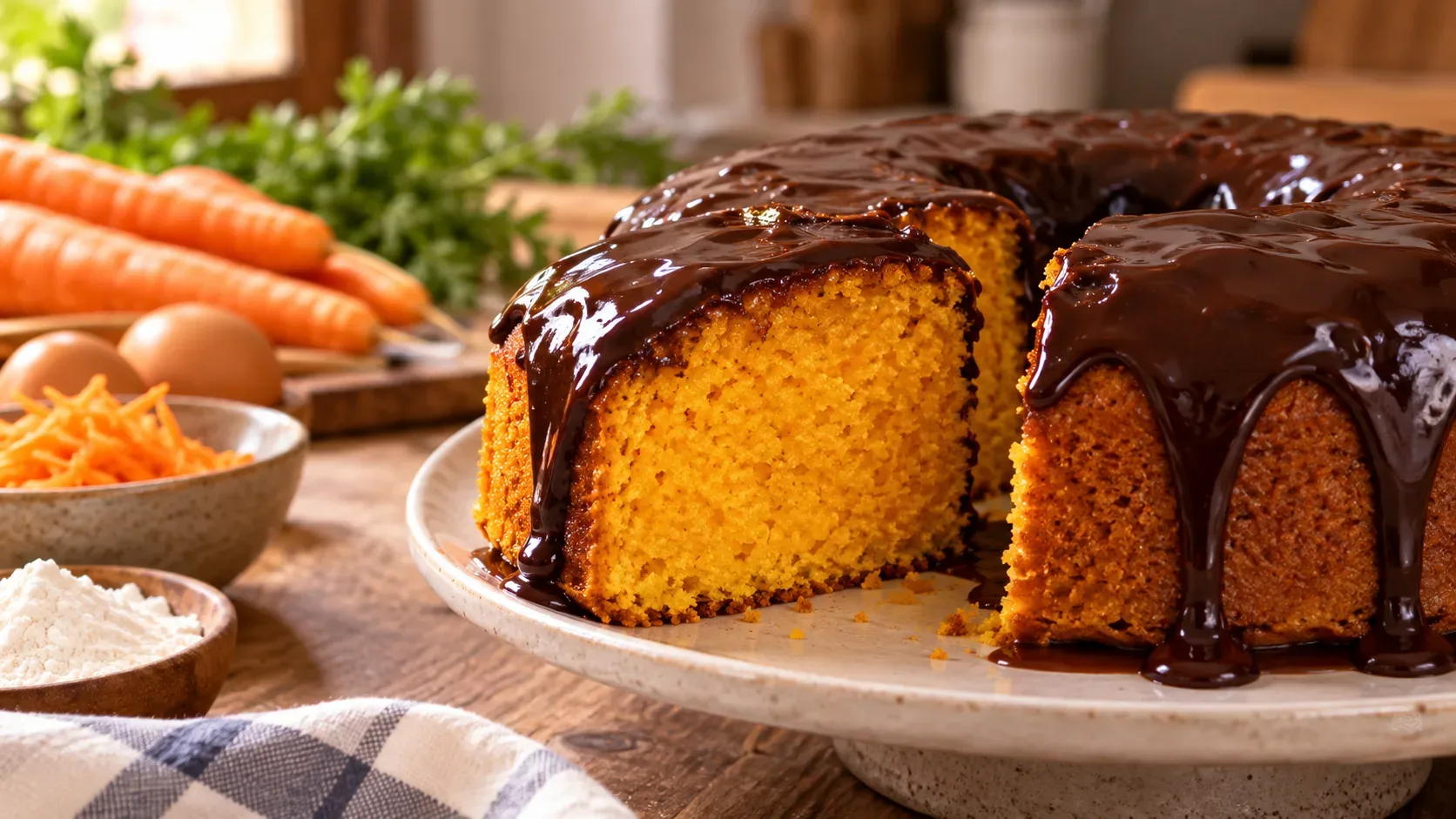
When Brazilian-style carrot cake comes out low, heavy, or with a wet, compact layer at the bottom, there is rarely a single culprit. In the blender-style cake, the most common problems often overlap: too much carrot for the amount of flour, extra water in the batter, flour mixed too much or too little, weak leavener, or a center that was still underbaked when the cake left the oven. The most practical way to reduce variation is to weigh the peeled carrot, blend only the liquid phase, and use doneness cues — not just the clock — to decide when the cake is baked.
A gram-based formula to reduce variation
For an approximately 22 cm tube pan, this is a balanced baseline for a light Brazilian carrot cake that stays moist without becoming gummy and still tastes clearly of carrot:
- 250 g raw carrot, peeled and cut into small rounds or cubes;
- 3 large eggs, about 150 g without shells;
- 110 g neutral oil, about 120 ml;
- 200 g sugar;
- 220 g all-purpose flour;
- 12 g baking powder;
- 2 g salt.
This formula is not meant to be the only correct ratio. Published recipes vary: TudoGostoso specifically warns against excess carrot and cites 270 g as a reference point for one of its formulas, while other recipes use roughly 200 to 250 g. The useful principle is different: do not increase the carrot by itself. As a conservative working rule for a blender cake of this size, 250 g carrot with about 220 to 250 g flour is a reliable starting point. If you want more carrot flavor, it is better to rebalance the entire formula than simply add more root.
Why weighing the carrot matters
“Two medium carrots” can represent very different weights. Larger carrots also bring more water and fiber into the batter. In April 2026, the Brazilian site Receitas published guidance on dense carrot cake and highlighted excess carrot as one of the most common mistakes. In a separate TudoGostoso recipe, the advice is to weigh the peeled carrot so that “three medium carrots” does not quietly become an excessive amount.
The goal is not to make the cake dry. Carrot and oil contribute moisture, but there is a limit to how much weight the structure formed by flour, eggs, and leavener can support. When the liquid phase becomes too heavy, the cake may rise at first and then settle into a dense layer, or it may simply bake with a compact crumb.
For that reason, weigh the carrot after peeling. If it is very wet from washing, dry the surface before cutting. If you use frozen carrot, treat the water released by ice as an extra ingredient and do not pour it into the batter without control.
Batter consistency: what should happen in the blender and in the bowl
1. Blend carrot, eggs, oil, and sugar until truly smooth
Put the carrot, eggs, oil, and sugar in the blender. Blend until there are no visible carrot pieces and the mixture is uniform, glossy, and thick like a pourable smoothie. With a less powerful blender, stop, scrape the sides, and blend again. The goal is to break down the fiber well before the flour goes in.
2. Add the flour outside the blender
Transfer the mixture to a bowl. Add the flour in two or three additions and stir with a whisk or spatula only until the dry pockets disappear. The science behind this is straightforward: when flour meets liquid, gluten-forming proteins begin to bond; additional agitation strengthens that network. In cakes, excessive development tends to produce a firmer, less tender crumb. King Arthur Baking also notes that both overmixing and undermixing can contribute to dense streaks in some cakes, so the best target is to mix enough to make the batter uniform, without beating it for a long time.
3. Baking powder goes in last
Fold in the baking powder and salt with just a few strokes, distributing them well. The finished batter should fall from the spatula in a thick, continuous ribbon. It should not run like juice, and it should not be as stiff as bread dough. Small marks on the surface should level out within a few seconds.
Checkpoint before baking
- there are no carrot chunks;
- there are no white pockets of flour;
- the batter has body but still flows;
- the baking powder was added last without prolonged beating;
- the pan is filled to roughly one-half, or at most two-thirds, of its height.
Oven and pan: avoiding a baked crust with a raw center
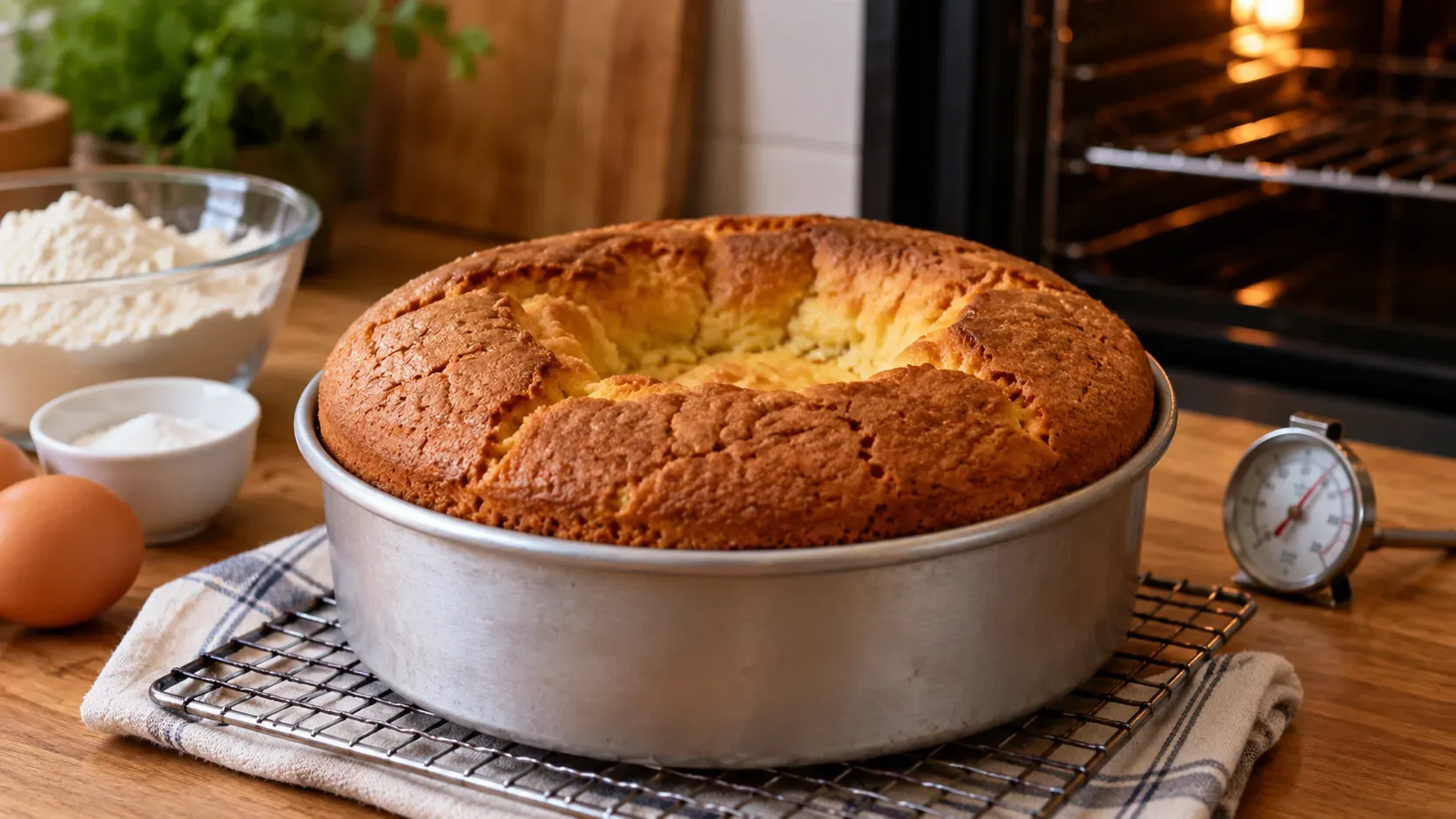
Preheat the oven to 180 °C and place the rack in the middle area. Home ovens can display one temperature and deliver another; an independent oven thermometer is useful when the same cake repeatedly stays raw in the center. King Arthur Baking recommends checking actual oven temperature because calibration errors can substantially change baking time and the way the center sets.
Bake for about 35 to 45 minutes, using time only as the first window. Avoid opening the door during the first 30 minutes, while the structure is still setting. Start checking when the top is firm and golden, the edges are beginning to pull slightly away, and the center responds to a gentle touch.
To confirm doneness, insert a toothpick or thin paring knife near the center of the cake without touching the tube. It should come out clean or with a few moist crumbs, never with shiny batter. Gently press the center: if it sinks and keeps the indentation, it needs more time. If it springs back, that is a good sign that the crumb structure has set.
If the outside darkens quickly while the center remains raw, first suspect an oven that is running too hot or a pan that is too small and deep. Lowering the temperature without identifying the problem can stretch the bake so long that the outside dries before the center stabilizes.
Post-bake diagnosis: what the cake is telling you
| Symptom | Likely causes | What to change next time |
|---|---|---|
| Dense, wet band at the bottom | Too much carrot/water; underbaked center; weak leavener; improper mixing. | Weigh the carrot; drain extra water; check the baking powder; mix flour only until uniform; bake until the center is set. |
| Cake rose and sank in the middle | Removed too early; too much leavener; oven opened too soon; structure still fragile. | Do not automatically double the baking powder; avoid opening early; confirm doneness with a tester and spring-back. |
| Elastic or rubbery crumb | Flour worked too much or flour that is unusually strong. | Mix the flour by hand and stop when no dry spots remain. |
| Heavy, oily, very wet crumb | Too much oil and/or carrot; extra water from frozen carrot. | Weigh liquids and carrot; discard thaw water; do not increase wet ingredients in isolation. |
| Dark outside, raw in the middle | Oven hotter than the setting or pan too deep/small. | Check the oven with a thermometer; use the intended pan size; bake on the middle rack. |
| Low and pale even after the suggested time | Oven too cool; expired/weak leavener; pan too large for the batter amount. | Preheat fully; test/replace the baking powder; use a compatible pan. |
What if the carrot is frozen?
You can use it, but water becomes the main concern. TudoGostoso advises against fully thawing the carrot and pouring all the released liquid into the batter, because that changes the formula balance. For frozen grated carrot, use it cold or only partly thawed; for cubes, remove excess ice crystals and drain any puddled water before weighing and blending.
If the carrot is visibly very wet, it makes more sense to reduce the oil slightly than to compensate blindly with extra flour. The TudoGostoso guidance suggests about 10% less oil in higher-moisture situations. Treat that as a contingency adjustment, not a new fixed rule: the actual water load varies with freezing, piece size, and thawing.
A simple method for repeating the result
- Preheat the oven to 180 °C and prepare an approximately 22 cm tube pan.
- Weigh 250 g carrot after peeling.
- Blend the carrot, eggs, oil, and sugar until completely smooth.
- Transfer to a bowl and incorporate 220 g flour in a few additions.
- Mix in salt and baking powder only until evenly distributed.
- Put the cake in the oven immediately and do not open the door during the first 30 minutes.
- From 35 minutes onward, check color, firmness, the toothpick/knife test, and spring-back.
- Let the cake rest in the pan for 10 to 15 minutes before unmolding so it does not break while the structure is still hot.
This process cannot eliminate every variable — flour, egg size, carrot moisture, pan material, and oven accuracy differ from kitchen to kitchen. But it replaces vague measures and guesswork with checkpoints that can be repeated. If the cake comes out dense, compare the result with the table above and change one variable at a time; that is the fastest way to learn what was actually throwing your formula off balance.
Sources and references
- Receitas — guidance for avoiding dense Brazilian carrot cake (2026)
- TudoGostoso — recipe and carrot-weight reference
- TudoGostoso — using frozen carrot (2026)
- King Arthur Baking — gluten development in cakes
- King Arthur Baking — causes of dense cake bands (2026)
- King Arthur Baking — cake doneness cues
- King Arthur Baking — oven and preheating guide