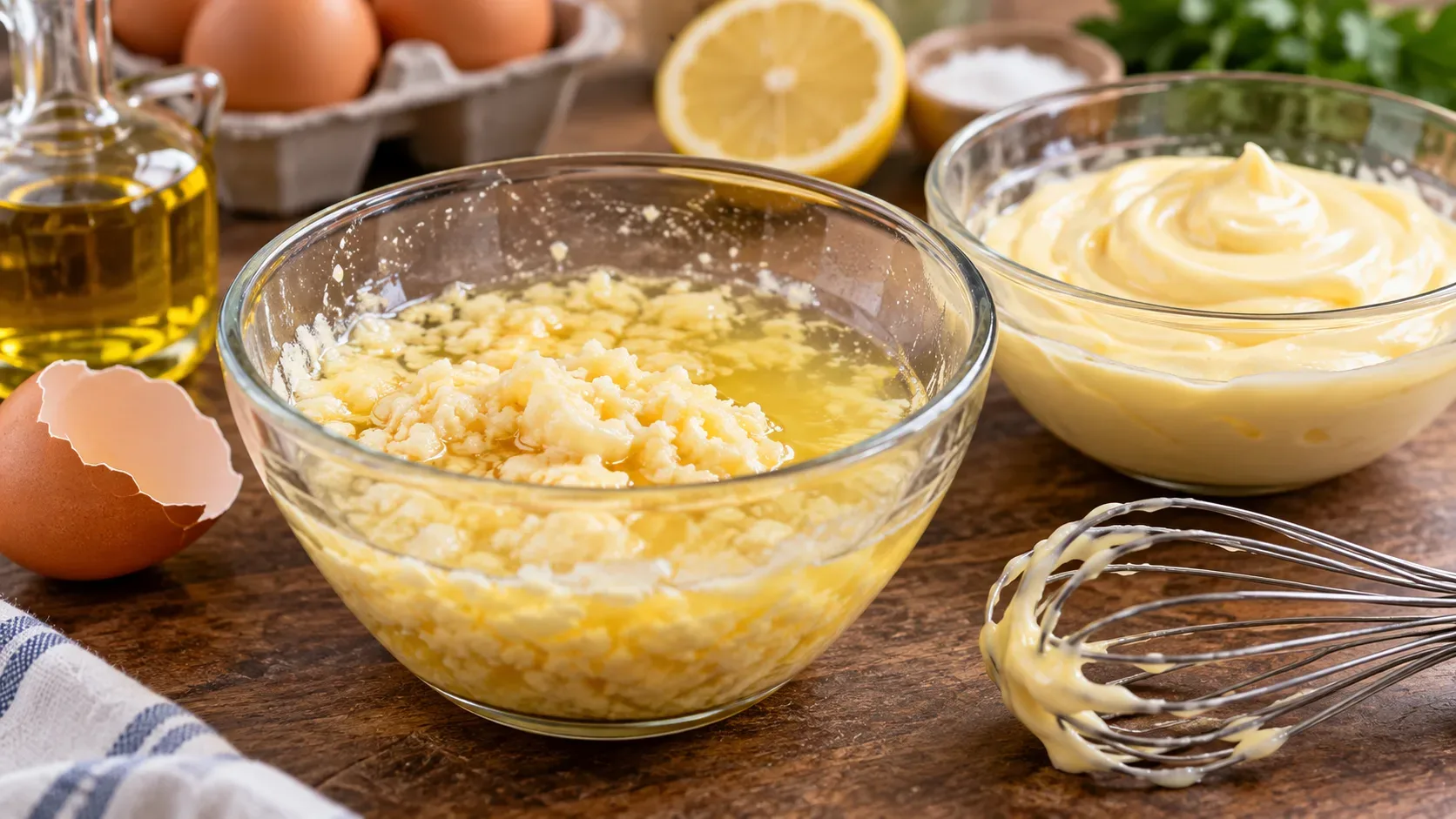
When mayonnaise breaks, the clearest sign is not simply that it has become thin: the mixture stops looking homogeneous and starts showing separated oil, curd-like bits surrounded by fat and, sometimes, a shiny oily layer on top. At that point, stop adding oil. The way to save it is to rebuild a stable emulsion and slowly incorporate the broken mixture, treating it as if it were the oil phase.
How to tell whether the emulsion has actually broken
Mayonnaise can be looser than expected without necessarily being broken. Texture, sheen and visible separation are more useful clues.
| Sign | What it usually means | What to do |
|---|---|---|
| Smooth, uniform and simply thinner | The emulsion may still be intact | Keep mixing and check the recipe ratio before changing the oil amount |
| Grainy or curdled appearance | Oil droplets have begun to merge | Stop the oil and rebuild the emulsion |
| Visible oil around the edges or on top | Clear separation between fat and the water phase | Transfer the mixture and create a new emulsifying base |
| Oily layer plus watery liquid underneath | The emulsion is fully broken | Use a fresh-base rescue; do not try to fix it by pouring in more oil |
Why adding more oil usually makes things worse
Mayonnaise is an emulsion: tiny oil droplets are dispersed in a water-based phase with the help of emulsifiers from egg. If oil is added too quickly or the amount of fat exceeds what the base can stabilize, droplets merge and the mixture separates. Adding more oil after separation increases the amount of fat the broken emulsion would have to absorb.
Rescue works in the opposite direction: first create a small base that can emulsify, then add the broken mayonnaise in drops or a thin stream. Professional cooking guidance follows this principle, and the 2026 advice from Receitas Globo uses the same logic: blend an egg first, then stream in the broken mayonnaise.
Three ways to rescue broken mayonnaise
1. Start with water: best for an early break
If the mayonnaise has started to look oily but has not yet separated into two distinct layers, a small water phase may be enough to restart the emulsion. Put 1 to 2 teaspoons of water in a clean bowl. Whisk vigorously and add the broken mayonnaise drop by drop at first. Once it thickens and turns uniform, switch to a thin stream.
This method is described by RICARDO Cuisine, which recommends about 5 to 10 ml of water and slow incorporation of the broken mayonnaise. It is a useful first attempt because it adds neither more fat nor another egg.
2. A fresh yolk or pasteurized egg: the most robust route
If oil is already clearly separated, use a clean bowl or cup and start a new emulsion. Whisk one yolk — preferably from a pasteurized egg when the preparation will be eaten raw — with about 1 teaspoon of water. Then add the broken mayonnaise in small amounts, whisking continuously. Once the base gains body, gradually increase to a thin stream.
In practice, you are treating the broken mixture as the “oil” of a new batch of mayonnaise. That avoids the most common rescue mistake: adding free oil to a structure that has already lost stability.
3. Cooked egg: an option that avoids adding another raw egg
The guidance published by Receitas Globo in July 2026 presents cooked egg as an alternative to raw egg. The idea is to blend the cooked egg into a fresh base, then gradually stream in the broken mayonnaise until the texture comes back together.
This route is especially useful if you want to avoid adding another raw egg. It also fits food-safety guidance that favors cooked eggs or pasteurized egg products in preparations that will not be cooked afterward.
Which rescue route should you choose?
- Just starting to separate? Try the water method first.
- Visible oil and curd-like clumps? Rebuild the emulsion with a yolk or pasteurized egg.
- Want to avoid another raw egg? Use the cooked-egg alternative.
In every case, the rule is the same: the broken mayonnaise goes slowly into the new base, not the other way around.
When it is better to discard it and start over
A texture problem is usually worth trying to rescue. A food-safety problem is not. Discard the batch and make a new one if there has been time-temperature abuse, uncertain refrigeration, a cracked egg or ingredients showing signs of spoilage.
For perishable foods containing eggs, the FDA recommends refrigeration at 40 °F/4 °C or below and says egg-containing foods should not stay unrefrigerated for more than 2 hours — or more than 1 hour when ambient temperature is above 90 °F/32 °C. If that limit has been exceeded, re-emulsifying the mayonnaise does not make it safe.
It is also better to restart if the oil is rancid, the flavor has become irreparably bitter or the batch was contaminated by dirty utensils or work surfaces. Fixing the emulsion improves texture; it does not reverse spoilage or contamination.
Raw egg: the safety limit technique cannot solve
Brazil's Ministry of Health lists raw or undercooked eggs among possible routes of Salmonella transmission and recommends thoroughly cooked eggs. For recipes served with raw or undercooked egg, the FDA advises using eggs treated to destroy Salmonella or pasteurized egg products.
This matters especially for pregnant people, children, older adults and people with weakened immune systems, who face a higher risk of severe illness. Lemon juice, vinegar, salt or the fact that the mayonnaise emulsified successfully do not replace pasteurization or cooking.
Once prepared, keep homemade mayonnaise refrigerated and remove only the portion you plan to serve. With egg-based homemade mayonnaise, do not rely on smell or appearance alone as a safety test; time, temperature and ingredient handling matter more.
How to keep mayonnaise from breaking next time
- Mix the base thoroughly before adding most of the oil.
- Add oil in drops at first; move to a thin stream only after the emulsion has thickened.
- If the mixture becomes too thick while you are making it, a few drops of water or acid can help maintain enough water phase.
- Stop adding oil at the first sign of separation.
- Use a clean container and utensils free of loose grease or dirty water.
- If the mayonnaise will be eaten without cooking, prefer pasteurized egg or an appropriate cooked-egg route.
Practical takeaway
Broken mayonnaise shows separated oil, a curdled look or two visible phases. Rescue starts by stopping the oil and creating a fresh base: water for a slight break, yolk/pasteurized egg for a full break, or cooked egg if you want to avoid another raw egg. Then incorporate the broken mixture slowly. If refrigeration failed or the mayonnaise stayed warm too long, do not rescue it: discard it and start again.