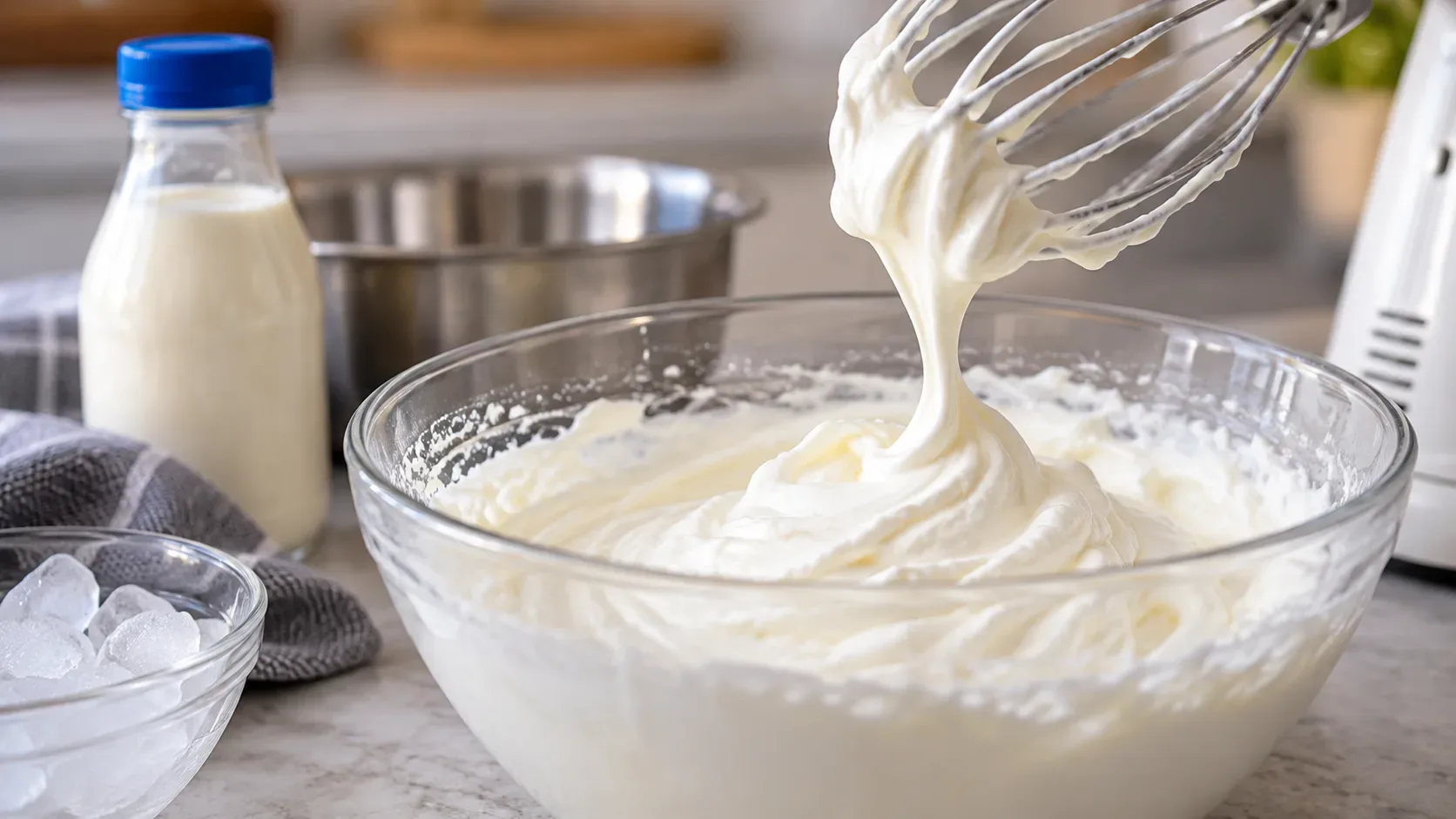
If whipped cream will not thicken, beating it longer is not the first answer. Start with three questions: does the cream contain enough fat to form a stable foam, is it truly cold, and is it still before — rather than beyond — the ideal whipping stage? The wrong cream can stay liquid despite prolonged beating; warm cream is harder to whip; and cream that has already gone too far stops looking smooth and begins to turn grainy.
A practical benchmark is to use cream intended for whipping, generally with about 30% fat or more. King Arthur Baking explains that creams in the 30% to 35% range can form a stable foam, while versions at 36% or above tend to provide more structure. In Brazil, a recipe published by Receitas uses fresh cream with at least 35% fat and well-chilled equipment. Product names vary by market, so the label and intended use are more reliable than assuming that any product called “cream” will whip.
Quick diagnosis: what the cream is telling you
| What you see while whipping | Most likely cause | Next action |
|---|---|---|
| It stays liquid and only develops bubbles after several minutes | Too little fat or a product not designed for whipping | Check the label; if fat is too low, restart with whipping cream |
| It begins to gain volume but softens or cannot hold peaks | Cream, bowl, or room is too warm | Stop, chill everything thoroughly, and only then try again |
| The whisk leaves trails, but the peaks still collapse | It has not reached the desired stage yet | Continue in short intervals while watching the texture |
| It is smooth, voluminous, and holds the peak you need | Correct stage | Stop whipping; continuing increases the risk of overwhipping |
| It becomes thick, dull, or grainy with small clumps | Overwhipped, but possibly still recoverable | Add a little very cold unwhipped cream and combine gently |
| It turns yellowish and separates into solids and liquid | The fat has become butter | It cannot return to whipped cream; use the butter and restart for whipped cream |
1. Before turning on the mixer, read the cream label
Whipped cream is a foam: whipping incorporates air, and the fat in the cream helps stabilize the tiny bubbles. When there is too little fat, air may enter the mixture, but the structure does not hold. That is why milk, light cream, and many lower-fat cooking creams do not behave like cream meant for whipping.
As a practical rule, look for a product with roughly 30% fat or more; around 35% to 36% gives you more margin for volume and stable peaks. If the label does not clearly state the percentage, prefer a product the manufacturer specifically describes as suitable for whipping.
It is also useful to separate two things that are often confused: heat treatment and fat content. A UHT or ultra-pasteurized product is not automatically unable to whip. King Arthur notes that ultra-pasteurized cream can make acceptable whipped cream, although some conventionally pasteurized creams may whip more easily and hold peaks better. The first filter therefore remains: is there enough fat, and is the product intended for this use?
2. The cream is suitable but warm: why temperature weakens the result
Even with the right fat content, the cream needs to be cold. At a low temperature, the fat is firmer and can organize more effectively around air bubbles. When the cream warms up, that structure loses strength, and whipping may produce loose foam, unstable volume, or a cream that seems “almost there” but never holds a peak.
Chill the cream well in advance and, if possible, chill the bowl and beaters too. King Arthur recommends cooling the equipment before whipping; this is especially helpful in a hot kitchen or when the mixer warms the mixture quickly. A metal bowl cools fast, but the material itself is not the solution: what matters is keeping the cream and equipment cold.
If you notice the mixture warming during an attempt, stop whipping. Refrigerate the cream again until it is thoroughly cold and chill the equipment before restarting. Continuing to beat while it is warm adds heat without fixing the cause. In a very hot room, placing the mixing bowl over a larger bowl of ice for part of the process can help, as long as no water or ice gets into the cream.
3. Do not use the clock to judge the stage: watch the peaks
Mixer time changes with batch size, machine power, bowl shape, fat content, and temperature. A recipe that says “whip for five minutes” is therefore only an estimate. Visual cues are more reliable.
- Beginning: large bubbles appear and the cream still flows freely.
- Thickening: the whisk begins to leave visible trails and the volume increases.
- Soft peaks: when you lift the whisk, a tip forms but bends and falls. This works for lighter mixtures and softer desserts.
- Medium peaks: the tip keeps more shape but still looks soft and smooth. This is a versatile stage for serving and decorating.
- Stiff peaks: the tip stands and the cream is denser. Stop immediately once this is the stage your recipe calls for.
- Overwhipped: the smooth surface turns grainy, the cream loses volume, and eventually fat and liquid separate.
The transition from stiff peaks to overwhipped cream can be fast. Once the cream thickens, reduce the speed or finish in short bursts. Staying beside the mixer matters more than following a timer.
4. When you can still recover it — and when you should restart
If the cream is too low in fat
This is the situation in which persistence usually wastes time. Whipping cannot create missing fat. If the product is below the useful range and was not formulated for whipping, the safest correction is to use it in another preparation and restart with proper whipping cream.
If the cream became warm
Recovery is still possible because the ingredient itself may be suitable; the problem is the working condition. Stop, chill the cream, bowl, and beaters, and resume only when they are cold. If the mixture never came close to thickening, this check is especially useful before discarding the batch.
If it is still smooth and simply too soft
It probably needs more whipping. Continue at moderate speed and stop every few moments to test the peak. The goal is to move through texture stages, not simply to add minutes.
If it has started to turn grainy
That is a sign of overwhipping. If there is no clear separation of fat and liquid yet, it may still be recoverable. King Arthur Baking recommends slowly adding very cold unwhipped cream at low speed until the texture becomes smoother and more aerated again. Start with a small amount and stop as soon as the appearance improves; the further the overwhipping has progressed, the less airy the final result is likely to be.
If it has become butter
Once yellowish clumps and separated liquid appear, the structure has changed from whipped cream to butter and buttermilk. Do not try to “unwhip” it. Use the butter elsewhere and make a fresh batch of whipped cream.
5. Sugar, vanilla, and stabilizers do not fix the main cause
Sugar sweetens; it does not turn a low-fat cream into one that can whip. It also cannot compensate for a mixture that is too warm. For better control, begin whipping the cold cream and add sugar once it has started to thicken and leave trails. Confectioners’ sugar dissolves easily and, when it contains starch, can contribute some stability, but that is a supporting effect rather than the main structure.
Vanilla and other flavorings can be added in small amounts. Larger quantities of thin liquids, syrups, alcohol, or purées can dilute the mixture and change its stability. If a recipe requires a strong added flavor, it is safer to follow a tested formula rather than pour in extra liquid freely.
Stabilizers — such as those used in pastry work to help whipped cream decorations last longer — are useful when the issue is holding time. They should not be treated as a patch for unsuitable cream, excessive warmth, or cream that has already turned into butter.
6. How you whip also changes your margin for error
Starting at a lower speed reduces splashing and helps keep the cream from warming too quickly. Once it begins to thicken, you can increase to medium or medium-high speed, then slow down again near the target stage. With a powerful mixer, the final seconds can make a large difference.
Use a bowl with enough room for the cream to expand and for the whisk to move without spilling. The bowl and beaters should be clean, and the entire setup should stay cold. Do not chase a fixed time: two equal batches can reach the same stage at different rates if the temperature or equipment changes.
If you are whipping by hand, the same logic applies. The process takes longer and room temperature has more time to affect the cream, so keeping everything cold becomes even more important.
7. A simple decision tree for whipped cream that will not thicken
- Check the product. Does it have about 30% fat or more, or is it explicitly intended for whipping? If not, restart with a different cream.
- Check the temperature. Are the cream, bowl, and beaters cold? If not, chill them before continuing.
- Watch the texture. If it is liquid and cold, continue whipping; if it leaves trails, test the peaks frequently.
- Stop at the stage you need. Medium peaks are often enough for serving; if a recipe calls for stiff peaks, go only until they stand.
- If it turns grainy, correct it early. Add a little cold liquid cream and combine carefully.
- If it separates into butter and liquid, stop. For whipped cream, you will need to restart.
Common questions
Can I use any cream?
No. Products sold as cream can have very different compositions. For dairy whipped cream, fat content and intended use are decisive.
Does beating longer always solve the problem?
No. It only helps when the right, cold cream is still below the target stage. If the cream is too low in fat, time cannot fix its composition; if it is already overwhipped, more beating makes it worse.
Do I need to put the bowl over ice?
Not necessarily. Well-chilled cream and equipment are usually enough. An ice bath is an extra aid in a hot room or when the mixture warms quickly.
My whipped cream is grainy. Can I save it?
If separation is still mild, often yes: gradually incorporate a little very cold unwhipped cream. If there are already yellowish solids and separated liquid, you have reached butter.
What about plant-based whipping creams?
They can behave differently because they use other fats, emulsifiers, and stabilizers. Follow the manufacturer’s temperature and preparation instructions; the criteria in this guide mainly apply to whipped cream made from dairy cream.
The rule that prevents wasting the next batch
When whipped cream will not thicken, the useful question is not “how much longer?”, but “which of the three factors is wrong?”. Too little fat calls for different cream; excess warmth calls for chilling; smooth but soft cream calls for more whipping; grainy cream calls for an immediate correction; separation into butter means starting over. Reading the label, working cold, and watching the peaks is the safest sequence for reaching the right stage without turning one simple attempt into a second failure.