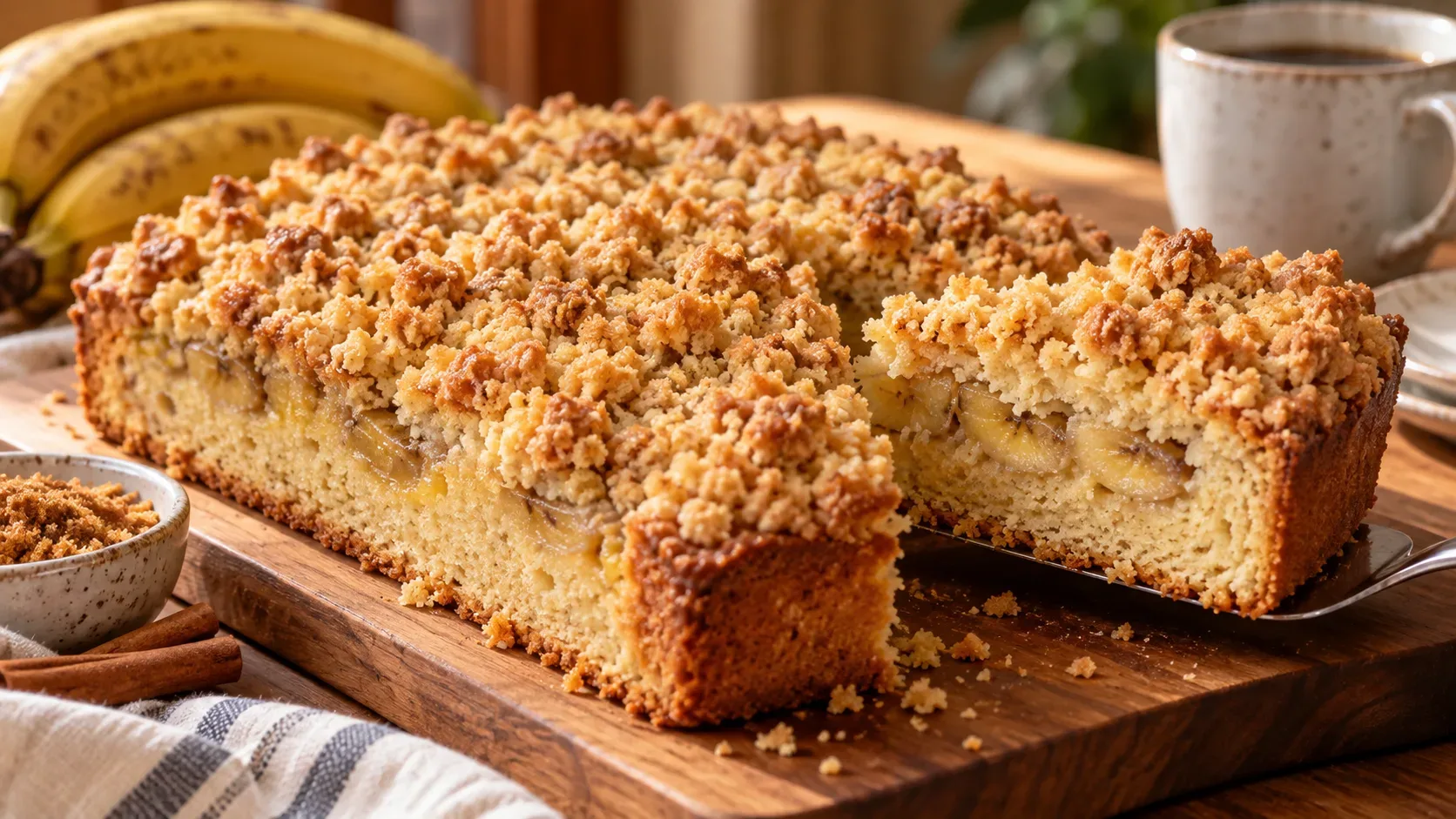
For banana crumb cake to come out with a craggy, crisp streusel and a fully baked cake that does not sink, treat the two layers as separate problems. The topping needs to keep small pieces of fat cold until it reaches the oven; the batter needs to be thick enough to support the bananas and crumbs without carrying too much moisture. When the streusel butter gets too soft or the batter is thin and overloaded with fruit, the layers are more likely to merge.
The right streusel texture: clumps, not paste
A good cuca topping should not be perfectly uniform. The goal is a mixture of flour, sugar, cinnamon, and butter with different-sized clumps: small crumbs that brown quickly and larger pieces that stay crisp. Using cold butter and handling the mixture briefly is common advice in both Brazilian cuca recipes and streusel methods. Receitas Nestlé recommends cold butter and gentle mixing with the fingertips; King Arthur Baking likewise mixes the topping only until coarse crumbs form.
For a medium cake, a practical streusel base is:
- 100 g all-purpose flour;
- 70 g sugar;
- 60 g very cold unsalted butter, diced;
- 1 teaspoon ground cinnamon;
- 1 pinch of salt.
Combine the dry ingredients first. Add the cold butter and quickly press it in with your fingertips until clumps appear. Stop before the mixture turns into a compact dough. If the kitchen is warm or the crumbs start to look shiny and sticky, refrigerate the bowl for 10 to 15 minutes before assembling the cake.
Why streusel melts into a smooth crust
This problem usually comes from a combination of heat and overworking. Very soft butter spreads through the flour before the cake structure begins to set; in the oven, the topping can fuse into one flat layer. Mixing for too long can produce the same result. A recent banana cuca article from Confeitaria em Casa also emphasizes cold butter and brief handling to help preserve a crumbly texture.
Another detail matters: do not press the crumbs onto the bananas. Scatter the clumps over the fruit without compacting them. A compressed topping is heavier and more likely to sink before the batter has enough structure to hold it.
The batter should be thicker than a very fluid cake batter
To support bananas and streusel, cuca batter should fall from a spatula in thick portions rather than pour like a thin cream. An overly fluid batter offers little resistance to the weight of fruit and topping. The result may be a damp stripe through the center, partly submerged crumbs, or a cake that rises and then collapses.
A balanced base for a pan of about 22 × 30 cm (9 × 12 inches) is:
- 100 g butter, at room temperature;
- 160 g sugar;
- 2 eggs;
- 180 ml milk;
- 240 g all-purpose flour;
- 10 g baking powder;
- 1 pinch of salt;
- 3 medium ripe but still firm bananas.
Beat the butter and sugar until evenly creamy. Mix in the eggs, then alternate the flour and milk, stirring only until no dry pockets remain. Add the baking powder last. Avoid extended mixing after the flour goes in: it does not improve the rise and can make the crumb heavier. The cake guide from King Arthur Baking likewise recommends gentle flour incorporation for a tender texture.
Use ripe bananas, but not liquefied ones
The fruit should be sweet and aromatic while still firm enough to slice. Extremely overripe bananas release more liquid and can weigh down an already moist batter. Receitas Nestlé also advises against overly soft bananas when the goal is to avoid excess moisture.
Slice the bananas lengthwise or into medium-thick rounds and make one even layer without excessive stacking. For this amount of batter, three medium bananas are usually enough. If the fruit is very large, use less. The key is proportion: more banana does not automatically make a better cake if the batter cannot support it.
Assembly that keeps the layers in place
- Preheat the oven to 180°C (350°F) before assembly.
- Grease and flour a low-sided pan of about 22 × 30 cm (9 × 12 inches).
- Spread the batter into an even layer.
- Arrange the bananas without pressing them down into the batter.
- Scatter the cold streusel over the top, keeping the clumps intact.
- Move the cake directly to the oven.
A lower pan helps the center bake before the edges dry out and gives the streusel more surface area to brown. A similar principle appears in crumb-cake recipes, where the batter and topping are spread evenly so heat can reach the full cake predictably.
Oven timing: let the cake set before exposing it to temperature shock
A preheated oven matters because the batter needs to begin setting early. Putting the cake into a cold oven extends the period in which the bananas and streusel sit on unsupported batter. As a reference, banana cuca recipes from Receitas Nestlé use 180°C and often bake for about 30 to 40 minutes, although the real timing depends on the pan and oven.
Avoid opening the oven during the initial rise. After roughly 30 minutes, look for doneness cues: browned streusel, firm edges, and a center that no longer wobbles like liquid. Test with a toothpick or thin knife through the cake portion, avoiding banana pieces. In its crumb-cake method, King Arthur Baking also uses a clean blade inserted into the cake base as a doneness indicator.
If the streusel is browning too quickly while the middle still needs time, loosely cover the surface with foil and continue baking. This slows further browning without stopping the center from cooking.
Quick troubleshooting: what went wrong?
| Problem | Likely cause | How to fix it |
|---|---|---|
| Streusel turned into a smooth sheet | Butter was too soft or the mixture was overworked | Use cold butter, handle briefly, and chill the crumbs if necessary |
| Streusel sank | Thin batter, heavy topping, or compressed crumbs | Check the flour amount, keep the clumps light, and simply scatter the topping |
| Center stayed wet and heavy | Too much banana, very overripe fruit, or insufficient baking | Reduce the fruit, choose firmer bananas, and bake until the center sets |
| Cake rose and then collapsed | Underdone center, oven opened too early, or weak baking powder | Do not open early, verify the center is baked, and use active baking powder |
| Streusel browned before the cake was done | Strong top heat or a pan that is too tall | Loosely cover with foil and finish baking the center |
When you cut it also matters
Even when the cake comes out firm, its crumb continues to set as it cools. Wait at least 20 to 30 minutes before slicing. Hot banana releases steam and dissolved sugar; cutting immediately can make a fully baked cake seem underdone and can also disturb the streusel.
Checklist for crisp streusel and a stable cake
- cold butter for the topping;
- irregular clumps, without kneading or compacting;
- thick batter, not runny batter;
- ripe but firm bananas;
- a moderate, even fruit layer;
- a relatively low pan and a fully preheated oven;
- keep the oven door closed during the early bake;
- test the cake crumb, not the banana, for doneness;
- let the cake rest before slicing.
The main improvement is to stop looking for a single trick. Crisp streusel depends mainly on fat temperature and handling; a cake that does not sink depends on proportions, moisture, and baking. Control those variables separately and the cuca is much more likely to keep its three distinct layers: cake, banana, and craggy topping.