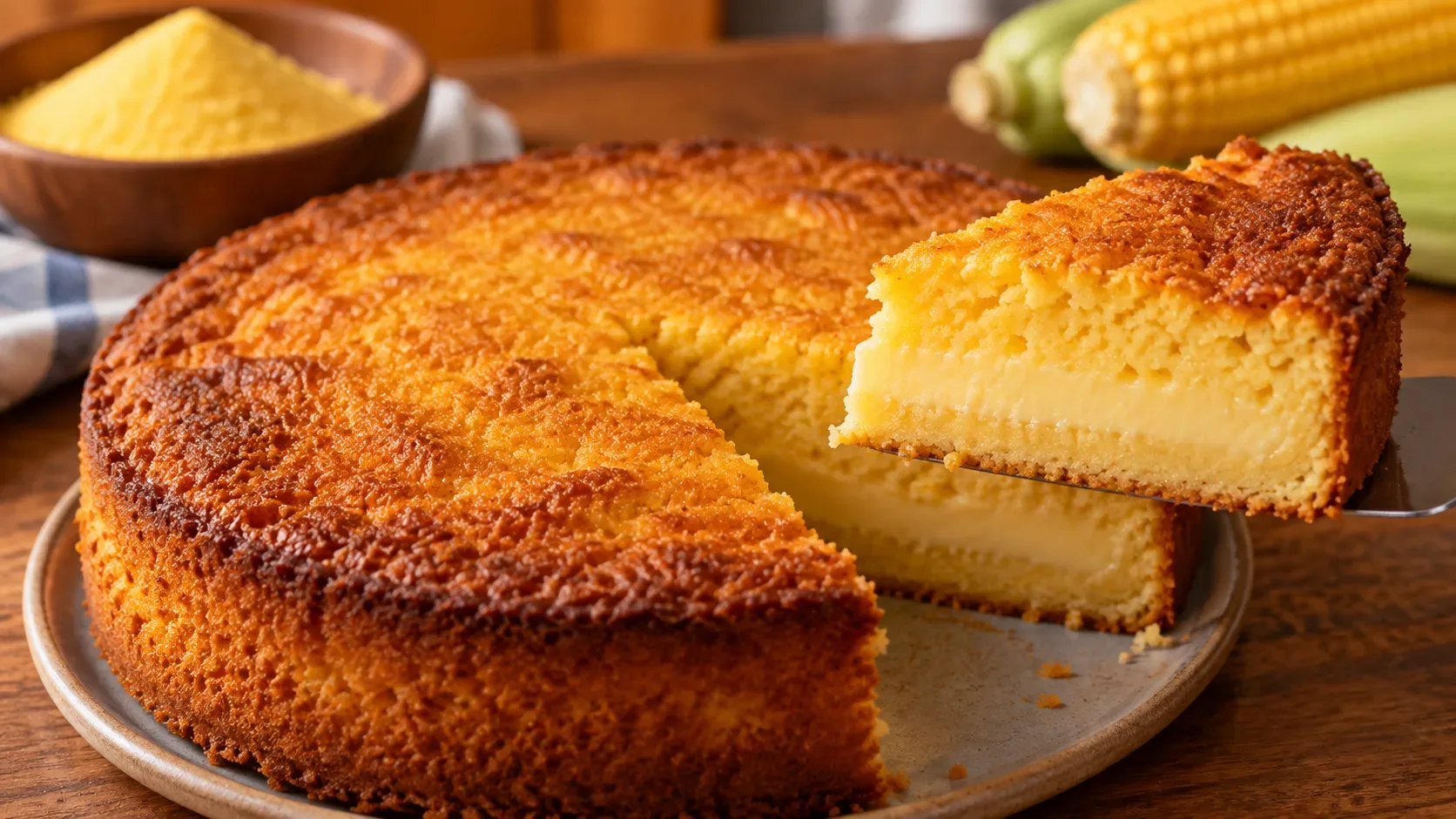
Yes. In many creamy Brazilian cornmeal cake recipes, the batter is intentionally very fluid and develops different textures as it bakes. That does not mean every cake must show three perfectly defined bands. The result changes with the proportions of milk, eggs, fubá (finely milled cornmeal), flour, cheese or coconut, as well as pan size and oven behavior.
The more useful point is this: a creamy layer is not the same as raw batter. A properly creamy center has already undergone heat-driven changes; it should be soft, moist and delicate, but it should not run like the batter that went into the oven.
Why creamy cornmeal cake can form layers on its own
Classic recipes in this style use a large amount of liquid compared with the cornmeal and flour. The Panelinha creamy cornmeal cake recipe, for example, describes the batter as very liquid and tells cooks to remove the cake when the surface is golden, the sides are beginning to pull away and the center is still soft.
As the fluid batter heats, its components do not all stay equally mobile or set at the same time. Before the structure fixes in place, some solids can redistribute. At the same time, starch from the cornmeal and flour absorbs water and gelatinizes with heat; food-science research describes corn-starch gelatinization as a structural change in starch granules in the presence of water and heat. Eggs also contribute structure: their proteins coagulate during heating and form a network that helps trap water.
In practice, this combination of high hydration + redistribution of solids + starch gelatinization + protein coagulation can create a firmer portion, a creamy middle band and a baked surface. The exact visual separation depends on the formula. That is why “two layers” and “three layers” are culinary descriptions of possible results, not a physical rule that every recipe must reproduce.
Creamy center or raw batter? Compare the signs
| Sign | Expected creamy center | Still-raw batter |
|---|---|---|
| Surface | Golden with a baked appearance | May be pale or browned outside while still lacking structure inside |
| Edges | Firm; they may begin to pull away from the pan | Very soft and unable to support the cake |
| Center when the pan is moved | Slight jiggle or softness, but no liquid wave | Sloshes like a liquid and seems to move batter from side to side |
| Skewer | Comes out lightly moist or with a little cream attached | Comes out coated in fluid batter with a clearly raw appearance |
| After cooling | Becomes more stable and slices while keeping a creamy crumb | Remains pasty, flows or sticks like unbaked batter |
Why the skewer test should not be used like it is for a dry cake
For a standard fluffy cake, many bakers wait until a skewer comes out completely dry. With creamy cornmeal cake, that can lead to overbaking and losing the texture the recipe is designed to produce. Panelinha specifically says the skewer should come out slightly moist.
A better diagnosis combines several signs: a golden top, structured edges, no free-flowing liquid in the center and a skewer that is moist but not smeared with raw batter. Resting time matters too. As with milk-and-egg preparations, the protein network continues to stabilize texture as heat redistributes and the food cools. The University of Illinois Extension explains that egg proteins coagulate under gentle heat and thicken custard-type mixtures; too much heat, on the other hand, can make the texture grainy or tough.
What to do if the top is browned but the center still looks raw
- Do not sharply increase the oven temperature. Excessive heat tends to brown and dry the edges before the center catches up.
- Bake for a few more minutes and reassess. Recipe times are guides; pan shape, batter depth and oven performance change heating speed.
- If the top is already dark, shield it lightly. A loose sheet of foil can reduce additional browning while the interior finishes setting.
- Wait before cutting. Cutting immediately can make a correctly creamy center look too fluid. Some recipes advise cooling completely and even chilling before serving.
Pan size and batter depth change doneness
The same recipe can behave differently in a wider or deeper pan. A thicker layer of batter takes longer to heat through at the center; a wide pan creates a shallower layer and tends to bake faster. Changing pan size without adjusting the baking time is a common reason for cooked edges and an underbaked middle.
It is also worth using the type of fubá called for in the recipe. Particle size, flour quantity and the presence of cheese or coconut change water absorption and final texture. Instead of instinctively adding flour to “fix” a liquid batter, first follow the proportions of the formula you chose.
Resting is part of the process
A creamy cake comes out of the oven more delicate than a dry cake. As it cools, gelatinized starch and the protein network lose heat and the slice gains stability. Judging the texture only in the second the pan leaves the oven can therefore create a false diagnosis of “raw.”
The correct point is a balance: the center should be cooked enough not to remain fluid batter, but moist enough to stay creamy after cooling.
Do not taste raw batter to check doneness
Texture and flavor should not be tested by tasting the raw mixture. The CDC notes that uncooked flour and raw eggs can carry germs that cause illness and recommends baking batter before eating it. Use visual and structural signs in the oven, then evaluate the slice after the cake has baked and rested.
In short
Creamy Brazilian cornmeal cake can form layers without being assembled because its highly fluid batter redistributes before starch and proteins set the structure. To avoid confusing creaminess with raw batter, look for a baked surface, firm edges, a merely soft center and a slightly moist skewer. If liquid runs or fluid batter coats the skewer, it needs more oven time; if the skewer is completely dry and the crumb loses its softness, the cake has probably gone beyond the creamy point.