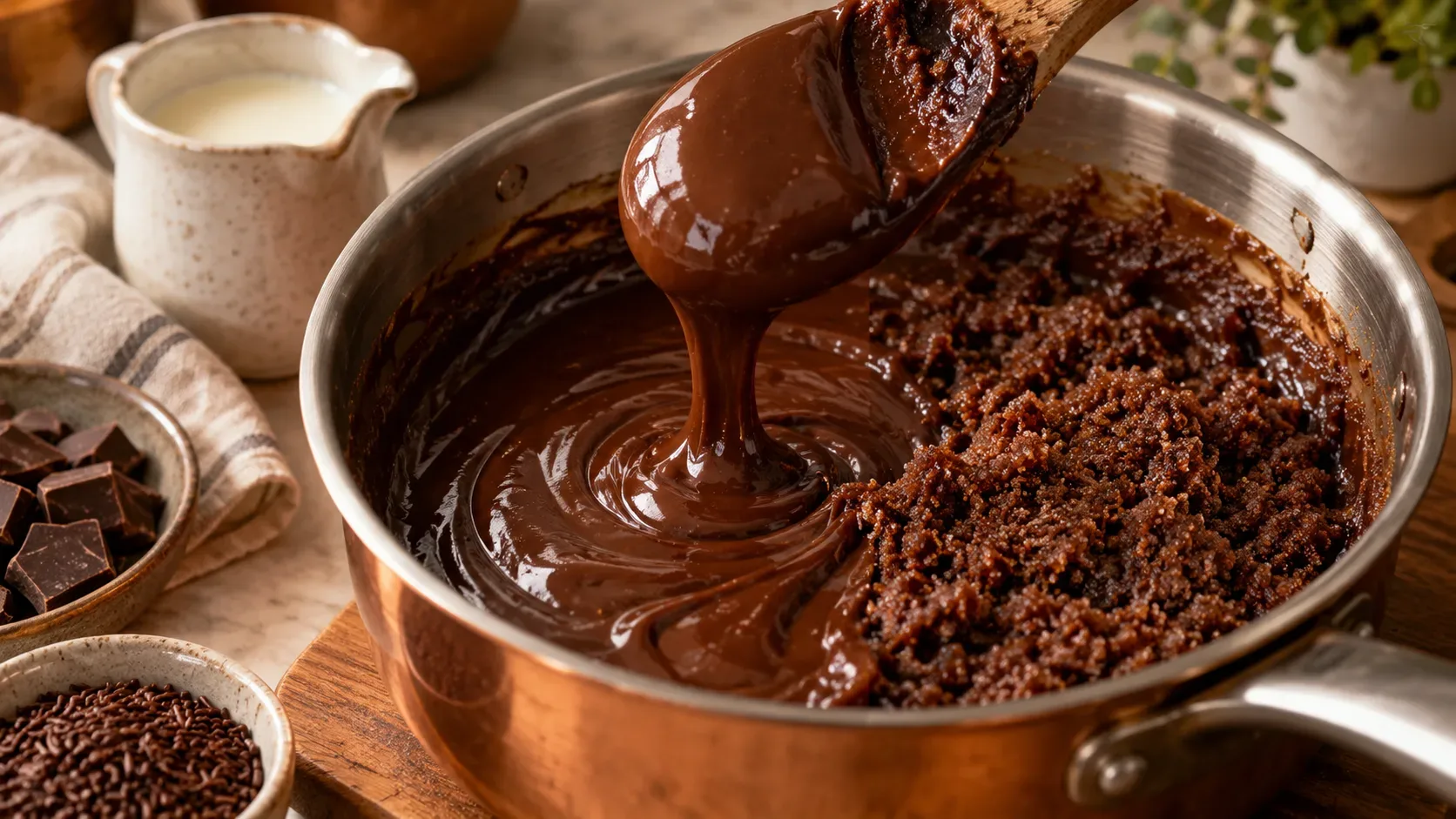
When brigadeiro turns gritty, “sugary,” or develops tiny grains you can feel on the tongue, the problem usually involves sugar crystallization. But not every hard or thick brigadeiro is crystallized: sometimes it has simply lost too much water during cooking. The fix depends on the defect, so the first step is to identify what actually happened.
Brigadeiro is a concentrated mixture of milk, sugar, fat, and cocoa or chocolate. As it cooks, part of the water evaporates and the sugars become increasingly concentrated. If crystals grow large enough to be felt, the candy develops a sandy mouthfeel. Research specifically involving brigadeiro has linked this graininess to sugar crystallization and shown that crystal size can increase over time. In products made with sweetened condensed milk, both sucrose and lactose can contribute to the texture defect.
Before fixing it, confirm whether it is crystallization
| Symptom | Most likely cause | What to look for |
|---|---|---|
| Gritty or “sugary” on the tongue | Noticeable sugar crystals | The mixture feels grainy even when it is soft. |
| Smooth but very hard after cooling | Overcooking and excessive water loss | There are no grains; the candy is simply too firm. |
| Greasy film or visibly separated texture | Broken emulsion | Visible fat and uneven texture, not just sandiness. |
| Dark spots, bitter taste, or burnt smell | Localized scorching | Adding cream may soften it, but it will not remove burnt flavor. |
This distinction prevents a common mistake: treating every flawed brigadeiro with more fat. Fat by itself does not dissolve sugar crystals. Redissolving sugar requires available water and enough heat to put it back into solution; cream or milk can help because they add water while also changing the final texture and concentration.
Why brigadeiro crystallizes
Crystallization happens in two stages: first a nucleus, or “seed,” forms, then other molecules organize around it. In confectionery, dry crystals on the side of the pan, undissolved particles, and areas that have dried more than the rest can become starting points. As the mixture loses water and cools, conditions become more favorable for crystal growth.
Sweetened condensed milk also contains lactose, the natural sugar in milk. Studies on condensed milk show that lactose crystallization during storage can create a sandy texture; the dairy industry controls crystal size precisely so the crystals are not noticeable in the mouth. In brigadeiro, which concentrates the mixture further through cooking, the same principle helps explain why a batch can look smooth while hot and become grainy several hours later or the next day.
This does not mean that every late-onset graininess is “caused by lactose,” or that you can identify the type of crystal by sight. In a home kitchen, the practical diagnosis comes from the texture, the cooking history, and when the defect appeared.
If it starts turning gritty while still in the pan
If you notice grains before cooking is finished, stop concentrating the mixture before the problem advances. Remove the pan from the heat and make a gradual correction.
- Take the pan off the heat briefly. This slows evaporation while you adjust the mixture.
- Add a small amount of a water-containing liquid. For a batch based on roughly one can or carton of sweetened condensed milk, start with about 1 tablespoon of warm cream or milk.
- Mix until uniform, then return to low heat. Stir continuously, as standard brigadeiro preparation requires, to prevent scorching on the bottom.
- Stop at the correct stage. For rolling brigadeiro, the mixture should pull away from the bottom without being cooked until dry and brittle. For spoonable brigadeiro, stop earlier.
If the texture remains clearly gritty, adding more and more cream is not guaranteed to fix it. Too much liquid may simply make the candy softer without eliminating all the crystals. Make any additional adjustment in small amounts — about a teaspoon at a time — rather than pouring in a large amount all at once.
If the brigadeiro crystallized after cooling
You can also try to reprocess the batch. The logic is the same used to correct other grainy candies: provide a little water, warm gently to dissolve crystals, then reconcentrate to the desired stage.
- Return the brigadeiro to a clean saucepan.
- Add a small amount of warm cream or milk and heat over low heat.
- Stir continuously until the mixture becomes uniform again. Avoid incorporating dried crusts or crystallized residue from the sides of the pan.
- Once the grains decrease or disappear, keep cooking only until the needed consistency returns.
- Transfer to a clean container and let it cool before deciding whether the final consistency is right, because brigadeiro thickens as it cools.
This is a rescue attempt, not a guarantee that the batch will return exactly to its original state. Brigadeiro that has been cooked far past its ideal stage may have too little water, more extensively cooked proteins, and flavor changes. Reheating can improve texture, but it can also darken the mixture or intensify cooked notes.
If the problem is overcooking, the strategy is different
If the brigadeiro is hard but smooth, you probably do not need to “fight crystals”; you need to restore some moisture and reduce the concentration. In that case, adding a small amount of cream or milk and warming over low heat is consistent with the cause. The goal is to adjust consistency, not disguise graininess.
A simple reference is how the mixture behaves in the pan. Traditional brigadeiro recipes call for low heat and constant stirring until the mixture pulls away from the bottom. Cooking well beyond that point removes more water and increases the chance of a hard, sugary candy after cooling.
How to keep it from crystallizing again
- Use low heat and a heavy-bottomed pan. This reduces hot spots and gives you better control over evaporation.
- Stir constantly, but keep the sides clean. Brigadeiro differs from many sugar syrups: because it contains milk and solids, it needs agitation to avoid scorching. The goal is to prevent dried residue from building up on the sides and then being scraped back into the mixture.
- Do not overcook it. The more water leaves, the more concentrated the sugar becomes and the smaller the margin for a stable texture.
- Do not raise the sugar load without adjusting the formula. Sweetened chocolate drink powders and very sugary coatings can increase sucrose relative to cocoa or lower-sugar chocolate.
- Use anti-crystallizing ingredients only as part of a tested formula. Glucose syrup, invert sugar, and other sugars can interfere with sucrose crystal formation, a well-known confectionery principle, but they also change sweetness, viscosity, and setting behavior.
- Protect the candy from drying out. Surfaces that lose water become more concentrated and can develop a different texture from the center. Once cool, keep brigadeiro well covered.
Why “do not stir the syrup” does not apply the same way to brigadeiro
In candies and caramels based mainly on sugar syrup, many techniques tell you to stop stirring after the sugar has dissolved so you do not trigger crystal formation. Brigadeiro is not a simple syrup: it contains milk, proteins, fat, and cocoa solids, and reference recipes instruct cooks to stir continuously over low heat to keep the bottom from sticking or scorching.
So prevention in brigadeiro is not about abandoning the spoon. It is about controlling heat, concentration, and dried residue. If a crystallized crust forms on the wall of the pan, avoid aggressively scraping it back into the batch.
Not every batch should be “saved” at any cost
If there is a burnt taste, severe fat separation, an off smell, or a texture that remains very grainy after one careful reprocessing attempt, continuing may make the flavor worse. At that point, it is more realistic to accept that the structure has changed and use the mixture where texture matters less — for example, blended into a creamier filling — rather than promise that it will become perfectly smooth rolling brigadeiro again.
The rule is simple: correct the likely cause, not just the symptom. Crystallization calls for an attempt to redissolve and reconcentrate; overcooking calls for restoring moisture; scorching and emulsion failure are different defects with their own recovery limits.
Sources and further reading
- IFRS — Study of particle size and microbiological quality in brigadeiro-type sweets
- International Journal of Dairy Technology — lactose crystallisation in sweetened condensed milk
- Exploratorium — Science of Candy: sugar crystallization and interfering agents
- Colorado State University Extension — candy making and sugar crystal formation
- Receitas Nestlé — traditional brigadeiro preparation