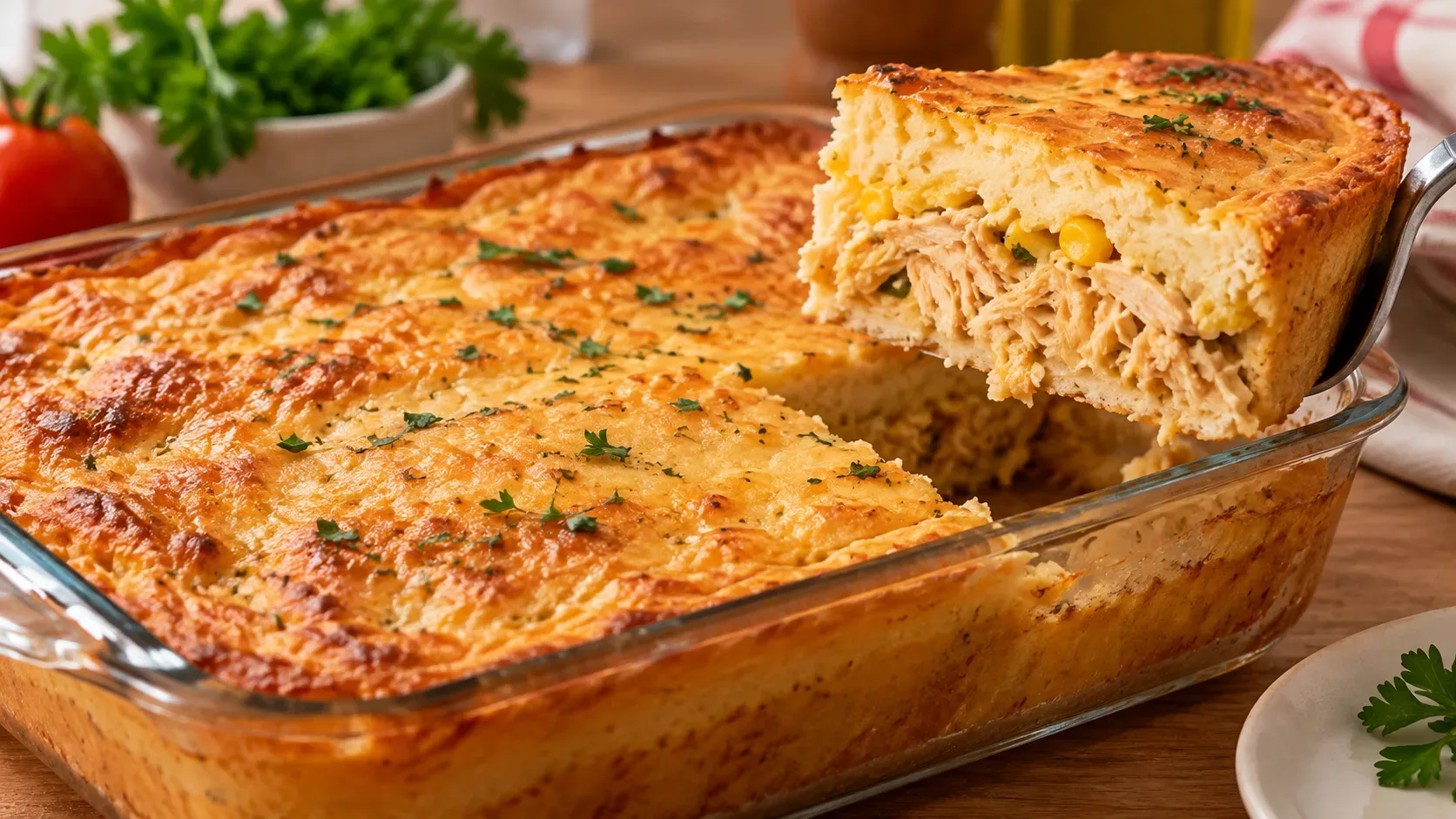
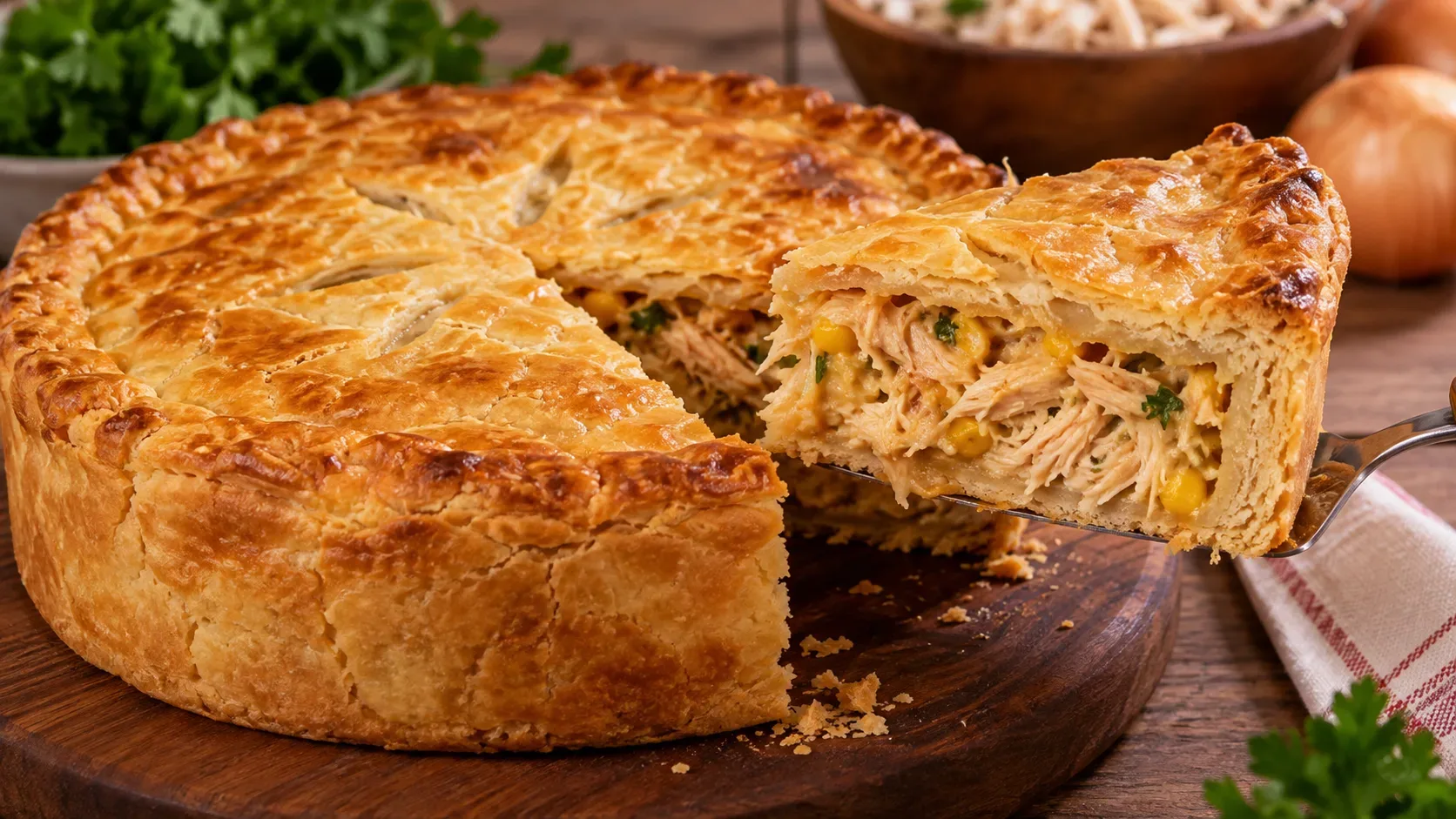
A good Brazilian chicken pie, or empadão de frango, depends on a tricky balance: the crust should be short, buttery and crumbly in the mouth, but it should not turn into crumbs when you roll it, cover the pie, unmold it or cut the first slice. The key is to control four variables at the same time: the flour-to-fat ratio, the amount of liquid, how much the dough is handled and the moisture in the filling.
The ratio that gives tenderness without removing all structure
For a stable homemade pie, a reliable starting point is about 2 parts flour to 1 part butter by weight. A tested Receiteria recipe, for example, uses 400 g flour and 200 g cold butter, plus egg, yolk and milk for binding. This ratio is not a rule: some shortcrust formulas use more fat and become even more delicate, but they also become more sensitive when rolled and sliced.
In practice, fat “shortens” the dough. It coats part of the flour and limits the formation of a strong gluten network, producing a friable texture. The trade-off is straightforward: too much fat or poorly hydrated flour leaves less structural margin. The goal is not an elastic bread dough; it is a dough that holds together when pressed.
The right consistency: press, do not knead
Mix the flour and salt with cold butter cubes using your fingertips, a pastry cutter or short pulses in a food processor. Stop when the mixture looks like coarse crumbs with small pieces of fat. Then add egg or yolk and introduce cold liquid gradually, only until the dough comes together.
Once liquid is added, excessive mixing encourages gluten development and can make the crust tougher. A technical overview of pastry notes that extended mixing after water is added increases dough toughness. So, when the mixture forms a cohesive mass when squeezed, stop mixing. Do not wait for a smooth, elastic surface.
How much liquid to add
The exact amount depends on the flour, egg size and ingredient temperature. Treat milk or water as a consistency adjustment rather than a mandatory volume. Add it in small amounts. If the mixture still turns to powder when compressed, add a little more; if it already forms a mass and there is no dry flour left in the bowl, stop.
A properly made dough may show small cracks around the edges when rolled. That is different from breaking into dry slabs. Small cracks can be patched with your fingers; dough that shatters with minimal movement probably needs a little more binding or a few minutes out of the refrigerator before rolling.
Resting and temperature: why chilling helps
Flatten the dough into disks, wrap well and refrigerate for about 30 minutes. Resting firms the fat and makes the dough easier to roll without sticking. If it comes out of the refrigerator too hard, wait a few minutes before rolling; forcing very cold dough encourages cracking.
If, on the other hand, it becomes shiny, sticky or very soft while you shape it, the fat has warmed. Chill it again for 10 to 20 minutes. Immediately throwing extra flour onto warm dough may solve sticking in the moment, but it also changes the ratio and can make the crust drier.
The chicken filling should be creamy, not runny
One of the most useful recommendations in empadão recipes is to keep the filling on the drier side. Loose sauce migrates into the crust in the oven, softening the base and making a slice more likely to collapse. The chicken can be creamy, but the cream should coat the shredded meat rather than pool at the bottom of the pan.
Reduce tomato, stock and other liquids well before finishing the filling. If necessary, use a small amount of flour or another thickener that fits the recipe. Then let the filling cool completely before assembly. Shortcrust recipes published by Globo and Ana Maria Braga explicitly call for a cold filling.
How to roll, assemble and seal without breaking
- Divide the dough: reserve a little more than half for the base and sides and the rest for the lid.
- Roll with support: use two sheets of plastic, parchment paper or a lightly floured surface. For a medium pie, a thickness of about 4 to 5 mm gives a good balance of delicacy and support.
- Transfer without stretching: settle the dough into the pan and gently press the corners. Stretching creates tension and may cause shrinkage or cracks.
- Patch instead of restarting: shortcrust accepts repairs. Press a small piece over a crack rather than rolling the whole base again.
- Add the cold filling: spread it without packing too tightly and leave a little room at the top.
- Cover and seal: lay on the lid, trim the excess and join the edges with your fingers. Make a few small vents on top so steam can escape.
Baking and when to slice
A practical reference is a preheated 180°C (350°F) oven for about 40 minutes, or until the top is deeply golden; actual time varies with the pan, crust thickness and oven. Brushing with egg yolk makes browning easier to judge.
Slicing is part of the technique too. Straight from the oven, the fat is fluid and the filling is very hot. Let the pie cool for at least 15 minutes before unmolding or cutting. This reduces the risk of the sides collapsing and the filling dragging the crust apart. Ana Maria Braga's shortcrust recipe also recommends waiting before unmolding.
Signs the dough is too dry or too greasy
| Sign | What probably happened | How to fix it |
|---|---|---|
| Turns to powder when squeezed | Not enough binding or hydration | Add cold liquid in very small amounts, only until it comes together |
| Cracks into slabs when rolled | Dough is too cold or too dry | Wait a few minutes; if it still crumbles, add a tiny amount of liquid |
| Feels sticky and shiny | Fat has warmed or there is too much fat for the flour used | Chill before adding more flour |
| Bakes up tough | Too much handling after liquid was added | Mix only until a mass forms; do not knead |
| Soggy bottom and collapsing slice | Filling was hot or too wet | Reduce liquids, thicken the cream and assemble only with cold filling |
A practical formula to use as a starting point
For a medium pan, you can start with 400 g all-purpose flour + 200 g cold butter, salt, 1 egg and 1 yolk, adding cold milk or water gradually until the dough binds. This is close to the ratio used in a tested Receiteria recipe. The important point is not to turn the liquid into a target: stop as soon as the dough holds together.
For the filling, use shredded chicken coated in a thick cream. Corn, olives, herbs and creamy cheese can be added as long as the mixture is not watery. Assemble only after the filling has cooled.
Checklist before baking
- cold butter and quick handling;
- cohesive dough, but not elastic;
- refrigerator rest before rolling;
- cold filling with no loose liquid;
- base without excessively thin spots;
- sealed lid with a few small vents;
- pie allowed to cool before the first slice.
When these points line up, shortcrust can do the two things that seem contradictory: break delicately in the mouth while staying intact enough to deliver a clean slice.