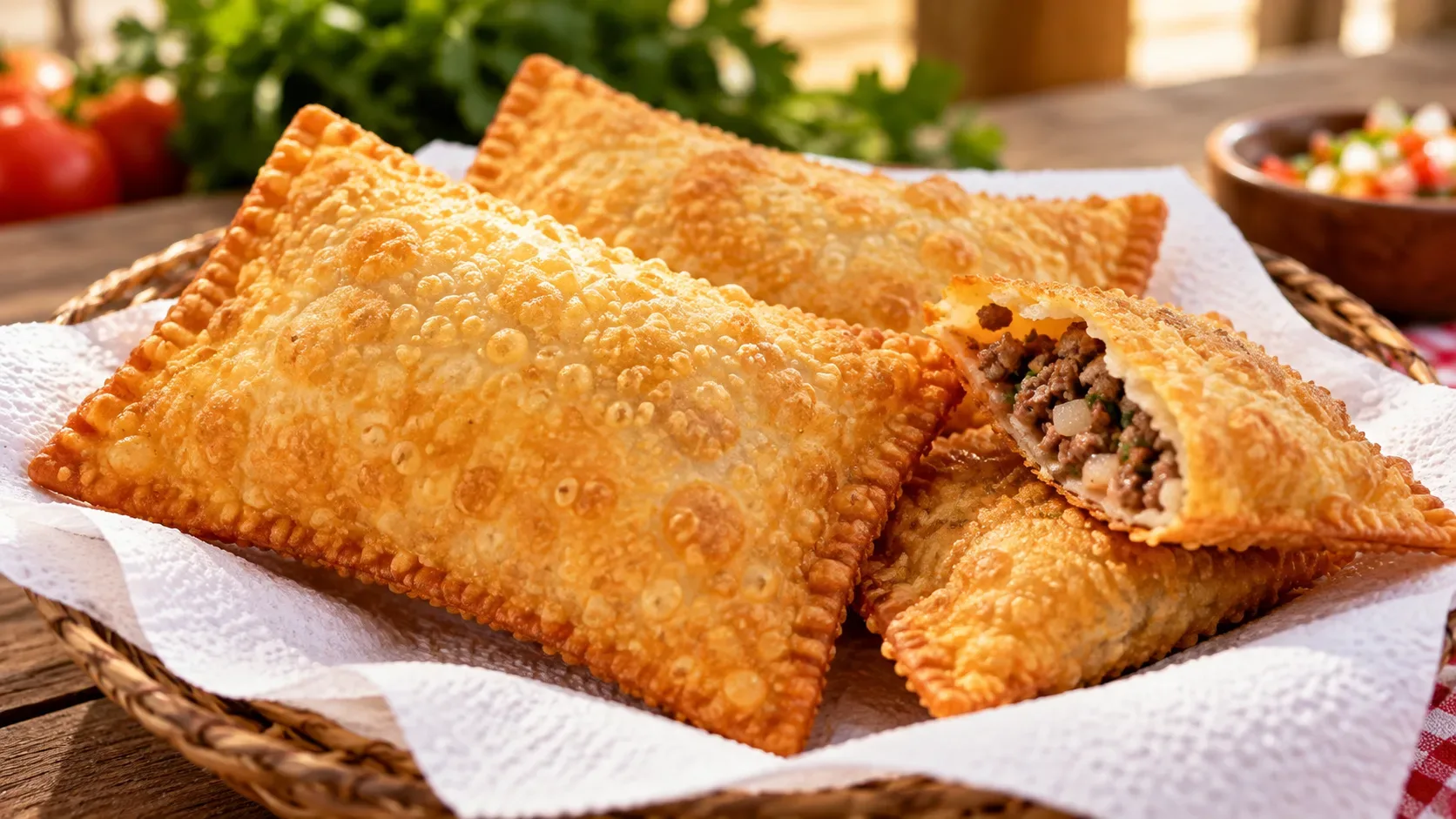
Brazilian street-market pastel turns out crisper and less greasy when four elements work together: well-kneaded, rested dough; a thin, even sheet; cool filling without excess liquid; and deep-frying in plenty of oil close to 180 °C (356 °F). Cachaça can help the texture, but it will not fix thick dough or oil that has dropped too far in temperature.
October 4 is presented by Brazilian recipe publishers as a day associated with celebrating pastel, making it a useful seasonal hook for this homemade version. The technique, however, is useful all year. The goal below is to reproduce the main features of a feira-style pastel at home: a thin blistered shell, crisp bite, securely sealed filling and little greasy mouthfeel.
A base dough for homemade Brazilian pastel
A simple formula close to one used by Mais Você is a practical starting point:
- 480 g all-purpose flour;
- about 180 ml warm water;
- 30 ml neutral oil;
- 30 ml cachaça;
- 10 g salt.
Mix until no dry flour remains, then knead for about 5 minutes, until smooth and uniform. If the dough is very sticky, add only enough flour to make it workable; too much extra flour can make rolling harder and the finished shell tougher.
Cover well and rest for 30 minutes before rolling. Some recipes use longer rests, including refrigeration, but half an hour is a common reference for relaxing the dough and making it easier to roll by hand or through a pasta machine.
The right dough texture: firm, smooth and flexible
Before resting, the dough should feel firm without being crumbly. After resting, it should yield to the rolling pin without snapping aggressively back. If it shrinks immediately, cover it and give it another 10 to 15 minutes.
Do not leave unused dough exposed. A dry surface creates edges that crack during sealing and increases the chance of leaks in the fryer. Keep portions that are waiting under plastic wrap or a barely damp cloth.
Thickness: about 2 mm is a useful target
A homemade feira-style pastel recipe from Receitas recommends rolling the dough to roughly 2 mm and notes that thinner dough becomes crisper when fried. At home, treat 1.5 to 2 mm as a practical working range.
Without measuring tools, aim for a thin, even sheet that lets you faintly perceive the counter underneath without becoming so translucent that it tears. Uneven thickness is often a bigger problem than average thickness: thick spots cook slowly while thin edges darken too soon.
Cool filling, moderate portions and clean edges prevent leaks
The filling should reach the dough cold or at least at room temperature. Hot filling releases steam too early and can weaken the seal. Moisture also matters: ground beef should be cooked without loose liquid; chopped tomato should be well drained; very moist cheeses are easier to handle in smaller portions.
Leave a clean border of about 1.5 cm. Press out excess air as you fold, seal first with your fingers and finish with a fork or pastry wheel. If filling or grease touches the sealing area, wipe it clean before closing.
Do not compensate for a small wrapper by overfilling it. Too much filling makes sealing difficult and raises pressure inside the pastry, especially as cheese melts or moisture turns to steam.
Oil at 180 °C: the center of a crisp, non-greasy fry
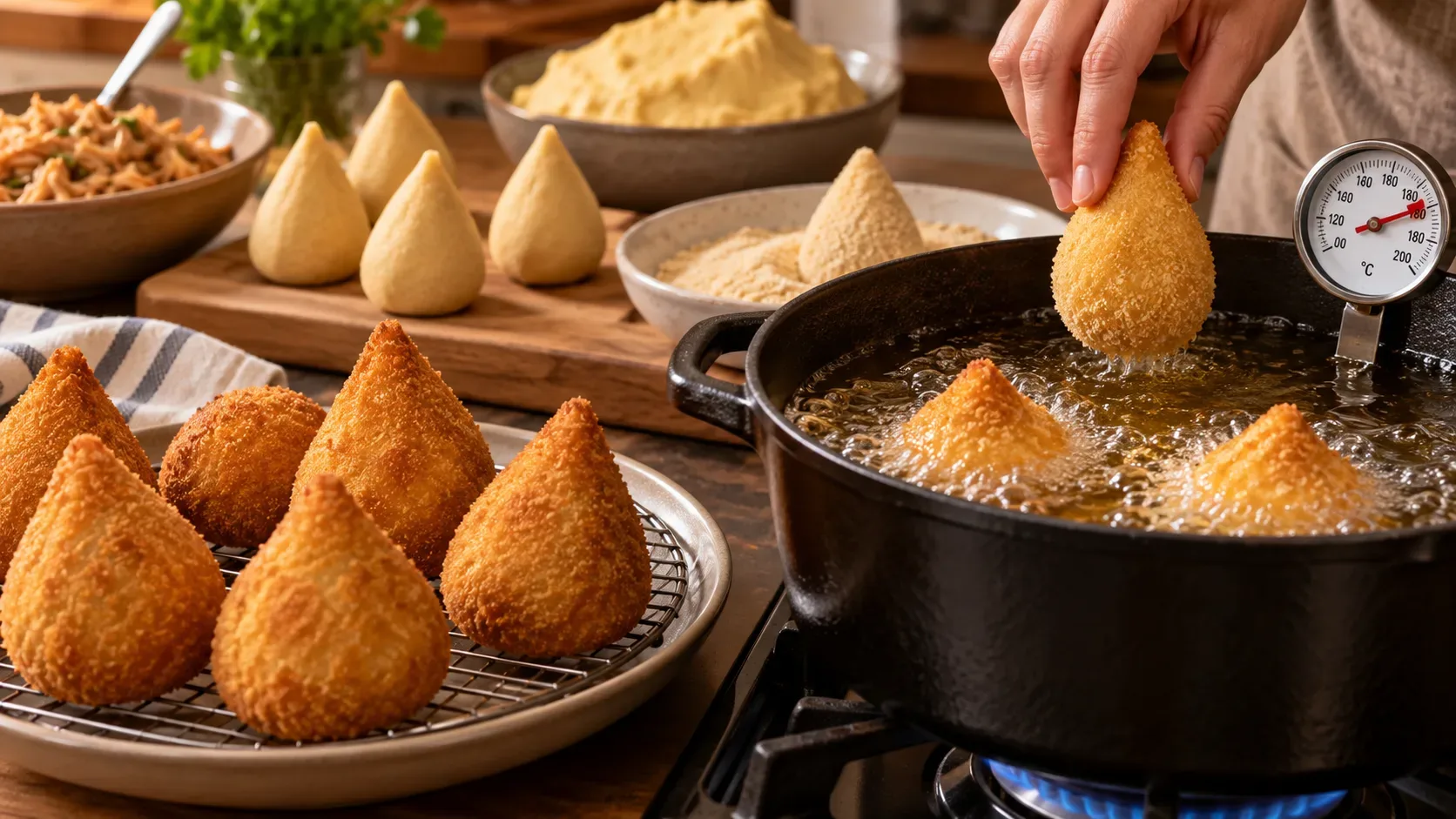
The most repeatable approach is to use a thermometer and work close to 180 °C (356 °F). Receitas Nestlé gives that temperature for a drier pastel, and a pastel dough recipe from Ana Maria Braga also calls for frying a few pieces at a time in abundant oil at 180 °C.
In practice, a working range of 175 to 185 °C (347 to 365 °F) gives some room for the temperature drop when the pastry goes in. Below that range, frying takes longer and the shell tends to feel heavy. Far above it, the dough can darken before it dries properly and may become hard rather than light and crisp.
How to recognize oil that is too cool or too hot without a thermometer
- Too cool: weak bubbling, slow inflation and browning, pale surface and a greasy feel.
- Useful range: lively, steady bubbling as soon as the pastry enters, quick blister formation and gradual browning.
- Too hot: edges darken almost immediately while the center still looks pale or insufficiently crisp.
These are approximations. For consistency across several batches, a thermometer is more reliable than tests involving flour, bread or a wooden skewer.
Fry only a few pieces at a time
Use a reasonably deep pot and enough oil for the pastel to float rather than sit on the bottom. Crowding the pot drops the temperature and creates a bad cycle: the pastries take longer to brown, retain more surface oil, and the next batch enters oil that has not recovered.
- Heat the oil to about 180 °C.
- Add 1 or 2 pastéis, depending on pot size.
- Turn when the lower side is blistered and beginning to brown.
- Remove when the shell is evenly light golden.
- Drain on a rack or absorbent paper without stacking immediately.
- Let the oil return to the working temperature before the next batch.
Stacking very hot pastries traps steam between them and softens the shell. Keep them in a single layer while finishing the remaining batches.
What cachaça can do — and what it cannot fix
Traditional Brazilian recipes use cachaça in pastel dough and associate it with a drier, crisper texture. Receitas Nestlé likewise says cachaça helps crispness and mentions white vinegar as an alternative in its recipe.
Still, treat cachaça as one element of the formula, not a magic fix. Thick dough, wet filling or cool oil can still produce a heavy result. Rolling and frying technique have a larger influence on the final texture.
Quick diagnosis: why did the pastel go wrong?
| Problem | Likely cause | Adjustment for the next batch |
|---|---|---|
| Greasy pastel | Oil too cool, overcrowded pot or thick dough | Return to 180 °C, fry smaller batches and roll thinner |
| Dark, hard shell | Oil too hot | Lower the heat and let the temperature drop before continuing |
| Pastel opened | Dirty seam, weak seal, dried dough or excess filling | Clean the edge, seal in two steps and reduce the filling |
| Few blisters or little expansion | Dough too thick or oil below range | Roll near 2 mm and recover the oil temperature |
| Shell softened after frying | Hot pastries were stacked and trapped steam | Drain in a single layer and serve promptly |
How to organize the preparation for October 4
If you plan to serve pastel on October 4, make the filling early enough for it to cool completely. The dough can be prepared a few hours ahead and kept tightly wrapped in the refrigerator. Roll, fill and seal closer to frying so the edges do not dry out.
Before guests arrive, organize the counter, rolling pin or pasta machine, cutter, fillings, slotted spoon, thermometer and draining area. Pastel is best with little delay between fryer and table, so a simple workflow is more useful than frying a large quantity far in advance.
The target, in short
- Rest the covered dough for at least 30 minutes.
- Roll it thin and even, around 2 mm.
- Use cool filling with no loose liquid and keep portions moderate.
- Keep the sealing edge clean and press it firmly.
- Fry a few at a time in abundant oil close to 180 °C.
- Let the oil recover between batches.
- Drain without stacking and serve promptly.
With these controls, crispness no longer depends on a single “secret”: it comes from the combination of thin dough, reliable sealing and stable frying temperature.