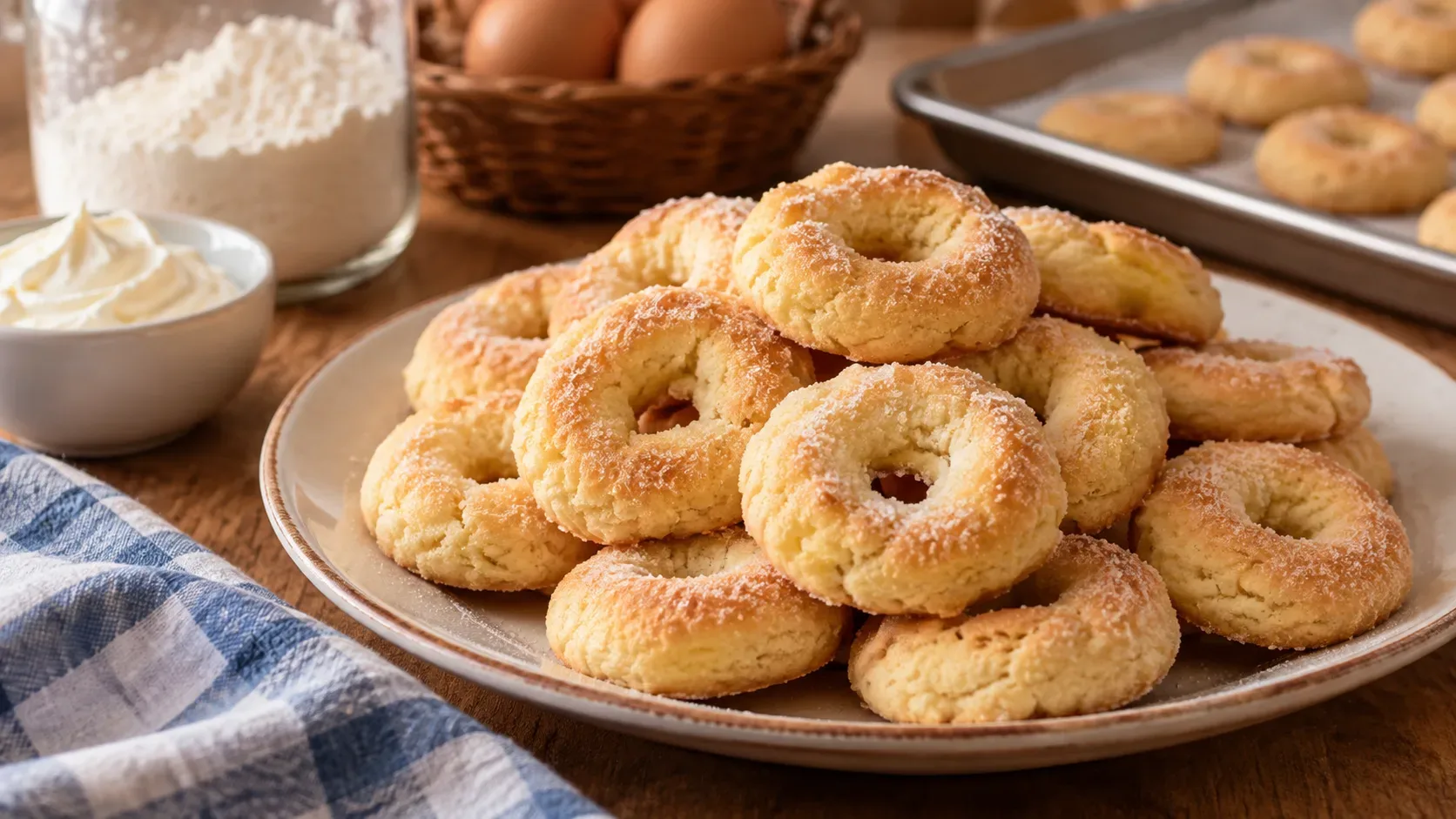
Soft Brazilian cream ring cookies depend less on forcing the dough to take a fixed amount of flour and more on recognizing the moment when it can already be shaped without becoming dry. The Receitas Globo reference uses 1 cup of nata, 2 eggs, 4 tablespoons of granulated sugar, 1 tablespoon of baking powder, and wheat flour as needed, with one crucial instruction: add the flour gradually and stop as soon as the dough can be rolled. That approach lowers the risk of hard, crumbly cookies.
Ingredients and a practical flour range
- 1 cup nata, or Brazilian dairy cream
- 2 eggs
- 4 tablespoons granulated sugar
- 1 tablespoon baking powder
- 3 cups all-purpose flour to start
- up to 1 additional cup of flour, only if the dough truly needs it
The 3 to 4 cup range should be treated as a working reserve, not a target. A version published by Ana Maria Braga, made with 1 cup of nata and 2 eggs, uses 3 cups of flour, while the main recipe behind this article leaves the amount open and says to stop adding flour once the dough can be rolled. The moisture of the nata, egg size, and the way flour is measured all change absorption. Start with 3 cups, then move forward one spoonful at a time only if needed.
What should the dough feel like?
The ideal dough is soft, pliable, and only slightly tacky. When you press a small piece, it should hold its shape; when you roll it into a rope, you should be able to curve it and join the ends without multiple cracks forming. There is no need to chase a completely dry or very firm dough.
Too much flour is a direct path to a drier texture. King Arthur Baking notes that small differences in flour quantity can separate a soft cookie from a dry one and that volume measurements vary considerably depending on how densely flour is packed. A scale improves repeatability. If you use cups, spoon or lightly fill the flour rather than pressing it down.
How to mix the dough without making the cookies hard
- Mix the nata, eggs, sugar, and baking powder until the base is uniform.
- Add about 3 cups of flour in stages, mixing only until incorporated.
- Test a small piece in your hands. If you can already roll a rope and close it into a ring, stop adding flour.
- If the dough still sticks so much that it cannot hold its shape, add flour 1 tablespoon at a time.
- Shape rings with similar thickness so they bake at a similar rate.
A common mistake is continuing to add flour simply because the dough still feels soft. In this recipe, softness does not mean the dough lacks structure. The important sign is whether it can be shaped without falling apart or sticking heavily to your hands.
Oven: treat time as a reference, not a command
Published recipes vary widely in baking time. The main Receitas Globo recipe says about 40 minutes in a preheated oven but does not specify a temperature. Another version on the same site uses a moderate 180 °C oven and advises not to let the cookies brown deeply, while Ana Maria Braga gives about 20 minutes at 180 °C or until golden. The gap shows how cookie size, pan choice, and individual ovens can change the result.
For a softer result, preheat the oven to 180 °C and run a first test with only a few rings. Start checking at 15 minutes. Remove them when the surface is set, the bottom is lightly golden, and the center still seems tender. Do not wait for the cookies to become deeply browned or rigid in the oven. They continue to firm as they cool on the pan.
Use two test cookies first
Baking two pieces first reduces the risk of losing the whole batch. If they spread too much or lose their shape, the dough may need a small flour adjustment. If they come out dry, cracked, and hard, the problem may be too much flour, excessive baking time, or rings shaped too thin. Make the adjustment before baking the rest.
How to correct the dough before baking
| Problem | What you see | Practical correction |
|---|---|---|
| Dry dough | Cracks while rolling and crumbles at the ends | Stop adding flour. Mix in a small spoonful of nata only until the dough becomes pliable again. |
| Very sticky dough | Cannot hold a rope shape and sticks heavily to the hands | Add flour 1 tablespoon at a time and test again before adding more. |
| Hard cookie | Becomes rigid after cooling | On the next batch, reduce the final flour amount, shape slightly thicker rings, and remove them from the oven earlier. |
| Very pale and raw | Wet center and weak structure | Bake for a few more minutes, checking frequently so the cookies do not go too far. |
Why nata helps the texture
Nata contributes fat and moisture to the dough. In this kind of cookie, those components support tenderness and flavor, while flour still supplies the structure needed for shaping. The balance is lost when flour is used to eliminate every trace of softness. The goal is not a dry block of dough, but the minimum structure needed to roll it successfully.
How to tell when the batch is right
A well-baked nata ring cookie should hold its shape, have a set exterior, and remain softer and more tender inside without tasting raw. Once cool, it should not require force to bite through. If it becomes very hard after cooling, review two things first: how much flour went in at the end and how long the cookies stayed in the oven.