
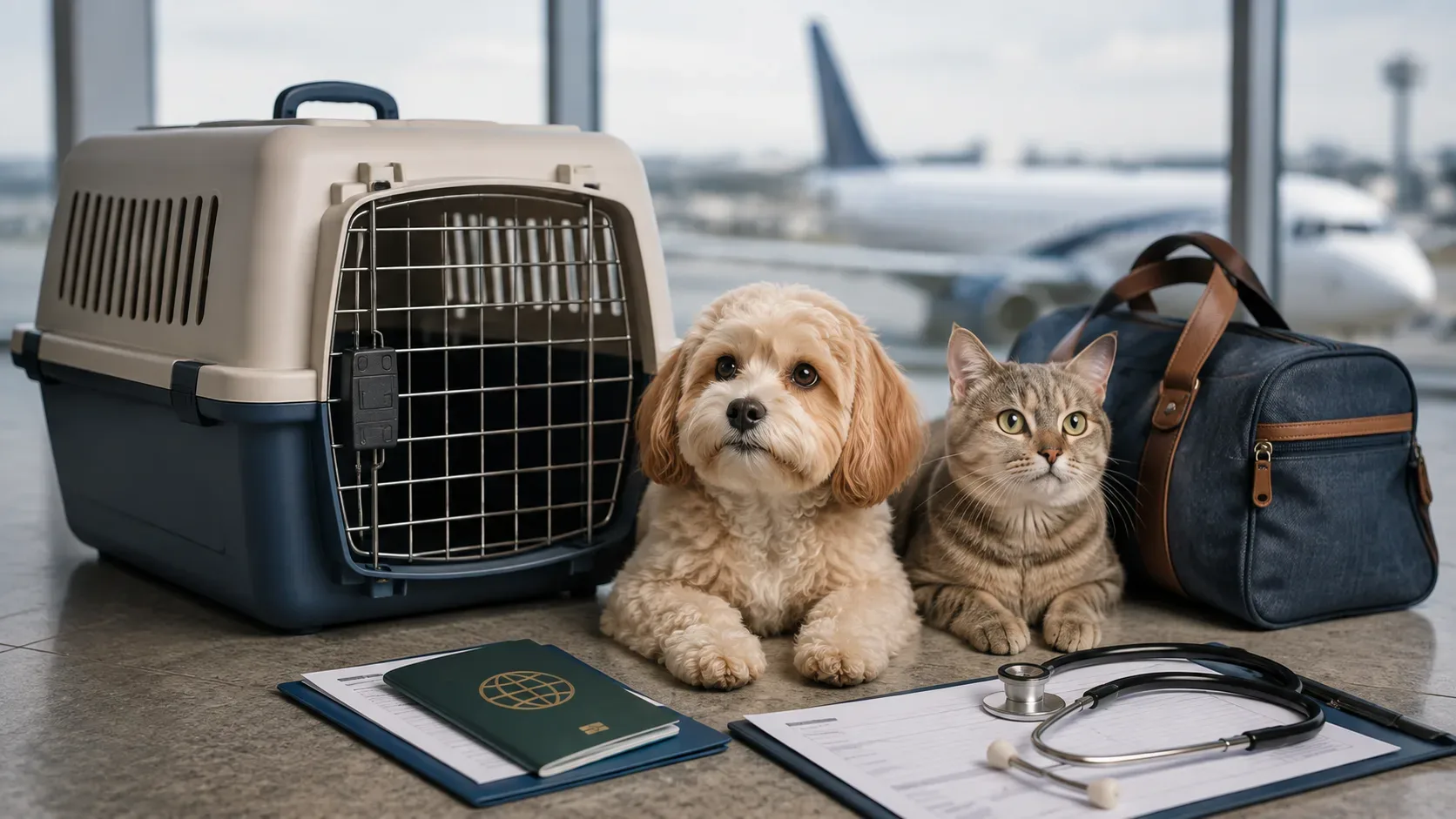
Traveling abroad with a dog or cat in 2026 requires attention to a change that does not appear in the final document: in several destinations, the owner can no longer initiate the request for the electronic International Veterinary Certificate, the e-CVI alone. The request now depends on a veterinarian qualified on routes such as Mercosur, the European Union, the United States, Japan and Great Britain.
There is also no single deadline valid for all countries. For some destinations, the order must be sent between three and nine days before departure; for Mexico, the window starts 14 days earlier; In the United States, dogs and cats have different deadlines. Furthermore, certain certificates still require physical approval from the Ministry of Agriculture and Livestock — MAPA, even when the request started online.
There are also two important corrections in relation to the information that circulated about the changes:
- Mercosur's new e-CVI came into force on July 2, 2026, initially for Argentina, Paraguay and Uruguay.
- The mention of rules applicable since August 1st, in the United States area, refers to August 1st, 2024, according to the official manual linked by MAPA. This is not a new effective date in 2026.
What changed in the electronic CVI in 2026
June 1st: European Union begins to require a veterinarian's request
Since June 1, 2026, the e-CVI for European Union countries and the group that includes Northern Ireland, Norway and Switzerland must be requested by a registered veterinarian residing in Brazil. The official manual indicates an analysis period of up to 72 hours when the documents are correct, but warns that periods of high demand and requests returned for correction can prolong the process.
June 15: Argentina stops requiring physical approval
Since June 15, 2026, the e-CVI destined for Argentina no longer needs to receive a stamp or physical signature at a MAPA unit. The electronic document must be issued correctly, printed and presented in accordance with travel guidelines.
July 2: new Mercosul e-CVI
On July 2, 2026, a new version of the e-CVI came into operation for trips with dogs and cats to Argentina, Paraguay and Uruguay. From this version onwards, only a qualified veterinarian can send the request.
The new model also allows the inclusion, in the same certificate, of a lactating female and her puppies less than 90 days old, as long as the applicable sanitary conditions are met.
When the requesting veterinarian himself performed the clinical examination and issued the health certificate, the file does not need to be attached to the system. Even so, the document must be completed, signed, stamped and scanned or electronically signed, remaining in the custody of the professional for the period indicated in the manual, up to five years. If the certificate was issued by another veterinarian, it must be attached to the application.
Bolivia and Venezuela: change not yet confirmed as being in force
MAPA's general page informs that Bolivia and Venezuela will use the same Mercosur health model and that the exclusive request for veterinarians will be implemented “soon”. However, in the version consulted on August 3, 2026, the body did not present an effective date for this transition, while the specific services still indicated assistance to citizens. Therefore, it is not safe to treat a supposed entry into force in July as a confirmed fact.
Who applies and what is the deadline by destination
The windows below indicate when the e-CVI request must be sent to MAPA. They do not represent the total time required for vaccinations, microchip identification, laboratory tests, import authorizations or airline requirements.
| Destination | Responsible for the request | Shipping before boarding | Physical chance |
|---|---|---|---|
| United States | Qualified veterinarian | Dogs: 5 to 2 days; cats: from 10 to 3 days | No |
| Argentina, Paraguay and Uruguay | Qualified veterinarian | From 9 to 3 days | No |
| Bolivia and Venezuela | Service still recommended for citizens; transition to veterinarian announced, but no confirmed effective date | From 9 to 3 days | Yes |
| Canada | Citizen or person responsible for the animal | From 9 to 3 days | Yes |
| Chile | Citizen or person responsible for the animal | From 9 to 3 days | No |
| Colombia | Citizen or person responsible for the animal | From 9 to 3 days | Yes |
| Mexico | Citizen or person responsible for the animal | From 14 to 3 days | Yes |
| Peru | Citizen or person responsible for the animal | From 9 to 3 days | Check the manual and Vigiagro before ordering |
| European Union, Northern Ireland, Norway and Switzerland | Registered veterinarian residing in Brazil | From 9 to 3 days | Depends on country of entry |
| Japan | Qualified veterinarian | From 9 to 3 days | No |
| Great Britain, Channel Islands and Isle of Man | Qualified veterinarian | From 9 to 3 days | Yes |
In the list made available by MAPA in July 2026, the physical seal also appeared for certificates destined for Germany, Spain, Italy, Ireland, the Netherlands and Sweden. As this relationship can change and depends on the route, the traveler must check the country of first entry and the current version of the manual.
For countries that do not appear in the electronic system, the issuance may need to be done in person. MAPA recommends looking for a Vigiagro unit at least 60 days in advance to check the procedure and requirements of the destination.
The CVI deadline is not the deadline to start preparation
A common mistake is to use the three, five, nine or 14 day window as the date to start all planning. This window is just the time to protocol the certificate. Depending on the country, the previous health steps may require weeks or months.
European Union
To enter the European Union from Brazil, the animal must be identified by microchip, receive vaccination against rabies after identification and, in cases subject to serology, have blood collected at least 30 days after primary vaccination. The result must be at least 0.5 IU/ml in a recognized laboratory, and the collection must respect a minimum interval of three months before issuing the certificate for the trip.
The European health certificate must normally be issued within ten days prior to arrival. For dogs entering Finland, Ireland, Malta, Northern Ireland or Norway, there is also treatment against Echinococcus multilocularis between 24 and 120 hours before entry.
United States
On April 15, 2026, the CDC continued to classify Brazil as a high-risk country for canine rabies. For vaccinated dogs outside the United States arriving from a country on this list, a microchip, specific vaccination documentation, CDC import form, minimum age of six months and, as appropriate, valid serology or reservation at a CDC-registered facility may be required.
These CDC requirements are separate from the Brazilian e-CVI request. Therefore, obtaining the MAPA certificate within the deadline does not correct an incomplete health preparation or replace the entry documents required by the United States.
Great Britain
Brazil is not part of the British list of countries listed for the simplified procedure. As a rule, the entry of dogs and cats from the country involves a microchip, anti-rabies vaccination, serological examination and a health certificate specific to Great Britain. The microchip must be implanted before the vaccine used in the process.
Japan
Japan requires prior notification to the animal quarantine service and inspection upon arrival. When requirements are complete, release can occur within 12 hours; Documentary or health failures can lead to quarantine of up to 180 days or prevent entry.
Documents that must be organized
The exact list varies depending on the destination, but preparation usually involves:
- identification document of the guardian or guardian;
- animal and flight data;
- health certificate issued after clinical examination;
- vaccination card or proof;
- identification by microchip, when required;
- serology reports or other tests;
- import authorization, when required by the country;
- authorization from the owner, when the traveler or applicant is another person;
- additional forms for the country of destination;
- PDF files electronically signed or scanned according to the manual.
In flows exclusive to professionals, first access may require a registration number with the Regional Council of Veterinary Medicine and a negative certificate issued by the Federal Council. The veterinarian must check in the system whether your license is active before leaving the request for the last few days.
Step by step to reduce the risk of missing your trip
1. Confirm the country of first entry
On connecting trips, the country that analyzes the animal is not always the final destination. In the European Union, for example, the need for a transit or entry certificate may vary depending on the animal traveling accompanied, as cargo and whether or not it remains in the customs area during the connection.
2. Consult three sources separately
Check it out:
- the MAP page for the destination;
- the veterinary or border agency of the country of entry;
- the airline and, where applicable, the connecting airports.
The CVI complies with government health certification, but does not replace operational rules for transport boxes, reservations, embargoes based on temperature, breed, weight or shipping method established by the carrier.
3. See the vet before the e-CVI window
Even when the system only accepts the request nine or five days before the flight, the professional must evaluate the microchip sequence, vaccines, serology, antiparasitics and forms in advance.
For destinations where only veterinarians can request the certificate, also confirm that the professional is qualified in the corresponding system.
4. Submit the order within the correct window
Orders submitted too early may not be accepted. Requests submitted at the limit leave little room to correct name, microchip number, vaccination date, itinerary or unreadable file.
In MAPA manuals, a request returned for adjustment returns to the queue and the analysis period starts again after resubmission.
5. Follow the portal and email
The applicant must monitor progress until approval. When issued, the e-CVI is made available as a digitally signed PDF and must be printed according to the destination's guidelines.
6. Solve the seal before going to the airport
When physical approval is mandatory, contact a Vigiagro unit in advance. MAPA warns that not every station has a veterinarian available without an appointment and that the procedure should not be left until the day of boarding.
7. Also plan your return to Brazil
The requirements used to leave the country do not replace the conditions for return. Before traveling, check the necessary documentation for the animal's re-entry into Brazil and assess whether any steps will need to be carried out abroad.
Frequently asked questions
Can the tutor still request the e-CVI?
Depends on the destination. In August 2026, the request was already exclusive to a qualified veterinarian for the United States, Argentina, Paraguay, Uruguay, the European Union, Japan and Great Britain. Other services, such as Canada, Chile, Colombia, Mexico and Peru, still appeared open to citizens.
Does every e-CVI require a physical stamp?
No. The digital signature eliminates the seal only on expressly indicated routes. Bolivia, Canada, Colombia, Mexico, Venezuela, Great Britain and some European countries still appeared on the physical approval list consulted in July 2026.
Can I request the certificate well in advance?
Not beyond the window defined in the system. Health planning must start early, but the e-CVI protocol must respect the destination's specific interval.
Was there a new rule for the United States on August 1, 2026?
The documentation consulted does not support this statement. Although the general page shows the expression “from August 1st”, the linked official manual identifies the change as effective from August 1st, 2024.
Before purchasing or rebooking your ticket
Save the list of documents, but check the official pages again before filing the request and again before boarding. Health rules, forms, countries subject to approval and airline conditions may change without following the travel calendar.