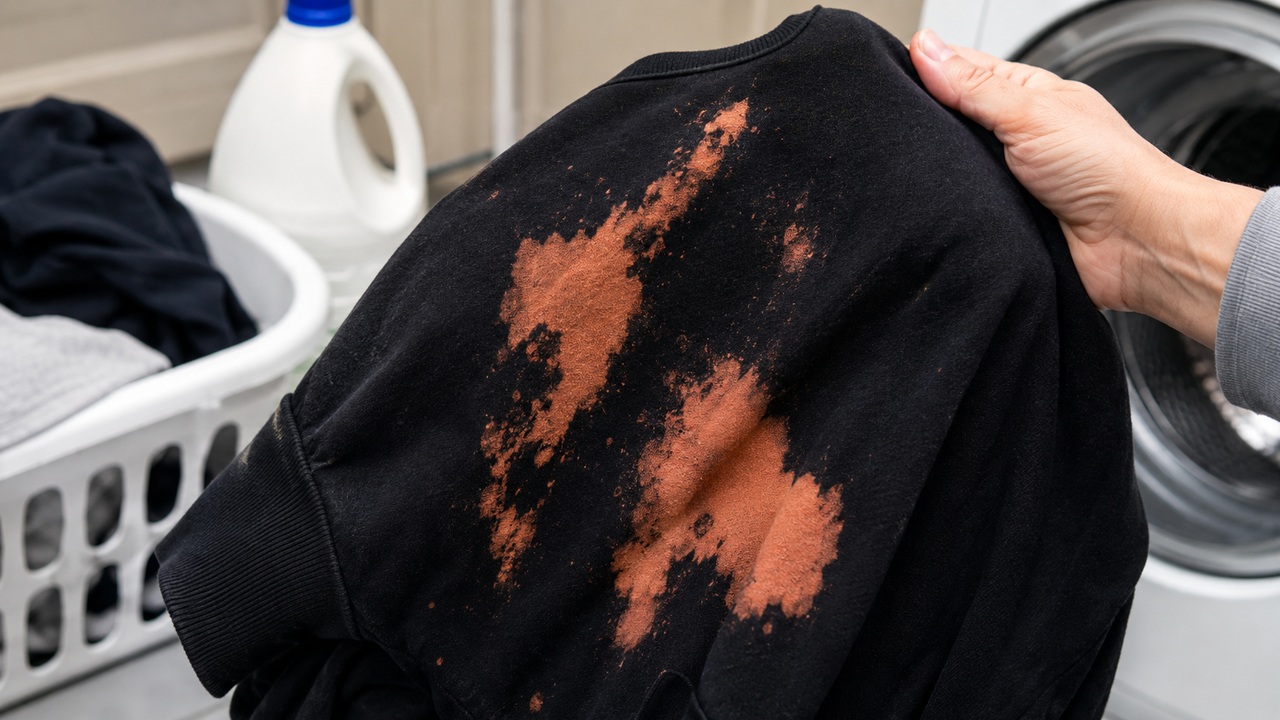
If bleach left an orange, reddish, beige, or much lighter area on black clothing, the most likely answer is inconvenient but important: this is not an ordinary stain sitting on top of the fabric. Hypochlorite can remove or alter the dye in the fiber. Once the color has been lost, more washing, scrubbing, or applying another product will not bring the original black back.
What can still be done depends on two questions. The first is whether the bleach contact has just happened and there may still be product in the fabric. The second is whether the garment only lost color or whether the chlorine also weakened the fiber. In the first case, the priority is to rinse and stop the exposure. In the second, the solution becomes touch-up, dyeing, creative repair, or professional evaluation.
First: is it a removable stain or color loss?
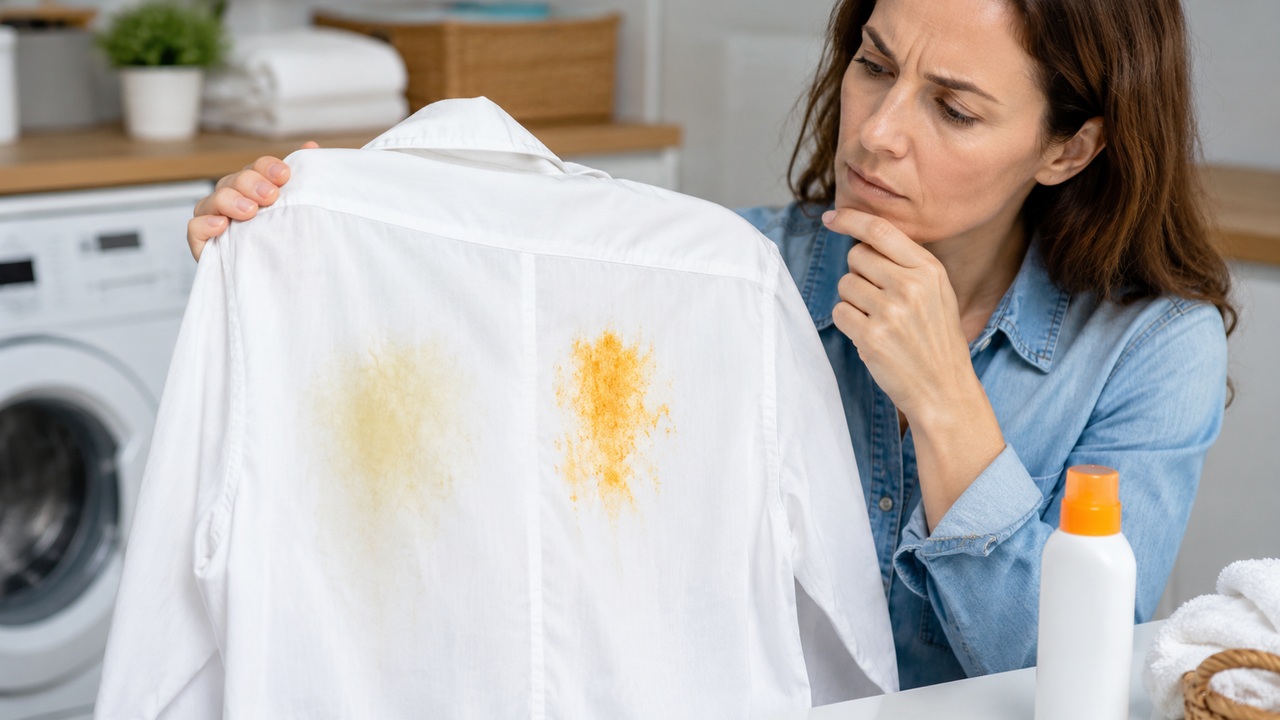
On black clothes, the classic sign of bleach contact is a localized change to copper, orange, rust, pink, beige, or nearly white tones. This happens because hypochlorite-based bleach reacts with dyes. The American Cleaning Institute classifies color loss caused by improper bleach use or direct application of undiluted product as an irreversible condition. Clorox likewise states that color loss after bleach contact cannot be reversed.
This is different from detergent, powdered soap, or dirt residue that remains on the fabric. Residue can leave whitish, rough, or superficial marks and may change after a thorough rinse. An area that remains a different color when the fabric is clean and dry, however, indicates that the pigment was altered or removed.
There is also a third possibility: the fiber may have been damaged in addition to the color. If the affected spot became thin, rough, brittle, developed small holes, or tears easily, recoloring is not enough. Hypochlorite can also degrade the material, especially after concentrated or prolonged contact.
If the contact just happened, the priority is to remove the remaining product
When the splash is recent, do not start by looking for a mixture to "neutralize" the bleach. Rinse the area thoroughly with water, without adding another product, and follow the garment care label. After the product has been well rinsed out, wash the item in a way that is compatible with the fabric and with the detergent label.
This rinsing may limit continued chemical contact, but it does not undo discoloration that has already appeared. If the area has already turned orange or pale, the goal changes: you are preserving what remains of the garment, not removing a stain as if it were coffee, grease, or sauce.
Let the clothing dry and observe the result in natural light. Only then decide whether the defect is small enough for a touch-up or requires a larger intervention. If the fiber appears weakened, avoid rubbing, brushing, or repeating aggressive treatments.
What not to mix with bleach
The most dangerous part of home remedies is treating the problem as if any household ingredient could be stacked on top of another until the mark disappears. Anvisa advises against mixing cleaning and disinfecting products and recommends strictly following their labels. Bleach labeling warns that mixing it with acids or ammonia-based products can produce toxic gases.
For that reason, do not try to correct the garment by adding vinegar, ammonia, alcohol, bathroom cleaners, disinfectants, or other cleaning products on top of bleach. Vinegar is acidic. Ammonia may be present in some cleaners. Anvisa also calls attention to the risk of mixing alcohol and bleach. Even when two substances are useful separately for other tasks, that does not mean they can be combined safely.
Baking soda does not put color back into the fabric either. The main point here is not to find a stronger household reaction, but to recognize that lost pigment will not return through a cleaning step. Adding products by trial and error increases chemical exposure without solving the visual cause.
If you have already mixed products and notice strong fumes, eye irritation, coughing, shortness of breath, dizziness, or discomfort, leave the area and seek health guidance. Anvisa maintains the Disque-Intoxicação hotline at 0800-722-6001.
Local touch-up works best on small splashes
When the damage consists of only a few small spots, the simplest route may be to disguise the color difference. For black clothing, a fabric marker usually allows better control of the finish. Clorox even suggests a black permanent marker for small splashes, while warning that the color match may not be perfect and that the touch-up may fade with washing.
Test any product on a hidden area before working on the visible spot. The marker's black may be bluer, grayer, or shinier than the black of the fabric. On brushed knits, sweatshirts, or textured fabrics, the touch-up may also affect the surface differently.
A localized touch-up makes sense when the area is small and the garment remains structurally sound. On large marks, trying to paint only the center tends to create a visibly different patch from the rest of the clothing.
Dyeing the whole garment may even out the color, but it is not guaranteed
When discoloration covers a larger area, covering only the isolated spot is usually difficult. Dyeing the entire garment black can produce a more uniform result, provided the fabric accepts the chosen type of dye and has survived the chemical damage.
Fiber composition matters. The dye, temperature, and process need to be compatible with the material listed on the care label. Seams, elastic, prints, embroidery, and fiber blends may react differently and may remain visible after dyeing.
There is also an important limit: dye manufacturers warn that bleach can damage fabric and make dyeing unpredictable. Rit, for example, states that garments affected by bleach can be very difficult to dye and that there is no guarantee of even coverage. Dyeing, therefore, is an attempt at recovery, not a certain way to restore the garment to its original condition.
If the sweatshirt, T-shirt, or pants are expensive or have sentimental value, the best time to look for a dyeing service or textile-dyeing professional is before an extensive home attempt. A treatment that changes the entire color is harder to undo afterward.
When physical repair is better than recoloring
Not every garment has to look exactly as it did before. If the faded area is localized but too large for a marker, embroidery, an appliqué, a patch, a cutout, or a sewing intervention can turn the defect into a deliberate detail. This approach does not restore pigment; it covers or visually incorporates the damaged area.
It is also useful when the fiber has lost strength. If there is a thin spot or small hole, simply painting or dyeing will not restore the fabric's structure. In that case, the repair needs to physically reinforce the area.
For structured garments, uniforms, tailored clothing, pieces with special finishes, or fabrics you cannot identify, professional evaluation reduces the risk of turning a localized discoloration into greater damage.
How to choose between touch-up, dyeing, and a professional
If there are one or two small splashes and the fiber is firm, a local touch-up is the least invasive option. If there are several spots or a broad area, full-garment dyeing or a deliberate aesthetic solution is more likely to look coherent than trying to "erase" each mark. If the fabric is thin, brittle, or perforated, sewing and reinforcement become the priority. If the garment is expensive, sentimental, structured, or made from blended fibers, it is worth seeking specialized service before testing products.
The decision also depends on how much contrast you are willing to accept. On a casual T-shirt, a small touch-up that is not perfectly invisible may be enough. On black dress pants or a uniform piece, minimal differences in shade and sheen are more noticeable, making professional work more justified.
Why vinegar and other remedies appear so often in searches
Vinegar, baking soda, and other ingredients may be useful for completely different laundry problems, such as certain mineral residues, odors, or buildup. That helps explain why they appear on so many pages and videos about "removing stains." The mistake is transferring a residue-removal recipe to a situation in which the fabric dye itself was destroyed.
With bleach on black clothing, the right question is not "what product dissolves this stain?" It is "is the color still there, or was it removed?" If the area remains orange or pale after rinsing, washing properly, and drying, the chance that it is only residue is small. The repair needs to restore appearance, not remove dirt.
How to prevent the problem in the next wash
Keep bleach away from dark clothing while sorting and preparing laundry. Never pour concentrated product directly onto the garment. When the bleach label and the garment care label allow its use, follow the dilution and the dispenser instructions provided by the washing-machine or product manufacturer.
For colored clothing, use only products labeled for colors and compatible with the garment care instructions. Test a hidden area when there is doubt about colorfastness. The fact that a garment withstands washing does not mean its dye will withstand hypochlorite.
If the accident has already happened, the most useful rule is simple: rinse away fresh product, do not make mixtures, and stop treating pigment loss as a removable stain. From there, choose the repair according to the size of the damage, the strength of the fabric, and the value of the garment.