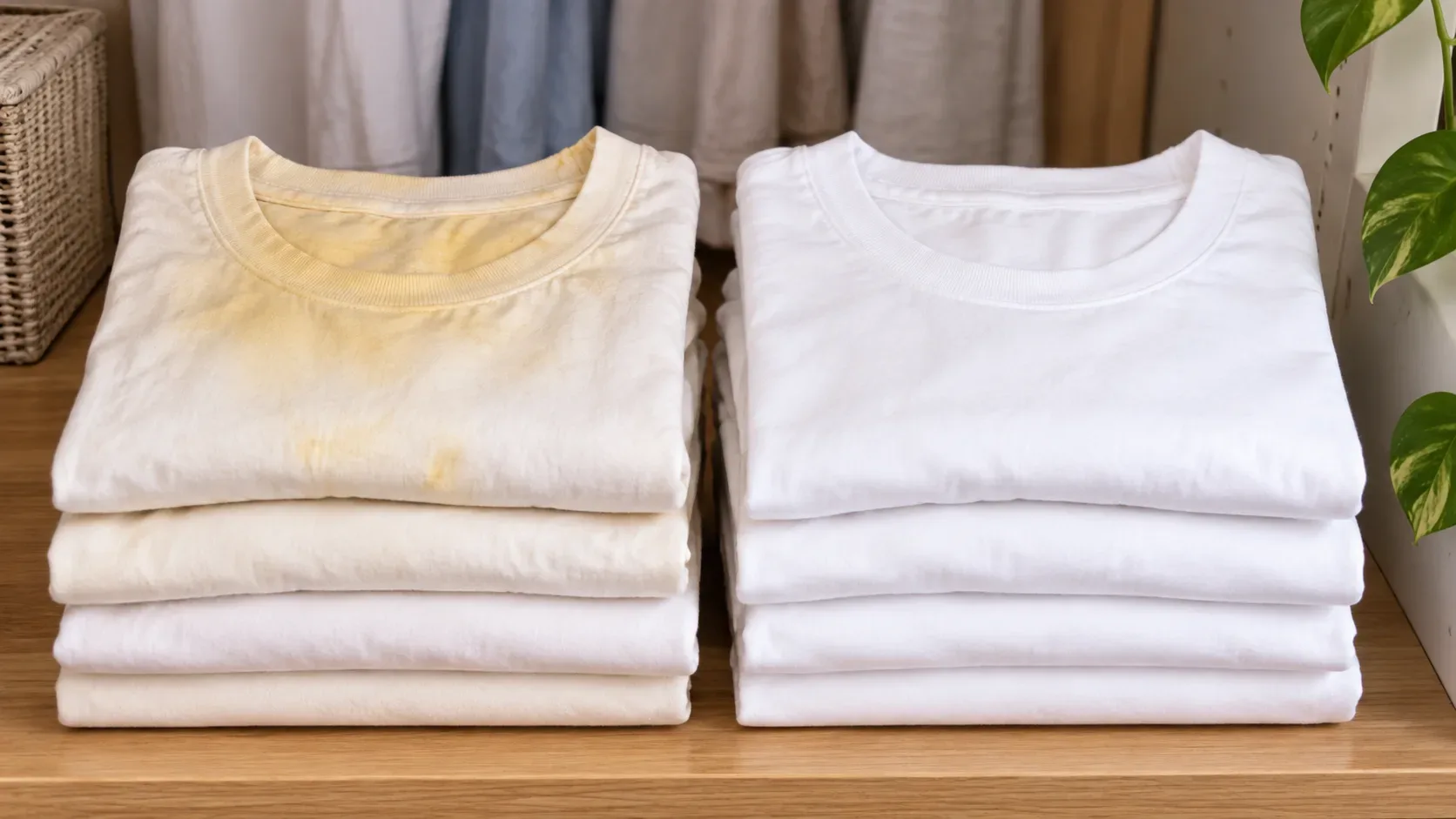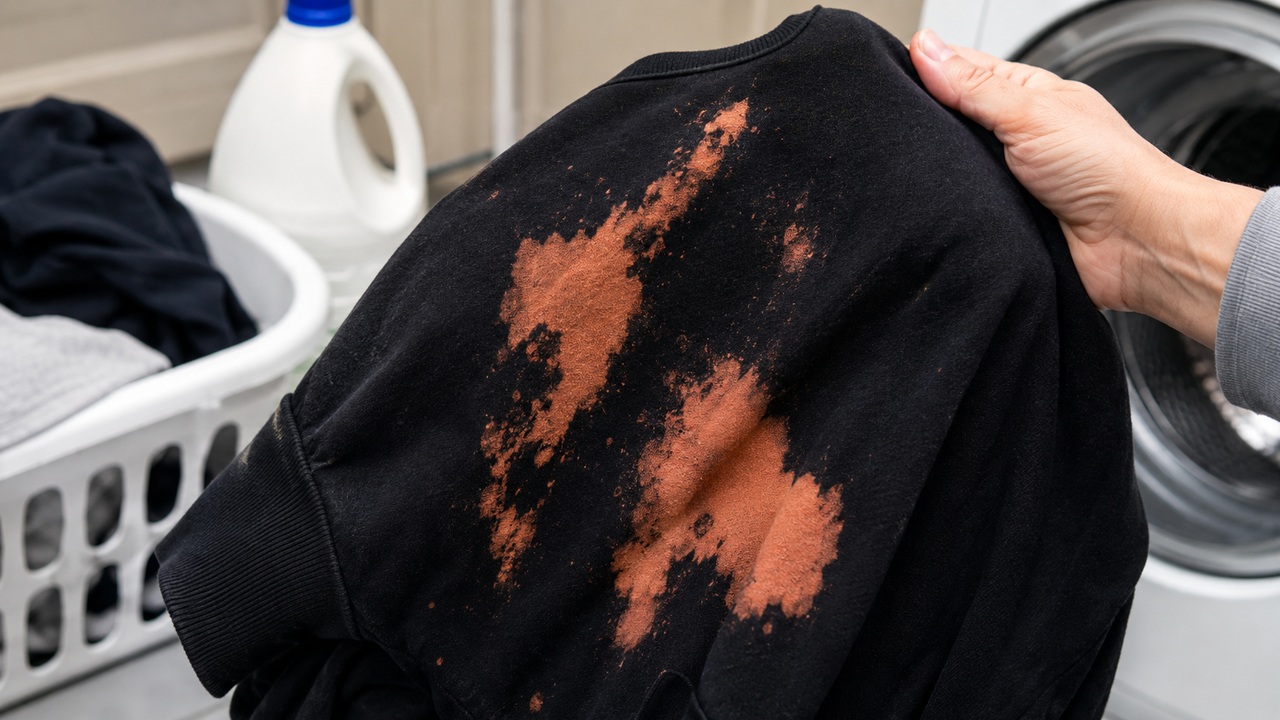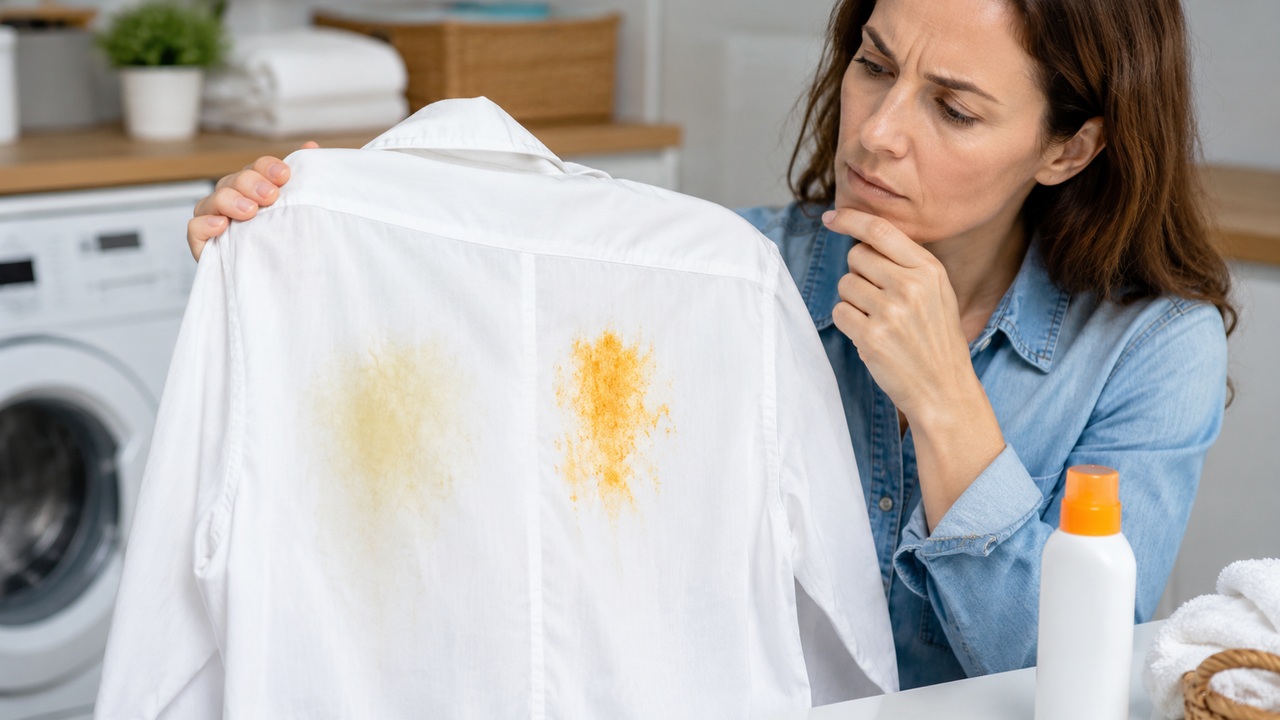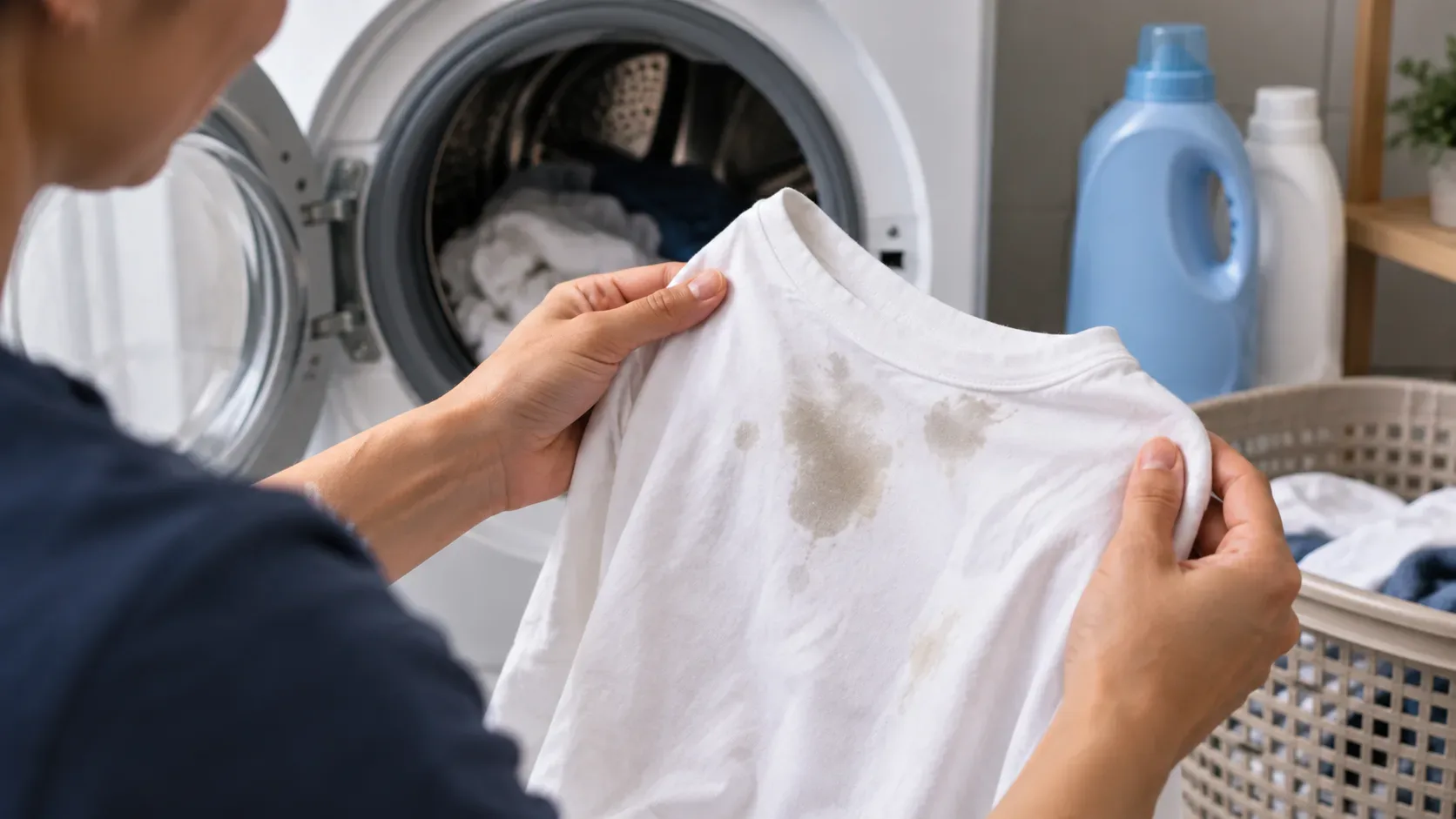
If clothes went into the washer without an obvious mark and came out with stains that look oily or greasy, the best first move is not to pour on stain removers or run several more cycles. Separate the possibilities. Concentrated fabric softener, buildup inside the washer and an equipment fault can create similar-looking marks; an oily stain that was already on the fabric can also become more visible after washing. Diagnosis is more reliable when you look at the stain pattern and run a controlled test.
Before troubleshooting: do not put the item in the dryer
Set the stained clothes aside and air-dry them while you identify the source. Dryer heat can set oil stains and make them harder to remove. Whirlpool advises against machine-drying an item while a stain remains: oil and grease stain guide.
It is also worth checking whether the mark was truly absent before washing. GE and LG note that cooking oil, cosmetics and other fats may be nearly invisible before the cycle and become more noticeable afterward as they pick up soil from the wash water or fabric. That helps avoid blaming the washer too early.
The stain pattern helps choose the first suspect
| What you see | Most useful hypothesis to test first | Next step |
|---|---|---|
| Small translucent, dark or “wet-looking” spots, especially after using fabric softener | Concentrated or poorly distributed fabric softener | Stop using softener, clean the compartment and repeat a controlled test |
| Irregular marks on several items, with residue visible in the drawer, gasket or drum | Detergent, softener or soil buildup in the washer | Follow the manual’s cleaning procedure and check dispensers, gasket and filter where applicable |
| Fresh stains reappear on clean cloths even without softener, after cleaning | A source in the washer, hoses or water supply | Stop testing with good clothes and investigate the appliance/installation |
| White, grayish or powdery residue | Poorly dissolved detergent or excess product, not necessarily oil | Review dosage, detergent type, load size and rinsing |
1. How to test whether fabric softener is responsible
Manufacturers treat fabric softener as a common cause of oily-looking spots. Samsung lists several risk situations: pouring softener directly on clothes, using the wrong drawer compartment, exceeding the MAX line, using too much product or having an obstructed drawer. Maytag and Whirlpool also connect greasy-looking spots with excess or poorly distributed softener. See the guidance from Samsung and Maytag.
Use a simple checklist:
- confirm that softener was placed in the correct compartment and stayed below the maximum line;
- look for dried, gummy or accumulated product in the drawer or dispenser;
- do not pour fabric softener directly onto clothes;
- if the product label or washer manual requires dilution, use that proportion;
- run the next test without fabric softener.
If a similar load stops developing marks when softener is removed from the process, that hypothesis becomes stronger. It does not mean the earlier stain “proves” which ingredient caused it; it means you isolated an important variable.
2. How to check whether the washer is redepositing residue
Detergent, fabric softener, lint and soil can build up in dispensers and internal areas and later redeposit on clothing. Maytag recommends regular washer cleaning in part to reduce buildup and redeposition. Samsung likewise advises maintaining the detergent drawer and the cleaning components specified for each model.
Before testing again:
- remove and wash the product drawer if the manual allows it;
- clean the door gasket and accessible areas where film or soil is visible on front-load models;
- check a debris or pump filter only if your model provides that access, and follow the manual;
- run the “Clean Washer,” “Self Clean,” “Tub Clean” or equivalent cycle exactly as the manufacturer instructs.
Do not invent a cleaning mixture. The CDC warns not to mix household bleach with other cleaners or disinfectants because dangerous vapors can be released: CDC bleach safety guidance. If the washer manual calls for a specific product, use only the method approved for the appliance.
3. Run a small white-load test with few variables
After cleaning the washer according to its manual, use two or three clean white cloths or towels that you do not mind using for troubleshooting. The goal is to create an easy-to-compare test, not to risk a full load of clothing.
- Do not use fabric softener, stain boosters, laundry fragrance or other additives.
- Use only the detergent appropriate for the washer, in a dose suitable for the small load.
- Choose a normal cycle that the manual recommends for white cotton.
- At the end, inspect the cloths while they are still damp and under good light.
- If they are clean, return to your normal routine by adding back one variable at a time, starting with the most suspicious product.
If fresh oily marks appear again on cloths that were clean, the result does not identify the defective part by itself, but it makes it less likely that every mark came from pre-existing soil on the garments. At that point, the washer, hoses and even the incoming water deserve attention. GE, for example, notes that some oily marks may be tied to laundry additives or, in specific cases, the water supply; for its own product line, the company also states that the design of many modern models prevents transmission oil from reaching the wash basket. “Mechanical oil” is therefore not a universal diagnosis.
When a mechanical fault becomes a reasonable suspicion
Suspicion rises when the problem is repeatable after you remove fabric softener, clean the appliance and use clean test fabrics. It becomes more relevant when one or more of these signs is present:
- black or greasy film appearing inside the drum, on the gasket or in one specific area;
- visible oily fluid under the washer or around external components;
- new noise, vibration or abnormal operation that began along with the stains;
- similar stains across successive loads and on fabrics known to be clean.
At that stage, stop using good clothing as a test load and consult the manufacturer’s service channel. Avoid opening the cabinet, disassembling a transmission or applying solvents internally without a service procedure. Mechanical design varies by brand and model, and the source may be different from what online posts broadly call “washer oil.”
Do not rule out an oily stain that was already on the garment
Sometimes washing only reveals an earlier stain. GE describes food-oil spots that may go unnoticed before washing and become more visible after they pick up soil. LG also lists cosmetics, vegetable oils, animal fats, fabric softener and soap residue as sources that can show up after a cycle.
If only one item has the mark, especially in an area consistent with food, cosmetics, body lotion or workshop/kitchen contact, test that possibility before blaming the machine.
How to recover the garment without confusing the diagnosis
Once you have separated the most likely cause, treat the garment individually. Check the care label, apply a fabric-compatible pretreatment — liquid laundry detergent is a common option — and wash at the warmest temperature the label allows. If the stain remains, air-dry and repeat treatment instead of using the dryer. Delicate fabrics may require professional cleaning.
Avoid combining multiple stain removers “just in case.” Mixtures can damage fibers, alter color or create dangerous gases. Use one product at a time, follow the label and spot-test in a hidden area when appropriate.
A short decision sequence that avoids wasting clothes
- Set aside stained items and do not machine-dry them.
- Check whether the pattern fits fabric softener and run a cycle without it.
- Clean the drawer, gasket, filter and drum only as the manual instructs.
- Run a small test with white cloths and minimal products.
- If the mark reappears, stop using good clothes and investigate the washer, hoses and water supply.
- If there is a leak, oily internal residue or abnormal operation, contact service.
This method does not depend on guessing from stain color alone. It removes variables until you can see whether the problem follows the fabric softener, the washer’s cleanliness or the appliance itself.