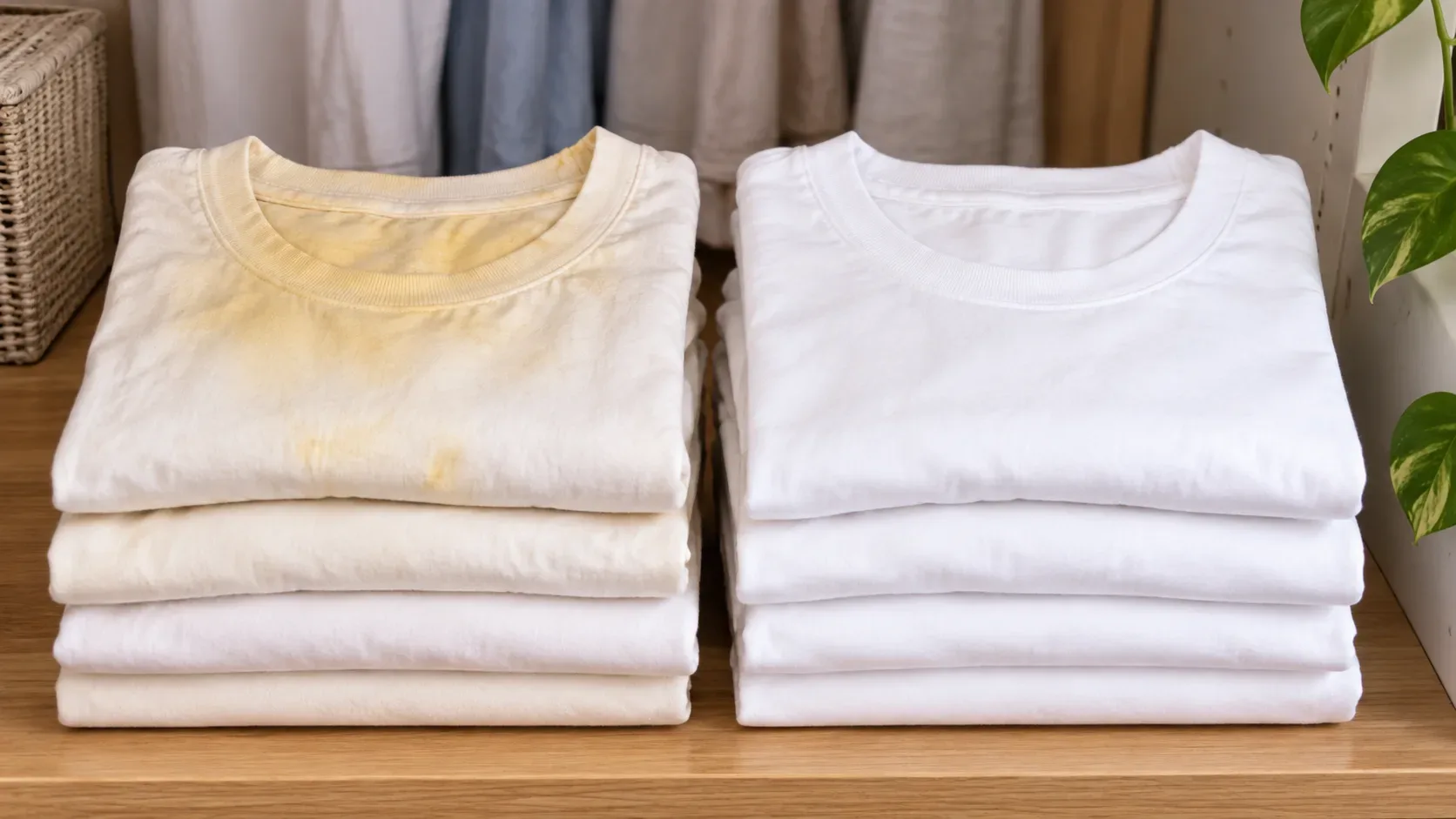
If a white garment comes out of storage yellowed, it is not safe to assume that it simply “needs chlorine bleach.” Yellowing that appears during storage can have different causes: skin oils and sweat residues aging in the fibers, laundry products that were not fully rinsed away, changes in finishes that make fabric look brighter white, or damage caused by chlorine bleach. The stain pattern, the feel of the fabric, and the garment's history can help separate these possibilities before treatment.
The first diagnosis comes from where the yellowing appears
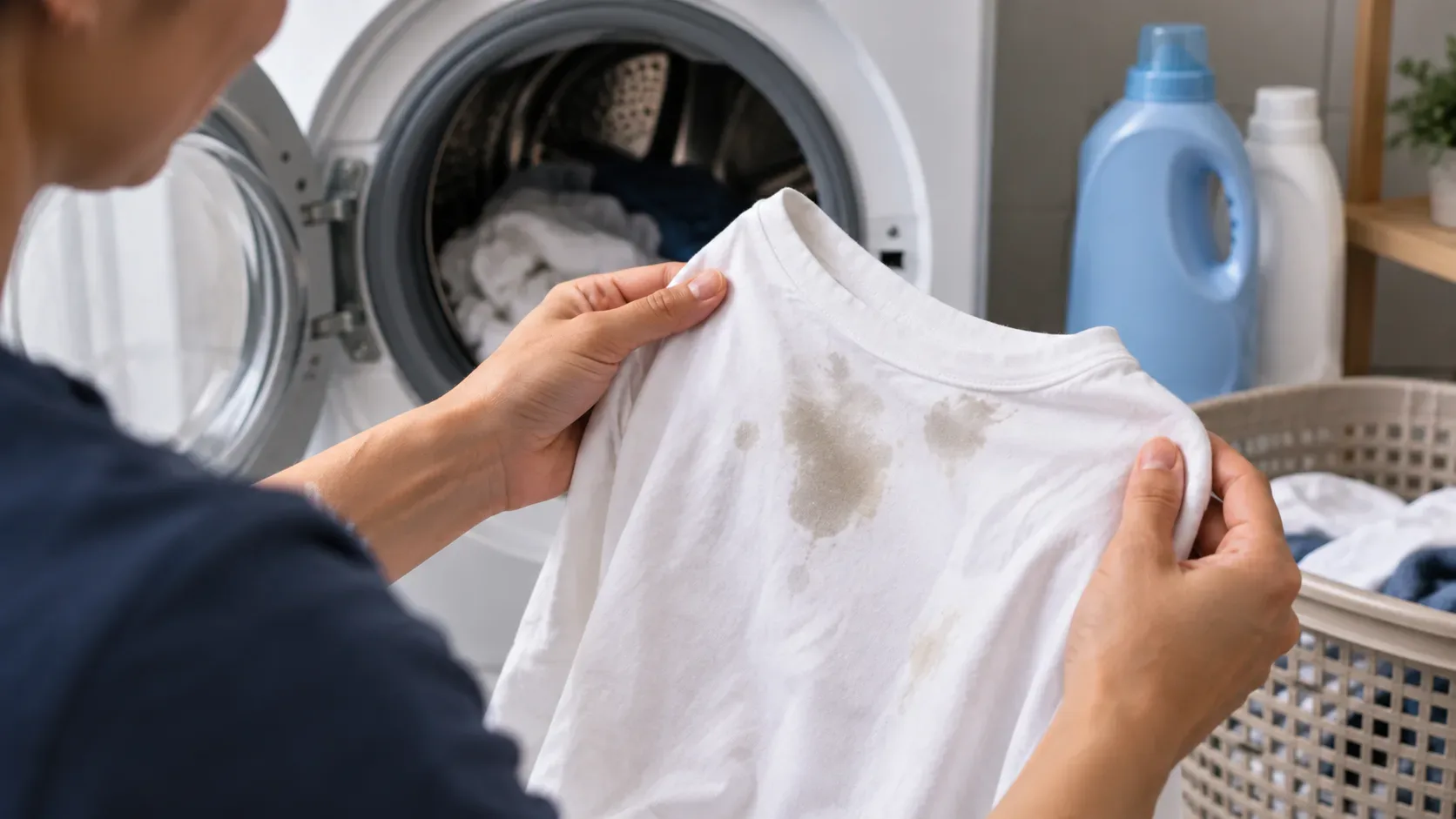
Before wetting the garment, inspect it in natural light and compare the front, back, collar, underarms, cuffs, folds, and elastic areas. Location alone does not prove the cause, but it helps choose the safest first test.
| Observed pattern | Most likely cause | Useful clue | Conservative first step |
|---|---|---|---|
| Stronger yellowing at the collar, underarms, cuffs, or other skin-contact areas | Sweat, sebum, deodorant, or other body residues | Localized stain and sometimes a stiffer feel | Pretreat with an enzyme detergent that is compatible with the care label, then wash before using heat |
| Diffuse cream or yellow cast after months in storage | Aging of oily residues, finishes, or optical brighteners | The garment looked clean when it was stored | Rewash according to the care label and reassess; if allowed, consider oxygen bleach according to its label |
| Dull, stiff, waxy, or “soapy” feel | Excess detergent, fabric softener, or insufficient rinsing | The problem is more general than spot-like | Run an extra rinse or rewash without adding more product than recommended |
| Yellowing appeared right after chlorine bleach, or is strongest around stretch areas | Reaction to or damage from chlorine bleach | Clear bleach history; elastic fibers can yellow | Stop using chlorine bleach and do not escalate to stronger mixtures; the damage may be irreversible |
Why sweat and body oils may turn yellow only later
A garment can look clean while still retaining small amounts of sebum and other oily soils. Textile research shows that unsaturated oils in body soil can oxidize as they age and form yellow compounds that are difficult to remove. This mechanism helps explain why a white T-shirt may come out of storage with marks that were not visible when it was put away. Research on aging oily soils on textiles describes oxidation and the formation of yellow chromophores during this process (Journal of Surfactants and Detergents).
In practice, the pattern is often strongest where skin contact is frequent: collars, underarms, backs, and cuffs. That does not mean “sweat alone” is always responsible. Sebum, antiperspirant, cosmetics, and particulate soil can all contribute to the deposit.
Not all yellowing is dirt: fabric whiteness can age too
Many white textiles use finishes and optical brighteners to appear whiter. The Dry Cleaning and Laundry Institute explains that some of these finishes can lose performance or yellow with exposure to light, atmospheric gases, storage, and normal use. It also notes that white fabrics tend to yellow to some degree over time (DLI: Yellowing).
This matters because it changes expectations: washing can remove soil, but it cannot necessarily restore a finish that has already degraded. If the garment is old, has been stored for years, or has yellowed very evenly, treat recovery as a gradual attempt rather than a guaranteed restoration.
When laundry residue looks like the problem
More detergent does not mean more cleaning. The American Cleaning Institute recommends using the correct amount specified by the manufacturer and notes that too much or too little detergent can leave clothes less clean. It also advises storing garments only when they are fully dry (ACI: Laundry Basics).
If the fabric feels stiff, dull, or coated, start with the lowest-risk procedure: an extra rinse or a rewash that follows the care label, without “compensating” with extra detergent or fabric softener. Let the garment dry completely and reassess it under the same light. This simple step helps avoid treating removable buildup as if it were permanent chemical discoloration.
How to recognize possible chlorine-bleach damage
Chlorine bleach is not safe for every white textile. Fiber content and care instructions matter more than the color of the garment. The American Cleaning Institute notes that wool, silk, mohair, spandex, and certain finishes can be incompatible with sodium hypochlorite and recommends following both the garment label and the product label (ACI: How to Use Bleach). Clorox also states that misuse, excessive concentration, or incompatible fibers can cause yellowing, including permanent yellowing (Clorox: Why Does Bleach Turn White Clothes Yellow?).
A strong clue is timing: the garment was white, went through a chlorine-bleach treatment, and yellowed immediately afterward. Another clue is yellowing around elastic areas. In these cases, repeating chlorine bleach increases the risk. If fibers or finishes have been degraded, there is no reliable household “antidote” that rebuilds the material.
A conservative testing sequence before treatment
- Read the care label. Identify fiber content, allowed temperature, and bleach symbols. If it says “do not bleach,” stop there.
- Photograph and map the discoloration. Record where the yellowing is strongest so you can tell whether the next step improved or worsened it.
- Start with rinsing or rewashing. This is the most prudent option when detergent, softener, or poor rinsing is suspected.
- For body-contact areas, treat organic soil first. Use an enzyme detergent or stain remover that is appropriate for the fabric and follow its label. Avoid a hot dryer or ironing while the mark remains.
- If the garment allows it, move to oxygen bleach. Use only the concentration, temperature, and contact time stated by the manufacturer. The ACI describes oxygen bleach as gentler for washable fabrics, but the garment care label still controls.
- Rinse fully, dry, and reassess. Do not stack chemical treatments in the same container or apply a new product without removing the previous one.
- Stop if there are signs of damage. Thinning, loss of stretch, yellowing that followed chlorine bleach, or a delicate garment are reasons to seek professional care rather than increase treatment strength.
Safety rule: chlorine bleach does not belong in combined “home recipes”
Do not mix chlorine bleach with vinegar, acids, ammonia, or other cleaners. The CDC states that hypochlorites can release chlorine gas when mixed with acids and dangerous gases when combined with ammonia; the general guidance is not to mix cleaning products (CDC: Chemical Disinfectants). Even if an earlier step used a different product, rinse the garment and container completely before any new step, and always follow the product label.
How to reduce yellowing during storage
- Wash white garments that are sweaty or worn directly against the skin before long-term storage.
- Use the correct detergent dose and avoid overloading the washer so washing and rinsing can work properly.
- Store garments only when they are completely dry.
- Do not use chlorine bleach “just in case”; use it only when both the garment label and product instructions allow it.
- For valuable, vintage, silk, wool, stretch, or specially finished garments, prefer professional guidance.
The safest logic is simple: diagnose before whitening. Yellowing concentrated in skin-contact areas points toward body residues; a stiff or dull feel suggests laundry buildup; a change immediately after chlorine bleach suggests incompatibility or damage; and uniform yellowing on an older garment may involve aging of the finish itself. Starting with the least aggressive test preserves more fabric and reduces the chance of turning a treatable change into permanent damage.