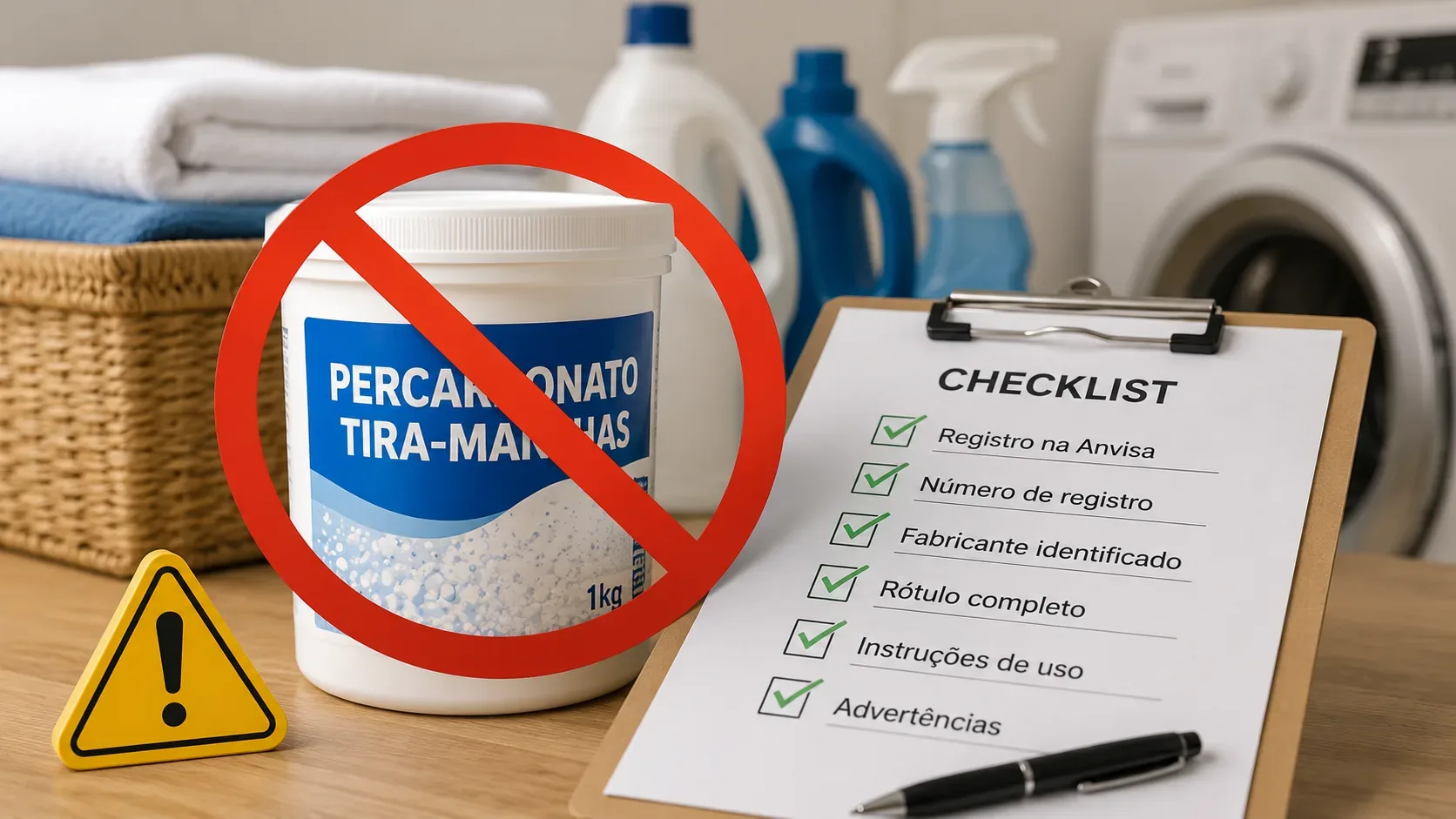
If you bought a stain remover or sodium percarbonate product and want to know whether it is among the products banned by Brazil's Anvisa, start by comparing the exact product name and the brand or distributor identification with the official list. On August 12, 2026, the agency published an enforcement measure against 12 household cleaning products that lacked sanitary registration and had unknown origin. The action applies to those identified products; it does not mean that all sodium percarbonate has been banned.
Which 12 products were named by Anvisa
The list released by the agency is:
- Oxypur – Quimpac
- Percarbonato de Sódio - Los Chefs
- Alvejante Natural Multiuso – nova fórmula
- Percarbonato de Sódio - Vong Home
- Boa Alvejante Percarbonato de Sódio em pó
- Percarbonato Plus – ANS Agrária
- Percarbonato de Sódio - Nativa
- Yta Clean
- Alvejante Tira Manchas – Amigos Distribuidora
- Percarbonato de Sódio - Oxigen
- Tira Manchas – FV Group
- Percarbonato Top Brilho
The primary source is Anvisa's enforcement notice on the 12 cleaning products, which points to Resolution-RE No. 3,147 of August 11, 2026.
How to check whether your product is one of the banned items
- Read the front and back of the package. Write down the commercial name exactly as shown, the brand, manufacturer or distributor, tax ID if present, batch number, and any registration or process number printed on the label.
- Compare it with the official list. Do not decide based only on the word “percarbonate.” Many products may use that ingredient or description. For this measure, what matters is the identification of the product covered by Anvisa's action.
- Check its regulatory status. Anvisa provides a product registration lookup service and a broader Consultation System with public information about cleaning products, irregular products, and registration status.
If the name looks similar but the brand, responsible company, or other details do not match, do not assume it is the same product. Use the full label information in the official search. Likewise, a number printed on a package should not be treated as proof of registration until it is confirmed in Anvisa's system.
What “unregistered” means and why it matters
For the products named on August 12, Anvisa said they were cleaning products without sanitary registration and of unknown origin. In its guidance on irregular household cleaning products, the agency explains that products lacking the required regularization do not provide the assurance of efficacy, safety, and quality associated with sanitary oversight, and it does not recommend using them.
This does not mean that a regulated product is risk-free. Household cleaning products must still be used according to the label, including the manufacturer's dilution instructions and precautions. The difference is that regularization provides a verifiable reference for responsibility and compliance with applicable sanitary requirements.
I already bought one of the listed products: what should I do?
- Do not use it. If the identification matches a banned item, the prudent choice is to stop using it.
- Keep it in the original package. Do not transfer the contents into bottles, jars, or unlabeled containers. Keep it away from children and pets while arranging its destination.
- Document the details. Photograph the label, batch number, manufacturer or distributor, and keep the receipt, marketplace record, or order confirmation.
- Contact the seller. Explain that the product is covered by a sanitary measure and ask for instructions on return, collection, or another commercial solution. Avoid transporting an open, leaking, or damaged container without appropriate guidance.
- Report irregularities or problems. Anvisa's e-Notivisa accepts technical complaints and adverse-event reports from consumers involving household cleaning products.
The specific notice on the 12 products states that manufacturing and sale were prohibited, but it does not set out one universal consumer return procedure. Practical disposal or return should therefore follow guidance from the seller, the responsible company, and, when necessary, the local health surveillance authority.
Do not try to “fix” an irregular product with homemade mixtures
If a stain remover is not trustworthy, mixing it with bleach, acids, ammonia, alcohol, or other cleaners does not make it safer. It can create an unpredictable reaction. Anvisa warns that combining cleaning products can generate toxic substances and advises consumers to follow label instructions instead of improvising household formulas.
In particular, do not try to “boost” a percarbonate product with another bleach because it seems weak or because you want to use up what you bought. When the origin and regulatory status are uncertain, the safe response is not to experiment.
If there was contact, inhalation, or a reaction
If someone developed severe burning, significant irritation, breathing difficulty, malaise, or another reaction after using a cleaning product, stop the exposure and seek health guidance. Brazil's Ministry of Health maintains a list of Poison Information and Assistance Centers (CIATox), and the Poison Information line 0800 722 6001 serves several regions and routes calls to centers in the network.
For severe breathing difficulty, loss of consciousness, or another emergency sign, seek emergency medical care immediately.
Quick checklist before using a stain remover or percarbonate product
- Are the product name and brand clearly shown on the label?
- Is the manufacturer or responsible company identified?
- Are there directions, warnings, and a batch number?
- Can the product's status be confirmed in Anvisa's official systems?
- Is the item absent from alerts or enforcement measures involving irregular products?
- Are you using the product on its own, exactly as the label directs, without improvised mixtures?
For this August 2026 case, the safest path is straightforward: confirm the product's identity, verify its regulatory status through an official source, and do not use an item that matches the banned list. There is no need to test it at home or try to correct an unknown formulation by adding other substances.