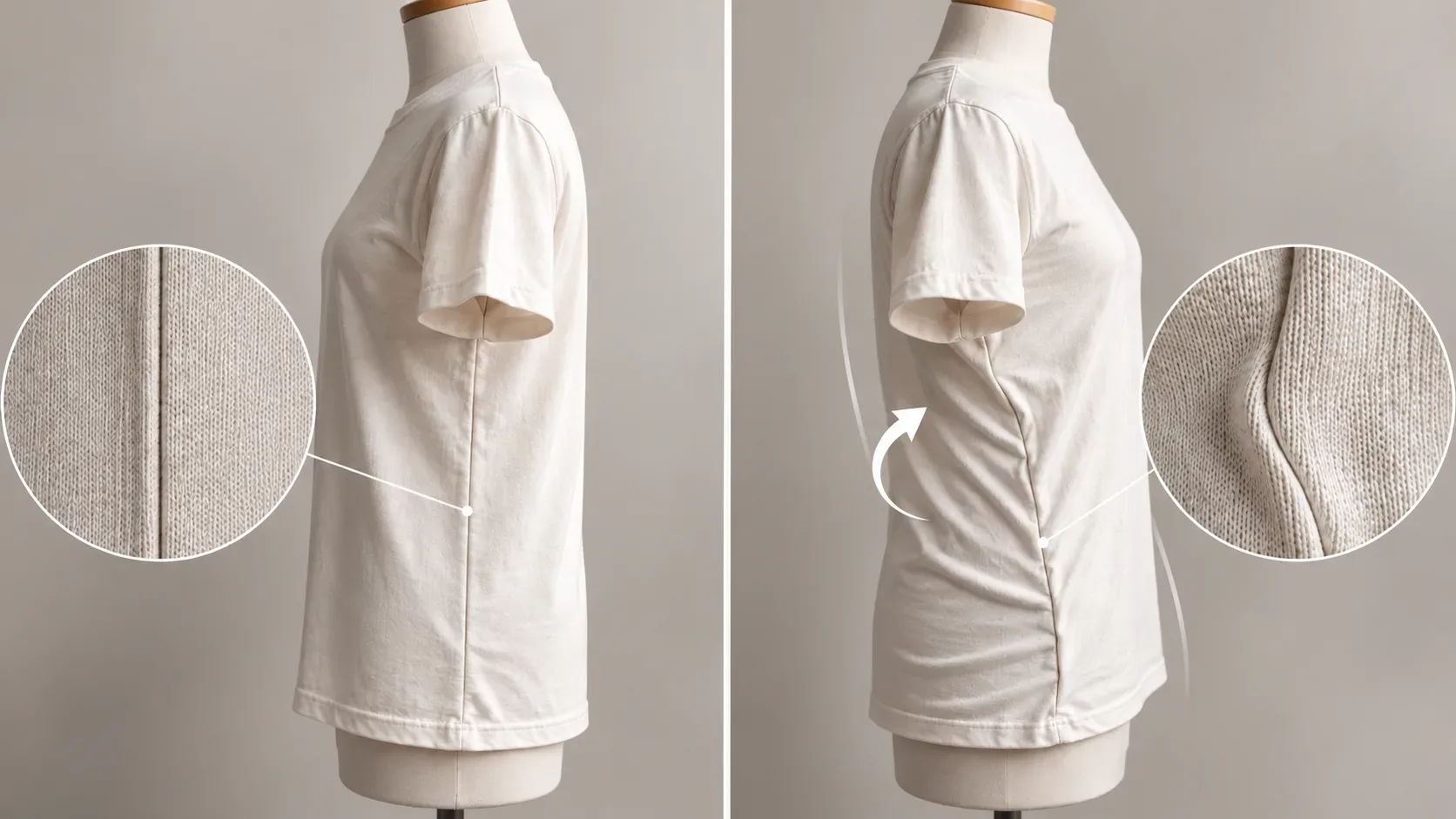
When a T-shirt side seam moves away from the side and rotates toward the front or back after washing, the most likely problem is not simply crooked stitching. In knitted fabrics, especially single jersey, this behavior is known as spirality or seam twist: the knitted structure relaxes, rotates, and changes the position of the side line. Washing often reveals the problem because water, movement, heat, and drying allow residual stresses in the yarn and fabric to settle.
That does not mean every twisted T-shirt has the same diagnosis. Off-grain cutting, asymmetric assembly, and localized sewing problems can also move or distort a side seam. The most useful approach is to separate what was already wrong before the first wash from what appeared when the fabric relaxed.
What makes a T-shirt side seam rotate
Spun yarns are twisted to hold fibers together. Some of that twist can remain as residual torque. When the yarn becomes knitted fabric, each loop is constrained by neighboring loops, but the tendency to rotate does not necessarily disappear. With certain combinations of yarn, construction, and knitting process, the wales stop running perfectly vertically and begin to lean.
This effect is particularly associated with single-jersey knits. Technical literature points to factors such as residual yarn torque, twist level, stitch length, process tension, and machine configuration as variables that can increase or reduce spirality. Rizex Apparel describes the phenomenon as the release of stored yarn twist energy during laundering. CottonWorks also treats skew and dimensional stability as issues connected with fabric construction and processing.
A three-step diagnosis
1. Compare the shirt before and after washing
If possible, look at both side seams while the garment is still new. Lay the T-shirt on a flat surface, align the neckline, shoulders, and hem without stretching the fabric, and note where each seam reaches the hem. Then wash and dry according to the care label and repeat the check.
A seam that was essentially on the side and then clearly migrated after laundering suggests fabric relaxation and rotation. If the seam was already displaced, slanted, or attached to visibly asymmetric panels before washing, cutting and assembly become stronger possibilities.
2. Look at the knit structure, not only the seam
On T-shirt fabric, the vertical columns formed by the loops can be used as a visual reference for the fabric direction. When these columns lean across a large part of the garment body and the seam follows that rotation, the evidence points toward spirality in the knit itself.
A home check is only indicative. Quality-control laboratories use standardized methods. AATCC distinguishes fabric skew change from seam twist in a finished garment. The organization refers to TM179 for skew change in fabrics and TM207 for seam twist in garments before and after home laundering. The association's 2026 manual lists AATCC TM207-2025 as a revised method.
3. Decide whether the distortion is global or localized
Spirality tends to appear as rotation of a panel or the garment as a whole, not just small ripples next to the stitches. If the problem is confined to a narrow strip along the seam, with puckering, waviness, or a length mismatch between the joined plies, the sewing operation may be involved. Coats connects seam puckering with factors including thread tension, uneven feeding, fabric structure, and dimensional instability between thread and fabric.
| Observed sign | What it suggests | How to check |
|---|---|---|
| Seam straight before washing and displaced afterward | Spirality or skew revealed by relaxation | Compare photos and the seam position at the hem |
| Knit wales lean across the garment body | Rotation of the fabric structure | Inspect loop direction away from the seam |
| Seam is already crooked on a new shirt | Possible cutting, assembly, or pre-existing fabric skew | Lay the garment flat before washing |
| Waviness appears only along the stitches | Possible seam pucker or feeding/tension problem | Check whether the rest of the panel remains aligned |
| Hem and body seem to rotate together | Strong indication of garment-wide spirality | Compare both sides and the knit orientation |
When it is a fabric defect
For a consumer, a T-shirt whose side seam rotates noticeably after normal care can reasonably be treated as a performance problem in the garment. Technically, when the seam is merely revealing rotation that occurs throughout the knit, the origin is closer to the material and fabric processing than to the stitch line itself.
The cause can involve yarn torque, knitted construction, and the way the fabric was knitted and finished. The important point is that the seam acts like a visual ruler: it makes rotation in the panel easy to see. Cutting a garment so the skew is less obvious can improve its initial appearance, but it does not remove the fabric's tendency to relax during laundering.
When cutting or sewing may be responsible
Some signs call for a different diagnosis. If a new T-shirt already has a side seam moving toward the front, if panel hems do not match, if one side appears longer, or if the garment will not lie flat before laundering, the panels may have been cut off the proper alignment or assembled asymmetrically.
A narrow wavy pucker along the stitch line is also different from spirality. Excessive thread tension, uneven feeding of the layers, and incompatibility between fabric and thread can distort a seam. In those cases, the affected area is concentrated around the stitches while the overall knit direction may remain correct.
Why washing makes the problem visible
Laundering does not have to create spirality from nothing. It often allows stresses held since manufacturing to be released. Water and agitation help the fabric relax, while drying can complete part of that rearrangement. That is why professional specifications evaluate behavior after defined laundering cycles rather than relying only on the appearance of a newly made garment.
This also explains why a T-shirt can look straight on the rack and change after its first home-care cycle. The initial appearance shows the state of the fabric at that moment, but not necessarily its stability after relaxation.
Does pre-shrunk fabric prevent twisting?
Not necessarily. Shrinkage and spirality are both related to product stability, but they are not the same property. Compaction and finishing can reduce dimensional changes in length and width, yet they do not guarantee that all residual yarn torque or fabric skew has been removed.
Technical quality-control methods likewise separate dimensional change, fabric skew, and garment seam twist. A T-shirt can therefore shrink very little and still develop side-seam rotation, or it can shrink more without showing obvious spirality.
Can you fix it at home?
You may be able to improve the appearance of some damp garments temporarily by reshaping the T-shirt without stretching it, aligning the hem and side seams, and letting it dry in a controlled position. Careful steaming or pressing can also help the garment settle. However, when the cause is residual torque and structural spirality, these measures do not remove the material cause. The rotation can return in later washes.
Avoid trying to compensate by forcefully pulling one side, because that can create additional distortion. For a new garment with pronounced twist, the most useful step is to document its condition before and after care performed according to the label and then check the seller's return or warranty policy.
How to document the problem objectively
- Photograph the T-shirt flat before the first wash if you notice any misalignment.
- Follow the temperature, cycle, and drying method stated on the care label.
- Once dry, lay the garment flat without stretching and align the shoulders and neckline.
- Check where each side seam reaches the hem and whether it migrated toward the front or back.
- Compare the direction of the knit wales in the center of the panel with the seam position.
- Record whether the distortion is garment-wide or only a localized pucker next to the stitches.
This procedure is not a laboratory test, but it helps distinguish fabric rotation from a localized construction defect.
Practical summary
If the seam was in the correct position before laundering, then migrated afterward, and the knit itself appears slanted, spirality or fabric skew is the strongest explanation. If the T-shirt was already misaligned when new, cutting and assembly should also be considered. If the problem is only waviness around the stitches, investigate seam tension, feeding, and construction. In every case, comparing the garment before and after washing and looking at the knit direction is more informative than judging only the visible side seam.