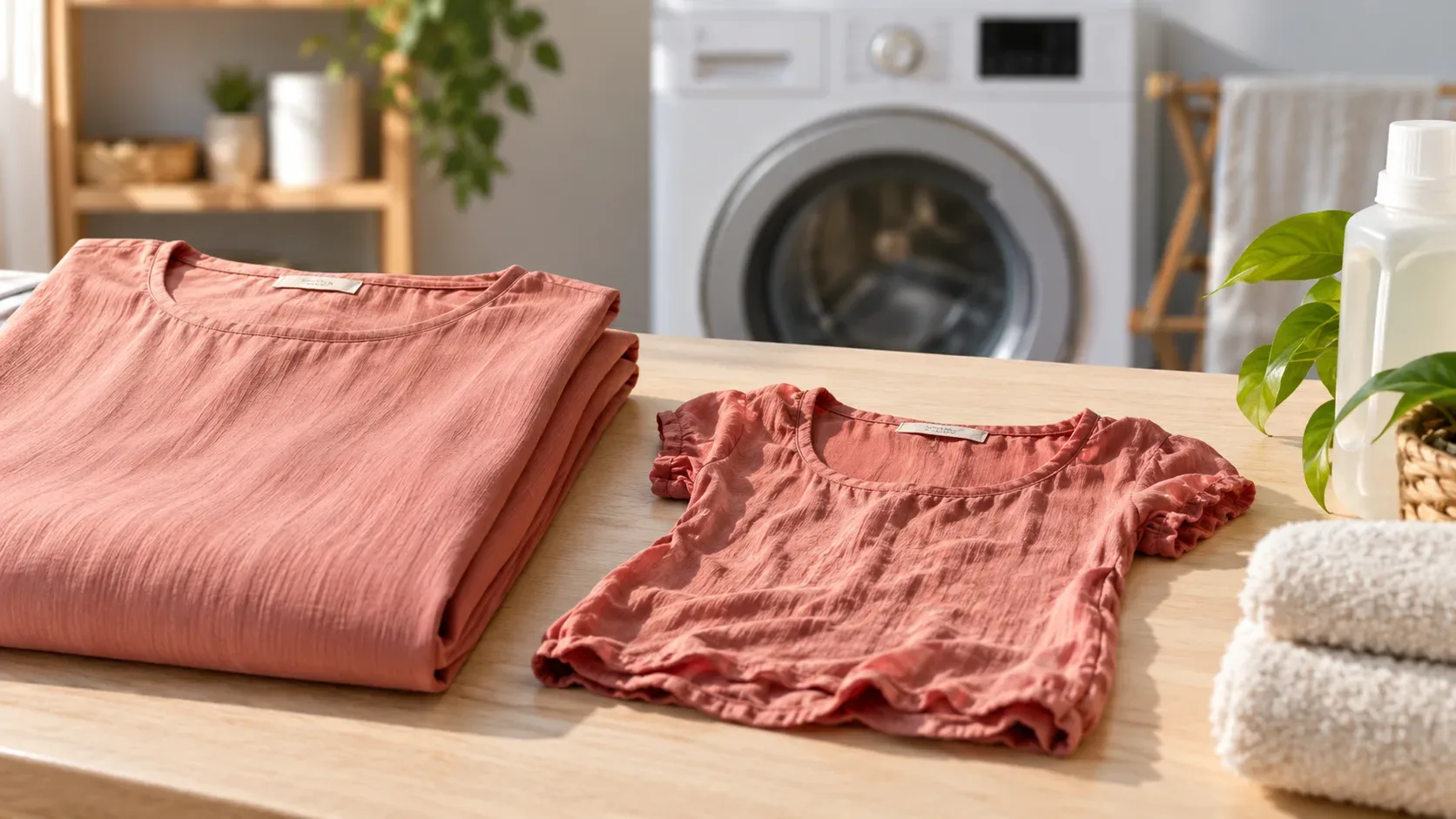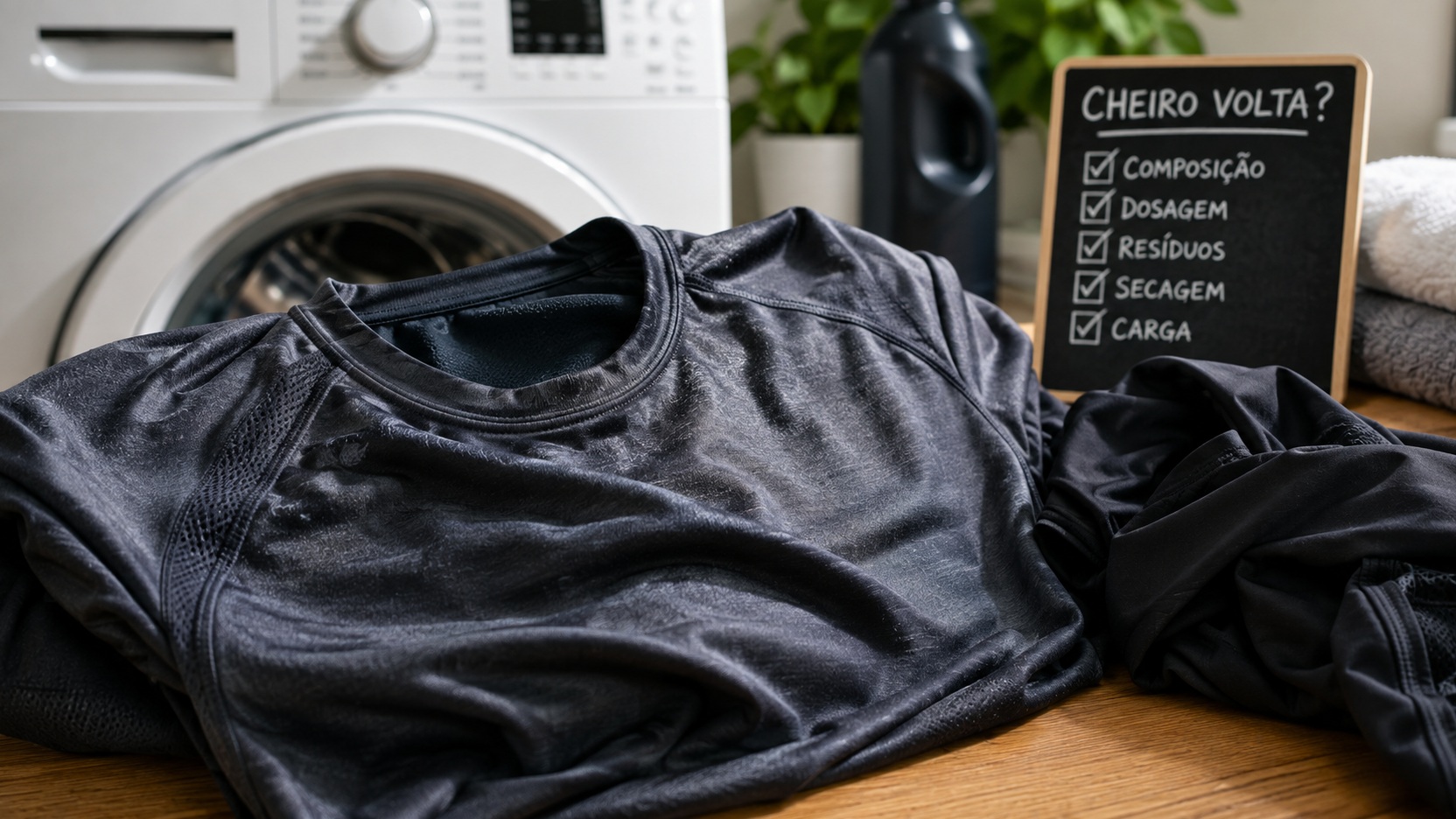
The t-shirt comes out of the machine without an obvious smell, dries, goes in the closet and looks sorted. The problem reappears when it returns to the body: just a few minutes of training, heat and sweat are enough for the odor to appear again. This pattern is different from a piece that comes out of the washer smelling bad and is also different from the smell of damp that appears during drying or storage.
In sportswear with a lot of polyester, there is an additional explanation: the type of fiber itself influences how much certain odor compounds and oily residues are associated with the fabric and how they are released afterwards. This does not mean that every synthetic item will smell bad or that polyester is impossible to wash. It just means that, when the odor persists, it is worth reviewing the washing process before increasing the dose of product or adopting a homemade recipe.
The moment the smell appears changes the diagnosis
The first step is to observe the piece at three different times: when it comes out of the machine, after it is completely dry and again during use. This sequence helps separate different problems that are often treated as one.
If the item comes out of the washing machine with an unpleasant smell, the investigation begins with the cycle itself: load size, dose and type of detergent, choice of program, rinse efficiency and condition of the machine. If it comes out clean and remains odorless when dry, but the odor reappears when the fabric heats up and receives sweat, the hypothesis of odor residue or body dirt trapped in the fiber gains strength.
If the smell only appears after the clothes have been damp for a long time, whether in a backpack, closed basket or long drying, the focus changes again. In this case, the wet residence time is included in the diagnosis and should not be confused with the specific behavior of the polyester during use.
Why polyester can smell better than cotton
The difference is not just an impression of those who train. In a study of 26 people who did an intense cycling session, polyester t-shirts were rated as significantly more intense and less pleasant in odor than cotton t-shirts after the incubation period used in the experiment. The researchers also found differences in the tissue-associated bacterial community.
Other work, this time following repeated soiling and washing cycles on cotton and polyester fabrics, showed that washing removed odor compounds more efficiently from cotton than from polyester. The authors related the accumulation of odor to the incomplete removal of these compounds, especially in polyester, which has a greater affinity for oily and less polar substances.
Further research helps explain this behavior. In an experimental model with sweat and sebum, the greater hydrophobicity of polyester favored greater bacterial adhesion and greater sebum absorption than cotton. In another study, volatile odor compounds applied through a solution that simulated sweat showed different sorption and release patterns between fibers, with polyester releasing greater amounts of several nonpolar compounds than cellulosic fibers.
In practice, this helps you understand why clothing may feel acceptable when it is cold and dry and smell again during training.. Some of the odorous material may not have been completely removed during washing and may be released again when the item receives heat, humidity, movement and a new load of sweat and sebum. It is not necessary to choose between a chemical and a microbiological explanation: the two can coexist.
Review washing before looking for a new recipe
Confirm the composition and read the label
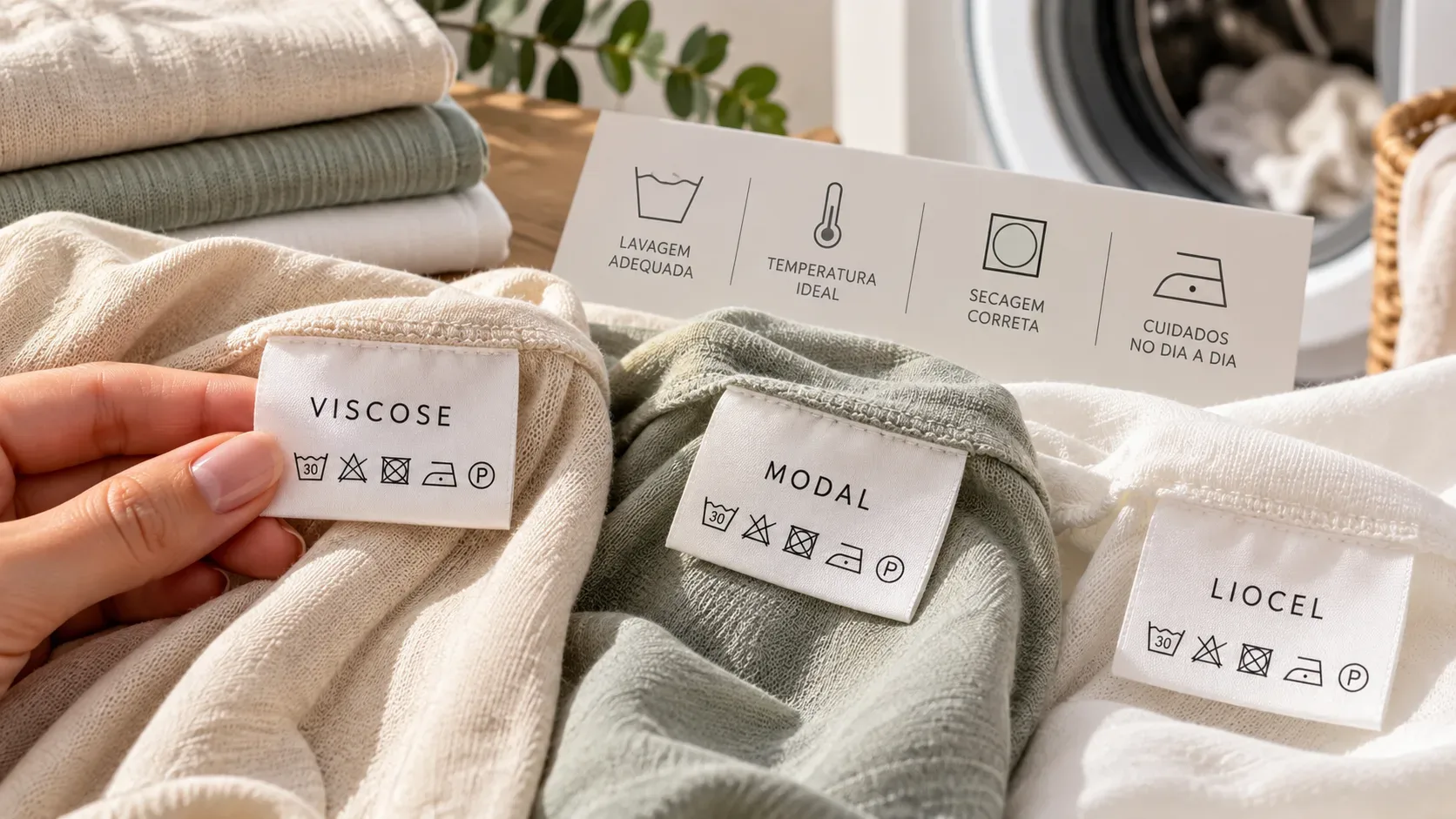
Look at the composition label before deciding what to do. A t-shirt can be mostly polyester, but also contain elastane, polyamide or other materials that limit temperature, bleaching and drying. The conservation label is the safest limit for any adjustment. A method that would be tolerable on a cotton t-shirt may damage the elasticity, finish or color of an athletic garment.
It is also worth confirming whether the problem is concentrated in synthetic parts. If cotton clothes washed in the same cycle come out well and only a few training t-shirts smell again during use, this reinforces the hypothesis of an interaction between composition, body residues and history of that specific item.
Reduce the load if the drum is too full
Clothes need space to move, receive water and detergent evenly and be rinsed. A heavily loaded machine can reduce mechanical action and make it difficult to remove and rinse residue. In a garment that already has a tendency to retain oily material, this detail can be enough to transform a cycle that seems normal into an incomplete wash.
The simplest test is to repeat the wash with a smaller load, without changing all the other variables at the same time. If the result improves, the amount of laundry in the drum was probably part of the problem.
Adjust the detergent dose instead of just increasing it
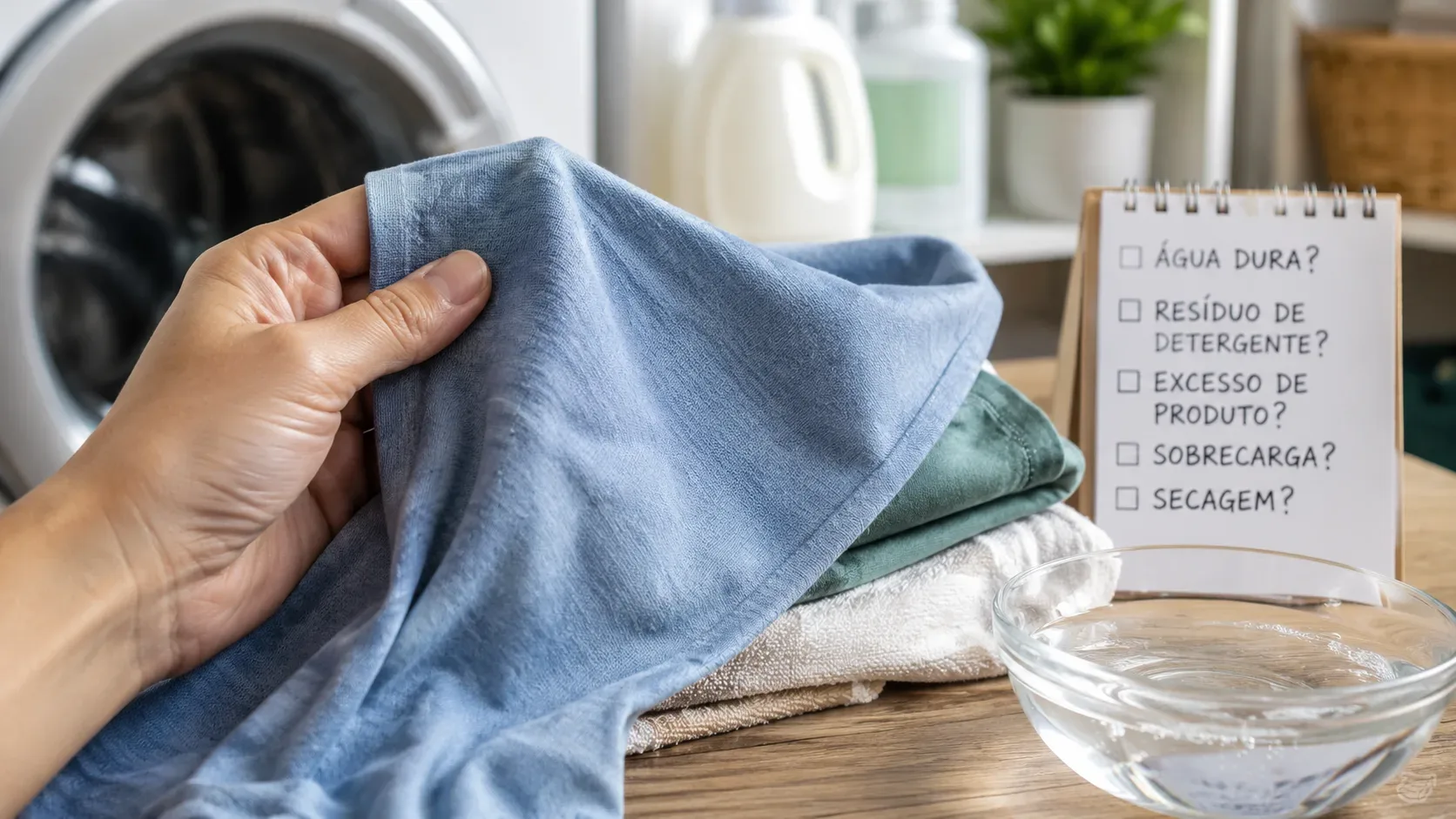
More detergent does not automatically mean more cleaning. The dose must follow the size of the load, the degree of dirt, the concentration of the product, the type of machine and, when the manufacturer advises, the hardness of the water. Insufficient detergent can leave sweat, sebum and particles on the fabric. In excess, it can be more difficult to rinse and leave residues that mask the assessment of what was actually removed.
Therefore, check the dosage on the detergent label and the type of product recommended for the washer. If the machine is high efficiency, use a detergent compatible with that system. The idea is to correct the quantity, not compensate for the odor with an increasingly larger dose.
Treat rinsing as part of cleaning
If the item comes out feeling slippery, very perfumed, with spots of product or a feeling of residue, rinsing deserves attention. When the washer offers additional rinsing and the clothing label does not impose restrictions, an extra cycle can serve as a test to see if there is any remaining product.
This doesn't need to become a mandatory step forever. The goal is to use the rinse as a diagnostic tool. If the improvement only appears when it is necessary to rinse repeatedly, it is worth checking the detergent dose and the quantity of clothes in the machine beforehand.
Check the use of softener on performance parts
Softeners deposit agents on the fibers to alter the feel. In garments designed for moisture management, some machine and garment manufacturers recommend not using fabric softener because this deposition may interfere with expected performance.. The safe rule is to check the part label and the manufacturer's instructions, rather than assuming that the product is always necessary or always prohibited.
If clothes with a persistent odor receive fabric softener in every wash, it's worth doing a test without it when the label allows. Again, change one variable at a time to see what really made a difference.
Remove from the machine and dry completely
Even when the main problem is odor retention in the polyester, leaving wet clothes sitting after the cycle adds another source of smell. Remove the load when finished and dry completely using the method permitted on the label.
If the odor only appears after the item is damp or stored before it dries completely, don't attribute it all to polyester. In this scenario, the investigation should include drying time, the location where the clothes were left and, if other items also have an odor, the washer itself.
When the smell appears, what to test first
The clothes come out of the machine with a smell
Start with load, dosage, type of detergent, program, rinse and cleaning of the washer. The problem is present before the garment returns to the body, so it doesn't make sense to just blame the reactivation of the odor on sweat.
Clothes are odorless when they dry, but they stink as soon as training starts
This is the pattern most compatible with compounds and residues that have not been completely removed and are re-perceived when the fabric receives heat, humidity and sweat. In pieces with a lot of polyester, the affinity for oily materials and the pattern of release of volatile compounds make this hypothesis especially relevant.
The smell appears after being wet in your backpack or basket for hours
Time in humid conditions becomes a central variable. Airing the item until washing, when it is not possible to wash it immediately, and avoiding keeping it stuffy help to separate this problem from an odor that actually persists despite adequate washing.
All clothes start to smell alike
When towels, cotton and regular clothing present the same problem, look beyond the sports t-shirt. Accumulation of residue in the drawer, rubber, filter or drum, as well as drainage and maintenance problems, can affect the entire load. In this situation, follow the cleaning and maintenance procedure provided in the washer manual.
Only one item gets worse with each use and wash cycle
The history of that fabric gains weight. Repeated sweating and washing cycles can accumulate compounds that are more difficult to remove from polyester. Correcting the process can improve the situation, but a heavily impregnated garment may not respond in the same way as a new garment.
When it makes sense to use a specific intervention
After correcting the load, dose, rinsing and drying, there may still be a residual odor. Then it makes sense to start with an intervention compatible with the label, such as pre-treatment in areas that are most exposed to sweat, choosing a cycle more appropriate to the level of dirt or using a product formulated to remove body and oily dirt.
The important point is not to treat any solution as universal. A study that compared common liquid detergent and detergent aimed at sportswear showed that the result is not limited to the name of the product: the type of fiber and the accumulation over repeated cycles also influence odor retention.. Therefore, changing detergents can help in some cases, but it does not replace a well-adjusted washing process.
It is also not wise to increase the temperature, use bleach or mix homemade ingredients without checking the label. Sportswear often includes spandex, finishes and colors that can react poorly to excessive heat or oxidizing agents. If the proposal requires ignoring the conservation guidelines for the piece, it has already started down the wrong path.
What studies do not allow us to conclude
The experiments show clear trends between fiber types, but they don't turn all polyester into an inevitably smelly fabric. Fabric structure, finish, fiber mix, amount of sweat, individual microbiota, product used and washing conditions alter the result.
There is also no universal number of washes, a single temperature or a proven home recipe for all fitness clothing. Controlled studies isolate some variables to understand mechanisms; The laundry at home mixes many of them at the same time. This is why a stepwise diagnosis is often more useful than testing multiple solutions at once.
The best clue is to compare before and after use
If the clothes already smell when they come out of the machine, correct the washing process. If it is truly neutral when dry and the odor reappears only with heat and sweat, focus the investigation on the removal of body residues and the behavior of the synthetic fiber. If the smell arises during drying or storage, treat this third scenario separately.
This simple division avoids two common mistakes: blaming the machine for an odor that is strongly linked to the item's history and, at the opposite extreme, blaming the polyester for a wash that is overloaded, poorly dosed or poorly rinsed. Before looking for the next recipe, it's worth finding out at which stage the smell appears and only changing what the test actually points out.