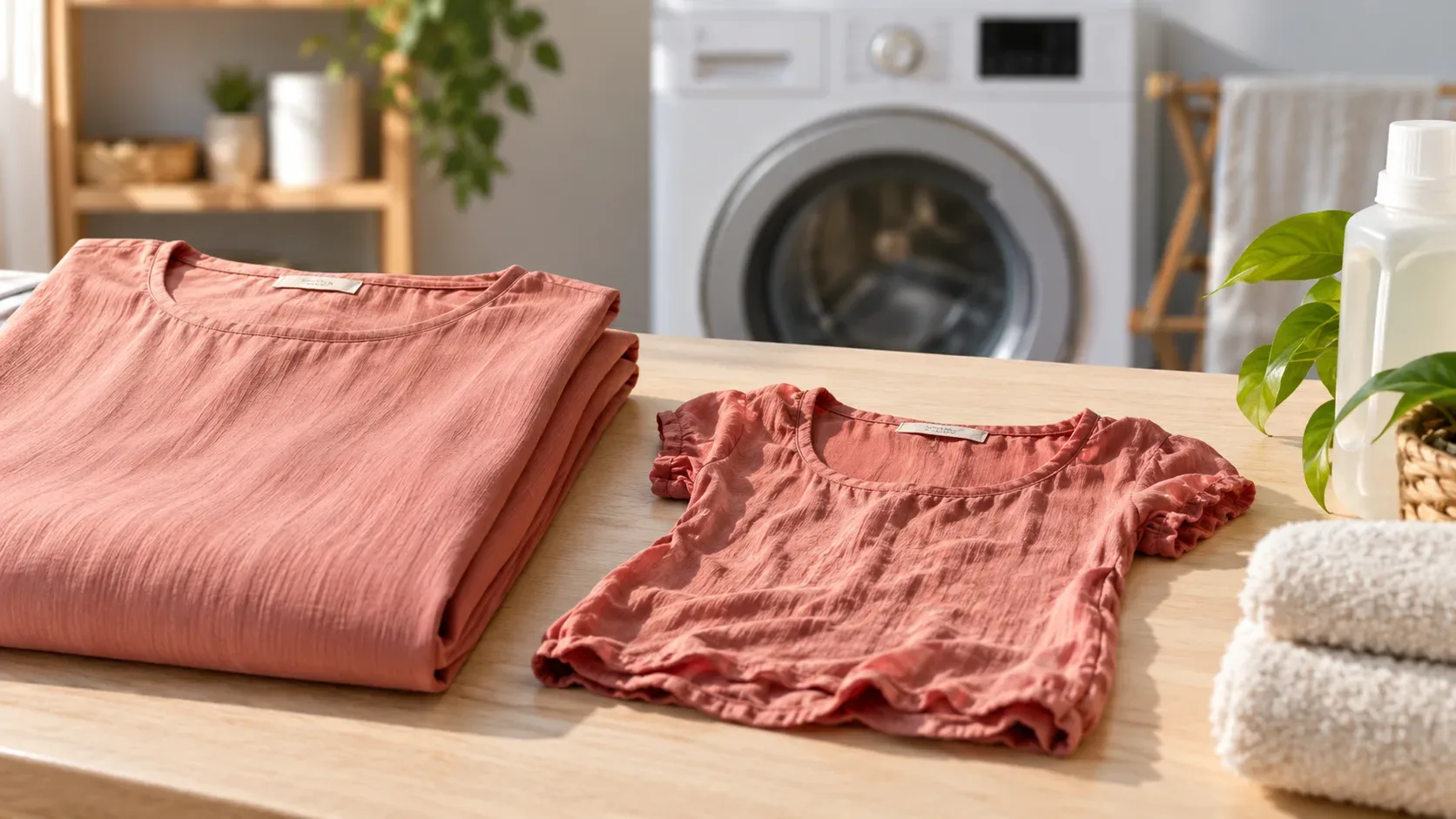
If a viscose garment became smaller after washing, the first point is not to treat it like a stretchy fabric that only needs to be pulled back into shape. Viscose — a common type of rayon, a regenerated-cellulose fiber — can lose strength when wet and can also undergo dimensional changes. Depending on fabric construction, finishing, temperature, agitation, and drying, it may shrink, stretch, or distort. Recovery, when possible, is usually partial and should involve very little force.
Why viscose can shrink in the wash
The University of Georgia Extension describes rayon as a manufactured cellulosic fiber that becomes weaker when wet and may shrink or stretch unless the fabric has been appropriately treated. This helps explain why a garment that seems sturdy while dry can become much more vulnerable during laundering.
1. The fiber absorbs water and the fabric becomes less stable
When wet, the cellulosic structure absorbs water and loses part of the strength it has while dry. In that state, twisting, rubbing, aggressive spinning, or pulling the garment can not only change its size but also shift seams, distort necklines, and leave different areas at different lengths.
2. Tensions in the fabric can relax
The Smithsonian's Museum Conservation Institute notes that rayon fabrics are especially susceptible to relaxation shrinkage during dry cleaning or wet cleaning. In practical terms, tensions introduced during manufacturing and finishing can ease when the material is cleaned, changing the garment's dimensions without any visible “melting” or obvious fiber damage.
3. Construction and finishing matter as much as the word “viscose”
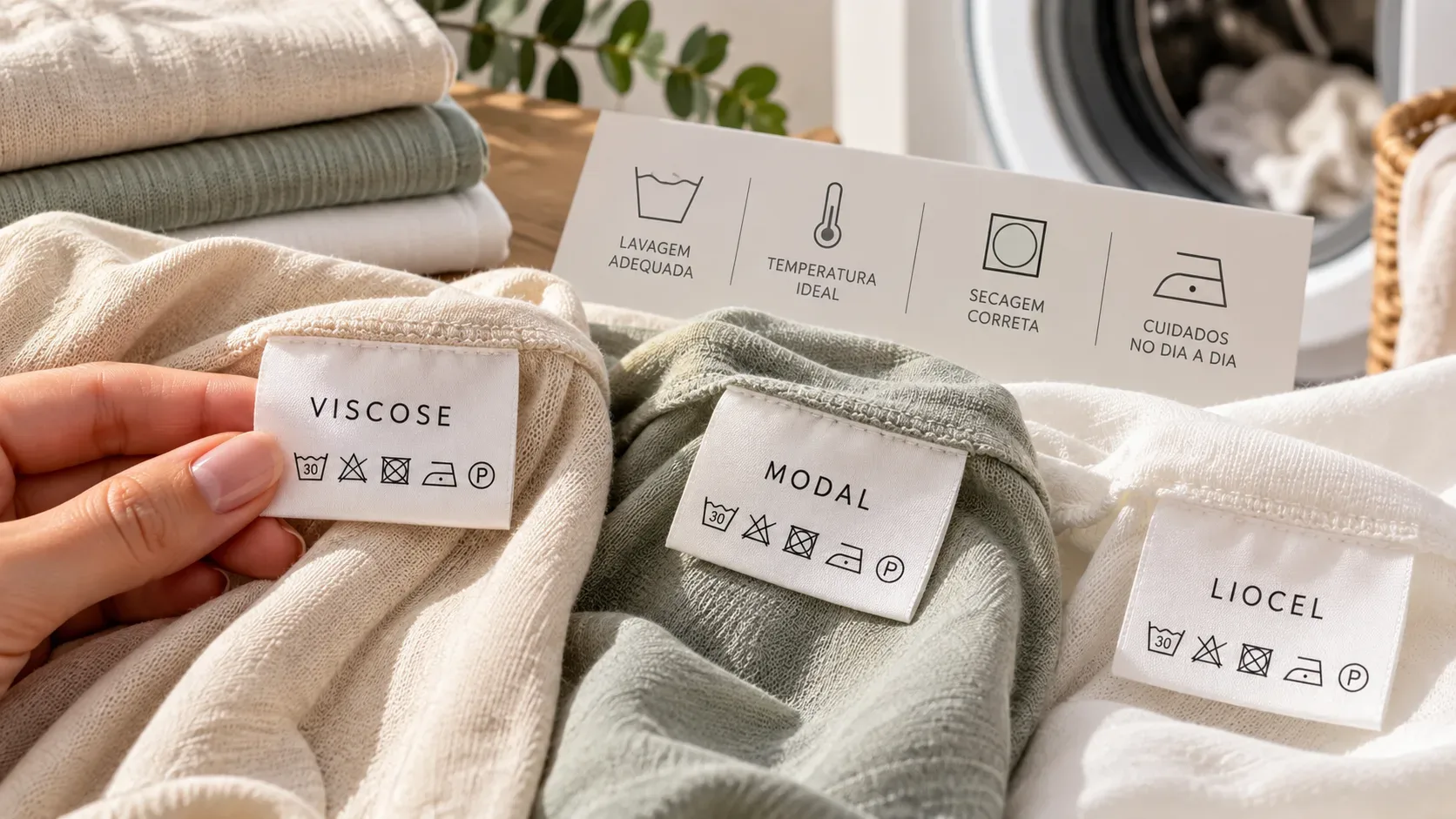
Two garments with the same viscose percentage can behave differently. Knit or woven construction, yarns, density, lining, interfacing, fiber blends, and stabilizing finishes all affect the result. That is why there is no safe rule such as “all viscose can be hand-washed” or “all viscose must be dry-cleaned.” The care label on the actual garment is the most important practical reference.
Before trying to restore it, check the care label
The safest rule is to follow the permanent care instruction. The Federal Trade Commission's Care Labeling Rule requires washing or dry-cleaning instructions to identify a regular care method that can be used without harming the item. The Mississippi State University Extension likewise emphasizes that the label provides specific requirements such as water and drying temperatures.
If the label says “dry clean only,” do not soak the garment in water to try to restore its size. If washing is allowed, the method below may be reasonable, but there is still no guarantee that the original dimensions will return completely.
Decision tree: what to do based on the garment's condition
| Garment condition | What to try | What to avoid |
|---|---|---|
| Still damp and only slightly smaller | Lay it on a towel, align seams and edges, and gradually reshape it to a plausible original form. | Hard pulling, twisting, thin hangers, and direct heat. |
| Already dry, but the label allows washing | Evenly dampen it with cold water or according to the label, remove excess water without twisting, and reshape while damp. | Repeating hot cycles or trying to “make up” for shrinkage by stretching one isolated area. |
| Dry-clean-only, lined, pleated, interfaced, or structured | Take it to a professional cleaner and explain that the garment changed dimensions. | Home soaking or intense steaming without care-label guidance. |
| Severely shrunken, twisted, or changed in texture | Stop aggressive attempts; consider tailoring or another use for the garment. | Forcing it back to size, because wet rayon is more vulnerable. |
How to try to restore it without distorting it
For a washable garment with mild shrinkage, the most conservative approach is to work with it evenly damp and without abrupt tension. Extension guidance for rayon has long recommended avoiding wringing and rough handling while wet; that approach remains consistent with the properties described by current sources.
- Confirm that the label allows contact with water. If it does not, stop here.
- Dampen the entire garment evenly. Use the temperature stated on the label; when no more specific instruction is given for a washable delicate item, favor a cool, gentle approach.
- Remove water without twisting. Press lightly between clean towels to reduce excess moisture.
- Lay the garment flat. Align shoulders, side seams, hem, sleeves, and stitching before trying to regain length or width.
- Reshape in small increments. Distribute the adjustment across the whole garment. If a dress lost length, for example, do not pull only the hem; work gradually from the body toward the hem.
- Stop if signs of distortion appear. Wavy seams, a crooked neckline, whitening from tension, or increasing asymmetry mean that continuing may make the result worse.
- Dry according to the label. For garments that allow air drying, flat drying reduces the weight of retained water pulling the fabric downward.
This technique is better understood as reshaping, not as a guaranteed “unshrinking” method. If there has been major structural shrinkage, loss of finishing, or a permanent change in construction, the original measurements may not be recoverable.
When a home attempt is unlikely to work well
- Structured or lined garments: outer fabric, lining, and interfacing may respond differently.
- Pleats or special finishes: water, pressure, or steam may alter an effect that depends on industrial finishing.
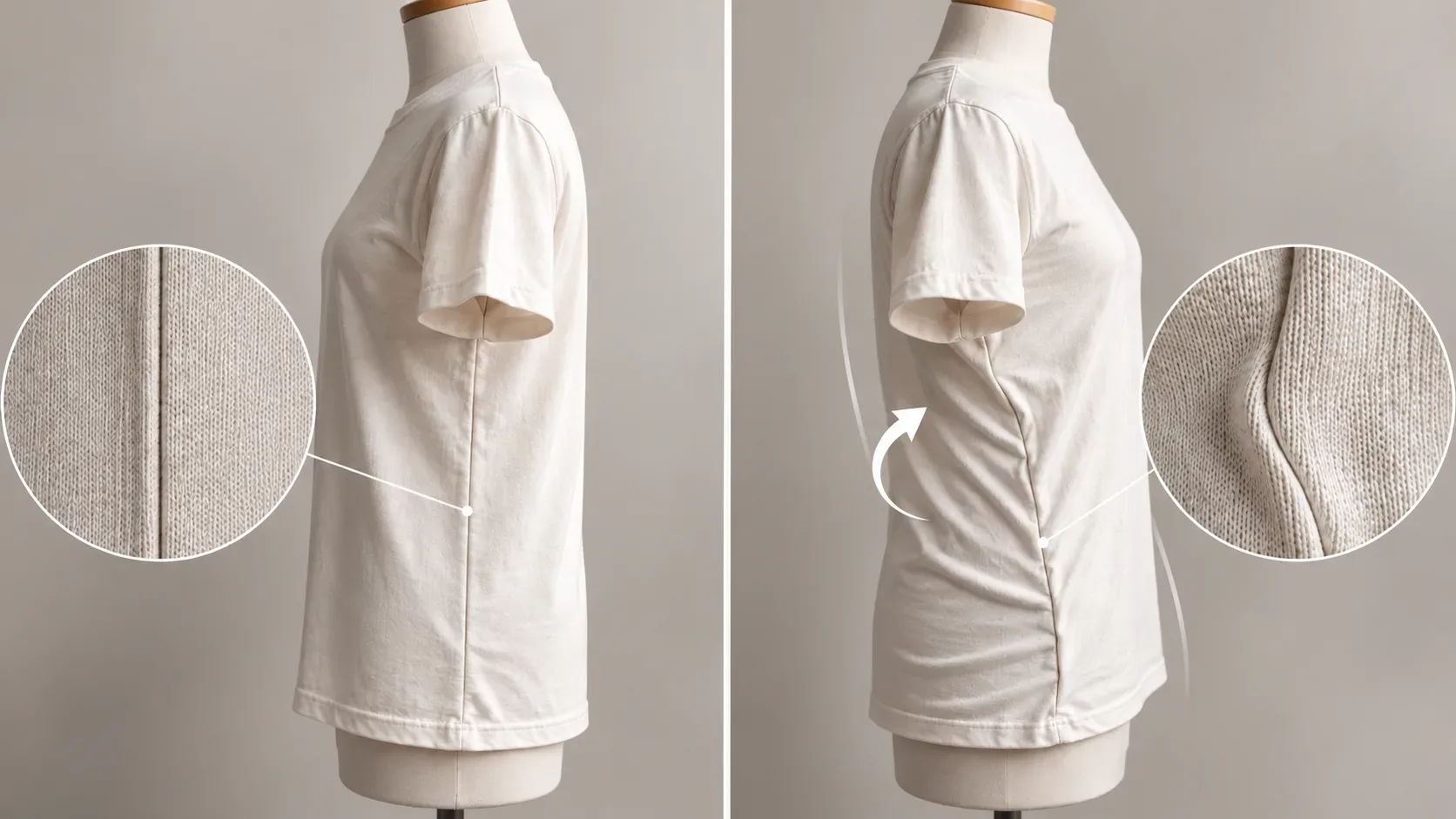
- Uneven shrinkage: one side becoming shorter, twisted seams, or a wavy hem indicates distortion rather than only uniform size reduction.
- Major change in hand: stiffness, severe wrinkling, or a changed surface suggests that the problem is not only dimensional.
- A label that does not allow washing: if the manufacturer specifies dry cleaning, another immersion adds risk.
How to reduce the risk of viscose shrinking next time
Prevention starts before the machine is turned on. The University of Georgia Extension recommends following the care label and notes that rayon requires careful handling when wet. For garments that are genuinely washable, use the permitted cycle and temperature and minimize unnecessary mechanical stress.
- Read the label for each garment, not just the fiber content. “100% viscose” alone does not tell you the construction or finishing.
- Use the stated care method. Hand washing, a delicate cycle, and dry cleaning are not interchangeable instructions.
- Avoid wringing and rubbing. Lower wet strength increases the risk of distortion.
- Control drying. The University of Hawai‘i Cooperative Extension lists rayon as a fiber for which tumble drying can cause shrinkage and advises consulting the care label; when air drying is allowed, handle the item gently and support it appropriately.
- Do not use heat as a shortcut. Temperature and drying method should follow the label, especially for delicate garments, fiber blends, or special finishes.
- Store only when completely dry. Besides reducing distortion from weight and handling, this also reduces moisture problems in storage.
What if the garment is a viscose blend?
Fiber composition changes behavior, but it does not automatically make the garment dimensionally stable. Polyester, cotton, elastane, linen, or other fibers may limit or increase certain movements in the fabric; seams, yarns, and finishing also matter. The care instruction for the finished garment still carries more weight than a rule based on only one fiber in the blend.
What to remember
- Viscose/rayon can become weaker when wet and can shrink or stretch.
- Some dimensional change can result from relaxation shrinkage in the fabric structure.
- A mildly shrunken, washable garment may tolerate careful reshaping while damp.
- There is no guarantee of a return to the original size, and forceful stretching can create a new distortion.
- Dry-clean-only, structured, or severely distorted garments are better candidates for professional assessment.
- For prevention, the specific care label should override generic viscose advice.