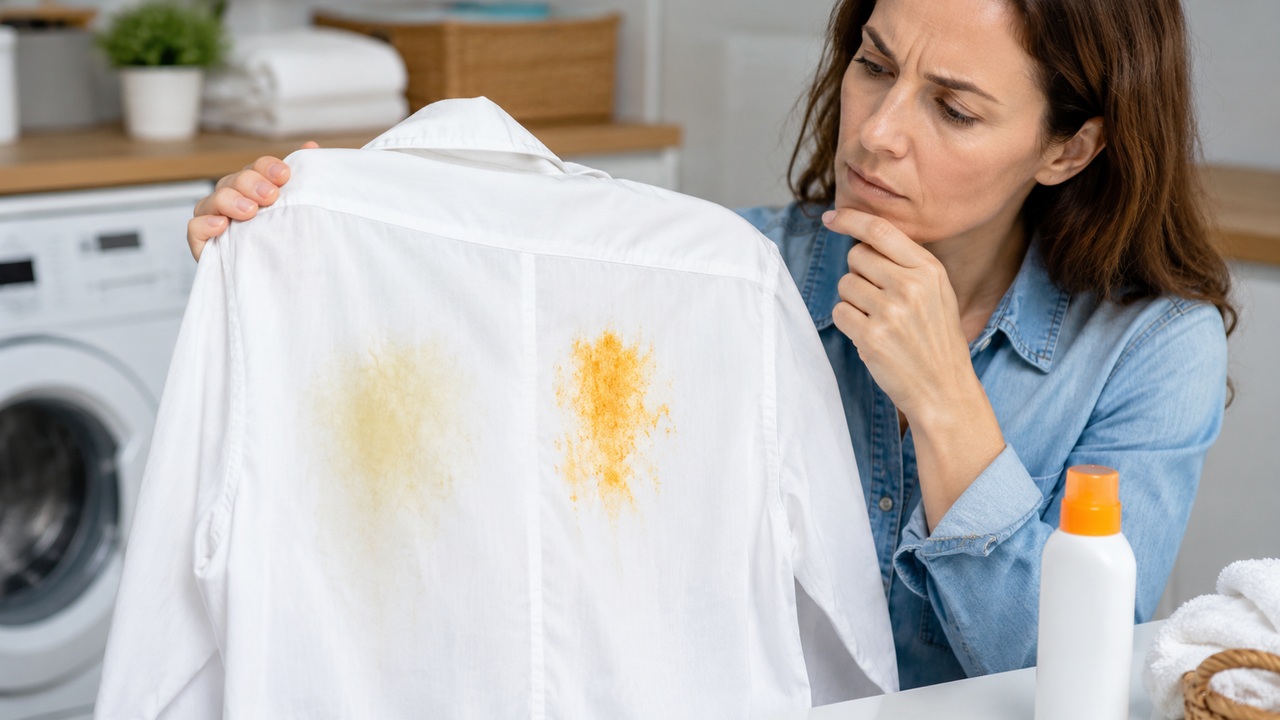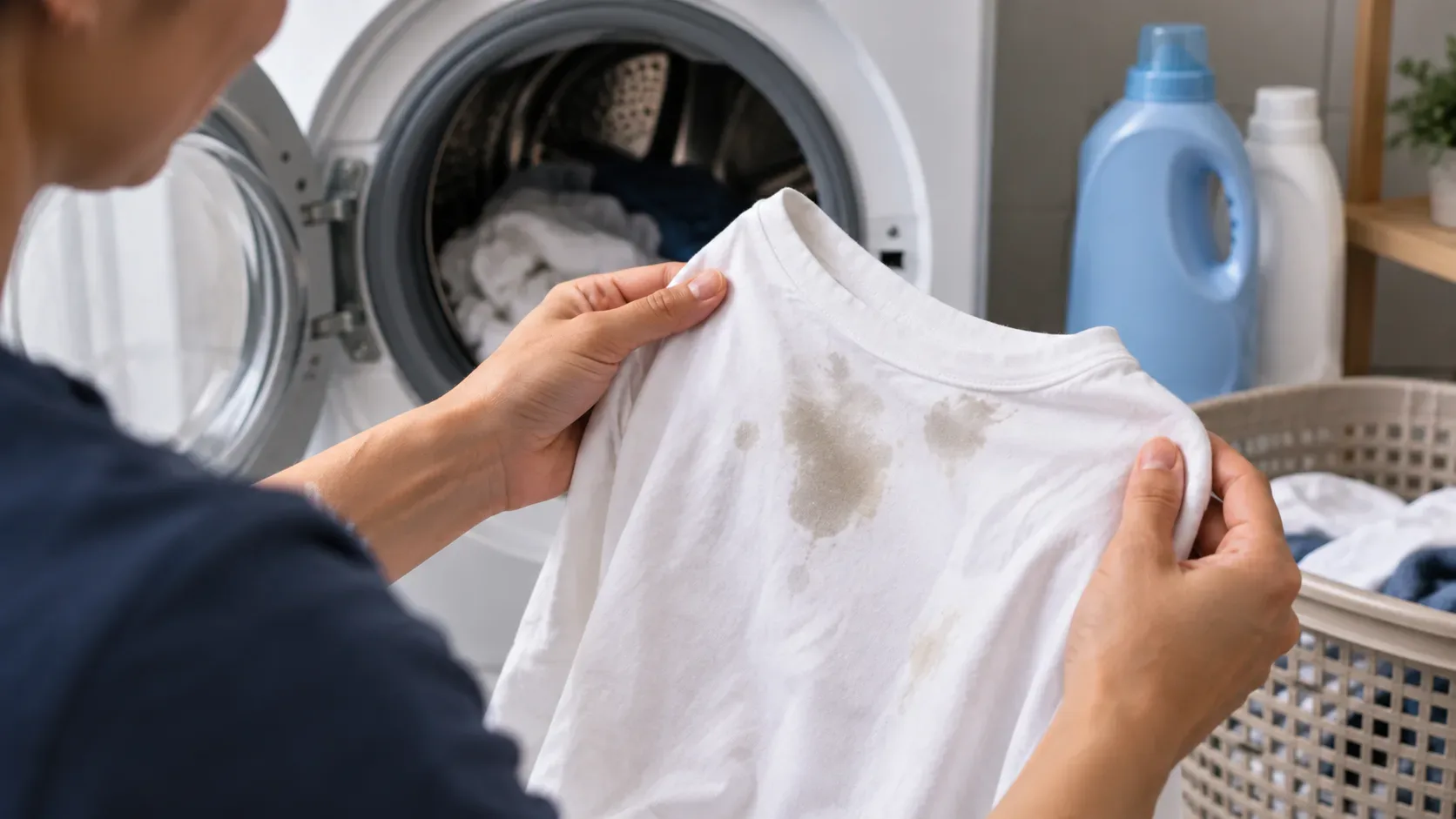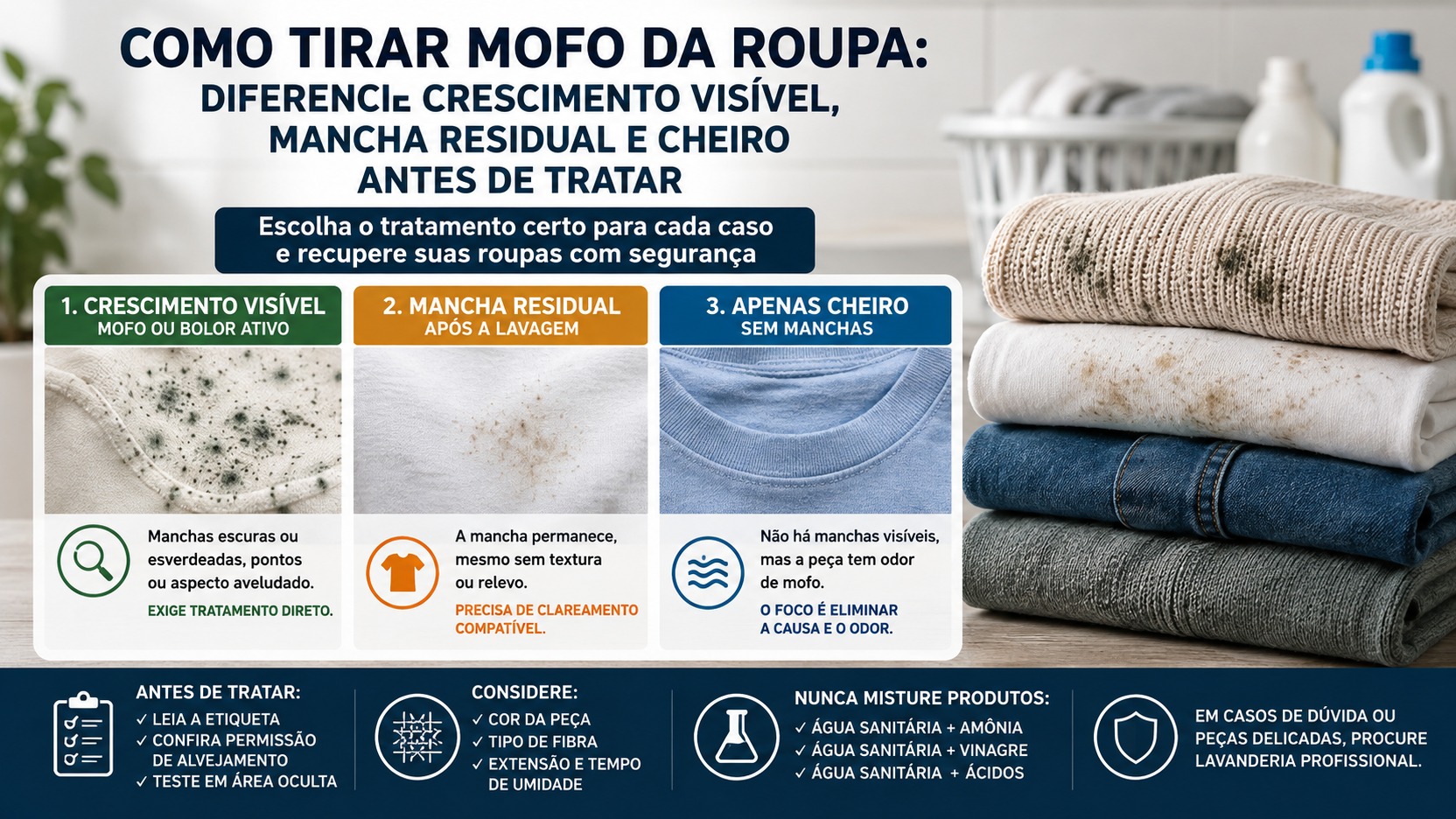
If a piece of clothing comes out of the closet with dark spots, greenish areas or a stale smell, the first impulse is usually to look for a strong mixture. This is precisely the time to reduce your rush. The safest treatment starts with the right question: is there still visible growth on the fiber, is there just some discoloration left after washing, or does the item just have an odor? The answer changes what is worth doing and how much risk of fading, yellowing, weakening or deforming the fabric you accept. This separation is a practical tool, not a microbiological diagnosis. At home, you can't confirm just by looking whether a fungus is "alive" or "dead", and the color of the mold alone does not tell you the degree of risk. To decide on cleaning, treat as visible growth any area with spots, deposits or a fuzzy, powdery or velvety appearance on the surface. When, after washing, there is only a flat mark left with no visible material on the fiber, the problem becomes mainly one of staining. If there is no visible mark and only the smell remains, the focus is on washing, drying completely and controlling the humidity that caused the problem.
Before choosing the product, the label decides the limit
In Brazil, textile product conservation instructions are mandatory and include washing, bleaching, drying, ironing and professional textile care. This makes etiquette more important than any generic recipe on the internet. Before using bleach, non-chlorine bleach, stain remover or hotter water, confirm what the item allows. The first reading should answer three things. Can the item be washed in water? Is bleaching allowed? Is there a recommendation for professional care? If the symbol or text prohibits bleaching, do not attempt to circumvent the restriction because the clothing is white. A white piece of wool, silk, elastane or with a sensitive finish can suffer damage even without the risk of "fading" a color. It is also not enough to classify clothes as just white or colored. Fiber, print, lining, embroidery, elastic, coatings and other components may have different tolerances. In practice, the most sensitive part of the piece should define the treatment.
Step 1: Is there visible growth on the clothing?
When there are spots or areas that look like growth on the fabric, the priority is to remove the material without spreading it around the house and then wash the item in a way compatible with the label. If so
If possible, move the laundry outdoors before handling or removing loose residue. Avoid shaking, hitting or brushing vigorously inside closed bedrooms, closets or laundry rooms as this can disperse particles. For cleanings where mold will be disturbed, public health guidance recommends reducing exposure with adequate respiratory protection, gloves and eye protection. People with asthma, COPD, major allergies, chronic lung disease or immunosuppression should not take on cleaning very moldy materials. In a single piece with a small affected area, the risk is usually lower than in a contaminated room, but the principle remains valid: the more growth there is and the more you need to touch it, the greater the need to limit exposure. If the garment is washable, apply laundry detergent according to the label and wash at the highest temperature the garment label allows.. Don't increase the temperature just because the stain looks tough. Water above the limit can shrink fibers, deform finishes, affect prints or reduce the useful life of elastic components. Bleach only enters when two permissions coincide: the clothing label accepts the process and the product label informs that it is suitable for that type of fabric. Chlorinated bleach may be appropriate for some compatible white or colorfast items, but it is not a universal solution. On colored pieces or sensitive materials, a chlorine-free or oxygen-based product may be an alternative when both labels allow it. "Chlorine-free" does not automatically mean "safe for any fabric." After washing, dry the clothes completely before storing them. If the visible growth has disappeared but a shadow, brown spot or discolored area remains, do not continue treating it as if there is still a layer of mold on the surface. Proceed to the residual stain step.
Step 2: the growth is gone, but the stain remains
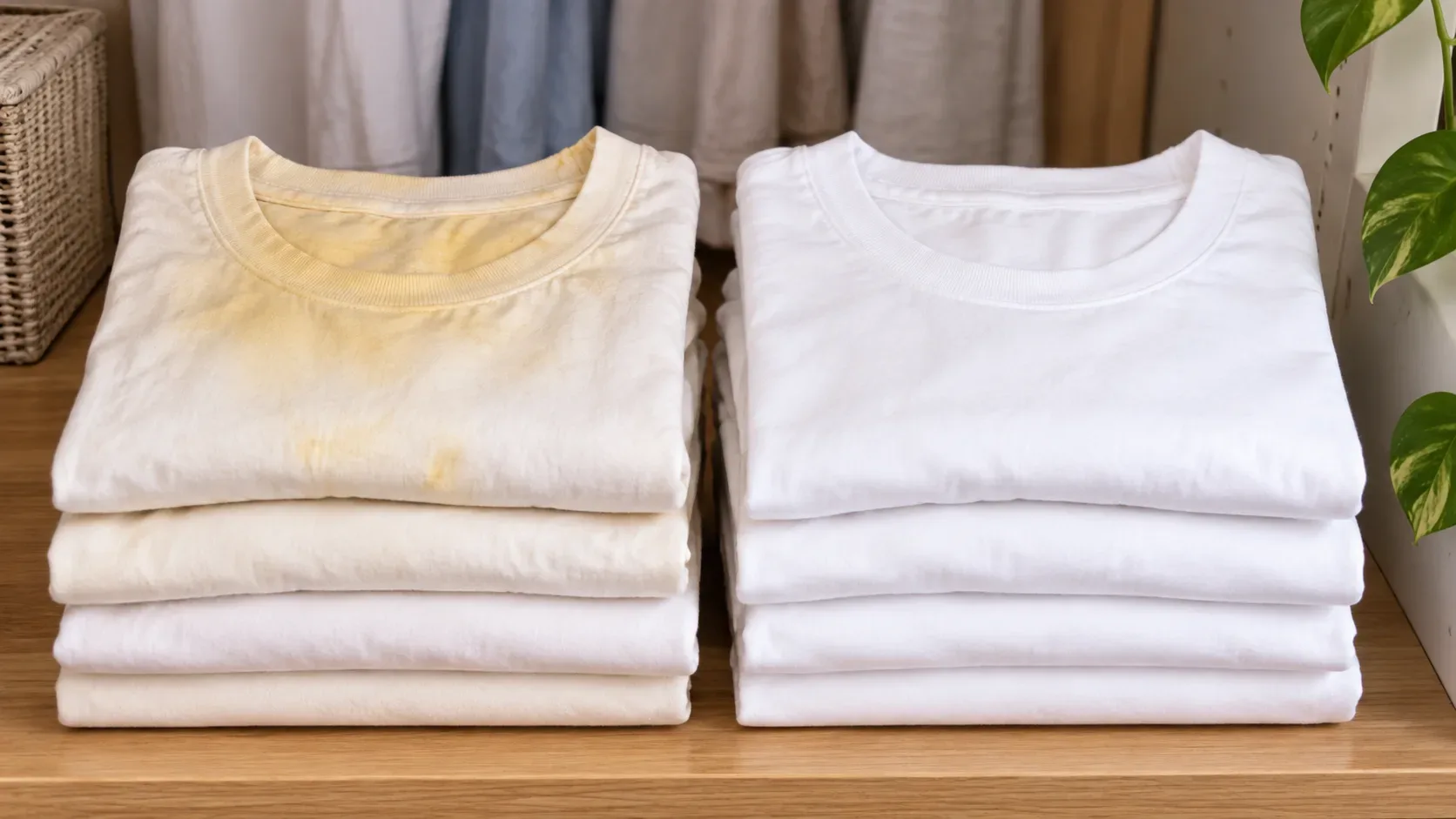
Mold and moisture can change the appearance of fabric even after surface dirt has been removed. The remaining stain may be pigmentation, dye change, oxidation, damage to the fiber itself, or a combination of these effects. This explains why a garment can be clean and still carry a mark. Here, the logic changes: the objective is to improve the appearance without destroying the material. Start with the least aggressive treatment compatible with the label, using a stain remover or bleach appropriate to the fabric and respecting the manufacturer's time, concentration and method of use. Before treating a visible area of a colored piece, test a hidden area when the label recommends it or when there is doubt about the color fastness. On white pieces, the temptation is to go straight to hypochlorite. Still, "white" does not replace the label. There are fibers and finishes that can yellow, lose strength or undergo other changes with chlorine. For colored items, it is also not correct to conclude that all non-chlorine bleach will be harmless. Treatment needs to match the bleaching allowance of the garment with the product restrictions. If the stain does not improve after correct attempts within the label, increasing the dose, prolonging the soak indefinitely or repeating strong cycles tends to increase the risk of damage faster than the chance of recovery. Fabrics heavily attacked by mold may be weakened and some marks may be permanent. On a valuable, antique, structured, or sentimental piece, stopping early and seeking professional cleaning can preserve more than a last-ditch attempt at home.
Step 3: There is no visible stain, but the smell remains
A musty smell without visible spots or deposits does not in itself prove that there is active growth on the clothing. The odor may be linked to persistent humidity, incomplete drying, storage in a humid environment, accumulated residue or contamination of the cabinet, basket or washing equipment itself. In this scenario, there is no reason to start with the most aggressive product. Wash the item according to the label with a suitable detergent, use the permitted temperature and ensure complete drying. If the
smell reappears shortly afterwards, investigate where the clothes are getting damp: cupboard against a cold wall, closed drawer with little circulation, basket that receives wet items, laundry room without ventilation or clothes stored before finishing drying. Strong perfume can mask the smell for a few hours without solving the cause. If several items in the same closet have the same odor, the problem probably isn't with a single shirt or towel. It is necessary to correct the source of humidity and clean the storage environment; otherwise, the clothes may smell again or have new growth.
White clothes and colored clothes: color is just the first filter
Color helps estimate the risk of fading, but it does not alone decide which bleach to use. A strong white cotton item can accept treatment that would be inappropriate for a white wool item. A colorful garment with good fastness and a permissive label can tolerate products that another colored garment, with a delicate print or unstable dyeing, cannot tolerate. Therefore, the safest decision order is label, fiber and construction, color and, finally, product choice. When the label is faded or has been removed, be more conservative. If you cannot identify the fiber, the presence of a special finish or the bleach tolerance, choose a less aggressive method or take the item to a professional dry cleaner.
What changes depending on the extent of mold and moisture history
A small mark on a t-shirt left damp in the hamper is different from a set of clothes kept for months in a leaky closet. The larger the affected area, the older the stains and the more recurrent the problem, the less chance of resolving everything with localized treatment alone. If several pieces show growth, also look for signs of moisture on the furniture, on the wall, at the bottom of drawers and in storage boxes. Mold control depends on moisture control. Washing clothes without eliminating the source leaves the cycle ready to start again. It is also worth considering the physical state of the fabric. Old mold can weaken fibers. If the item is brittle, fraying, with compromised seams or areas that have lost strength, insisting on rubbing or bleaching can transform a stained garment into a torn garment. When the damage is extensive, professional disposal or restoration may be more sensible than successive at-home attempts. Items affected by floods, sewage water or other relevant contamination are beyond the common scenario of clothing stored with mold. In these cases, the risk is not limited to mold and requires specific guidance for the type of contamination before deciding on recovery.
Products that should not be mixed
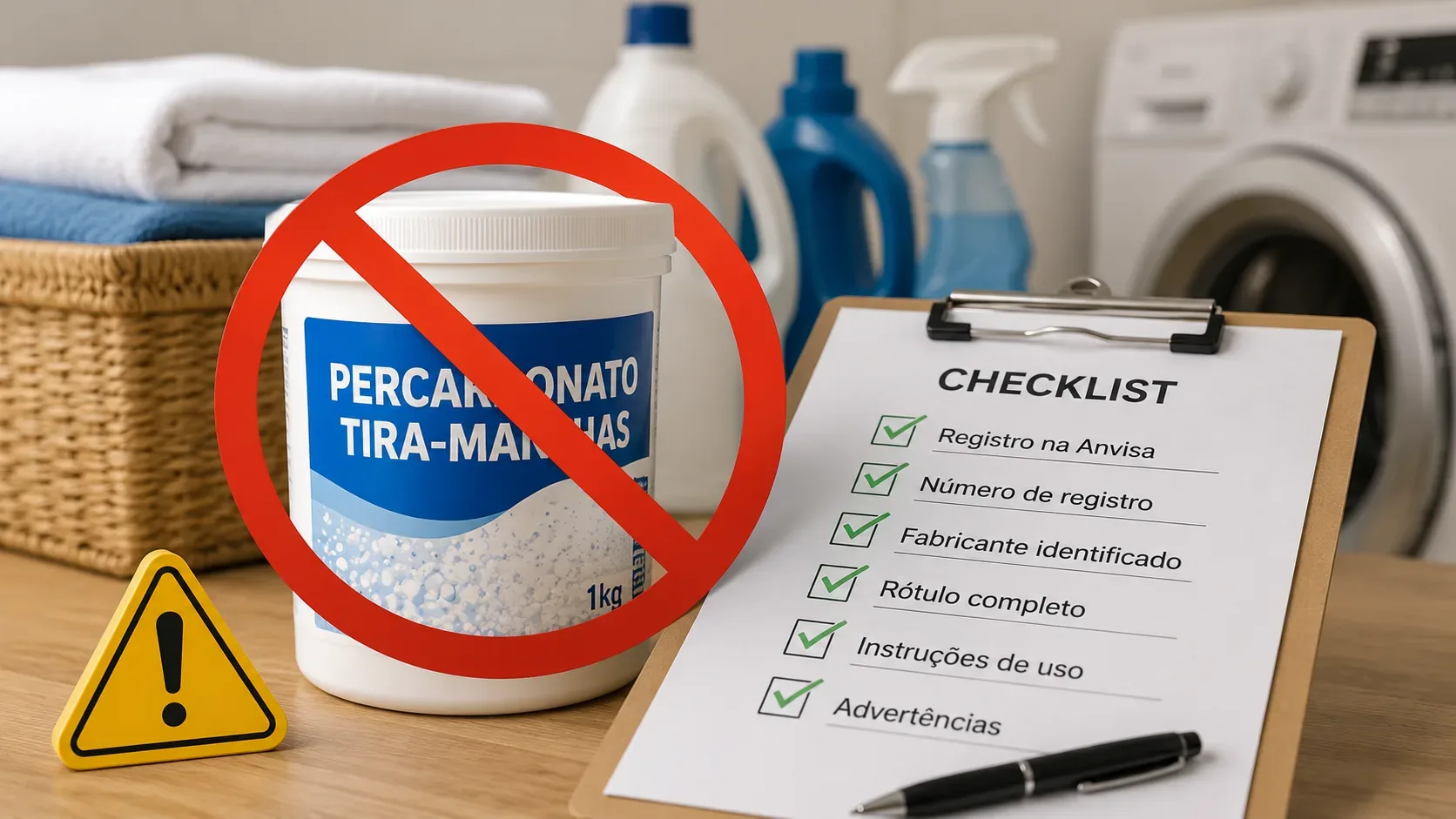
The most important rule of chemical safety is simple: Don't turn your stain treatment into a mixture of cleaning products. Bleach and other hypochlorite-based bleaches should not be combined with ammonia or other cleaners. Mixtures with acidic products, such as vinegar, can also release dangerous gases. This matters because many homemade recipes recommend vinegar, bleach, detergent, alcohol, bicarbonate or other ingredients in sequence without explaining compatibility. For musty clothing, only use the combinations explicitly provided for by the product label and the washing process.. Do not improvise a chemical "reinforcement" inside the bucket, tank or machine. It is also a mistake to copy bleach dilutions from foreign pages without checking the Brazilian product. Active chlorine concentration varies between categories and markets, and dilution guidelines are formulated for specific concentrations. For clothing, follow the label dosage of the product you actually have on hand, not a generic ratio found elsewhere. If there is accidental mixing and strong vapors, burning eyes, coughing, shortness of breath or discomfort appear, stop cleaning, move to a place with fresh air and seek health advice. Don't try
"neutralize" the mixture by adding another product.
When is it worth stopping the domestic attempt
Trying at home is no longer a good bet when the label requires professional care, when the item is of high value or very delicate, when the growth is extensive, when the fabric has lost strength or when the problem returns even after washing and drying correctly. The same applies when the person doing the cleaning belongs to a group at higher risk of reacting to mold. A dry cleaner or textile restorer may also be the most prudent option when there is lining, tailoring, embroidery, specialty dyeing, wool, silk, leather or construction that does not tolerate soaking. In these cases, the goal stops being to find the "strongest" product and becomes preserving the piece.
The decision tree in one sentence for each case
If there is visible growth, limit spread, protect yourself, check the label, wash with detergent in the permitted condition and only use compatible bleach. If growth has come out and a flat mark remains, treat as residual stain and stop before sacrificing color or fiber. If there is no mark and only the smell remains, prioritize washing, complete drying and correcting the source of moisture. The bottom line is that mold on clothes doesn't require a single recipe. The safest intervention depends on what is still in the fabric, what the label authorizes and how much the item can withstand. This order avoids two common mistakes at the same time: undertreating a garment that still has visible growth and overtreating a garment that is already clean but has become marked.