A garment that has become smaller after washing does not always shrink for the same reason. Heat may play a role, mechanical action may be decisive in some fibers and, in other cases, the construction of the fabric itself has simply lost tension accumulated during manufacturing.
Therefore, before trying to “unshrink” the piece, it is worth reconstructing what happened. At what point did she change? What is the composition? Is the surface still the same or has it become denser? Did the piece shrink completely or just in one direction?
This distinction matters because some warps can accept careful reshaping, while shrinkage caused by severe felting or overdrying can be permanent. The American Cleaning Institute, for example, classifies both residual shrinkage and that caused by excessive drying as irreversible conditions. For knitwear, especially cotton, it is recommended to remove the item while it is still slightly damp, return it to its shape and finish drying lying down.
First find out when the clothes shrank
Wash sequence often provides a better clue than simply blaming “hot water.”
The technical methodology used to evaluate dimensional stability separates these variables. The AATCC TM150-2025 method for home laundered clothing works with different wash temperatures, agitation cycles, and drying procedures. In other words: temperature, movement and drying are different factors, even though in domestic use they can act together.
If the clothes have already come out of the washer smaller, before entering the dryer, mainly investigate the action of the water, agitation and the stability of the fabric. If it came out of the washer apparently normal and only got smaller after the dryer, the drying stage becomes the main suspect.
When you don't know at which stage the change occurred, composition, texture and format help narrow the diagnosis.
The signs that help separate the causes
| What do you observe | Most likely cause | What does this suggest about recovery |
|---|---|---|
| The item was close to normal size when it came out of the washer and became smaller after drying with heat for a long time | Excessive drying or thermal action | Recovery tends to be low. ACI treats overdrying shrinkage as irreversible. |
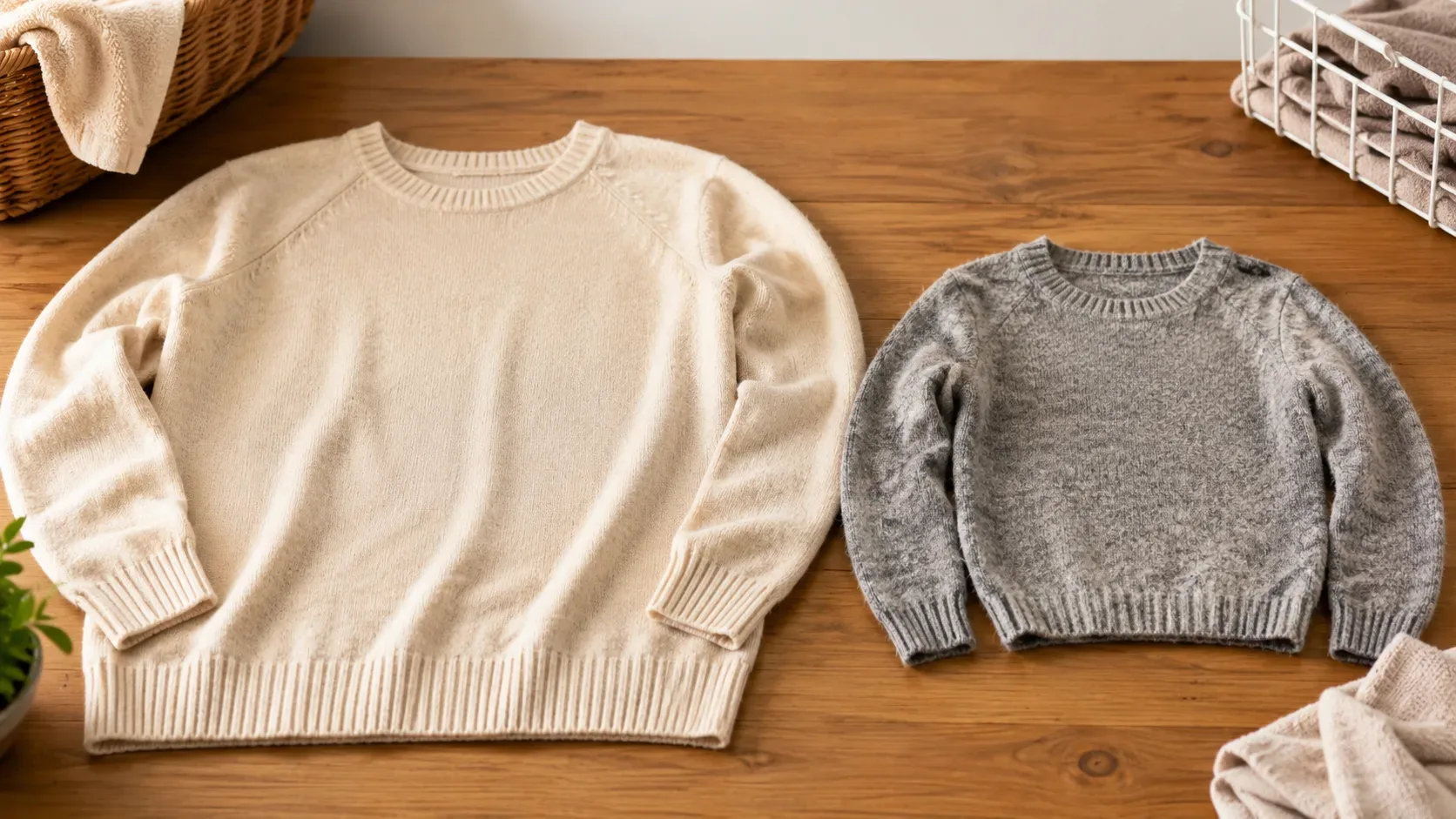
| A piece of wool has become smaller, thicker, compacted, or feels felted after washing with lots of movement | Agitation in the presence of water, favored by heat and humidity | Severe felting is not usually recoverable. |
| The piece diminished without a noticeable change in texture, especially during the first few washes | Residual shrinkage linked to fabric structure and processing | There may be some possibility of reshaping the shape while the piece is damp, but a return to original size should not be promised. |
| Length, width, seams or parts of the garment have changed differently | Construction, finishing or components with different dimensional stability | Recovery is variable; forcing one part may just transfer the deformation to another. |
| A knit has changed dimensions more than flat-woven garments washed under the same conditions | Mesh structure as an important factor | The problem does not need to indicate a “serious error” in washing; meshes are naturally more susceptible to dimensional change. |
Cotton Incorporated highlights that shrinkage depends not only on the fiber, but also on the yarn, structure, wet processing, finishing, manufacturing and care of the garment. The entity also points out that knits tend to be more open and dimensionally unstable than flat fabrics, making them more subject to changes in size.
This explains why two cotton t-shirts can react differently to the same wash.
When the problem appears to be heat
The most useful sign is temporal: the clothes looked normal after washing and clearly changed during drying.
The ACI identifies over-drying as a cause of shrinkage and recommends reducing dryer time. In the case of knitwear, especially cotton, the guideline is to remove it while there is still a little moisture, remodel it and finish drying on a flat surface.
If the item has already undergone intense drying and is completely dry and smaller, there is no basis to guarantee that re-wetting, pulling or steaming will permanently return it to its previous measurements. Applying even more heat in an attempt to fix it could create another problem.
The first rule, therefore, is simple: do not try to compensate for possible thermal damage with more temperature. Check the label before using a dryer, iron or steamer.
When agitation is the prime suspect
The clearest situation appears in the wool.
Wool fibers have microscopic scales on their surface. According to Woolmark, in contact with heat and humidity, these structures can, under mechanical action, begin to stick together. The result is felting, tangling and compaction of the fabric. When this occurs, the process is irreversible.
In practice, it is not just a question of “washing hot”. A wash with a lot of movement can be precisely the component that transforms a delicate piece into a shorter, thicker and more compact piece.
The care symbolism itself helps to identify this sensitivity. In the system presented by GINETEX based on ISO 3758:2023, the temperature indicated in the tank represents the maximum washing temperature. A bar under the symbol indicates reduced mechanical action and two bars identify an even gentler process, used, for example, for woolen goods.
There is also a useful detail: the American Cleaning Institute differentiates between agitation and spinning and states that regular spinning alone is not responsible for wool shrinkage.
When the fabric itself explains part of the shrinkage
Not every dimensional change indicates that an individual fiber has simply “shrinked.”
During manufacturing, dyeing, finishing and tailoring, fabrics can accumulate stress. During washing, part of these tensions is released and the structure finds another dimensional configuration. Cotton Incorporated classifies shrinkage behavior as a result of both the construction of the fabric and the processes it has undergone.
Knits deserve special attention. As the threads form loops and the structure tends to have more freedom of movement, they have a greater potential for dimensional instability. Manufacturing parameters, stress during processing and finishing techniques can reduce or increase the amount of shrinkage left to appear in the consumer's home.
Therefore, the “100% cotton” composition alone does not allow us to predict exactly what will happen. A t-shirt compressed and stabilized during finishing may behave differently than a cotton t-shirt constructed and finished in another way.
It is also possible for the piece to change more in length than in width, or vice versa. This is different from a piece that simply became proportionally smaller as a whole.
The label works as part of the diagnosis
Check two pieces of information separately: composition and care instructions.
Composition helps identify possible fiber behaviors. The symbols show the conditions for which that part was prepared. GINETEX clarifies that the number inside the washing symbol is a maximum temperature, and not a mandatory temperature. The bars below the bowl signal the need to reduce mechanical action.
If the label indicated very gentle wash, hand wash or no tumble drying and the item went through a more aggressive process, there is concrete evidence in favor of the washing error.
If all instructions were followed and a marked dimensional change still occurred, manufacturing characteristics, finishing or stability of the product itself deserve more attention.
What's still worth trying to recover
Before any attempt, stop subjecting the piece to heat and strong movements. The objective now is to verify that there is only a remodelable deformation, and not to “beat” the tissue by force.
- Read the label again. Do not use a temperature, washing or drying method that it prohibits.
- Observe the surface. If a piece of wool is clearly felted, smaller, thicker and more compact, insisting on stretching will hardly undo the internal alteration of the fibers. Woolmark considers severe felting to be non-recoverable.
- If a knit is still slightly damp and just out of shape, reshape without force. Lay the piece flat and gradually adjust the length, width and sleeves. The ACI recommends this procedure especially for cotton fabrics removed from drying before they are completely dry.
- For wool that is misshapen but not severely felted, there is a more specific possibility. Woolmark advises that out-of-shape areas can be moistened with warm water between 30°C and 40°C and massaged gently before drying flat. The entity itself points out that this does not recover a severely felted item after inadequate washing.
- Let it dry in the desired position. Do not hang heavy, wet knitwear to try to gain length: the weight of the water itself can deform them unevenly. For wool sweaters, Woolmark recommends flat drying.
If the clothing is expensive, has emotional value, mixes delicate materials or features lining, interlining and structured finishes, new home experiences can create more harm than good. In this case, stopping attempts and seeking specialized service is more prudent.
“It’s fit again” doesn’t necessarily mean it’s unshrinkable
A damp garment can accept some stretching and temporarily return to a more comfortable fit. This does not mean that the original shrinkage has been reversed at a structural level.
This difference helps to understand why some household techniques seem to work immediately, but the clothes return to a smaller size the next wash.
The most realistic criterion is to observe whether the piece regains sufficient shape without becoming frayed, crooked, with stressed seams or disproportionate parts. If you have to pull hard to reach the previous measurements, the attempt is no longer a gentle remodeling.
How to avoid repeating the problem
After discovering the probable cause, adjust precisely the variable that contributed most.
If the problem appeared in the dryer, reduce temperature and time or use another form of drying permitted by the label. If this happened to wool during washing, drastically reduce the mechanical action and follow the specific cycle indicated. If the item is a knit with a known tendency to change size, treat drying as part of the care: remove at the appropriate time, remodel and dry in the recommended way.
And don't discard the label after purchase. It is the best reference available for knowing what combinations of water, movement and drying a piece is designed to withstand.
When clothes shrink, therefore, the most useful question is not just “how to unshrink?”. Is it what changed in the structure of the piece and at what stage did this happen? This answer defines whether there is still room for careful correction or insisting will only increase the damage.