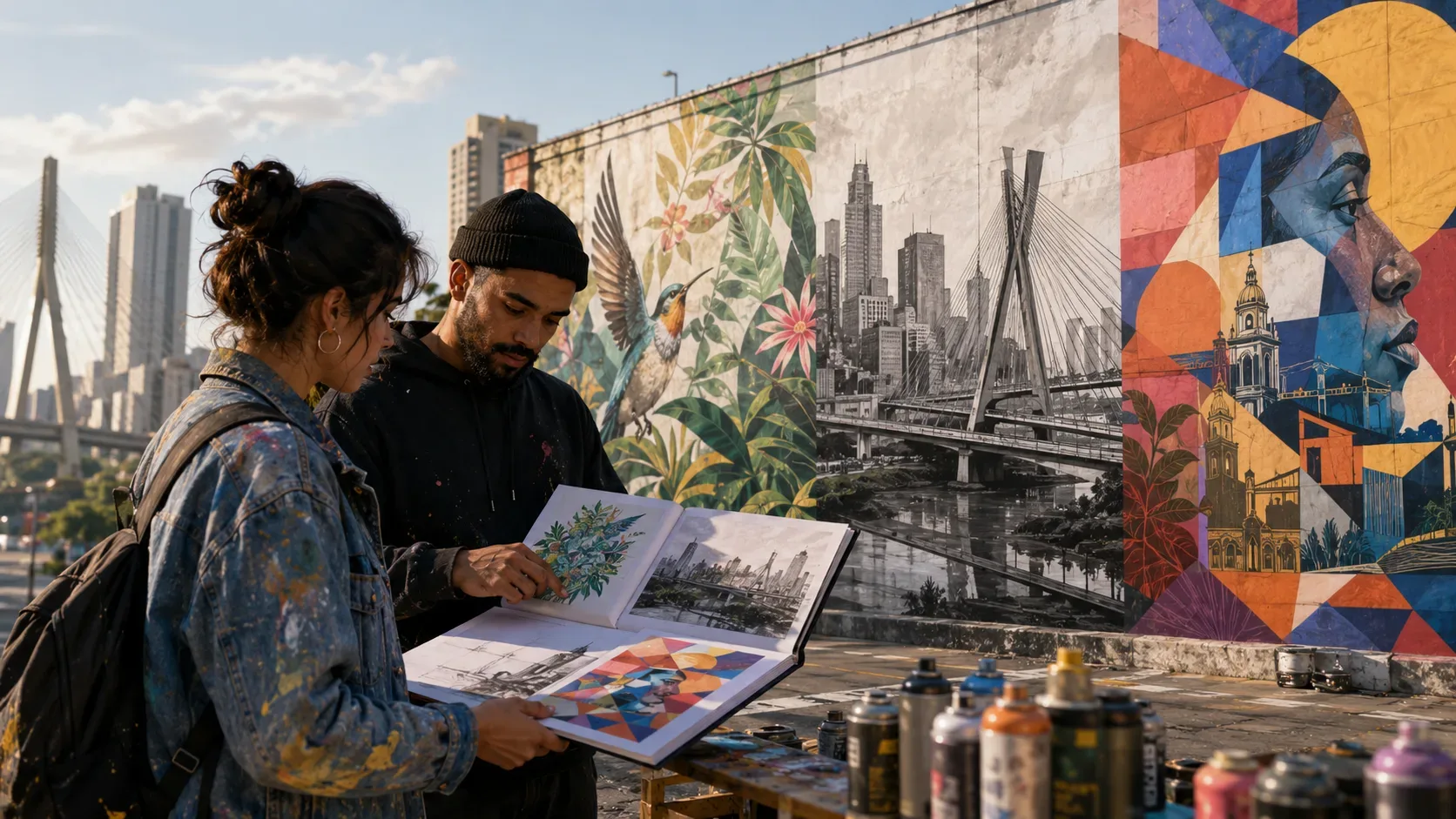
Call for proposals No. 28/2026/SMC/CPROG for the Museu de Arte de Rua (MAR) accepts applications from September 1 through September 20, 2026, until 11:59 p.m., for projects to be carried out in the City of São Paulo. The selection has up to R$4 million available and is organized into three funding tracks: new urban-art works, revamping/restoration/requalification of existing works, and graffiti and urban-art festivals. Applications are free and must be submitted through the SMC Editais system.
The first decision is not “which track pays more,” but which track correctly describes the project’s actual object. Choosing the wrong one can create inconsistencies among the proposal, required documents and evaluation criteria. The full call in São Paulo’s Official Gazette should be the final reference for the application, while the Municipal Secretariat of Culture and Creative Economy page summarizes the new format.
Who can submit a MAR 2026 project
Cultural agents, individuals or legal entities, with proven activity in the urban-art field may participate. The applicant is the party that submits the proposal and, if selected, signs the Cultural Execution Agreement, manages administrative and financial execution and is responsible for accountability.
- Individual: may submit up to 1 proposal and receive funding for up to 1 project.
- Legal entity: may submit up to 4 proposals and receive funding for up to 4 projects, provided each proposal complies with the rules on linked responsible persons.
- Group or collective without its own legal personality: may be represented by an individual. In that case, the representative is treated as an individual applicant and is subject to the limit of 1 proposal and 1 funded project.
There is also an important linkage rule: the same individual may be linked to only one proposal when acting as an individual applicant, a representative or identified member of a collective, the artistic lead, or the curatorial lead. For proposals submitted by legal entities, each application must identify a different artistic or curatorial lead.
The call also lists disqualifying circumstances. They include certain unresolved accountability obligations for cultural grants, declarations of ineligibility or bans on receiving public funds, and participation by municipal public employees in the situations described in Chapter 6. Because the list contains details and exceptions, review items 6.8 through 6.13 before submitting.
How to choose among the three tracks
| Track | Designed for | Amount per project | Distinctive requirement |
|---|---|---|---|
| I — Artistic Urban-Art Interventions | Creation of a new individual or collective work, at ground level or at height, in a public space or a private space of public interest. | Up to R$100,000 | Work plan with the final layout and total surface area to be executed. |
| II — Revamping, Restoration or Requalification | Updating, revitalizing or recomposing an existing urban-art work in São Paulo. | Up to R$80,000 | Photographic record of the existing work and documentation covering copyright/authorization to intervene. |
| III — Graffiti and Urban-Art Festivals | A structured public action with curatorship, multiple artists and broader territorial impact. | Fixed R$100,000 | At least 8 hours of artistic programming, a curatorial concept, audience estimate and proposed structure. |
Track I: when the project is a new work
Choose Track I when the core result is a new artistic intervention. The call allows languages such as graffiti, muralism, mural painting, stencil, wheatpaste posters, urban collage and artistic installations integrated into the surface or immediate intervention space. The site must have public visibility, and the project must state whether execution will take place at ground level or at height.
Track II: when an existing work will be restored or updated
Track II is specifically for a pre-existing work. In addition to documenting its current condition and technically explaining the intervention, the applicant must demonstrate that copyright requirements are in order. When the author is known, the applicable consent from the author or rights holder is required. The declaration of authorship research is accepted only for a work whose author remains unknown after effective searches; it does not replace consent when authorship is known.
Track III: when the object is a festival
Track III is not simply a collection of independent murals. The object must be a graffiti and urban-art festival, with defined curatorship, public programming of at least 8 hours and participation by multiple artists. The applicant’s experience must demonstrate the technical, artistic, curatorial and production capacity needed to deliver festivals, showcases, meetings, cultural events or equivalent actions. For a legal entity, the absence of its own artistic portfolio is not a barrier if it demonstrates consistent experience producing and delivering cultural projects.
Common checklist before submission
The form and attachments vary by track, but the core application includes information that must be consistent across all documents. Before final submission, check:
- applicant and artistic or curatorial lead details;
- CV and portfolio demonstrating activity and capacity compatible with the chosen track;
- chosen track, predominant artistic language and execution mode;
- concept, rationale, descriptive statement, cultural objectives, techniques and visual representation when there is a visual work;
- Subprefecture and full address of the site, always within the City of São Paulo;
- methodology, materials, surface area and safety conditions for work at height, when applicable;
- schedule, budget, expected results and project team sheet;
- Consent Letter from the person legally responsible for the site, required for execution in public spaces or private spaces of public interest;
- Acceptance Letter from members when a collective submits under the conditions described in the call;
- Declaration of No Impediments;
- additional documents specifically required for the chosen track.
Site consent has a practical consequence: by presenting it, the applicant states that a prior technical visit has been conducted and assumes responsibility for the information about physical, structural, logistical and safety conditions at the site.
What to check before clicking “final submit”
The call states that, after the application is finalized, documents cannot be changed, replaced or supplemented. Essential omissions also cannot simply be fixed later through an administrative request for clarification. That makes a cross-check between the online form and attachments essential.
- Object and track: does the main description precisely match the selected track?
- Site: are address, Subprefecture, consent and technical conditions consistent?
- Team: do CPFs and roles comply with the one-proposal linkage limit for individuals covered by the rule?
- Budget: are all costs within the track’s ceiling and proportionate to the scale of the project?
- Files: are CV, portfolio, layout and letters legible and correctly signed?
- Signatures: use a handwritten signature or a legally valid electronic signature. The call does not accept a signature inserted as an image or one drawn directly on a tablet as a substitute for a valid signature.
How proposals will be scored
The Evaluation Committee scores five criteria, each worth up to 20 points: artistic and cultural merit; territorial relevance, cultural impact and accessibility; technical feasibility; budget coherence and reasonableness; and alignment with public cultural policies. The technical score totals up to 100 points, and a proposal must obtain at least 40 points on these criteria to be classified.
Up to 20 additional points are available: +5 for projects in the Subprefectures of Cidade Tiradentes, Capela do Socorro or Sé; +10 when the artistic lead — or the curatorial lead in Track III — declares that they did not participate as artistic lead in MAR calls from 2022 through 2025; and +5 for the participation, in the project team, of Black, Indigenous or disabled people in conception or execution, under the call’s rules. These additional points do not replace the minimum technical score of 40.
A practical schedule so Sept. 20 is not your working deadline
The Secretariat itself recommends not submitting in the final days because of possible technical failures or network congestion. A review schedule could be:
- Sept. 1–6: define the track, object, site and responsible person; confirm that prior experience supports eligibility.
- Sept. 7–12: close the concept, descriptive statement, layout/visual representation, budget, schedule and portfolio.
- Sept. 13–16: obtain consents and signatures, review team linkages and the track-specific documents.
- Sept. 17–18: complete the system, upload PDFs and have another person compare the form with all attachments.
- Sept. 19: finalize the application if everything is checked, leaving room to solve a technical problem.
- Sept. 20: treat it only as the final safety limit. The system closes at 11:59 p.m.
What happens after selection
Classified projects still go through a qualification stage. Selected applicants will be called to present regularity documents and, after signing the Cultural Execution Agreement and validating bank information, funding will be paid in advance in a single installment. The call requires a dedicated Banco do Brasil account for project funds.
For the decision you need to make now, the rule of thumb is straightforward: prove your urban-art activity, choose the track according to the project’s real object, secure the site and required consents before submission, and treat September 20 as the maximum deadline — not the ideal submission date.