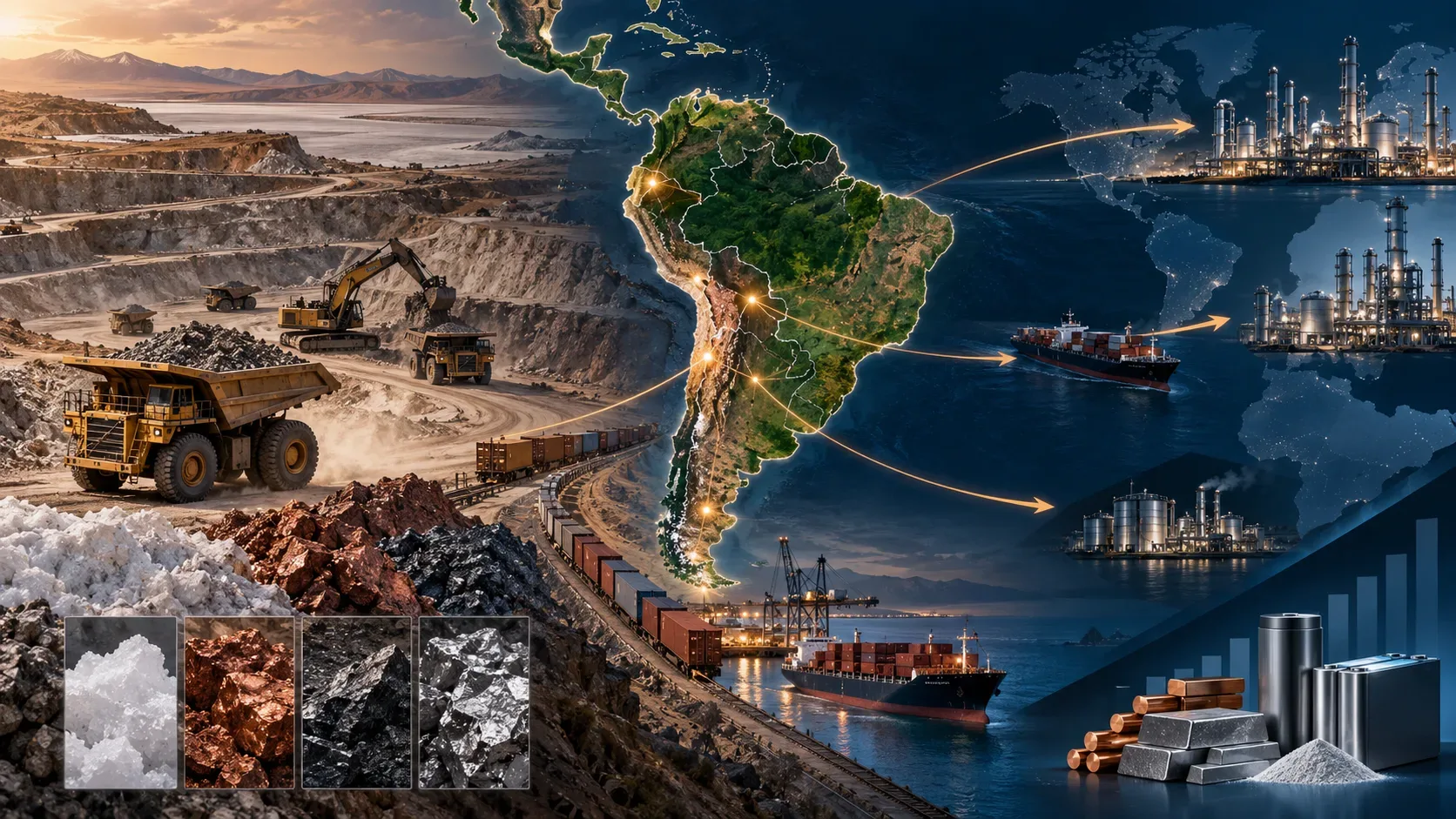
Latin America and the Caribbean already occupy a central place on the critical-minerals map, but having reserves and mines does not, by itself, mean capturing the largest share of the chain's economic value. The decisive point lies in the middle: turning ores and concentrates into refined materials and industrial- or battery-grade chemicals, and then into components used in power grids, batteries, magnets, semiconductors and other industries.
The IEA's Global Critical Minerals Outlook 2026 makes this gap clear. In 2025, the region refined, on average, only about 20% of the key energy minerals it mined, excluding lithium, where parts of the region already have greater integration between extraction and chemical processing. This helps explain why an area rich in copper, lithium and other minerals can still export a large share of its potential value to countries that dominate midstream and downstream stages.
The size of the opportunity: strong mining, much less refining
The region's mineral advantage is real. According to the IEA, Latin America and the Caribbean accounted in 2025 for about 40% of global mined copper output and roughly one-quarter of global lithium supply, while also playing important roles in tin, zinc, molybdenum, niobium and rhenium. The region also holds significant resources of silver, graphite and rare earths.
| Indicator | What it means for the regional value chain |
|---|---|
| Copper | About 40% of global mined production in 2025, according to the IEA. |
| Lithium | Roughly 25% of global supply, with regional output projected by the IEA to grow by nearly 50% by the end of the decade. |
| Refining of energy minerals | On average, about 20% of the volume mined in the region was refined locally in 2025, excluding lithium. |
| Economic value in 2035 | Under the IEA base-case project pipeline, the region could capture about USD 185 billion, but only one-fifth would come from refining. |
| Analytical case with more local refining | If all mined lithium, nickel, cobalt, graphite and rare earths and two-thirds of copper were refined locally, the economic benefit could reach about USD 220 billion in 2035. |
These figures do not mean that every mineral should be fully processed in the country where it is mined. The USD 220 billion case is an IEA analytical exercise, not a forecast that this configuration will occur. Its purpose is to show how much additional value could remain in the region when more processing stages are locally competitive.
Where value leaks out of the chain
Value loss does not happen at a single point. It can begin when ore or concentrate leaves a country without additional transformation and continue when technology, equipment, specialized inputs and engineering services are imported. ECLAC warns that mining with weak local productive linkages can reinforce primary specialization and limit employment and value added.
It is also important to remember that “refining” does not mean the same thing for every mineral. In copper, the chain involves concentration, smelting and refining. In lithium, the relevant step may be conversion into high-purity carbonate or hydroxide. In graphite, purification and spheronization are critical for battery applications. In rare earths, separation, metal production and magnet manufacturing require even more specialized capabilities. Capturing value therefore is not simply a matter of building a generic factory: each chain needs specific technology, scale, suppliers and customers.
Why opening a refinery is harder than opening a mine
Mining and refining depend on different capabilities. A competitive deposit may justify a mine, but a processing plant needs stable feedstock for many years, suitable power and water, logistics, skilled labor, reagents, equipment, quality control and contracts that provide predictable demand.
- Financing: refining plants are capital intensive and face price, technology and ramp-up risks. The IEA notes that outside dominant suppliers, capital and operating costs can be materially higher.
- Infrastructure: reliable electricity, water, ports, railways, roads and, in some cases, gas or industrial reagents are prerequisites for competitiveness.
- Technology and equipment: chemical, metallurgical and high-purity processes rely on accumulated know-how, specialized suppliers and intellectual property.
- Scale and market: a plant needs sufficient feedstock and buyers able to absorb output over many years.
- Regulation and permitting: regulatory uncertainty raises the cost of capital; at the same time, speeding permits without environmental and social governance can undermine a project's legitimacy.
- Skills: metallurgy, chemistry, automation, maintenance, geology, waste management and safety require technical training that does not emerge automatically when a deposit is discovered.
The bottleneck is not only industrial: it is environmental, social and regulatory
Adding processing capacity within the region can increase income, skilled employment and tax revenues, but it can also add pressure on power, water, emissions, waste and infrastructure. The IEA lists environmental management, community engagement and regulatory predictability among the core challenges for expanding Latin America's mineral value chain.
This changes the public-policy question. The goal should not be “refine at any cost,” but to identify which stages create durable value without shifting disproportionate risks onto territories and communities. Competitive projects need environmental and social standards, transparency, consultation and benefit-sharing mechanisms. The 2026 joint statement by multilateral development banks on critical-mineral value chains also emphasizes quality infrastructure, governance and environmental and social standards as part of investment in processing and manufacturing.
Why global refining concentration makes the issue more urgent
The region's challenge is also an economic-security issue. The 2026 Outlook executive summary shows that global refining remained highly concentrated in 2025. China dominates refining for several energy minerals, while Indonesia has become the leading nickel hub. Between 2023 and 2025, dominant suppliers accounted for more than three-quarters of the growth in refined supply across the main minerals assessed.
For Latin America, this creates two incentives. The first is economic: more local processing can retain margins, jobs and technological capability. The second is strategic: new refining hubs can diversify overly concentrated global chains. But diversification is resilient only when new capacity is technically capable, financially sustainable and environmentally acceptable.
Where the region can capture more value
The most robust strategy is likely to combine several links rather than focus only on large refineries. Countries can develop machinery and service suppliers, laboratories, maintenance, industrial software, logistics, recycling, intermediate materials and technical training. For some minerals, refining may be the best next step; for others, it may be a specific chemical stage or a supplier cluster.
Regional integration can also reduce scale barriers. The IEA itself points to opportunities in shared infrastructure, technology transfer, skills development and integration among countries. This is especially relevant when a plant needs feedstock from more than one market, common logistics corridors or access to low-carbon electricity.
What to watch through 2035
The most useful indicator will not be only how many tonnes the region mines, but how much of that output moves into higher-value stages and with what institutional quality. A practical reading requires tracking each mineral's regional refining share, new smelting and chemical-conversion projects, long-term contracts, infrastructure, supplier development, emissions, water use, territorial conflicts and recycling capacity.
The conclusion is that geological abundance and value capture are different things. Latin America can remain indispensable to global critical-mineral supply and still depend on processing abroad. The opportunity is to convert part of its resource advantage into industrial capability — choosing stages where scale, energy, technology, financing and social license make it possible to compete, without treating industrialization and sustainability as opposing goals.