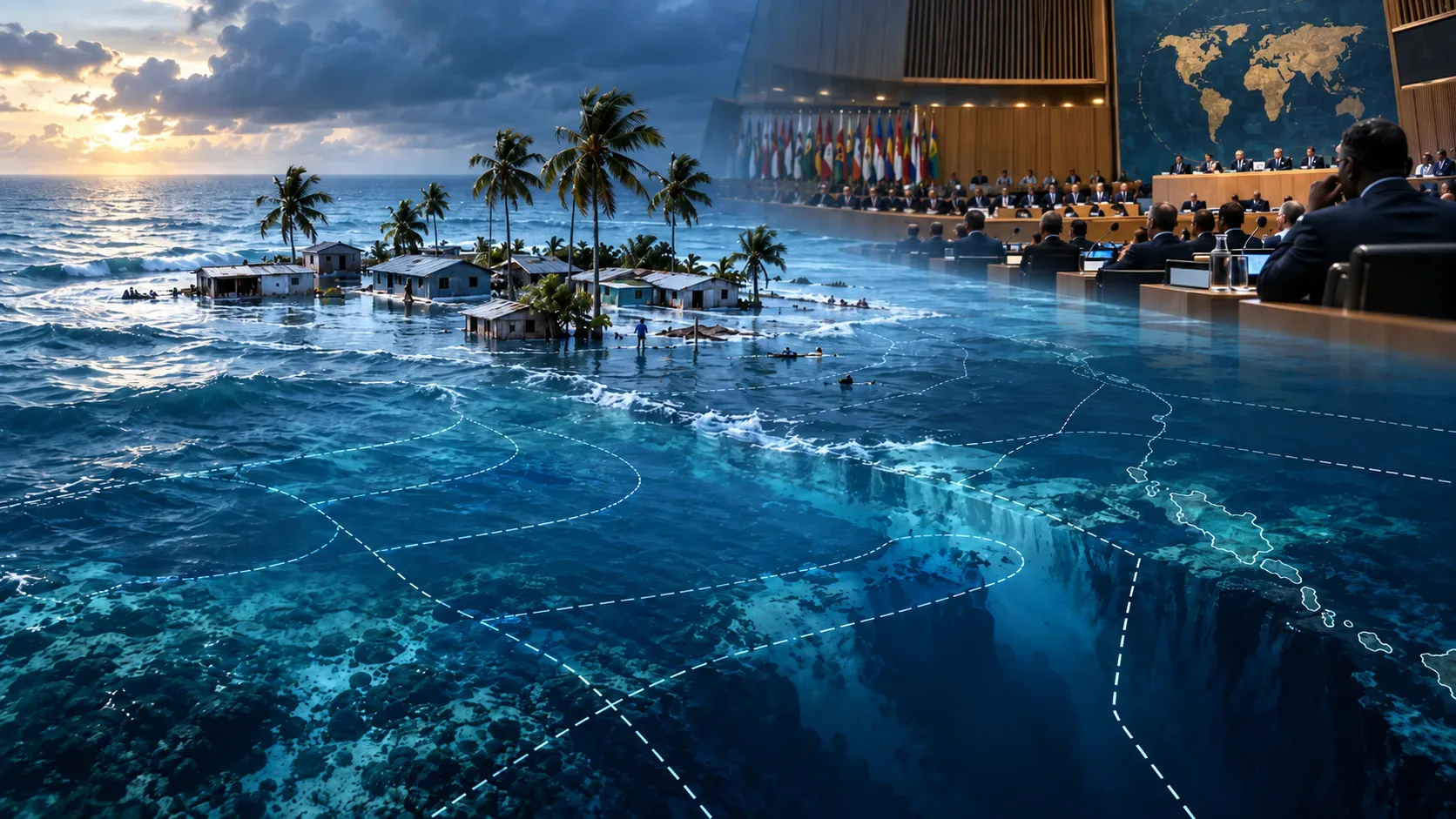
The UN General Assembly has scheduled a high-level meeting on 24 September 2026 in New York on the existential threats posed by sea-level rise. The meeting is not only about coastal adaptation. It comes as international legal debate increasingly connects three issues that once might have seemed separate: maritime zones and boundaries, continuity of statehood, and protection of affected people.
The central question is easy to state and difficult to answer: if the physical coastline retreats, an island becomes uninhabitable, or part of a state's territory is submerged, should its maritime rights and its legal existence retreat as well? The work completed in 2025 by the UN International Law Commission (ILC) points toward an increasingly supportive approach to preserving lawfully established rights, but that does not mean every consequence has already been codified in a new treaty.
What is happening at the UN on September 24
The official 2026 High-level Week programme schedules the High-level Plenary Meeting to Address the Existential Threats Posed by Sea Level Rise for September 24, from 10 a.m. to 1 p.m. and from 3 p.m. to 6 p.m., in Conference Room 4 at UN Headquarters. The UN's thematic page says the meeting is intended to build common understanding, mobilize political leadership and strengthen international and multi-stakeholder cooperation. The General Assembly held its first high-level meeting on the issue in 2024 and decided to return to it in 2026.
The timing matters because the meeting follows an important legal development. In 2025, the ILC adopted its final report on sea-level rise in relation to international law, concluding work that began in 2019. The study covered three subtopics: the law of the sea, statehood, and protection of persons affected by sea-level rise. The General Assembly later took note of that work and invited states to continue considering its legal aspects during the 81st session.
Why sea-level rise becomes a maritime-boundary issue
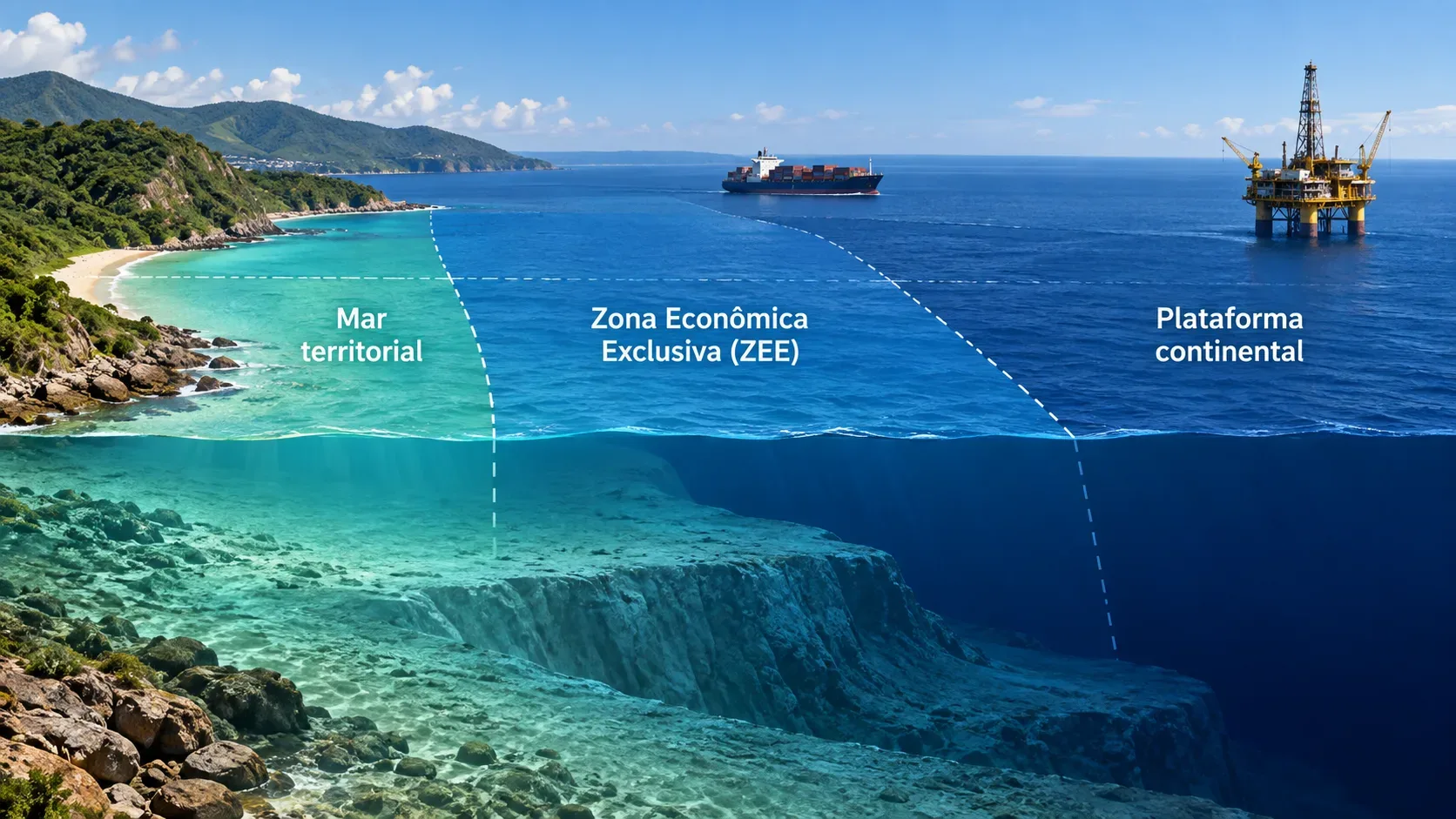
Under the law of the sea, the coast is more than a geographic reference. It helps determine the baselines from which several maritime zones are measured. Under the United Nations Convention on the Law of the Sea, the territorial sea may extend up to 12 nautical miles and the exclusive economic zone (EEZ) up to 200 nautical miles from the relevant baselines; the continental shelf follows its own rules and can, in certain circumstances, extend beyond 200 nautical miles.
Two concepts need to be separated. A baseline is a starting line used to measure maritime zones. A maritime boundary or delimitation line separates areas between neighbouring states when their maritime spaces meet or overlap. Sea-level rise can physically alter the coast and therefore raises questions about the coastal reference itself. An agreed maritime boundary, however, is a different legal object: if every coastal change could reopen a settled boundary, previously stable areas could become disputed again.
For island and archipelagic states, the economic implications are especially significant. Fishing, seabed resources, energy, research and other activities can depend on the extent and stability of these zones. This is why the debate is not merely cartographic; it is also about sovereignty, resources and legal predictability.
What the International Law Commission concluded about maritime zones
The ILC's 2025 final report notes that climate change-related sea-level rise was not an issue contemplated when the Law of the Sea Convention was negotiated. Even so, the Commission found strong state concern with legal stability, certainty and predictability.
- The ILC concluded that the Convention does not impose an obligation on states to update baselines, geographic coordinates or the outer limits of maritime zones already duly deposited with the UN Secretary-General simply because the coast changes as a result of sea-level rise.
- The report also states that there is no rule preventing states from preserving existing and lawfully established baselines and maritime limits.
- The Commission recorded widespread and consistent support among states for preserving those reference lines and the corresponding maritime entitlements, including positions developed by Pacific island countries.
- For maritime delimitation agreements, the report states that the doctrine of a “fundamental change of circumstances” cannot be used to undo established boundaries because treaties establishing boundaries are excluded from that route under the Vienna Convention on the Law of Treaties.
The practical benefit of this approach is that advancing seas would not automatically redraw the allocation of rights between states. The qualification is equally important: the ILC report is a highly influential source for clarification and progressive development of international law, but it is not, by itself, an amendment to the Law of the Sea Convention or a new universal treaty. Its direction can gain strength through state practice, resolutions, declarations and future instruments.
Continuity of island states: the question is not “creating a state without territory”
The statehood debate is sometimes reduced to the idea of a “country without land”. The actual legal problem is different: should an already existing state lose its international legal personality because climate change has made part or all of its territory uninhabitable?
The ILC recorded strong support among states for the continuity of statehood and sovereignty of particularly affected countries, including the maintenance of international legal personality and membership in international organizations. The report links continuity to principles such as sovereign equality, self-determination, territorial integrity, permanent sovereignty over natural resources, legal stability and international cooperation.
This also explains why maritime zones and state continuity are discussed together. If a state remained legally alive but its maritime rights disappeared automatically with its coastline, it could retain an international seat while losing a crucial part of its economic base and sovereign entitlements. The ILC treats these questions as interconnected: preserving state continuity supports the preservation of existing rights, and preserving maritime entitlements supports the population and the state's ability to function.
What is at stake for nationality, representation and people's rights
Sea-level rise creates more than a map problem. It can displace populations, make islands uninhabitable before they are physically submerged and force institutions to operate from other territories. That generates practical questions: who keeps nationality? How can statelessness be prevented? Where can the government perform its functions? Does the state retain its treaties, diplomatic representation and membership in international organizations?
The ILC final report says that affected people remain rights holders and recognizes that current legal frameworks are fragmented and were not designed specifically for sea-level rise. Possible responses identified in the report include special climate mobility agreements, admission pathways, humanitarian visas and measures to prevent loss of nationality and statelessness. It also stresses information, consultation and participation by affected communities, as well as protection of culture, heritage, identity and dignity.
This is why continuity of statehood is not merely an institutional abstraction. It can help preserve nationality, representation, the capacity to protect citizens and the continuity of human-rights obligations, even when part of the population must live outside the original territory.
What the September 24 meeting can — and cannot — do
The high-level meeting can deepen political consensus, amplify the positions of small island states, encourage declarations and resolutions, and shape future legal or cooperation mechanisms. The ILC report itself notes that the General Assembly and other international organizations may adopt binding or non-binding instruments addressing state continuity, sovereignty, maritime zones and protection of affected people.
But the September 24 meeting does not by itself redraw a specific maritime boundary, automatically amend the Law of the Sea Convention, or create a fully detailed universal rule for a state whose territory becomes uninhabitable. What will matter is the degree of political convergence and the language states choose to endorse.
Four questions to watch during the meeting
- Will baselines and outer limits be treated as preservable despite physical coastline change? The more states repeat this position, the stronger legal predictability becomes.
- Will states explicitly support continuity of the international legal personality of island states? That includes sovereignty, participation in organizations and maintenance of lawfully acquired rights.
- How will nationality, mobility and protection of people be addressed? The debate becomes concrete when it moves from general principles to mobility arrangements, residence, documentation and prevention of statelessness.
- What cooperation mechanisms will be proposed? Physical adaptation, financing, resource protection, cultural preservation and institutional solutions all depend on cooperation with other states and organizations.
The core issue
The legal debate over sea-level rise is moving from a purely geographic question — “where will the coast be?” — to a question about preserving rights: what should remain legally stable when geography changes? The ILC's work supports preserving already established baselines and maritime entitlements, records strong support for continuity of affected states, and connects that continuity to protection of people.
The September 24, 2026 meeting matters not because it is expected to settle all these questions in one day, but because it can show how far states are willing to turn that direction into political consensus, international practice and more specific instruments.
Official sources
- United Nations — Sea level rise: an existential threat?
- United Nations — General Assembly High-level Week 2026
- International Law Commission — Sea-level rise in relation to international law
- ILC — 2025 final report on sea-level rise and international law
- United Nations — Overview of the United Nations Convention on the Law of the Sea