Contran Resolution No. 1.031/2026 was published on August 18, 2026 and replaced Resolution No. 432/2013 as the main procedural rule for traffic enforcement involving alcohol and other psychoactive substances in Brazil. Most of the new resolution took effect on the publication date itself. The exception is the set of changes in Annex III, which amends the Annex to Contran Resolution No. 985/2022, linked to the Brazilian Traffic Enforcement Manual (MBFT): that part only takes effect 60 days after publication. On the calendar, that corresponds to October 17, 2026.
In practice, the rule organizes screening through preliminary alcohol tests, makes the circumstances requiring a retest explicit, regulates devices for detecting other psychoactive substances, requires at least two signs for an officer to establish altered psychomotor capacity by observation, and changes operational aspects of how enforcement is recorded. It does not create a new offense or change the penalties set by the Brazilian Traffic Code (CTB).
Timeline: what is already in force and what is still in transition
| Date | What happens | Practical effect |
|---|---|---|
| August 17, 2026 | Date of Contran Resolution No. 1.031/2026. | Contran approves the new regulatory text. |
| August 18, 2026 | Publication in the Federal Official Gazette. | The resolution's articles take effect, Resolution No. 432/2013 is revoked, and the new procedures begin to apply, except for the amendment to the Annex of Resolution No. 985/2022. |
| August 18 to October 16, 2026 | Annex III transition period. | According to the Ministry of Transport, the enforcement codes then in force continue to be used while agencies adjust their systems. |
| October 17, 2026 | 60 days after publication. | The Annex III changes to MBFT enforcement sheets and codes take effect. The date follows from counting the period stated in the resolution. |
What changed in alcohol enforcement
Preliminary or passive testing now has an explicit screening role
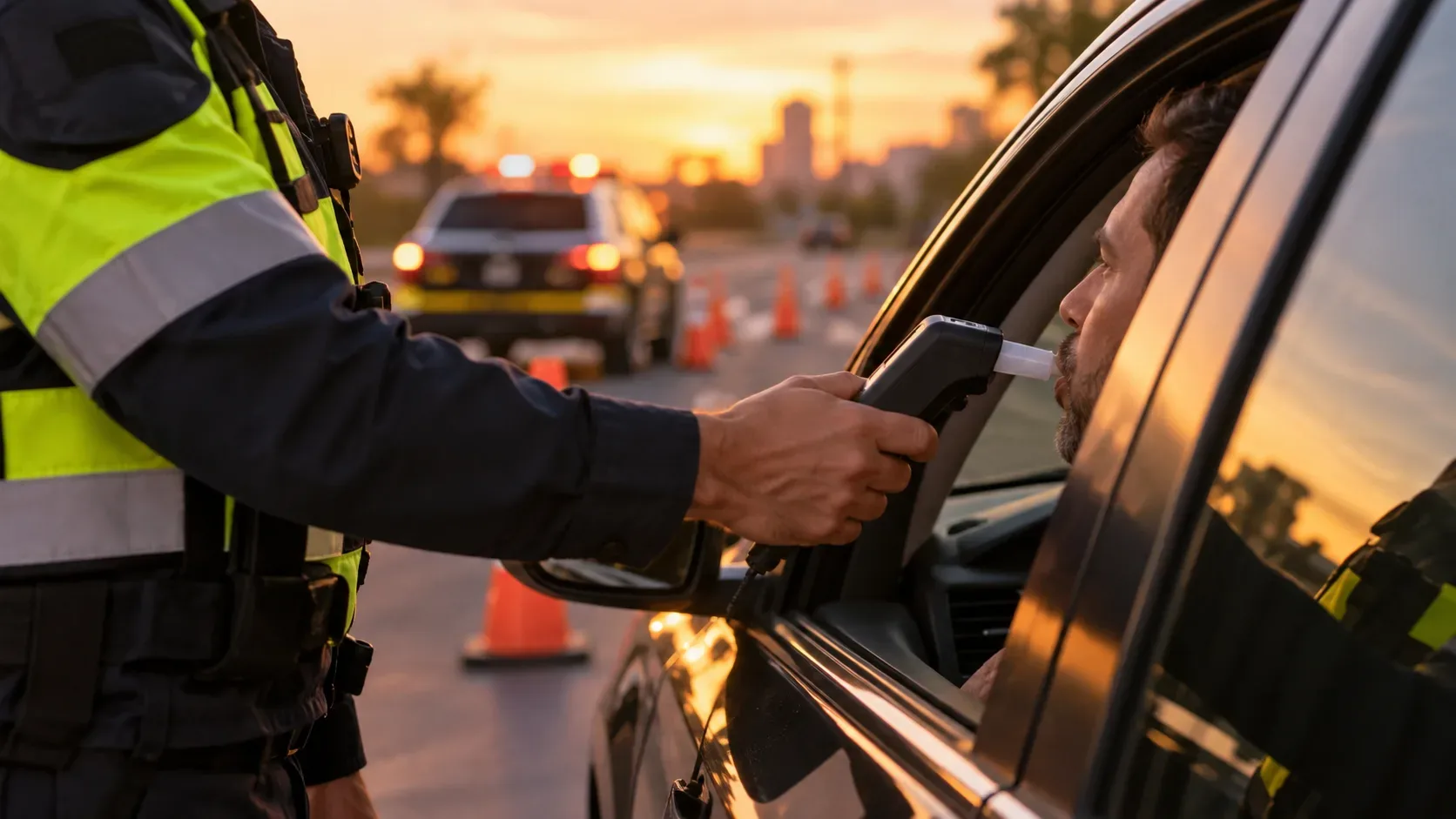
The resolution provides that alcohol enforcement may begin with a preliminary or passive alcohol test. This step is optional: the officer may proceed directly to an alveolar-breath test. The central point is that the preliminary result is only indicative. By itself, it cannot establish the offense or support a citation for driving under the influence of alcohol.
This formalizes a workflow already used by agencies such as the Federal Highway Police: the passive device serves to screen cases that require an appropriate evidentiary test, rather than replacing an active breathalyzer or other methods allowed by the regulation.
The retest now has a clearer rule
Article 5 states that a retest is necessary when a technical or operational reason prevents a valid result from being obtained, including situations in which residual alcohol in the upper respiratory tract may interfere with the reading. Where applicable, the waiting period required by metrological regulation must be observed.
The purpose is to reduce conclusions based on temporary interference, such as alcohol-containing residues in the mouth. This does not make every positive test automatically subject to repetition; the rule links the retest to situations in which the validity of the result has been compromised.
Breathalyzer thresholds remain in place
For the administrative offense under CTB article 165, Resolution No. 1.031/2026 keeps a measured result of 0.05 mg/L or more, after applying the maximum permissible error in the reference table. For the criminal offense under article 306, the text keeps the reference of 0.34 mg/L or more, also subject to the metrological deduction. These thresholds were already present in Resolution No. 432/2013.
Officer-observed signs now require at least two signs
The previous regulation referred to a set of signs. The new resolution makes the officer-observation criterion more objective: at least two signs must exist and, taken together, support the conclusion that the driver's psychomotor capacity is altered. Those signs must be described in the citation or in a specific form attached to it.
What changed and what did not
| Topic | Changed? | Rule under Resolution 1.031/2026 |
|---|---|---|
| Passive preliminary test | Yes, expressly regulated. | It is used for screening and cannot, by itself, support a citation. |
| Retest | Yes, an explicit criterion was added. | It is necessary when a technical or operational issue prevents a valid result, including residual alcohol in the upper respiratory tract. |
| Psychomotor signs | Yes. | Officer-based confirmation requires at least two signs considered together. |
| Devices for other psychoactive substances | Yes. | The rule now covers testing with a device certified under the Brazilian Conformity Assessment System (SBAC) by an Inmetro-accredited body. |
| Penalties under CTB articles 165 and 165-A | No. | The resolution regulates enforcement and evidence; it does not change the penalties established by statute. |
| Use of the breathalyzer | Not eliminated. | It remains the instrument used to measure alcohol in alveolar breath, subject to approval and metrological verification. |
| 0.05 mg/L and 0.34 mg/L thresholds | No. | They remain the measured-result references for the administrative offense and the criminal offense, respectively, with the applicable error deduction. |
| Physical seizure of the driver's license by the officer | Yes. | Article 12 states that the officer will not seize the driver's license for these offenses; any suspension of driving privileges follows a separate procedure. |
Refusal to test: what the new rule organizes
Refusal remains subject to the consequences of CTB article 165-A. Resolution No. 1.031/2026 defines refusal as the driver's denial to undergo the appropriate verification procedure when it is properly offered by the traffic officer. The text also states that the driver does not choose which verification method will be used.
There is an important distinction: if there are not at least two signs of altered psychomotor capacity, the refusal is handled under article 165-A. If at least two signs are present, the resolution directs application of article 165, without excluding possible application of article 306. The Ministry of Transport also explains that citations under articles 165 and 165-A should not be issued simultaneously in the same stop.
Other psychoactive substances enter a more defined procedure
The resolution allows the use of a device designed to verify the presence of other psychoactive substances, with a qualitative result, and requires the equipment to be certified under the Brazilian Conformity Assessment System (SBAC) by an Inmetro-accredited body. The citation must record, among other details, the device identification and the type of substance detected.
This does not mean every enforcement agency will immediately start using such devices. Deployment depends on procurement, certification, training and operational adoption. The Federal Highway Police, for example, said the new resolution provides a regulatory basis for future integration of these devices but that they were not in continuous operational use by the agency when the rule was published.
Why Annex III takes effect 60 days later
Article 14 states that the Annex to Contran Resolution No. 985/2022 will operate with the changes set out in Annex III of Resolution No. 1.031/2026. This material updates enforcement sheets in the Brazilian Traffic Enforcement Manual and the codes associated with the relevant enforcement situations.
Article 16 clearly separates the effective dates: the other articles have applied since August 18, while the annex amendment only applies 60 days later. The Ministry of Transport explained that the window is intended to give agencies within the National Traffic System time to adapt their computerized tools. During the transition, the existing enforcement codes continue to be used.
So the two dates should not be confused: the general procedural rule is already in force; the new MBFT sheets and codes take effect on October 17, 2026, based on the 60-day period counted from publication.
What drivers need to understand in practice
- A positive passive preliminary test is not, by itself, sufficient proof for an alcohol-related citation.
- The active breathalyzer test remains in use and continues to be subject to approval and metrological verification rules.
- A retest is provided for situations in which a technical or operational problem compromises the validity of the result.
- Officer-based confirmation through observed signs requires at least two signs evaluated together.
- Refusal continues to have its own administrative consequence and does not give the driver the right to choose the enforcement method.
- The penalties in the CTB were not increased or reduced by Resolution No. 1.031/2026.
- Until Annex III takes effect, agencies continue using the enforcement codes in force during the transition.
Official sources and scope
The full text is available in the official Datalegis database, while the transition was explained by the Ministry of Transport. The Federal Highway Police also published an operational explanation of passive screening and devices for other substances. Senatran's page lists Contran resolutions.
This article explains the regulation in general terms and does not replace legal analysis of a specific citation, license-suspension proceeding, criminal occurrence or individual case.