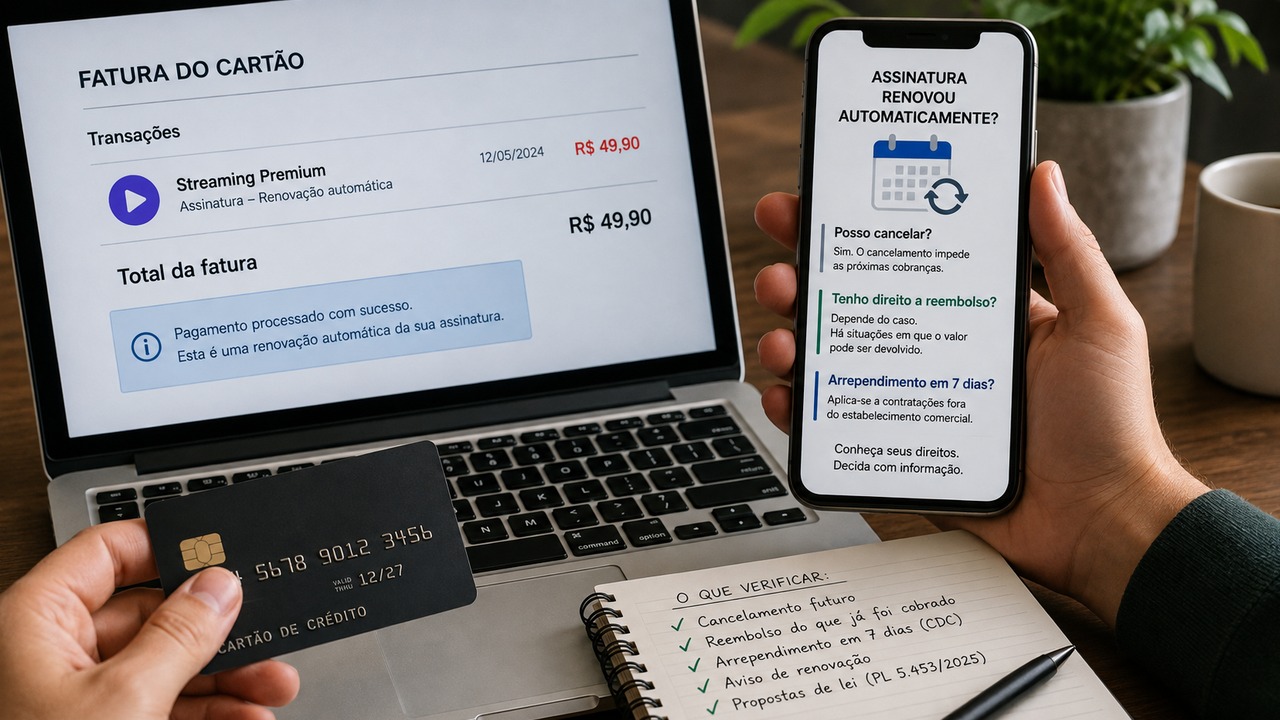
If the subscription renewed automatically and the amount has already appeared on your card, pressing "cancel" does not, by itself, mean that the charge for the new cycle will be refunded. Under consumer law, there are three different questions: how to stop future charges, whether the renewal that has already occurred can be undone, and whether a right of withdrawal exists in that specific case.
The safest answer today in Brazil is this: the Consumer Protection Code (Código de Defesa do Consumidor, CDC) does not contain a general rule stating that every automatic renewal automatically opens a new seven-day window to request a refund. Article 49 of the CDC provides seven days to withdraw from contracts made away from a business establishment, counted from signing or from receipt of the product or service. Applying that period specifically to a simple automatic renewal may depend on the circumstances of the contract and on how the case is interpreted.
That does not mean a renewed charge can never be refunded. If there was a charge after cancellation, lack of consent, inadequate information about the renewal, a hidden clause, a material change in price or terms, or another defect in the contracting process, the consumer may have independent grounds to seek repayment. A more favorable contractual refund policy may also exist.
Canceling the subscription and requesting a refund are different acts
Cancellation usually serves to end the relationship or prevent future charges. A refund concerns money that has already been charged and, in many cases, already paid. That is why a screen confirming "subscription canceled" is not necessarily the same as confirmation of a refund.
With a monthly, annual, or other recurring subscription, the company may record the cancellation for the end of the current cycle. In that scenario, access continues until the already-paid date and the next renewal does not occur. If the consumer also wants to undo the renewal that was just charged, that request needs to be made expressly, and the basis for repayment needs to be checked.
This distinction avoids a common mistake: canceling today, assuming the charge already made will automatically be reversed, and later discovering that only the next renewal was blocked.
What the CDC actually says about the seven days
Article 49 of the Consumer Protection Code establishes the right to withdraw from a contract within seven days when a product or service is contracted away from a business establishment, such as in distance contracts. The same article provides that, when the right of withdrawal is exercised within the deadline, the amounts paid must be returned.
For e-commerce, Decree 7,962/2013 reinforces the duties of information, facilitated service, and respect for the right of withdrawal. The decree also requires clear and effective means to exercise that right and provides that the consumer may use the same tool employed for contracting, without prejudice to other channels offered.
The decisive point for renewals is that the current wording of Article 49 does not say the period restarts with every automatic renewal. It refers to seven days counted from signing or from the act of receiving the product or service. For that reason, it is not safe to turn the seven-day rule into an automatic guarantee of "seven days after any renewal," as some internet pages do.
At the same time, digital contracts may involve specific facts capable of changing the analysis. A renewal may come with a new offer, a plan change, a new lock-in period, a price change, or another manifestation that makes the case closer to a new contract. The discussion then stops being only "did it renew or not" and begins to involve what was disclosed, accepted, and actually charged.
Is automatic renewal always abusive?
It is also incorrect to state, as a general rule, that every automatic renewal is illegal. The federal CDC currently in force does not contain a blanket prohibition worded that way for all consumer subscriptions. What it requires is adequate information, transparency, good faith, and contractual balance, while also prohibiting abusive practices and clauses.
In practice, the validity of the charge may depend on how the renewal was presented. A clause placed where it is hard to notice, a charge without identifiable consent, or the imposition of new obligations without clear information can weaken the supplier's position.
There are court decisions treating specific renewals as abusive. In 2025, for example, the Tribunal de Justiça do Distrito Federal e dos Territórios published a decision involving a gym in which the automatic-renewal clause was not properly highlighted and the consumer claimed she was unaware the contract would continue; the charge was deemed improper and repayment was ordered. This type of precedent helps explain the criteria, but it does not turn every automatic renewal into a mandatory refund.
Regulated sectors may also have their own rules. In telecommunications, for example, Anatel regulates minimum-stay periods and establishes specific rules for renewing offers with lock-in commitments. For that reason, a streaming subscription, a gym membership, a software service, and a telecom plan should not be treated as though they were governed by exactly the same sector-specific regime.
When a refund request becomes stronger
The charge occurred after you had already canceled
If there is proof that cancellation was requested and confirmed before the renewal, a later charge tends to be easier to characterize as improper. Keep emails, protocol numbers, confirmation screens, and the exact date when cancellation was made.
In that situation, the request does not depend on convincing the company that you simply changed your mind. The point is to show that, when the charge occurred, the supplier should no longer have renewed the service according to its own service history.
The renewal was not clearly disclosed
The duty to provide information is central to consumer relations. If automatic renewal was hidden, placed in hard-to-access text, or the consumer did not have a reasonable opportunity to understand the price, frequency, and cancellation method, there may be a
dispute over inadequate disclosure and an abusive clause.
The longer or more expensive the renewal, the more important it is to check the original offer, the contract summary, the accepted terms, and any notices sent before the charge. The absence of advance notice does not, by itself, create today an automatic federal right to seven days after renewal in every contract, but it can be relevant when assessing transparency and good faith.
The price, plan, or terms changed
One thing is to renew exactly the service the consumer contracted for, under the terms previously disclosed. Another is to start a new cycle with a different price, duration, features, or obligations without adequate communication.
If there was a material change, it is useful to separate the renewal dispute from the dispute over a contractual change. The supplier needs to show the basis for the charge and the information provided to the consumer.
The company itself offers refunds
Many platforms adopt commercial refund policies that are more favorable than the minimum protections debated under the law. Some accept a full refund if the request is made shortly after renewal; others condition the refund on non-use of the service; others do not refund but end the next cycle.
If the offer, terms, or customer service promise a particular refund policy, that promise becomes relevant to the consumer relationship. That is why reading only the CDC is not enough: it is also important to check what the supplier itself offered and recorded.
What if the charge is actually improper? Double repayment may apply
Article 42, sole paragraph, of the CDC provides that a consumer charged an improper amount is entitled to repayment of twice the excess amount paid, with monetary adjustment and interest, except in the case of a justifiable mistake.
The Superior Tribunal de Justiça has established that double repayment does not depend on proving an intention to harm the consumer. The focus is on whether the charge is compatible with objective good faith and on whether a justifiable mistake existed.
This does not mean that every dispute over a renewal automatically results in double payment. First, it is necessary to show that the charge was improper. Then there is still an analysis of whether the mistake was justifiable. In a concrete dispute, those points may depend on the documents and on administrative or judicial interpretation.
What to do when the renewal appears on the card
First, preserve the evidence before changing the account
Save the original offer, the plan terms, the renewal screen, the charge date, the amount, notice emails, and any message about a price change. If there is a page showing the next renewal date, save that as well.
These documents help answer what actually matters: did the consumer know about the renewal? Was the price clear? Was there notice? Was cancellation made before or after the charge? Was the service used during the new cycle? Did the company promise any refund period?
Then cancel to prevent future charges and request the refund separately
Use the subscription's official channel to cancel and keep the confirmation. Then make a specific request for a refund of the renewal already charged. Do not limit the request to the word "cancel," because the company may interpret that only as a block on the next renewal.
In the refund request, explain the objective reason. It may be a charge after cancellation, lack of clear information, an unaccepted change, application of the right of withdrawal depending on the circumstances, or a refund policy promised by the supplier itself.
If the company denies the request, record the dispute through a channel that generates a protocol
Consumidor.gov.br is a public service for direct dialogue with participating companies. The platform states that the supplier has up to ten days to respond to the complaint. When the company does not participate or the problem is not resolved, Procons, Public Defender's Offices, and Special Civil Courts remain available, depending on the case.
When filing the complaint, do not describe the charge as "card fraud" if you recognize the subscription and the dispute concerns contractual renewal. Explain exactly what happened. This makes the analysis easier and avoids confusing a consumer dispute with unauthorized use of the card.
What may change with Bill 5,453/2025
There is a legislative proposal precisely because the current CDC does not provide a general and explicit framework for a withdrawal window after each automatic renewal.
Bill 5,453/2025 was introduced in the Chamber of Deputies in October 2025. On August 28, 2026, the Chamber's legislative record listed it as "Pronta para Pauta" (ready for agenda) in the Consumer Protection Committee. The rapporteur presented a favorable report with a substitute text in May 2026, and the deadline for amendments to the substitute ended without amendments.
The substitute proposes adding to the CDC a specific rule for adhesion contracts involving continuing services or automatic renewal. The proposed points include advance notice before renewal, facilitated cancellation, and a seven-day period counted from the automatic renewal for exercising the right of withdrawal.
This matters when interpreting news and posts on the subject: the seven-day rule after renewal currently appears in a legislative proposal, but it cannot yet be treated as though it were already in force. A bill, a rapporteur's report, and current statutory text are different stages.
So, does canceling a renewal already charged entitle you to a refund?
Sometimes yes; automatically, no. Cancellation may operate only for the future. A refund for the cycle that has already been charged depends on the legal or contractual basis applicable to the case.
If the charge came after a cancellation, if there was no consent or adequate information, if the terms were changed without transparency, or if the company itself offers repayment, the refund request becomes stronger. If the renewal was clear, previously accepted, and the new cycle has already started with no other irregularity, simply canceling may only prevent the next charge.
And the CDC's seven-day period needs to be used precisely: it is an express protection for contracting away from a business establishment, but the current law does not generally say that each automatic renewal restarts that period. This is precisely one of the gaps that pending proposals seek to regulate.
For a high-value case, a complex contract, a lock-in commitment, repeated charges, or a refund denial despite strong documentation, an individual analysis by a consumer-protection body or a qualified professional may be necessary. This content is informational and does not replace legal advice for a specific case.