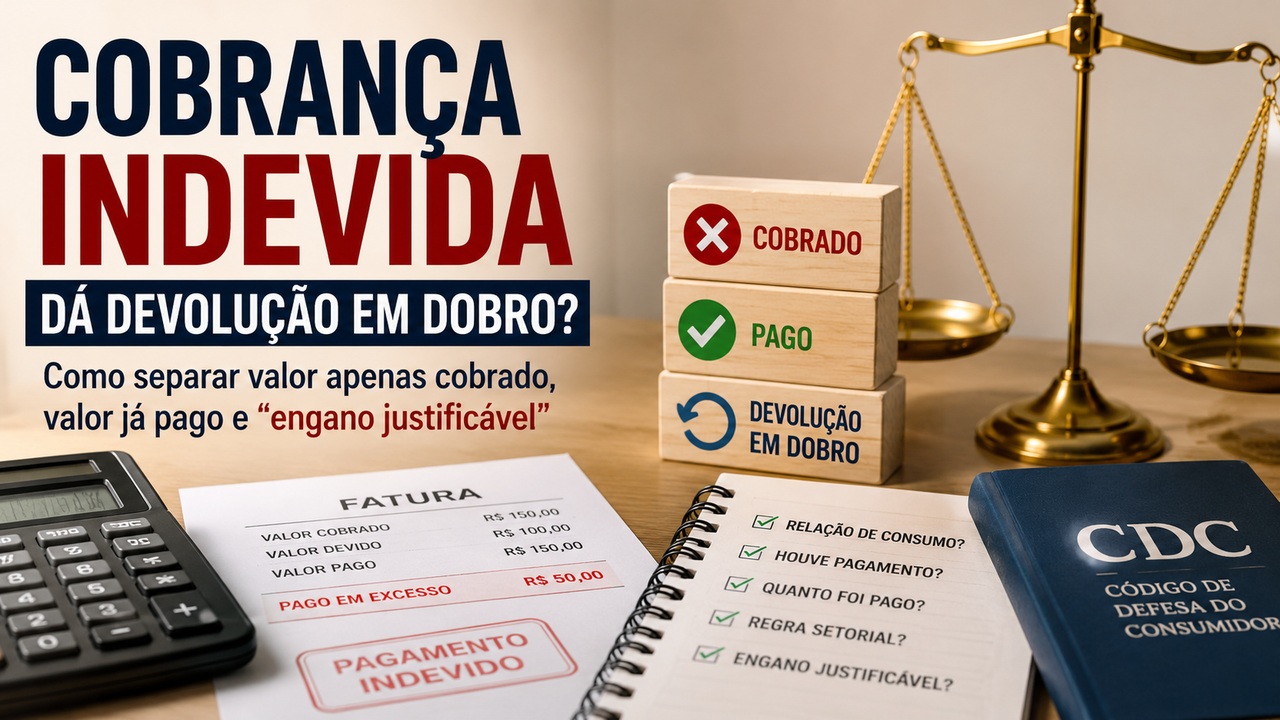
Not every undue charge automatically generates a double refund. The first question is whether the consumer simply received an incorrect charge or whether he actually paid an amount that he did not owe. Under the regime of art. 42, sole paragraph, of the Consumer Protection Code, the double repetition is calculated on what was paid in excess, and not on the entire amount that appeared on the invoice.
The current guidance of the Special Court of the Superior Court of Justice is that, once the consumption relationship, undue charging and overpayment are demonstrated, the refund must be made in double, unless the supplier proves that there was a justifiable mistake. The consumer does not need to demonstrate intent or subjective bad faith on the part of the supplier. The analysis focuses on objective good faith and the precautions that were required of those who carried out the charge.
This really changes the way we look at a specific case. Before asking "am I entitled to double?", it is more useful to separate five facts: whether there is a consumption relationship, what was charged, what was actually due, how much was actually paid and whether there is any specific sectoral rule. Only then does the discussion about justifiable deception come into play.
The rule of art. 42 of the CDC in one sentence
Art. 42 of the CDC protects the consumer against undue charges and provides, when there is an excess payment, refund for an amount corresponding to twice that excess, with monetary correction and legal interest, except in the event of a justifiable mistake.
In 2024, the Special Court of the STJ reaffirmed that the double refund does not depend on proof of guilt, intent or subjective bad faith. The central point is to know whether the charge went against objective good faith and whether the supplier can demonstrate, in the specific case, a justification capable of making the error excusable.
The expression "repetition of undue payment" is just the legal name given to the return of an amount paid without being due. For the consumer, the calculation starts with a simple question: how much of my equity came out beyond what I actually owed?
First: was there only collection or also payment?
There was only a charge, but the amount was not paid
If an invoice for R$150 should be R$100, but the consumer identifies the error before paying and only pays the correct R$100, there is no overpaid amount. In this scenario, art. 42 of the CDC does not provide a calculation basis for refunding double that R$50, because the device itself relates the double to what was actually paid in excess.
This does not mean that the wrong charge is irrelevant. The consumer can dispute the amount, request cancellation of the undue installment, seek a declaration that the debt does not exist and demand correction of the records resulting from the charge. Any additional losses or moral damage depend on the concrete facts and cannot be confused with the repetition of the undue payment.
The undue amount was paid
When the consumer pays the wrong charge, the analysis changes. It is necessary to compare the amount owed with the amount actually paid. The positive difference between these two numbers is overpayment.
If R$100 was owed, R$150 was charged and the consumer paid R$150, the excess paid was R$50. According to the rule of art. 42, if there is no justifiable mistake, the refund corresponding to double this excess is R$ 100, in addition to the applicable legal surcharges.
Double does not mean receiving back the undue amount and, furthermore, twice the same amount. If the excess was R$50, the double refund totals R$100. Treating the calculation as R$50 plus R$100 would produce a triple refund, which is not what the provision establishes.
There was partial payment
It is also possible that the consumer only paid part of the charge. Imagine again a bill of R$150 when the correct amount was R$100, but the payment made was R$120. The excess actually paid was R$20. If the other CDC requirements are met and there is no justifiable mistake, the basis for the double is R$20, resulting in a refund of R$40.
This separation avoids a common mistake: using the entire amount charged as a basis, even when part of it was legitimate or had not even been paid.
How to calculate charged, due, paid and return
When all extra charges have been paid
If the service cost R$100, the invoice came in at R$150 and the consumer paid the R$150, the difference between what should have been paid and what came out of the assets is R$50. This is the excess. In the event of a double refund, the corresponding amount is R$100, subject to updating and applicable interest.
When the extra charge was disputed before payment
If the consumer received the same invoice for R$150, but disputed the R$50 and only paid the undisputed R$100, the excess paid is zero. The objective becomes to remove or cancel the undue charge, not to double refund an amount that was never disbursed.
When the entire charge was undue
If nothing was owed, R$80 was charged and the consumer paid the R$80, the excess paid coincides with the total disbursed. In this case, the double refund, when applicable, corresponds to R$ 160, in addition to the additions provided for in applicable legislation.
The examples serve to show the logic of the calculation. The legal conclusion still depends on the nature of the relationship, the collection period, the evidence and any specific standards in the sector.
What is justifiable deception
Justifiable mistake is the exception that can prevent a double refund. It should not be confused with the simple allegation that "it was an error", because every undue charge already presupposes some mismatch between what was due and what was demanded.
According to the guidance of the Special Court of the STJ, it is up to the supplier to demonstrate, in the specific case, that the mistake was justifiable. The discussion does not depend on proving an intention to harm the consumer. The examination is objective: it considers whether the conduct complied with the duties of loyalty, care and organization expected of the supplier.
Therefore, a generic explanation such as "system failure" does not resolve the issue alone. What matters is proof of the circumstances that produced the error, the precautions taken, the way the charge was generated and the supplier's reaction after identifying the problem.
If the justifiable mistake is recognized, the penalty of double refund is waived. This does not make the amount that was not owed legitimate. If there is an amount unduly received, simple restitution may continue to be necessary, depending on the circumstances of the case.
Which documents really change the answer
Proof of the origin of the charge
Contract, order, budget, offer regulations, proof of membership and service history help to establish how much was actually owed. Without this reference, it may be difficult to even demonstrate that the charge exceeded what was agreed.
Proof of what was actually paid
Invoice, receipt, Pix receipt, bank statement, card statement and discharge document are essential to separate the amount charged from the amount actually paid. A charge capture shows what was required; the financial statement shows what actually came out of the assets.
In recurring charges, it is important to organize each competency separately. A sequence of five undue debits of R$20, for example, must be reconstructed based on the actual payments and not just the amount currently displayed in the application.
Proof of the supplier's dispute and response
Service protocols, emails, messages, recordings made available to the consumer, complaint numbers and formal responses help document when the error was reported and how the supplier reacted.
These records may also be relevant to the analysis of justifiable deception. Quickly correcting an error does not automatically erase the undue charge, but the chronology of the service can help clarify what happened and what measures were taken.
Proof of sector-specific rules
Some markets have their own regulations on disputes, suspension of charges, deadlines and method of return. The contract and CDC remain important, but the operational response may be further detailed by a regulatory agency or special legislation.
Sectoral rule can change the procedure
Telecommunications offers a clear example. Anatel's current General Regulation on Consumer Rights for Telecommunications Services establishes that the amount disputed and not yet paid may have the charge suspended and, if the dispute is valid or the provider does not respond within the regulatory period, the charge must be canceled when it has not yet been paid.
When the consumer has already paid the undue amount, Anatel regulations provide for a refund corresponding to twice the excess amount paid, with monetary correction and interest of 1% per month, proportionally per day. The regulation also details forms and deadlines for refunds.
This example shows why the answer to "improper charging is double?" should not ignore the sector. The CDC provides the transversal rule, while specific rules can organize the administrative procedure, dispute deadlines, form of credit and applicable additions.
Do not confuse the CDC with the judicial collection of the Civil Code
There is another double refund rule that is usually mixed with art. 42 of the CDC: art. 940 of the Civil Code. The assumptions are different.
Art. 940 deals with the situation in which someone sues in court for a debt already paid, in whole or in part, or asks for more than is owed. The STJ, in Repetitive Topic 622, established that the civil sanction for judicial collection of debt already paid requires demonstration of bad faith on the part of the creditor.
This difference is important because art. 940 may apply even without a new payment by the debtor, as long as there is judicial collection and its requirements are met. The double repetition of the art. 42 of the CDC, in the logic discussed here, is linked to undue payment made by the consumer.
The STJ itself has already recognized that, in a consumer relationship, a judicial collection of a settled debt can be examined under art. 940 of the Civil Code when the assumptions of this norm are present. Therefore, it is not correct to transform the two rules into a single formula.
What does STJ Theme 929 change in 2026
The STJ's official qualified precedents page still presents Theme 929 as "Under Trial". The theme was affected to discuss, under the rite of repetitions, the hypotheses of application of double repetition of the art. 42 of the CDC.
This does not mean that the subject is without guidance. The Special Court has already standardized the jurisprudence in previous judgments and reaffirmed, in 2024, that the double refund is related to the violation of objective good faith and does not depend on proof of intent or subjective bad faith on the part of the supplier.
There is also a relevant temporal caveat. The STJ modulated the effects of the standardized thesis for debts of a non-public contractual nature, establishing its application to charges subsequent to the publication of the ruling on March 30, 2021. Older charges may require specific analysis of the understanding applicable at the time.
A factual flow to analyze the case
1. Confirm if there is a consumption relationship
The first filter is whether the charge arises from a relationship submitted to the CDC. If there is no consumer relationship, the legal basis may be different and it is not safe to automatically carry the rule of art. 42.
2. Separate amount charged, amount due and amount paid
These three numbers are not synonymous. The amount charged shows what the supplier demanded. The amount owed shows what should have been demanded. The amount paid shows how much money actually came out of the consumer's assets.
3. Only calculate the excess actually paid
Subtract from the amount paid what was legitimately owed. If the result is positive, this is the amount paid. It is on this excess that the CDC's double refund is being examined.
4. Check if there is a specific sector rule
Telecommunications, financial services, energy, supplementary healthcare and other sectors may have their own administrative rules. They can define deadlines, dispute channels, suspension of charges and method of reimbursement.
5. Check out the discussion on justifiable deception
If there was an undue payment, the double refund may be rejected if the supplier proves a justifiable mistake. The assessment depends on the evidence in the case and objective good faith, not on a general requirement that the consumer demonstrate malicious intent.
What to keep before complaining or filing a lawsuit
The most useful set is the one that allows you to reconstruct history without relying solely on memory. Keep the document that generated the charge, proof of the correct amount, proof of payment, corresponding statements, dispute protocols and the supplier's response.
If there are multiple charges, organize them by date and amount. If the charge is judicial, also preserve the petition, the invoices, the decisions and proof of previous discharge, because the analysis may fall outside of art. 42 of the CDC and achieve the discipline of art. 940 of the Civil Code.
The short answer
Undue charging does not mean, in itself, a double refund. When the consumer was only charged and did not pay the undue amount, the typical measure is to cancel or declare the charge unenforceable. When there was an excess payment in a consumer relationship, the rule of art. 42 of the CDC points to double this excess being returned, unless a justifiable mistake is proven by the supplier.
The correct calculation starts with what was actually paid in excess. And the final answer still needs to consider the evidence, the collection period, the applicable sectoral rule and the difference between extrajudicial consumption collection and judicial collection of debt already paid.