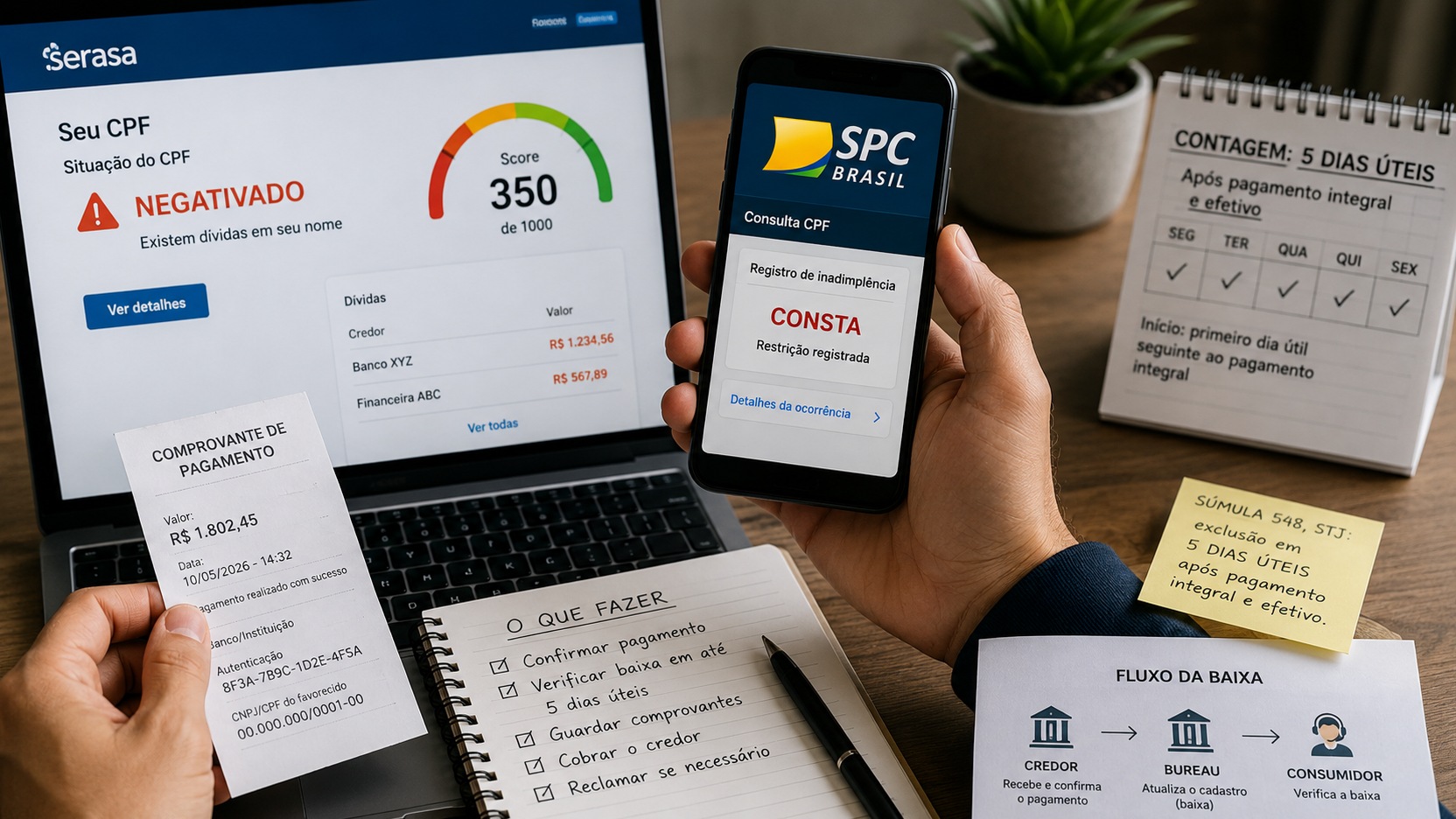
When a debt completes five years, three different things are usually mixed in the same sentence: getting out of negative status, prescribing and stopping appearing at Serasa. They don't mean the same thing.
The safest rule is this: negative information cannot remain in the defaulter register indefinitely; the statute of limitations depends on the type of debt and the circumstances of the case; and a negotiation offer can continue to appear on Serasa Limpa Nome without meaning that the CPF is negative.
There is still an open legal issue. The Third Panel of the Superior Court of Justice (STJ) has already decided that a prescribed debt cannot be collected judicially or extrajudicially, but considered that the mere presence of the debt on a voluntary negotiation platform does not, in itself, amount to collection. The Second Section of the STJ itself, however, will still standardize this matter in Repetitive Topic 1,264, which remained in the status of “Affected” on August 8, 2026.
Negative, prescription and Clear Name are not the same thing
| Concept | What happens | The five-year point |
|---|---|---|
| Negative | It is the negative record in the defaulter register. | Negative information cannot exceed five years. The STJ counts this period from the first day after the debt becomes due. |
| Prescription | It achieves the intention of legally demanding a certain obligation. | Five years is a common term for some debts, but it does not apply to all debts. |
| Serasa Limpa Name | It is a trading platform, different from negative registration. | An old debt may continue to appear as an “overdue account” or settlement offer without negative CPF. |
The Consumer Protection Code determines that consumer records and data cannot contain negative information relating to a period exceeding five years. In 2024, the STJ reinforced that this limit must be counted from the first day following the debt maturity — and not from the day on which a company decided to register it in the register.
This prevents, for example, that a debt due almost five years ago artificially gains another five years of negative status just because the creditor took a long time to forward the registration.
STJ Summary 323 also establishes a maximum period of five years for maintaining the debtor's name in credit protection services.
Prescription does not simply mean “the debt was five years old”
Here is one of the main sources of confusion.
The Civil Code says that, when a right is violated, a claim arises, which is extinguished by prescription within the deadlines provided by law. Technically, therefore, it is more accurate to talk about prescription of the claim to collect than to say that the debt simply disappeared.
The term is also not always five years. Article 206 of the Civil Code provides, for example, three years for some claims and five years for the collection of net debts contained in a public or private instrument. When the law does not establish a shorter period, article 205 provides for a period of ten years. There are also obligations subject to specific laws.
Therefore, the phrase “any debt expires in five years” is wrong.
In addition, the count may be affected by situations that prevent, suspend or interrupt the prescription. The Civil Code provides, among other hypotheses, for interruption by an unequivocal act that implies recognition of the right by the debtor.
The practical consequence is that the apparent age of the debt, alone, is not always enough to conclude that there has been a statute of limitations.
So the prescribed debt ceases to exist?
Not necessarily.
In REsp 2,103,726, the Third Panel of the STJ highlighted that the prescription of the claim does not automatically extinguish the credit. The distinction helps to understand why a prescribed obligation can continue to be subject to voluntary payment or negotiation, although its enforceability is limited.
The Civil Code itself reinforces this difference by establishing, in article 882, that, as a rule, one cannot request back what was voluntarily paid to settle a prescribed debt solely on the basis of the prescription.
A renegotiation also deserves attention. The Civil Code allows express or tacit waiver of prescription already completed when the behavior of the interested party is incompatible with it. Thus, signing a new agreement, formally recognizing a certain obligation or assuming new payment conditions can change the legal situation. Before accepting a renegotiation of an old debt, it is important to understand exactly the document being signed.
What happens to denial after five years
At this point, the rule is much more objective.
Article 43, paragraph 1, of the Consumer Protection Code prevents negative information relating to a period exceeding five years from remaining in records. According to the STJ, the maximum period is counted from the first day following the due date.
Thus, if the debt matured more than five years ago and what appears is effectively a denial regarding that same due date, the negative record should not continue to be maintained just because the obligation is still included in the creditor's controls.
This does not mean that the consumer will automatically be approved for credit. Removing a denial eliminates that specific restriction; credit analysis and scores may consider other legitimate information about financial history.
Why does an old debt still appear in Serasa Limpa Nome?
Because Serasa Limpa Name and registration of defaulters are different things.
According to the Serasa Help Center, debts older than five years may continue to be presented in Limpa Nome as “overdue accounts”, if the creditor makes an offer available. Serasa states that these offers are accessible to the consumer and the creditor company and are not equivalent to denial.
The company also informs that accounts overdue for more than five years are not considered in the Serasa Score calculation.
The STJ reached a similar conclusion in REsp 2,103,726: for the Third Panel, Limpa Nome is a trading platform and should not be confused with negative registration. In this judgment, the panel considered that the simple provision of a possibility of agreement to the consumer did not, in itself, constitute an extrajudicial charge.
This explains a situation that seems contradictory at first glance: the application can inform you that there are no negative debts and, at the same time, show an old debt in the negotiation area.
One thing does not automatically transform another.
And can the company continue to collect a prescribed debt?
This is where the answer requires more care.
In judgments of the Third Panel, the STJ adopted the understanding that the recognition of prescription prevents both judicial and extrajudicial collection of the debt. In REsp 2,103,726, however, the group differentiated a charge directed at the consumer from the mere presence of a voluntary offer at Serasa Limpa Nome.
The discussion is not yet over in court.
The Second Section affected REsps 2,092,190, 2,121,593 and 2,122,017 to Repetitive Theme 1,264 precisely to decide whether a prescribed debt can be demanded extrajudicially, including through the inclusion of the debtor's name in agreement or renegotiation platforms. On August 8, 2026, the STJ's official register still showed the cases without judgment on the merits and the topic as “Affected”.
Therefore, it is not appropriate to transform a class precedent into a statement that the issue has already been definitively resolved for all courts and situations. Repetitive judgment may still standardize or alter the scope of this understanding.
How to interpret an old debt that appears on your CPF
- Check the expiration date. To remain in negative registration, the maximum period of five years is counted from the first day following the expiration date.
- See where the information appears. A “negative debt” or “restriction” is not the same thing as a “delayed account” or offer available only in the Serasa Limpa Nome area.
- Do not conclude the prescription just based on age. It is necessary to identify the nature of the debt, the applicable legal term and any facts that have affected its count.
- Before renegotiating a possibly prescribed debt, read the agreement. Recognition of the obligation may have legal consequences, including in relation to the prescription itself.
If there is a denial that appears to exceed the allowed period or incorrect information in the registration, the CDC itself guarantees the consumer the right to demand correction of inaccurate data. In a conflict over prescription or collection of old debt, analyzing the contract, dates and possible renegotiations is especially important, even more so while Topic 1,264 remains pending in the STJ.
The idea that “after five years everything disappears” exchanges three different rules for an easy-to-remember but legally imprecise phrase. The negative record has a time limit; the prescription needs to be analyzed according to the obligation; and a private negotiation opportunity can remain visible without necessarily representing a new negative.