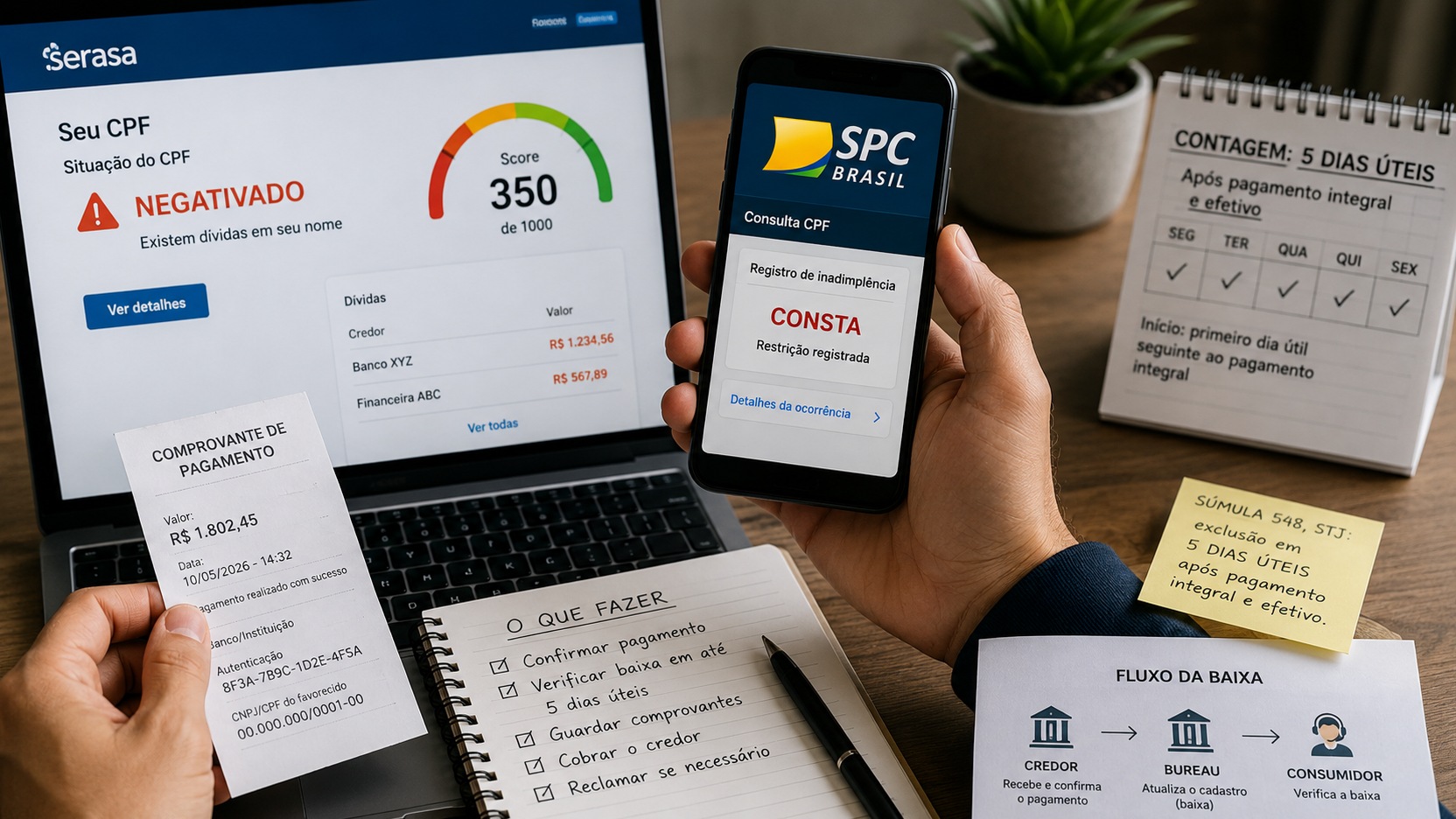
Paying a debt and continuing to see your CPF restricted does not mean, in itself, that the deadline has already been missed. Before complaining, it is necessary to confirm which note is still active, when the money actually became available to the creditor and whether what appears is a denial, a negotiation offer, a protest or another different debt.
Before counting the deadline, find out what is still appearing
The first diagnosis is simple: open the detailed query and compare the name of the creditor, the contract or origin of the debt, the amount and the date. The write-off is linked to the specific record. If you have paid off a debt, but there is another legitimate denial, the CPF may continue to appear as negative even if the first creditor did everything correctly.
It is also worth observing the exact screen on which the debt appears. A pending item displayed in the trading area is not necessarily an active negative note. Likewise, a protest at a registry office follows its own procedure and should not be treated as if it were just a line in the Serasa or SPC register.
What STJ Precedent 548 really determines
The central reference is Precedent 548 of the Superior Court of Justice. It gives the creditor the responsibility to delete the debt record from the defaulter register within five working days, counting from the full and effective payment of the debt.
The most important point is that the obligation to provide the write-off lies with the creditor who promoted the negative. The consumer does not need to figure out how to send a technical order to the registry on their own. If the information remains incorrect after the deadline, collection must begin with the company or institution that received the payment.
When the five working days start counting
The STJ went beyond the generic expression 'payment date'. In the judgment that gave rise to the guidance, the court indicated that the period begins on the first business day following the complete availability of the amount necessary to settle the overdue debt. This matters when the payment method depends on clearing or confirmation.
In practice, do not confuse the moment you issued or paid a bill with the moment the amount was actually made available to the creditor. If the payment was made on a Friday and only became available on Monday, it is this availability that serves as a reference to start counting on the first subsequent business day. Payments with immediate settlement tend to reduce this difference, but the relevant data remains the actual settlement.
Therefore, keep the receipt and, if in doubt, ask the creditor for the date on which the payment was recognized or cleared. This information helps avoid discussions based solely on the date the transaction was initiated.
Installed agreement: the first installment should not be treated as a universal rule
Precedent 548 speaks of full and effective payment of the debt. In renegotiations, however, the effect of the first installment may depend on the agreement signed. Serasa informs that, in agreements made by Serasa Limpa Nome, payment of the first installment can lead to the negative debt being reduced within five working days, as long as there are no other negative debts. SPC Brasil also informs a similar procedure in its channel agreements.
This does not mean that every renegotiation made with any creditor, on any platform, automatically produces the same effect. Read the conditions of the agreement and confirm that the old debt has been renegotiated so that the default note must be removed after the payment or first installment. If there is a subsequent delay, a new negative payment may occur depending on the debt situation and the applicable conditions.
If the customer service only responds 'the agreement is in installments', ask for objective information: which clause or condition keeps the denial active and what is the expected event for the write-off. This question helps separate a real contractual rule from a generic customer service response.
Serasa Limpa Name, negativity and protest are not the same thing
The name of a debt can continue to appear on a negotiation platform without this meaning that the consumer remains negative. The STJ itself has already differentiated Serasa Limpa Nome from the defaulter register. Therefore, the correct question is: is there an active negative annotation, or just an offer or trading record visible to the consumer?
The protest is also different. Cancellation of protest registration is done at the competent notary office and may require a document or cancellation authorization, in addition to the notary's office measures provided for the case. Paying off the debt with the creditor does not automatically transform this procedure into a simple write-off from Serasa or SPC.
If the deadline has passed, cover the write-off with proof
After counting five business days from the correct milestone, contact the creditor and inform them that the debt has been paid, that the note remains active and that you request deletion from the record. Ask for the protocol number and, if possible, confirmation of the date on which the discharge order was sent to the defaulter register.
Avoid relying solely on unregistered connections. Service via app, email or formal protocol makes it easier to demonstrate what was requested and when. If the company says it has already downloaded it, ask for the shipping date and just wait for the necessary technical time to check the update in the indicated record.
What documents are worth keeping
Keep proof of payment, the contract or renegotiation agreement, identification of the debt, proof of compensation when available, screenshots of the restriction with date, and all service protocols. If the payment was made by a third party or through an intermediary channel, also keep the proof that links the transaction to the correct debt.
These documents help in three aspects: they show that the debt was effectively paid, they allow identifying which note should have been removed and they record that the creditor was notified that the restriction will remain.
When to look for Serasa, SPC, Consumidor.gov.br or Procon
If the creditor does not resolve, the registration itself may have a rectification channel. Serasa, for example, advises consumers to first look for the responsible company and also allows them to request updates directly, with documents proving payment. When the information comes from another base, the correction may depend on confirmation or forwarding to the person responsible for originating the data.
Another alternative is to file a complaint at Consumidor.gov.br, if the company participates in the platform. The service informs that the company has up to ten days to analyze and respond. Procon is also a way to formalize the complaint and obtain guidance on the specific case.
If there is a relevant loss, disagreement about the settlement itself, persistent denial or discussion about compensation, seek individualized legal advice. The mere fact that the deadline has passed does not exempt the analysis of the evidence, other existing registrations and specific circumstances.
A script to solve without wasting time
Start by confirming which record is still active. Then, identify the date of effective payment or availability of the amount to the creditor and count the five business days from the first subsequent business day. If the period has expired, cover the creditor's write-off with a protocol. Then, request rectification of the registration in which the restriction appears and, if necessary, take the documentation to Consumidor.gov.br or Procon.
The central point is not to treat any screen with debt as proof of negative debt and not to count the period only by the date on which the payment started. The question that resolves the case is more precise: which record is active, when did the creditor actually receive the amount and when was the write-off order sent?