Short answer: the rules in Decree No. 13,109/2026 are already in force. The official text was published in Brazil’s Federal Official Gazette on September 1, 2026, and Article 8 states that it takes effect on the date of publication. The duty to allow people to enter with water in personal bottles or other containers applies to public-access events covered by the decree, regardless of the 1,000-person threshold. Free drinking water through fountains or individual packages, however, is required when expected attendance is more than 1,000 people.
When did the rule take effect?
Decree No. 13,109 of August 31, 2026 was published in the Federal Official Gazette on September 1, 2026. Article 8 says that the decree enters into force on the date of publication. Therefore, according to the official regulatory text, the obligations took effect on September 1, 2026.
There is a discrepancy worth noting: a Brazilian Ministry of Justice and Public Security news release published on August 31 said that the decree would take effect 30 days after publication. That statement does not match Article 8 of the published legal text. For determining the effective date, the official decree is the primary reference; because the news release and the regulation conflict, human legal review is advisable in situations involving inspections, contracts, or litigation.
Can I enter the event with my own water?
Yes, within the decree’s scope. Article 3 requires organizers of public-access events to allow consumers to enter with bottles and other personal-use containers holding drinking water for consumption during the event.
This right is not conditional on attendance exceeding 1,000 people. The attendance threshold appears in the following article, which deals with free water supplied by the organizer.
The organizer may impose restrictions on the materials used for bottles or containers, but only to the extent necessary to protect consumers’ safety and physical integrity. Those restrictions must be communicated in advance. The decree itself does not set a single required material, a maximum volume, or a mandatory container model.
When is free drinking water mandatory?
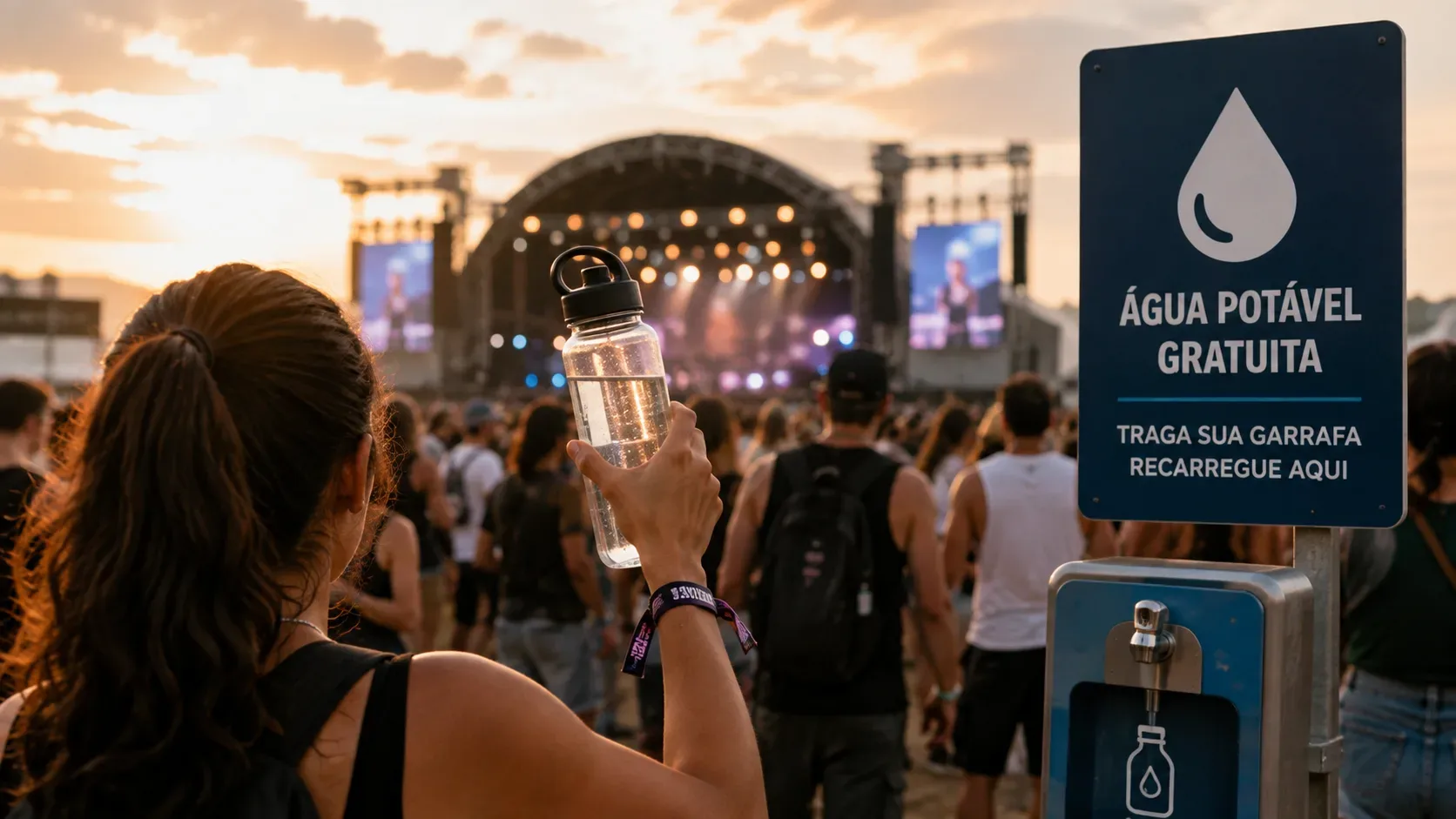
For public-access events with expected attendance of more than 1,000 people, Article 4 requires organizers to provide drinking water free of charge. This may be done through drinking fountains or by distributing individual packages.
Under the literal wording, “more than one thousand” means an expected attendance above 1,000. Accordingly, the specific Article 4 trigger refers to forecasts of 1,001 people or more. Even when that trigger does not apply, the rule allowing attendees to bring their own water still applies to events covered by the decree.
- Drinking fountains and free water distribution points must be in areas that are easy for the public to access.
- Their location must take the venue’s physical layout and estimated attendance into account.
- Organizers must also provide adequate space and structure for rapid access, care, and rescue in emergencies.
- Selling water or other beverages does not replace the duty to provide free drinking water when Article 4 applies.
Practical flow: “Can I bring water in?”
- Confirm that it is a public-access event. The decree cites festivals, congresses, conferences, fairs, concerts, and sports or cultural events, whether free or paid, indoors or outdoors.
- You may bring drinking water in a personal-use container. The organizer cannot treat on-site water sales as a substitute for that permission.
- Check any material rules disclosed in advance. For safety reasons, an event may restrict certain materials, provided the limitation is necessary and communicated beforehand.
- If expected attendance exceeds 1,000, look for free water points. The organizer must provide drinking fountains or individual packages at no charge.
- Paid water does not eliminate free water. Both may be offered at the same event.
Which events are covered?
The decree defines public-access events as those involving a significant concentration of participants and gives examples including festivals, congresses, conferences, fairs, concerts, and sports or cultural events. It covers free and paid events, as well as indoor and outdoor venues.
The text does not establish a single minimum headcount for every public-access event. The 1,000-person mark is used specifically for the additional free-water and emergency-structure obligations in Article 4.
Can the organizer ban a certain type of bottle?
There may be a restriction on the material for safety and physical-integrity reasons, as long as it is limited to what is necessary and communicated in advance. This allows producers to set safety rules for containers, while the decree preserves the general duty to allow consumers to enter with water in a personal container that complies with justified event rules.
A practical step is to check the event regulations, ticket email, and official organizer channels before leaving home. If there is a restriction, the information must have been disclosed beforehand.
Enforcement, prices, and penalties
Enforcement belongs to the agencies that make up Brazil’s National Consumer Protection System (SNDC), within their respective powers. The decree also instructs consumer protection bodies to monitor the prices of bottled water sold at events to curb unjustified price increases and demands for manifestly excessive advantage.
Violations may lead to the administrative penalties set out in Brazil’s Consumer Defense Code, without excluding other applicable civil, criminal, and administrative sanctions.
What should I do if entry with water or free water is denied?
- Ask event staff for guidance and, if needed, request a supervisor or responsible manager.
- Keep your ticket, event rules, emails, and official notices showing the conditions disclosed in advance.
- If it is safe to do so, document the refusal or the absence of a free water point, especially at an event expected to have more than 1,000 attendees.
- Contact a local Procon consumer protection office or another consumer authority. If the responsible company participates in the platform, a complaint may also be filed through Consumidor.gov.br.
If there is an immediate health risk, the priority should be to contact the venue’s emergency team and the appropriate emergency service.
How is this different from the measures adopted since 2023?
After episodes of extreme heat at major concerts, Brazil’s National Consumer Secretariat issued Ordinance No. 35/2023, with hydration measures aimed at concerts, festivals, and events especially exposed to heat, initially for 120 days. In March 2024, Ordinance No. 42/2024 extended that period by another 120 days.
Decree No. 13,109/2026 is broader: its rules are not conditional on periods of high temperature, and it establishes duties for public-access events, with additional requirements when expected attendance exceeds 1,000. The decree itself does not set an expiration date.
In summary
- Bringing your own water: allowed at public-access events covered by the decree, regardless of the 1,000-person threshold.
- Container restrictions: may apply to materials only as needed for safety and with prior notice.
- Free water: mandatory when expected attendance is more than 1,000 people, through fountains or individual packages.
- Water sales: allowed, but they do not replace the free supply when that supply is mandatory.
- Effective date: the official text of Decree No. 13,109/2026 points to September 1, 2026, although a Ministry of Justice news release mentioned a 30-day period.