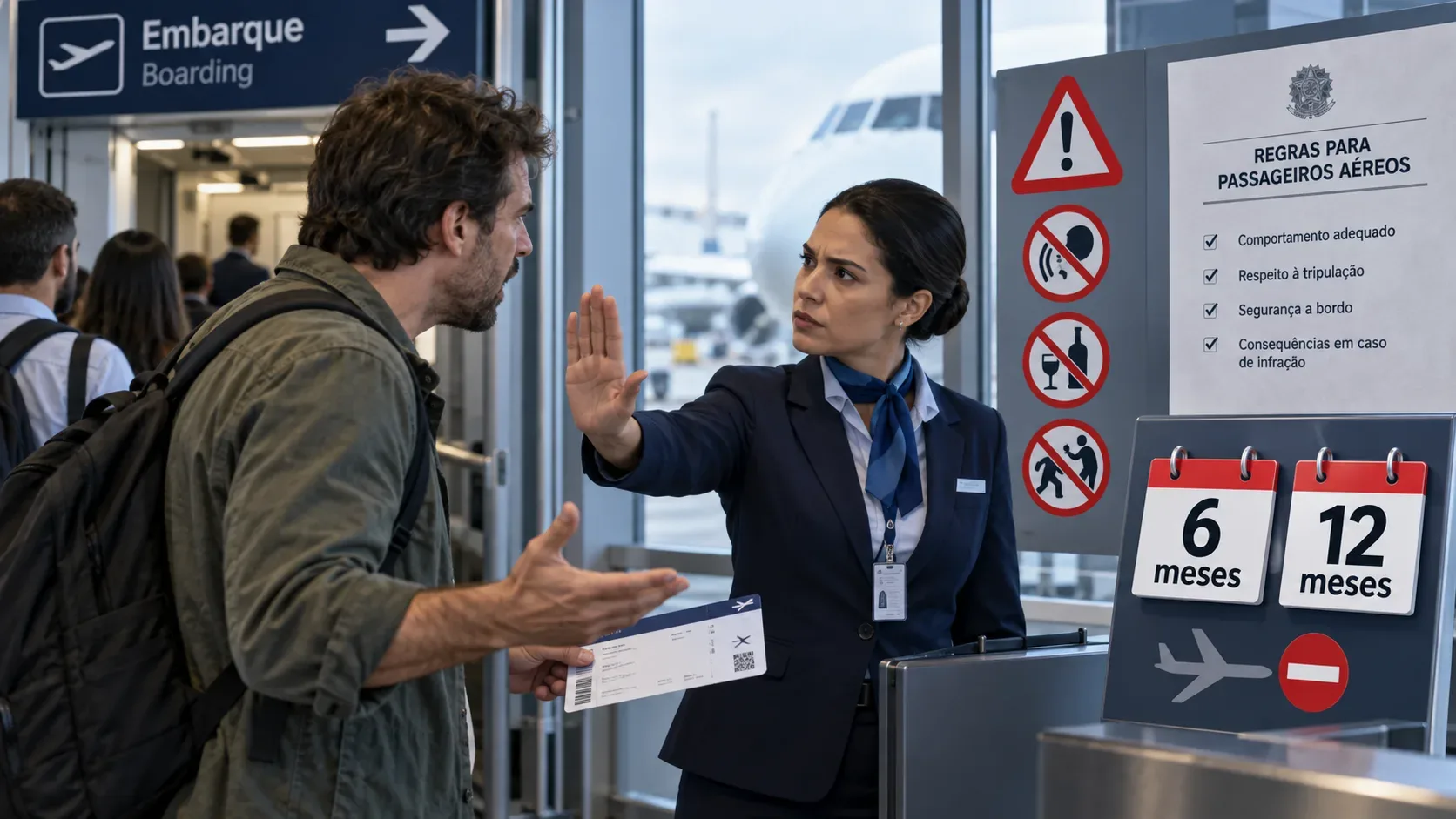
From September 14, 2026, ANAC Resolution No. 800/2026 will govern the suspension of access to scheduled domestic air transport for passengers who commit acts of misconduct classified as extremely serious. The rule does not create a flight ban for every argument, refusal to comply, or disturbance: the 6- and 12-month periods are tied to conduct exhaustively listed in Annex I of the resolution.
There is also an important distinction in the effective dates. Article 12 of the resolution, which amended parts of Resolution No. 400/2016 concerning the contract of carriage and passenger contact details, took effect on April 13, 2026. The rules on classification, suspension, notice, defense, refunds, and fines take effect on September 14, 2026.
When the suspension lasts 6 months and when it lasts 12 months
Suspension is provided only for extremely serious acts committed on board. The period runs from the date on which the passenger's details are added to the list of people whose access to air transport is suspended.
| Period | Conduct that may lead to suspension |
|---|---|
| 6 months | Tampering with, damaging, or destroying an onboard safety device without preventing or hindering the normal performance of the service; physically assaulting a crew member without preventing or hindering the normal performance of the service; or violating the sexual dignity of a crew member or passenger in a way that infringes the victim's physical or psychological integrity or sexual freedom. |
| 12 months | Tampering with, damaging, or destroying an onboard safety device in a way that prevents or hinders the normal performance of the service; physically assaulting a crew member with the same effect; carrying or handling explosives or weapons inside the aircraft, except where permitted by specific regulations; entering or attempting to enter the flight deck without authorization; or unlawfully attempting to take control of the aircraft. |
In extremely serious cases, the airline providing the service must assess the occurrence and apply the suspension when appropriate. At the same time, it must share the identifying data of the passenger added to the list with the other airlines participating in the mechanism required by ANAC.
What does not automatically trigger a 6- or 12-month suspension
The resolution also describes acts of misconduct on the ground and on board that may require intervention by the airline or airport but do not, by themselves, fall within the extremely serious list that triggers suspension. Examples include failing to follow a safety instruction at an airport, causing a disturbance on board, using a portable electronic device when prohibited, verbally abusing another passenger, or refusing a safety instruction from the crew.
There is also an exhaustive list of acts classified as serious, such as physical violence against an airline or airport employee, physical violence against another passenger on board, smoking on the aircraft, intentional damage that affects operations, threatening a crew member in a way that affects flight safety, and falsely reporting explosives or weapons. For serious or extremely serious acts, the airline must terminate the contract of carriage; however, the 6- or 12-month suspension is reserved for the extremely serious level.
How passenger notice and the right of defense work
Resolution No. 800 does not require the airline to wait for a final ANAC decision before imposing the suspension. When the conduct is classified as extremely serious, the measure must be applied immediately or no later than 5 days after the act.
- Assessment of the occurrence: the airline reviews the facts and determines whether the conduct fits the extremely serious list.
- Application of the suspension: when applicable, the passenger is added to the suspended-access list for 6 or 12 months.
- Immediate notice: the company must inform the passenger of the description of the occurrence, the legal basis, and available service and complaint channels, using the contact details provided in the contract of carriage.
- Right of defense: the airline must allow the passenger a full opportunity to defend themselves. If the passenger files a formal complaint about being placed on the list, the responsible airline has up to 5 days to respond.
- Correction of the list: if the airline reverses or corrects its decision, it must immediately remove the passenger's details from the list.
The rule guarantees the right of defense, but Article 8 does not set out a detailed multi-stage appeal procedure. It is therefore important to distinguish what is expressly required — notice, complaint channels, a response within five days, and immediate removal after a reversal — from any additional procedures that may be established by the airline, the contract, or supplementary regulation.
What happens while the suspension is in force
During the suspension period, subject to exceptions provided by law, airlines operating scheduled domestic services under RBAC No. 121 must take all technically and operationally feasible measures to prevent the passenger from using the service. The resolution gives examples such as preventing ticket issuance for flights during the suspension period, blocking check-in, and denying access to the aircraft.
The scope of Resolution No. 800 must be read carefully: it concerns scheduled domestic air transport operations governed by RBAC No. 121, including when a domestic segment connects with an international flight. The rule also covers misconduct in Brazilian airport facilities, including areas used to process international passengers, but that does not by itself create a worldwide no-fly ban across every airline or country.
Are already purchased tickets refundable?
As a rule, yes for certain contracts entered into before the suspension. A suspended passenger is entitled to a full refund of amounts paid, including airport charges, under the General Conditions of Air Transport, when the contract of carriage was concluded before the suspension was imposed and includes flights scheduled during the suspension period.
There are two important exceptions. This specific refund rule does not apply to the flight on which the act classified as serious or extremely serious occurred, nor to the remaining flights under contracts that were terminated by the airline because of a serious or extremely serious act.
Are suspension and a fine the same thing?
No. The suspension is imposed by the airline in extremely serious cases under the procedure established by the resolution. Separately, ANAC may fine a passenger who commits a serious or extremely serious act through an Administrative Sanctioning Proceeding. Annex II sets a base amount of BRL 17,500 per finding for the passenger violation, subject to the applicable administrative procedure.
The resolution also provides sanctions for operators that fail to comply with their obligations, such as failing to guarantee the right of defense, disregarding the suspension period, failing to answer a complaint on time, or failing to remove a passenger from the list immediately after reversing a decision.
What to keep if you receive a suspension notice
Because notice and any challenge depend on records, it is useful to preserve documents that can reconstruct the case and the applicable deadlines:
- the airline's suspension notice, with date and time;
- the description of the occurrence and legal basis provided by the company;
- tickets, booking references, and payment receipts for trips already contracted;
- complaint protocols, airline responses, and proof of submission;
- available records related to the incident, without interfering with official investigations or infringing third-party rights.
It is also prudent to keep your phone number and email address current in the contract of carriage: Resolution No. 400, as amended by Resolution No. 800, treats communications sent to the contact details supplied by the passenger as duly made.
The key point for September 14
The change is not a general authorization for airlines to ban customers for inconvenient behavior. Resolution No. 800 creates a regulated framework with categories of conduct, specific time limits, and duties for the airline. A 6- or 12-month suspension requires conduct that falls within the exhaustive extremely serious list, notice to the passenger, an opportunity to defend themselves, and compliance with the refund and duration rules.
For the official wording, see ANAC Resolution No. 800/2026, published on March 12, 2026 and corrected on August 19, 2026.
Editorial note: this is a legal and regulatory topic, so the final version should undergo human review before publication, especially to check for any supplementary acts, operational guidance, or later changes after the date of this brief.