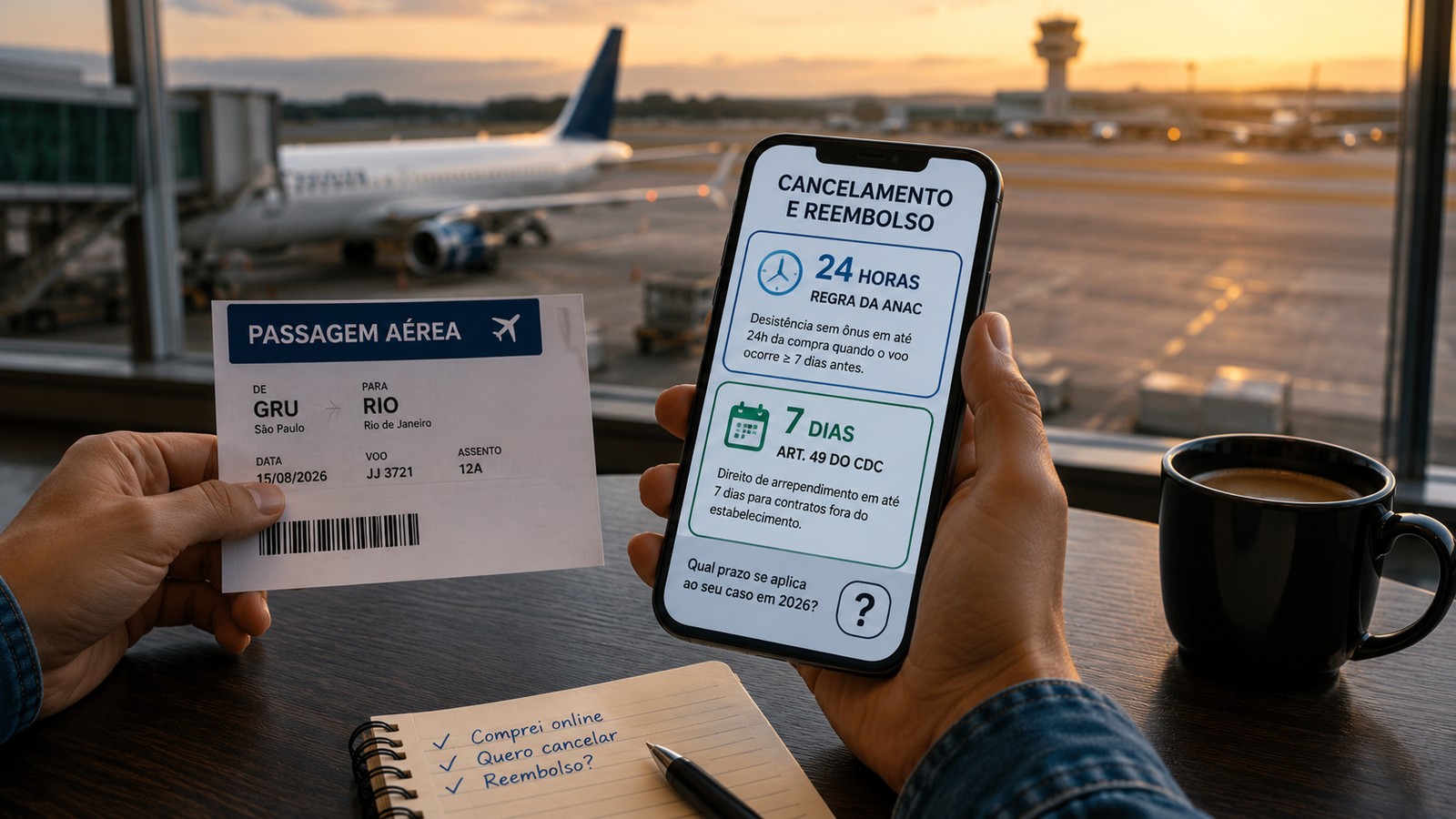
If you bought an airline ticket online and changed your mind, the safest answer in 2026 depends on how much time has passed since the purchase and how many days remain before departure. ANAC's administrative rule guarantees withdrawal without any charge within 24 hours of receiving the purchase confirmation, provided the ticket was bought at least seven days before the flight. The Consumer Defense Code, or CDC, provides seven days to withdraw from contracts entered into away from a commercial establishment. The problem is that application of this seven-day period to airline tickets purchased online is still being discussed by Brazil's Superior Court of Justice, the STJ.
Short answer: what to do depending on the time window
If fewer than 24 hours have passed since you received the confirmation and departure is scheduled for seven days or more after the purchase, this is the most straightforward situation. Article 11 of ANAC Resolution 400 guarantees withdrawal without charge. In that case, request cancellation immediately and keep the protocol number, the time of the request, and confirmation that the ticket was canceled.
If the first 24 hours have already passed but seven days have not yet elapsed since the online purchase, there is a relevant legal argument based on Article 49 of the CDC. That provision gives consumers seven days to withdraw from a contract made away from a commercial establishment. For airline tickets, however, that application has not yet been definitively settled by the STJ. It is therefore not accurate to treat the seven days as an automatic administrative guarantee equivalent to ANAC's 24 hours.
If seven days have already passed since the purchase, the right of withdrawal under Article 49 of the CDC is no longer the main basis. Cancellation then depends on fare rules, contract terms, and the other rules applicable to air transportation. This does not mean the company may necessarily keep the entire amount in every situation, but there is also no general rule granting free cancellation merely because the purchase was made online.
What ANAC guarantees in the first 24 hours
Resolution 400 establishes that a passenger may withdraw from the ticket purchase without any charge within 24 hours from receipt of the purchase confirmation. The sole paragraph makes that protection conditional on how far in advance the purchase was made: the ticket must have been bought seven days or more before the departure date.
In practice, both requirements must be met at the same time. The request must be made within 24 hours, and the flight must be at least seven days away from the purchase date. If either requirement is not met, the specific guarantee in Article 11 of ANAC's rule does not apply in the same way.
ANAC also provides a seven-day period for processing a refund, counted from the passenger's request and subject to the payment methods used for the purchase. This refund-processing period should not be confused with the withdrawal period. One is the window in which you exercise the cancellation right; the other is the time allowed to return the money after the request has been made.
Why the CDC mentions seven days
Article 49 of the Consumer Defense Code states that consumers may withdraw from a contract within seven days when products or services are contracted away from a commercial establishment. The provision also requires the return of amounts paid when the right of withdrawal is exercised.
Online purchases are at the center of the current controversy in air transportation. On one side is the CDC's general rule for distance contracts. On the other is an ANAC sector-specific rule that specifically governs withdrawal from an airline ticket purchase through a 24-hour window and a requirement that the purchase be made at least seven days before departure.
It is precisely this overlap that has produced different decisions and interpretations. For that reason, pages that simply state that “the STJ has already decided that every airline ticket bought online carries a seven-day cancellation period” go beyond what the official case record allows one to conclude at this point.
What the STJ has decided so far in REsp 1.913.986
The STJ's Fourth Panel began hearing Special Appeal 1.913.986 on November 18, 2025. The reporting justice, Marco Buzzi, voted in favor of applying the CDC's seven-day period to airline tickets purchased online and stated that an administrative resolution could not restrict a right established by federal law.
The hearing was then suspended after Justice Antonio Carlos Ferreira requested more time to review the case. As of August 29, 2026, the STJ's official page continued to identify the case as “EM ANDAMENTO” (“IN PROGRESS”). That means there is one vote in favor of the seven-day period, but not a final panel result that can be presented as a definitively settled holding of the Fourth Panel.
The reporting justice's own vote also draws a distinction for tickets purchased less than seven days before departure. In that situation, he considered that up to 5% of the amount to be refunded could be retained under Article 740 of the Civil Code. Because the hearing remains pending, that point must also be treated as the reporting justice's position, not as a final conclusion of the court.
I am between 24 hours and 7 days: can I request a full refund?
You can request it, and it makes sense to base the request on Article 49 of the CDC if the purchase was made online. The important point is that the airline or intermediary may deny full cancellation by relying on Resolution 400 and the fare rules. In this time window, the legal controversy is real.
For that reason, the best course is to formalize the request in writing as soon as possible. State the date and time of purchase, the date you received the confirmation, the flight date, and the exact moment when you requested cancellation. If you are still within the CDC's seven days, expressly state that you are exercising the right of withdrawal under Article 49 and request a full refund.
If the company replies that it recognizes only ANAC's 24-hour period, keep that response. It is important evidence that the denial did not result from a failure to request cancellation, but from a disagreement over which rule applies.
What if the flight is less than seven days away from the purchase date?
In that scenario, the specific 24-hour protection in Resolution 400 is not automatically guaranteed because ANAC's own rule requires the purchase to have been made at least seven days before departure.
If the purchase was made online and you are still within the seven days of Article 49 of the CDC, an argument for the right of withdrawal still exists. This, however, is precisely one of the most sensitive points in the dispute. In the vote already presented to the STJ, the reporting justice accepted that, for a ticket purchased less than seven days before the trip, up to 5% could be retained under the Civil Code. Because the hearing has not ended, do not treat this as a final rule for every case.
The closer the flight is, the more important it is to register the request immediately. Delay may hurt the refund dispute and may also increase the risk that the company treats the situation as a no-show, depending on the ticket conditions.
How to document the cancellation to avoid a dispute over timing
The easiest point to prove is the time. Save the issuance email or confirmation, the purchase screen, and the payment confirmation. Then register the cancellation request through a channel that generates a protocol number, email, or other proof showing the date and time.
Also keep the fare rules displayed at the time of purchase. They help separate two different questions: the right of withdrawal established by law and the contractual penalties that may apply when cancellation occurs outside a penalty-free withdrawal window.
If you bought through an agency or intermediary platform, register the request through the channel where the ticket was purchased and preserve the entire message exchange. When possible, also register the situation with the airline, especially if there is uncertainty about who is processing the cancellation or
refund.
The company denied the request: where to complain in 2026
The first attempt should be made directly with the company responsible for the sale or transportation, always obtaining a protocol number. If the response does not resolve the issue, ANAC continues in 2026 to provide the Anac Passageiro platform for complaints against airlines. The company has up to ten calendar days to respond to a complaint registered in the system.
You can also turn to traditional consumer-protection agencies such as Procons and to Consumidor.gov.br when the company participates in that platform. These channels do not replace a court decision when there is a legal controversy, but they help formalize the attempt to resolve the matter and gather documentation.
If the amount is significant, the trip is very close, or there is additional loss, it may be necessary to seek individualized legal advice. This article explains the general state of the rules and the court proceeding as of August 29, 2026; it does not replace an analysis of the contract, fare, itinerary, and evidence in a specific case.
So, is it 24 hours or 7 days?
ANAC's 24 hours are the clearest and most objective guarantee when the purchase was made at least seven days before departure. Within that window, cancellation must be free of charge.
The CDC's seven days exist in the law for contracts made away from a commercial establishment and are the basis used by consumers for airline tickets purchased online. The reporting justice in REsp 1.913.986 voted in favor of that application, but the hearing was suspended and remains in progress. Therefore, between 24 hours and seven days there is a legal basis for requesting full cancellation, but there is still a risk of denial and the need for an administrative or judicial dispute.
For someone who has just realized they bought the wrong ticket or changed their mind, the safest measure is not to wait: request cancellation immediately, document the time, and rely on the most favorable rule whose deadline still applies to your case.