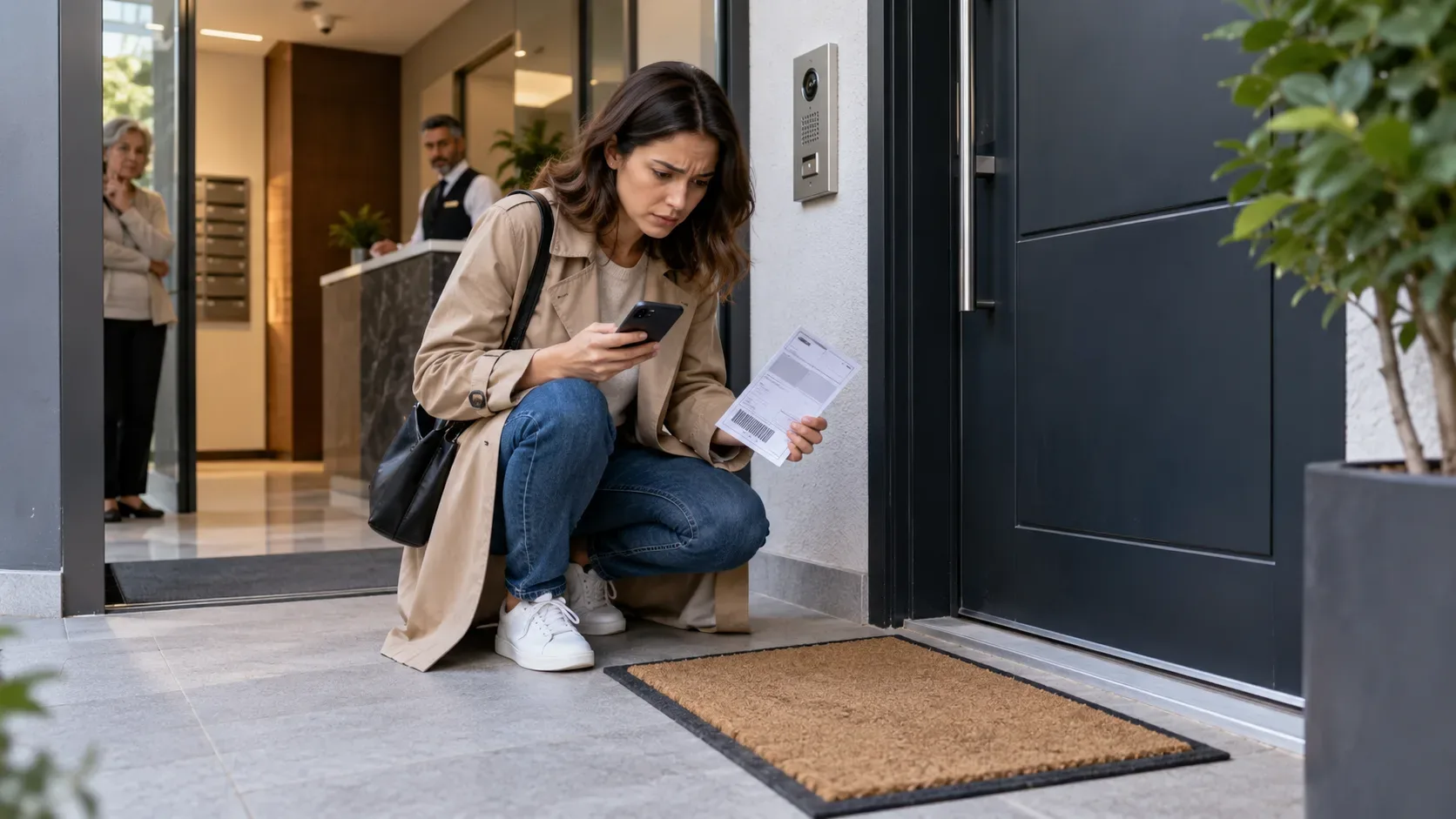
If tracking shows “delivered” but the package never reached you, the first goal is not to argue about who is at fault. It is to preserve evidence before screens, front-desk logs, or camera footage change or are deleted. Then file a formal complaint with the retailer or platform where the purchase was made and use the carrier as a parallel fact-checking channel, not as a substitute for that complaint.
In 2026, Brazil’s National Consumer Secretariat (Senacon) again stressed the importance of keeping invoices, payment receipts, and customer-service records. Procon-SP also advises consumers facing non-delivery to communicate their chosen remedy to the supplier and keep proof of the contact, such as a protocol number, email, or written record. These steps help turn a “my word against the tracking status” situation into a documented sequence of facts.
What the “delivered” status changes — and what it does not settle
When the delivery did not actually occur, the issue is no longer only a future delay; it becomes a question of compliance with the offer. Article 35 of Brazil’s Consumer Protection Code (Código de Defesa do Consumidor, CDC) provides options when an offer is not fulfilled, including demanding performance, accepting an equivalent product or service, or terminating the contract with reimbursement of amounts paid in advance. Procon-SP applies this guidance to non-delivery situations.
This does not mean every delivery problem automatically produces a damages award. Any additional losses or damages depend on the circumstances and the specific case. To solve the missing-package problem, the most useful strategy is to begin with what can be documented: where the parcel should have gone, when the system marked it delivered, who could have received it, and what remedy you requested from the supplier.
Immediate checklist: what to save before complaining
| Evidence or record | What to save | Why it helps |
|---|---|---|
| Status and tracking | Screenshots showing “delivered,” the date, time, tracking code, and the full tracking timeline. | Captures what the system showed when you discovered the problem. |
| Purchase data | Order confirmation, invoice, proof of payment, and the delivery address entered at checkout. | Shows the consumer transaction and the contracted destination. |
| Messages | Emails, text messages, app notifications, and conversations with the retailer, seller, marketplace, or carrier. | Helps rebuild the timeline and the promises made. |
| Front desk and nearby people | Check with household members, doorman, reception, security, and neighbors. Note whom you checked with and when. | Reduces the possibility of a legitimate handoff to someone nearby and documents the verification. |
| Entry log | If the building has a parcel log, front-desk system, or delivery register, check for an entry matching the date and time. | May confirm or contradict the delivery scan. |
| Camera footage | If cameras cover the area, ask the responsible party to preserve footage from the approximate time window when feasible. | This practical step can prevent loss of evidence that may be retained only briefly. |
| Proof of delivery | Ask the retailer and carrier for the delivery records available: recipient, location, time, signature, photo, or other record, if any. | Lets you compare the claimed proof with the address and the people who could actually receive the package. |
| Protocol numbers | Protocol number, date, time, channel, agent name when provided, and promised resolution. | Shows when and how you notified the company. |
There is rarely a single “proof of non-delivery.” The strongest file is usually a consistent set of records: delivered status + nobody at the address received it + no front-desk entry + a formal request for proof of delivery + service protocols.
1. Complain first to the retailer or platform where you bought the item
Open a formal case through the channel linked to the purchase — the retailer, app, marketplace, or payment platform, depending on the transaction flow. The point is not to leave the case as an informal conversation with a driver. Even if the retailer starts an investigation with the carrier, keep an active protocol with the supplier.
In the first message, state clearly:
- the order number and tracking code;
- the date and time when the system marked the order delivered;
- that you did not receive it and have already checked with household members, the front desk, or neighbors when applicable;
- that you want the available proof of delivery and an investigation into where the parcel went;
- the remedy you want: actual delivery, an equivalent product when appropriate, or cancellation with reimbursement, depending on the situation.
“Order no. [number] was marked delivered on [date/time], but it was not received at the registered address. I have already checked with [front desk/household/neighbors]. Please investigate the delivery, provide the available proof of delivery, and record this case under a protocol number.”
Do not treat a generic “the carrier confirmed delivery” statement as a complete resolution if the supplier does not explain what record supports that conclusion. If there is a recipient name, photo, signature, or other data, compare it with the address and with who was present.
2. Contact the carrier in parallel to trace the delivery scan
The carrier can be useful because it normally holds operational tracking data. Open a separate protocol and ask, without accusing anyone of fraud, where and how the delivery was recorded. Request the proof or details that can be provided about the recipient, location, and time.
Treat this contact as an evidence trail. If the carrier says the parcel was delivered to someone you do not know, to another address, or cannot provide a record consistent with the delivery, save that response and send it to the retailer. If the carrier later locates the parcel and delivers it, record the date on which you actually received it.
Do not share account passwords, authentication codes, or unnecessary data. Consumidor.gov.br itself warns that consumer-protection bodies do not ask for personal passwords.
3. If the retailer does not resolve it, take the history to Consumidor.gov.br
Senacon stated in July 2026 that Consumidor.gov.br can be used for delivery problems. Before filing, the official guidance is to gather the order number, invoice, payment proof, service protocols, and messages exchanged with the company, and to describe dates, amounts, and the remedy sought.
As of this update on September 8, 2026, the portal states that users must sign in with a Gov.br account at Silver or Gold level and that complaints can only be filed against participating companies. After filing, the company has up to 10 days to reply; the consumer then has up to 20 days to comment on and evaluate the response, marking the complaint resolved or unresolved.
On Consumidor.gov.br, attach only documents that help establish the transaction and the problem. The platform’s usage guidance also tells users not to put personal data in fields that will be public. Full taxpayer IDs, detailed home addresses, phone numbers, and personal documents should be placed only in the proper private fields when truly needed.
4. When it makes sense to contact Procon
If the company does not participate in Consumidor.gov.br, if its answer does not solve the problem, or if the dispute needs more individualized administrative review, contact the Procon office for your state or municipality. Senacon itself advises consumers who cannot solve a problem directly with the supplier to seek a Procon office or use Consumidor.gov.br.
Bring the same file: order, payment, tracking, screenshot of the “delivered” status, address, retailer and carrier protocols, received responses, and the remedy you requested. Procedures and channels vary by state and municipality, so confirm the requirements of the relevant local Procon.
The order that is usually most efficient
- Preserve evidence immediately. Save screenshots and purchase documents before starting long support conversations.
- Check the delivery surroundings. Household members, front desk, reception, neighbors, and building records may quickly resolve or clarify the case.
- Open a protocol with the retailer/platform. State non-receipt, request the available proof of delivery, and identify the remedy you want.
- Open a carrier protocol in parallel. Use it to investigate the delivery scan and obtain operational details.
- Return to the retailer with the carrier’s answer. Connect the two records rather than leaving them isolated.
- Escalate to Consumidor.gov.br. Do so when the company participates and the direct attempt has not solved the problem.
- Contact Procon if needed. Especially when the company is not on the platform or the dispute remains unresolved.
Mistakes that weaken the complaint
- waiting several days to save the tracking page and losing the original screen;
- complaining only by phone without recording protocol number, date, and time;
- speaking only with the carrier and leaving no record with the retailer or purchase platform;
- accusing a driver, neighbor, or doorman of theft without evidence;
- making “compensation” the first and only demand when the immediate goal is to locate, deliver, or reimburse the order;
- posting a taxpayer ID, full address, phone number, or other personal data in public complaint fields.
If the proof of delivery points to another person or another address
Treat that information as evidence, not as an automatic conclusion. Check whether the name belongs to someone authorized to receive parcels, whether the location is the same address entered in the order, and whether the time matches front-desk or camera records. If it does not, report the discrepancy to the retailer in writing and ask for the investigation to be corrected.
If the case involves a high-value purchase, a concrete suspicion of fraud, misuse of personal data, or another issue beyond an ordinary consumer complaint, individualized legal advice may be appropriate. This guide is informational and does not replace case-specific legal analysis.