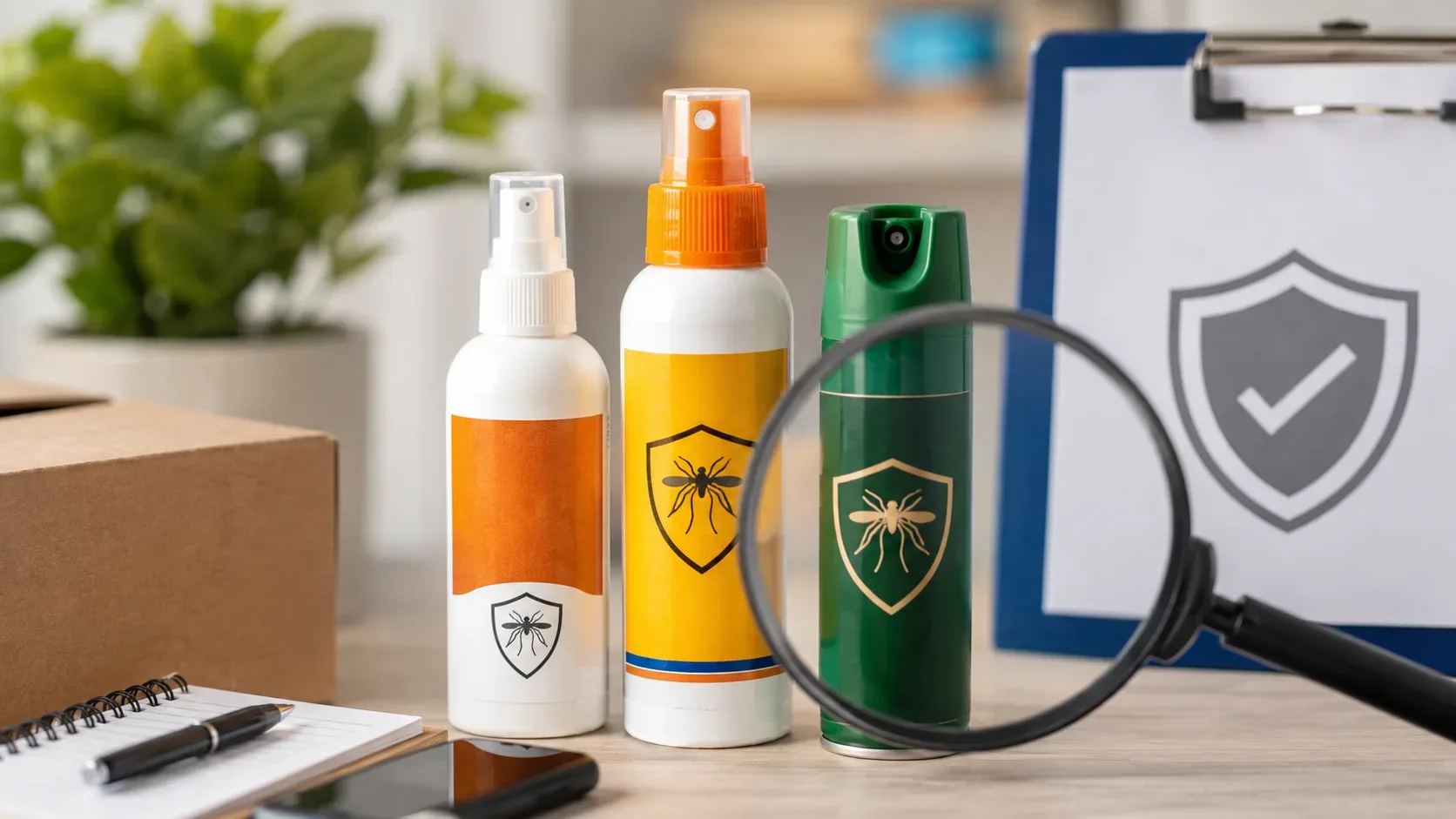
Update of August 4, 2026: Anvisa published, on August 3, 2026, a precautionary ban covering three specific batches of repellents from the Above and Repellere brands. The measure was motivated by unsatisfactory results in DEET tests carried out by the Adolfo Lutz Institute, a central public health laboratory in the State of São Paulo.
The most important point for the consumer is this: it is not enough to recognize the brand. The measure was not announced for all Above or Repellere products, but for three specific product and batch combinations.
What changed on August 3, 2026
Anvisa informed that the three lots cannot be sold or used while the precautionary ban is in force. The statement refers to Resolution-RE No. 3,020/2026, dated July 31, 2026 and published in the Official Gazette of the Union on August 3.
| Product identified by Anvisa | Batch reached | Informed measure | What to check on the packaging |
|---|---|---|---|
| Repellent with SPF 30 Above Protec solar filter | 189952 | Precautionary interdiction | Full product name and batch 189952 |
| Above Protect Insect Repellent | 205688 | Precautionary interdiction | Full product name and batch 205688 |
| Repellere Insect Repellent Aerosol | 2601001449 | Precautionary interdiction | Aerosol presentation and batch 2601001449 |
Names must be compared carefully. The first product appears in the official statement as Above Protec, while the second appears as Above Protect. The similarity between spellings increases the risk that the consumer will only look at the brand and fail to check the presentation and the batch.
The statement informs that the products showed unsatisfactory results in the DEET test, an active ingredient used to repel insects. However, the publication consulted does not present the values found nor clarify whether each result was above or below specification. Therefore, it is not possible to deduce from the statement the size or direction of the deviation in each batch.
How to know if the unit in your home has been hit
1. Locate the batch on the product itself
Look for the “lot” field, “lot.” or other equivalent abbreviation on the bottle, can, label, base of packaging or outer packaging. The code may be embossed, printed in ink, or included near the manufacturing and expiration dates.
Do not confuse batch with:
- barcode;
- registration or regularization number;
- expiry date;
- commercial reference;
- order or invoice number.
2. Compare the entire product, not just the brand
Check simultaneously:
- business name;
- type or presentation of the product;
- batch number;
- company indicated on the label;
- manufacture and expiration dates, if necessary to differentiate the unit.
A sanitary measure can affect just one batch, several batches, all batches of a product or all products from a company. Therefore, the coincidence of the brand alone does not define the scope of the action.
3. Register the conference
Photograph the product so that it can be read, in separate images or in the same sequence:
- front and back of packaging;
- name and presentation;
- lot;
- manufacture and validity;
- regularization number, when visible;
- responsible manufacturer or company and CNPJ;
- seal, lid, valve and general condition of the packaging.
Also save a screenshot of the official announcement and note the date the consultation was carried out. Alerts and precautionary measures may be updated or revoked later.
4. Discontinue use if matched
When product, presentation and batch coincide with one of the three items in the table, the guidance published by Anvisa is that the unit not be used while the measure is in force.
If the batch is different, this specific closure does not automatically reach the unit. This, however, does not act as a certificate of authenticity or absence of other problems. The regularization of the product, the origin of the purchase and any subsequent measures still need to be verified separately.
Evidence checklist before returning or discarding
Before delivering the product to a store, carrier, manufacturer or collection service, preserve what can be safely recorded.
Product identification
- readable photos of the label;
- full name and presentation;
- batch, manufacturing and validity;
- registration or regularization number;
- manufacturer, holder of regularization and CNPJ;
- quantity still in packaging.
Proof of purchase
- invoice or tax coupon;
- proof of payment;
- order number;
- confirmation email;
- name of the store or seller;
- date, price and place of purchase.
Proof of offer
When purchasing online, save:
- product page or advertisement;
- name and identification of the seller;
- advertised price;
- description and images of the offer;
- delivery time;
- page address and capture date.
These records are important because an ad can be changed or removed after consumer contact.
Service history
- messages exchanged with the store, platform or manufacturer;
- emails sent and received;
- date and time of calls;
- name or identification of the attendant;
- proposal presented by the company;
- service protocol;
- proof of return, postage or collection.
The Ministry of Justice and Public Security recommends gathering invoice, proof of payment, order number, protocols and messages before registering a complaint on Consumidor.gov.br. It also advises that the problem be described objectively, with dates, values and the intended solution.
Save a copy of files outside of the store or marketplace app. History available in the account may be closed, hidden, or inaccessible after return.
What the precautionary ban means
The precautionary ban is a precautionary health measure. It seeks to prevent exposure to the product during the investigation and should not be confused with a definitive conviction or with a penalty already applied to the manufacturer.
Law No. 6,437/1977 establishes that this type of interdiction must only last as long as necessary for tests, tests, analyzes or other measures, without exceeding 90 days. During this period, new acts may confirm, amend, replace or terminate the measure.
Therefore, the expression “period of up to 90 days” does not mean that the consumer must wait 90 days using the product. It also does not mean that the situation will necessarily remain unchanged until the last day. The status must be consulted again at Anvisa and in the Official Gazette of the Union.
What the measure does not allow us to conclude
The health resolution, in isolation, does not establish an automatic and identical solution for all purchases. The communication consulted does not indicate a specific exchange, return or refund program, nor does it authorize the conclusion that there will be automatic compensation.
In practice, the consumer can register the incident with the seller or manufacturer, present the documents and ask for a clear solution. The response, the method of return and any disagreements must be kept in writing.
It should also not be stated that:
- all Above products have been banned;
- all Repellere products have been banned;
- any packaging from these brands has the same problem;
- the ban is now definitive;
- the existence of the resolution guarantees reimbursement or compensation without analyzing the case.
Where to register each type of problem
To ask the supplier for a solution
First look for the establishment, sales platform or customer service provided on an official channel. Explain that the unit corresponds to a lot covered by Resolution-RE No. 3,020/2026 and attach legible photos.
Ask the company to inform you in writing:
- which procedure should be followed;
- whether there will be collection, return or delivery to the store;
- how the product should be stored until delivery;
- what solution is being offered;
- what is the service protocol.
To register a consumer dispute
When the company participates in the system, Consumidor.gov.br allows you to register the complaint and attach documents. State or municipal procons may also receive demands according to their own procedures.
To report a health complaint
e-Notivisa receives technical complaints and adverse events from citizens related, among other categories, to cosmetics and hygiene products. Technical complaint is the suspicion of alteration or irregularity in the product; adverse event is an undesirable effect associated with use.
If a reaction or other health effect has occurred, discontinue use and seek appropriate care depending on the severity. Preserve the packaging and inform professionals of the name, batch and, when possible, the ingredients of the product.
Before using, returning or discarding
Use this sequence:
Check the full name → locate the batch → compare with the resolution → photograph the label and packaging → save note and advertisement → suspend use if there is a correspondence → contact the supplier → save protocol → follow new publications from Anvisa.
Save this checklist and consult the official resolution again before using, returning or discarding the product. The most useful proof is not just the photo of the brand: it is the set made up of product, presentation, batch, origin of purchase, service and protocol.