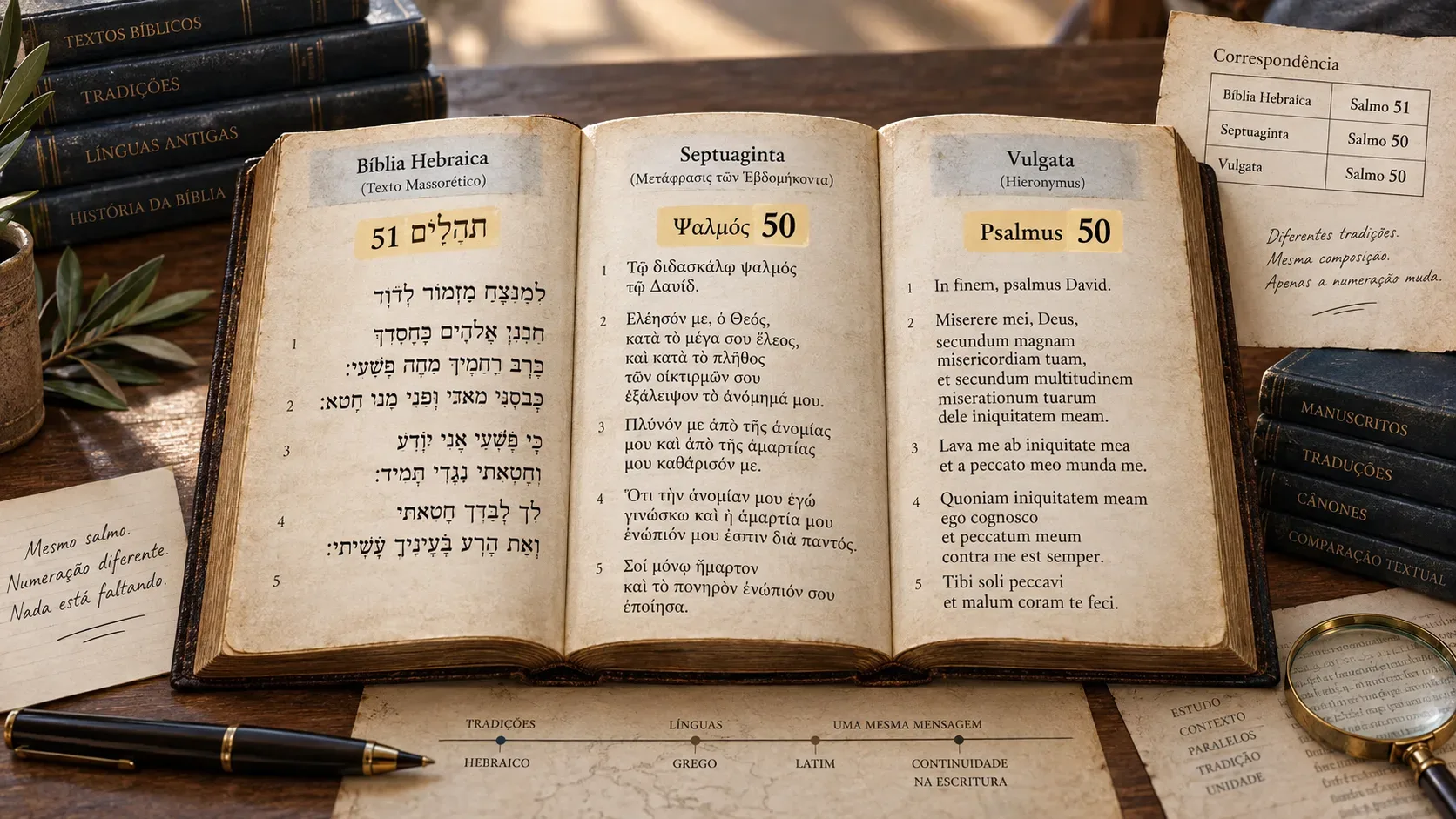
Short answer: Psalm 51 in Hebrew numbering is the same text that appears as Psalm 50 in the Greek Septuagint and in the Latin Vulgate tradition. The difference does not mean that a psalm has disappeared. It comes from ancient decisions about where one psalm ends and the next begins.
The USCCB introduction to Psalms summarizes the mechanism: the Hebrew Psalter has 150 psalms, but the Septuagint divides some of them differently; the traditional Latin Vulgate largely followed that Greek numbering. As a result, through much of the book the Greek/Latin number is one lower than the Hebrew number.
Why can Psalm 51 also be called Psalm 50?
The first major shift occurs near the beginning of the Psalter. In the Hebrew tradition, today’s Psalms 9 and 10 are two psalms. In the Septuagint and the older Latin tradition, they were transmitted as one composition. The USCCB note on Psalms 9–10 observes that, although they are separate in the Hebrew text, they form a single acrostic poem and are transmitted as one in the Greek and Latin traditions.
That joining shifts the count: after this point, Hebrew Psalm 11 corresponds to Greek/Latin Psalm 10; Psalm 12 corresponds to 11; and so on. By the time the penitential psalm beginning with a plea for mercy is reached, the Hebrew number is 51 while the Septuagint and traditional Vulgate number is 50.
The Vatican’s Nova Vulgata makes the relationship especially clear by printing the heading “PSALMUS 51 (50)”: 51 is the Hebrew-based number used as the main number in that edition, while 50 in parentheses preserves the traditional reference. Vatican documents also use forms such as “Psalm 50 (51)”, placing both conventions side by side.
Correspondence table: where the count changes
| Hebrew numbering | Septuagint / traditional Vulgate | What happened |
|---|---|---|
| 1–8 | 1–8 | No numbering difference. |
| 9–10 | 9 | Two Hebrew psalms are counted as one in the Greek/Latin tradition. |
| 11–113 | 10–112 | Greek/Latin numbering is one number behind. |
| 114–115 | 113 | The two Hebrew psalms are grouped under one number in the older tradition. |
| 116:1–9 | 114 | The first part of Hebrew Psalm 116 is counted separately. |
| 116:10–19 | 115 | The second part of Hebrew Psalm 116 receives another number. |
| 117–146 | 116–145 | The Greek/Latin tradition remains one number behind. |
| 147:1–11 | 146 | The first part of Hebrew Psalm 147 is a separate psalm in the older count. |
| 147:12–20 | 147 | The second part receives the next number. |
| 148–150 | 148–150 | The two systems coincide again. |
This is why a simple rule such as “subtract 1” cannot be applied to the whole book. It works across long stretches but fails where psalms are joined or split. The Nova Vulgata is useful for checking these transition points: it shows Psalm 114 as “113 A,” Psalm 115 as “113 B,” Psalm 116 as corresponding to “114, 1–9; 115,” and Psalm 147 as corresponding to “146, 1–11; 147.”
The Psalm 51/50 example
If one Bible identifies the “Miserere” prayer as Psalm 50 and another as Psalm 51, the first question should not be “which one is wrong?” but “which numbering system is this edition using?” The content can be the same even when the heading number differs.
In Hebrew numbering, used by many modern translations, the psalm is 51. In Septuagint and traditional Vulgate numbering, it is 50. That is why academic, liturgical, and historical references may appear as Ps 51 (50), Ps 50 (51), or simply with one of the two numbers, depending on editorial tradition.
Why can verse numbers differ too?
There is a second difference, separate from the number of the psalm itself: some editions count the superscription—the ancient heading before the body of the poem—as a numbered verse, while others leave it outside the verse count.
The USCCB notes that the New American Bible follows Hebrew verse numbering and that many traditional English translations can be one verse behind because they do not count superscriptions as verses. In Psalm 51, the Nova Vulgata counts the introductory lines about David and Nathan as verses 1–2; “Miserere mei, Deus” therefore appears as verse 3. In another Bible, the same opening line of the poetic body may appear as verse 1.
Two references can therefore differ at two levels: the psalm number and the verse number. A work might cite “Ps 50:3” under one convention while another edition points readers to “Ps 51:1” for the beginning of the poetic body. The safest check is to compare the actual wording and identify the edition’s counting convention.
Do not confuse the Septuagint, the Vulgate, and the Nova Vulgata
The Septuagint is the ancient Greek translation of the Hebrew Scriptures. Its division of the Psalms deeply influenced early Christianity and the Latin tradition. The historical Vulgate retained the numbering associated with the Greek tradition in many uses, which is why “Psalm 50” became a traditional reference for the Miserere.
The Nova Vulgata, however, should not be assumed to display the older numbering without adjustment. In the Vatican edition, the Hebrew number is printed as the main number and the traditional correspondence appears in parentheses. This is why a modern Vatican Latin text can read “Psalmus 51 (50)” while liturgical or historical documents still call the same composition Psalm 50.
How to check a reference without assuming a psalm is missing
- Identify the numbering tradition used by the edition. Prefaces, editorial notes, and introductions to Psalms often state whether Hebrew or Greek/Latin numbering is primary.
- Look for dual numbering. Forms such as “51 (50)” or “50 [51]” explicitly signal that two systems are in use.
- Compare the opening words. If the text is the same, the difference is probably one of division and numbering rather than omission.
- Check superscriptions. If the psalm matches but the verse number does not, see whether the opening heading is being counted.
- For Psalms 9–10, 114–116, and 147, use a correspondence table. Those are the main places where joining or splitting compositions changes the sequence.
What dual numbering actually tells us
The double numbering of Psalms is an example of how the same textual collection can be organized differently across manuscript transmission and translation traditions. The point is not that one Bible “has” one more or one fewer psalm in this case: the Hebrew Psalter and the main Septuagint/Vulgate sequence both work with a 150-psalm collection, but they draw some internal boundaries differently.
For comparative reading, the most useful rule is simple: treat the number as part of an editorial convention, not as automatic proof that the text has changed. In the best-known example, Psalm 51 and Psalm 50 are two traditional references to the same composition; correct cross-checking depends on recognizing the numbering system and, when needed, how the edition counts superscriptions.