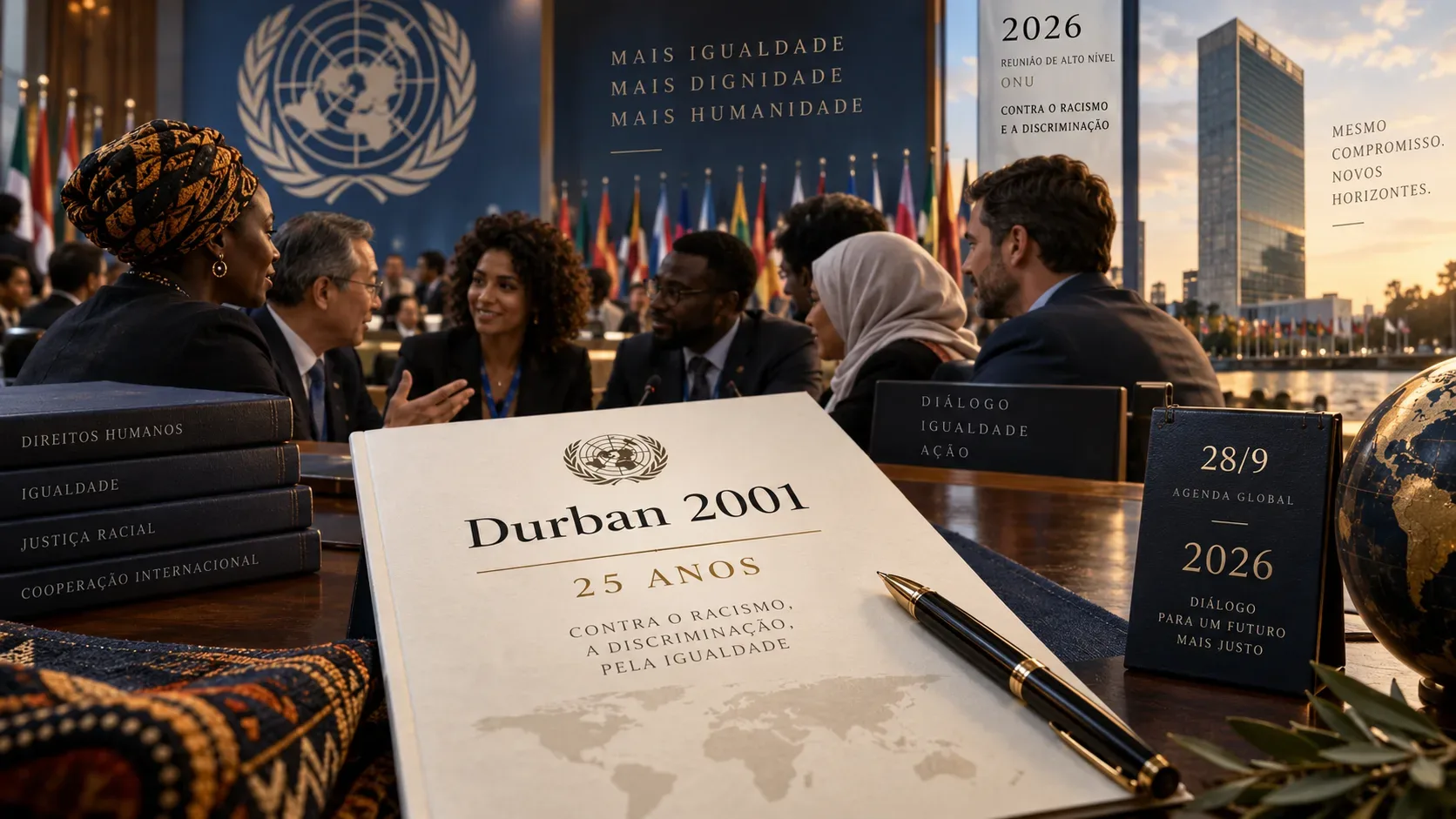
On 28 September 2026, the United Nations General Assembly will hold a high-level meeting to mark 25 years since the adoption of the Durban Declaration and Programme of Action (DDPA). The key point for understanding the document is both legal and political: Durban is not, by itself, a legally binding treaty, but an international political commitment that organizes principles, priorities and practical measures against racism, racial discrimination, xenophobia and related intolerance.
The DDPA was adopted at the World Conference against Racism, held in Durban, South Africa, from 31 August to 8 September 2001. Over the following 25 years, its content was revisited through review conferences, political declarations, recommendations by human rights bodies and specific UN mechanisms. The 2026 meeting, however, does not amount to an automatic rewriting of the text: the officially announced focus is to mobilize global public support for its full and effective implementation.
What the Durban Declaration and Programme of Action is
The name covers two components approved through the same process. The Declaration sets out diagnoses, principles and political commitments. The Programme of Action turns those commitments into recommendations and lines of action for States, international organizations, national institutions and civil society.
| Component | Main function | How it should be read |
|---|---|---|
| Durban Declaration | Sets out principles, recognizes problems and records political commitments against racism and discrimination. | As a political and interpretive framework adopted at the conference. |
| Programme of Action | Proposes measures for prevention, victim protection, education, access to justice, public policy and cooperation. | As an implementation roadmap, not as a worldwide legal code. |
| Relationship with treaties | Reinforces the central role of instruments such as the International Convention on the Elimination of All Forms of Racial Discrimination (ICERD). | Legally binding obligations arise from treaties applicable to each State, not from the DDPA alone. |
The UN itself describes the DDPA as a victim-centred document with a holistic vision. It seeks to connect present-day discrimination with historical structures while also identifying concrete institutional responses.
What the 2001 document established
“Established” here means that the conference consolidated an international political framework of reference, not that it created supranational law automatically applicable in every country. Its main pillars include:
- Racism as a global problem: the text starts from the idea that no country is immune to racism and that addressing it requires national action and international cooperation.
- Victims at the centre: the DDPA pays attention to Africans and people of African descent, Asians and people of Asian descent, Indigenous Peoples, migrants, refugees, displaced persons, victims of trafficking and different minorities, among other groups.
- Historical legacies: the Declaration gives weight to the enduring effects of slavery, the trade in enslaved persons and colonialism. When discussing these issues, the formulations should be attributed to the document itself because they include political and historical positions adopted in that multilateral process.
- National policies: the Programme of Action recommends anti-discrimination legislation, national plans, access to justice, institutions able to receive complaints, appropriate data collection, participation by affected groups and monitoring mechanisms.
- Education and prevention: it includes human rights education, training for public officials, action against stereotypes and measures to promote tolerance and equality.
- Multiple discrimination: the text calls for a gender perspective and recognizes that different forms of discrimination can overlap and intensify vulnerability.
- New channels of dissemination: the Durban agenda also addresses media, communications and technology, an issue that became even more relevant with the expansion of digital platforms and debates over hate speech.
How implementation was organized after Durban
Implementation did not proceed through a single channel. The General Assembly endorsed the Durban outcomes, while the UN system created or strengthened follow-up mechanisms. One of the main bodies is the Intergovernmental Working Group on the Effective Implementation of the Durban Declaration and Programme of Action, established early in the follow-up process to make recommendations and discuss gaps and complementary standards.
Other mechanisms also became connected to the agenda, including the Working Group of Experts on People of African Descent, the Committee on the Elimination of Racial Discrimination (CERD) and, more recently, the Permanent Forum on People of African Descent. CERD, for example, has repeatedly asked States to provide information on national action plans and other measures related to Durban implementation.
There were also major review and commemoration milestones: the Durban Review Conference in Geneva in 2009; the tenth-anniversary political declaration in 2011; and the twentieth-anniversary high-level meeting in 2021. On 31 March 2026, the Human Rights Council again renewed the mandate of the intergovernmental implementation working group. This institutional continuity shows that Durban remains active on the UN agenda, but it does not prove that its recommendations have been implemented uniformly across countries.
What exactly the UN is revisiting on 28 September 2026
The official programme for the 2026 High-level Week confirms a one-day meeting at UN Headquarters in New York on 28 September. The announced overall theme is “Mobilizing global public support for the full and effective implementation of the Durban Declaration and Programme of Action.”
This defines the purpose of the meeting: the UN is returning to the implementation of an existing framework and to its role in guiding policies against racism, racial discrimination, xenophobia and related intolerance. General Assembly resolutions A/RES/80/193 and A/RES/80/299 provide the basis for the meeting and its modalities.
As of the publication date of this analysis, the confirmed points in official UN material are the twenty-fifth-anniversary commemoration and the effort to mobilize support for implementation. It would therefore be premature to present as fact any new commitments, final declaration or substantive consensus that will depend on the 28 September meeting itself.
What the 2026 meeting does not change automatically
- It does not turn the DDPA into a treaty: the document remains a political commitment that is not legally binding by itself.
- It does not automatically create domestic law: internal changes depend on each country's institutions and procedures, as well as on obligations already assumed under treaties.
- It is not the same as implementation: a high-level meeting can renew political priority, but practical effects require laws, policies, budgets, data, enforcement and access to remedies.
- It does not erase political disagreement: an official UN agenda does not mean that every State shares the same interpretation of each passage or every policy associated with the document.
How to read Durban without turning political positions into universal facts
Four different layers need to be kept separate: what the 2001 text says, what UN bodies later reaffirmed, what constitutes a legal obligation under treaties, and what each government adopts as policy. Mixing these layers creates confusion.
The official edition of the Declaration and Programme of Action notes that the conference's final report records reservations and statements made by participants. This is a reminder that Durban emerged from a complex multilateral negotiation. On sensitive historical or geopolitical questions, the most precise editorial approach is to attribute claims to the document or body that adopted them rather than presenting them as universal legal consensus.
Why the document still matters 25 years later
Durban's continuing relevance lies less in creating a new category of law than in offering an architecture that links diagnosis, affected groups, prevention, access to justice, education, data and public policy. That architecture continues to appear in UN recommendations and mechanisms, including in 2026.
For readers, the key is to separate symbolism from legal effect. The twenty-fifth anniversary gives renewed visibility to a major political framework in the anti-racism agenda, but concrete outcomes depend on national implementation and on the application of human rights treaties already in force. The gap between international commitment and practical execution is precisely what the 28 September meeting brings back into focus.
Official sources to follow
- UN — 2026 General Assembly High-level Week
- UN — overview of the Durban Declaration and Programme of Action
- OHCHR — official text of the Durban Declaration and Programme of Action
- OHCHR Library — edition containing Durban 2001, the 2009 Review and the 2011 political declaration
- OHCHR Library — 2026 renewal of the intergovernmental implementation working group's mandate
- UN — official information for the 28 September 2026 high-level meeting