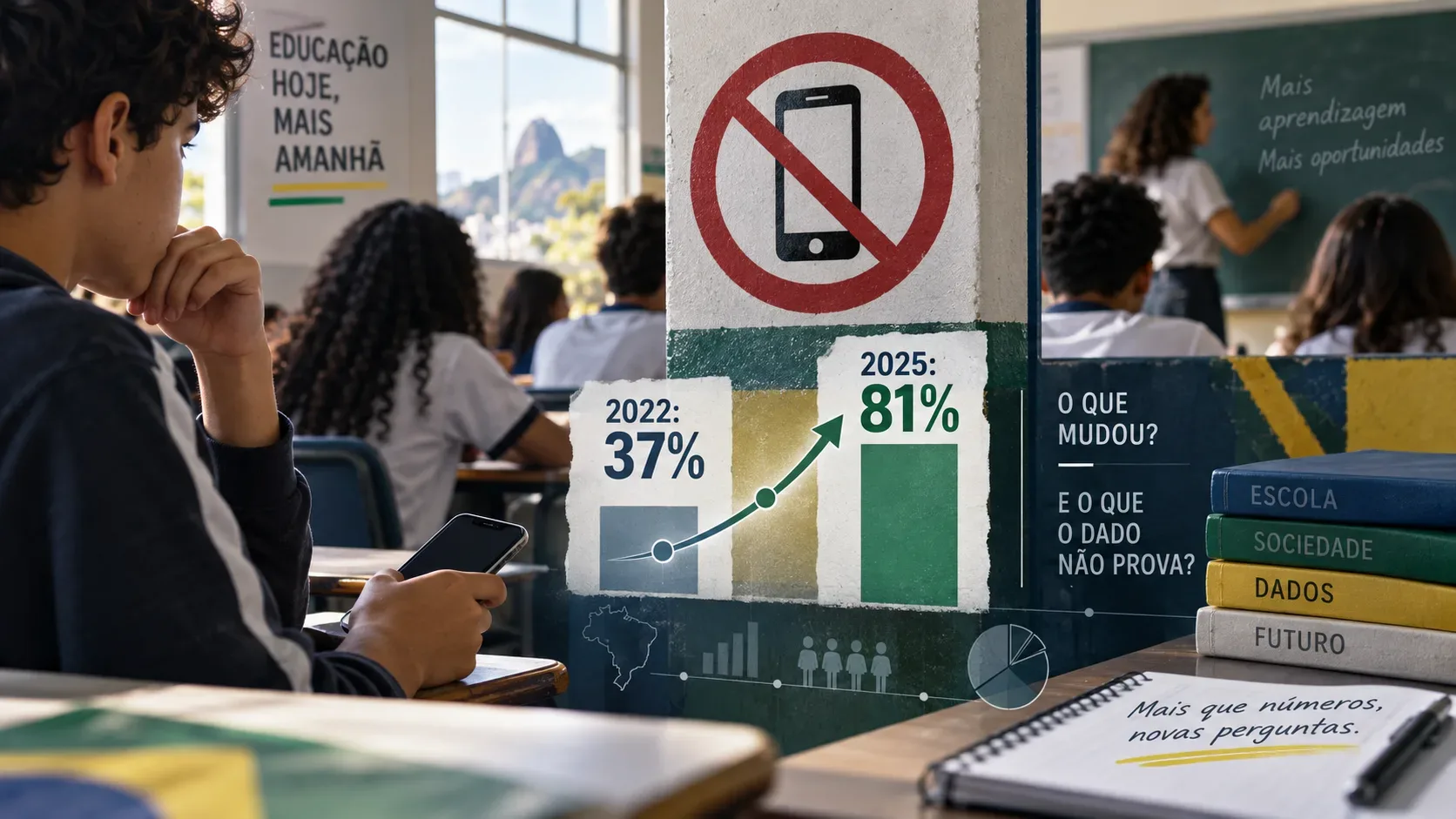
The 81% figure reported in PISA 2025 does not mean that 81% of Brazilian students stopped using phones at school, nor that bans automatically raised test scores. The indicator says something else: in 2025, 81% of the 15-year-old students assessed in Brazil attended schools where cell phone use was not allowed on school premises, according to PISA. In 2022, the figure was 37%.
The shift is large: +44 percentage points in Brazil. Across OECD countries on average, the same indicator rose from 34% to 49%, an increase of 15 percentage points. Brazil therefore moved from a position close to the OECD average in 2022 to a much broader prevalence of bans in 2025.
What changed from 2022 to 2025
| Indicator | 2022 | 2025 | Change |
|---|---|---|---|
| Brazil: students in schools with cell phone bans on school premises | 37% | 81% | +44 pp |
| OECD average | 34% | 49% | +15 pp |
| Brazil − OECD gap | +3 pp | +32 pp | widened by 29 pp |
The figures come from the PISA 2025 country note for Brazil. The OECD itself describes the change as a substantial increase in the implementation of cell phone bans.
This should be read as an institutional change: school rules governing digital devices became far more common within a single PISA cycle. Across OECD countries, this expansion did not occur in isolation. The report says that between 2022 and 2025 schools typically adopted cell phone bans together with formal, subject-specific guidelines for the pedagogical use of digital devices.
Brazil's context also changed through federal law
On 13 January 2025, Brazil enacted Law No. 15,100/2025, covering public and private basic education. It restricts students' use of personal portable electronic devices during classes, recess and breaks, while providing exceptions for purposes including pedagogy, accessibility, inclusion, health conditions and fundamental rights. Decree No. 12,385/2025 later regulated the law.
This helps explain why 2025 is an important regulatory milestone, but the two measures should not be treated as identical. The PISA indicator concerns students enrolled in schools where phones are not allowed on school premises; Brazilian law has its own scope, exceptions and implementation duties. Moreover, the 2022–2025 comparison by itself does not measure how much of Brazil's 44-point increase was caused by the federal law. Networks and schools had already been introducing rules before it, and PISA is not an experiment designed to isolate each cause of the expansion.
Bans and distraction: what the OECD found
Across OECD countries on average, students in schools where cell phones are not allowed on school premises are about 13% less likely to report digital distraction. This is a statistical association; it is not a 13-percentage-point drop and should not be read as a proven causal effect.
In PISA's chapter on school life, the OECD provides another comparison: digital distraction in science lessons was reported by 27% of students in schools with cell phone bans, with or without subject-specific guidelines, compared with 29% in schools with guidelines only and 32% in schools with neither policy, on average across OECD countries. The analyses account for students' and schools' socio-economic profiles, but they remain observational.
The pattern is consistent with the idea that clearer rules can reduce opportunities for interruption. Yet it may also reflect differences in implementation, school culture, discipline, pedagogical technology use, student composition and other factors that vary across schools and education systems.
What the data show — and what they do not prove
| The data show | The data do not prove |
|---|---|
| There was a sharp expansion in schools with cell phone bans among Brazilian students assessed: from 37% to 81%. | That 81% of students comply with the rule at all times. |
| Brazil was far above the OECD average in 2025: 81% versus 49%. | That every Brazilian school enforces the same rule or with the same intensity. |
| Across OECD countries on average, bans are associated with a lower likelihood of reported digital distraction. | That the ban alone caused the reduction in distraction. |
| Frequent digital distraction is associated with lower science performance in many education systems. | That banning phones necessarily raises science, reading or mathematics scores. |
| By 2025 Brazil had a more restrictive institutional environment for students' personal phone use in basic education. | That Law No. 15,100/2025 alone explains the entire change between 2022 and 2025. |
Why academic performance is a different question
The OECD report itself calls for caution. Between 2022 and 2025, changes in the prevalence of cell phone bans were not associated at the education-system level with changes in average science or reading performance. In 2025, countries and economies where bans were more prevalent even tended to have lower average science performance. The OECD explicitly states that PISA data do not allow causal inference and that this pattern may occur because lower-performing systems are more likely to introduce bans as mitigation measures.
This is an example of possible reverse causality: the ban does not necessarily produce the problem; the problem may encourage adoption of the ban. Confounding factors may also be present. A school system that restricts phones may simultaneously be dealing with discipline problems, inequality, learning deficits or weak pedagogical integration of technology.
Three questions therefore need to remain separate:
- Does the rule exist? The 81% indicator answers how widespread the school policy is.
- Does distraction fall? PISA finds an association with lower distraction on average across OECD countries, but it does not prove the isolated effect of the rule.
- Do scores rise? PISA 2025 does not provide a basis for claiming that the expansion of bans caused an improvement in academic performance.
How to interpret the 81% figure without overstating it
The safest reading is sociological and institutional: within three years, schools came to treat the smartphone less as an object of individual student choice and more as an object of collective regulation. That changes routines, behavioural expectations, teacher and school leadership authority, and the boundary between personal and pedagogical technology use.
At the same time, formal adoption is not the same as effective implementation. One school may have a written rule but uneven enforcement; another may collect devices; another may allow teacher-directed educational use. PISA identifies a normative environment, but it does not automatically turn that rule into a precise measure of everyday compliance.
To evaluate whether the policy works in Brazil, researchers would need data tracking implementation, actual use frequency, distraction, school climate and learning over time, ideally with designs able to compare similar groups before and after policy changes. PISA is valuable for revealing broad patterns and international associations, but it does not replace that type of causal evaluation.
In brief
- The jump from 37% to 81% shows a rapid expansion of cell phone bans in the schools attended by Brazilian students assessed by PISA.
- Across OECD countries on average, schools with bans show a lower likelihood of reported digital distraction, but this is an association, not proof of cause and effect.
- PISA does not demonstrate that banning phones automatically improves academic performance.
- Law No. 15,100/2025 is part of Brazil's new institutional context, but PISA cannot attribute the entire 2022–2025 change to that law alone.
- The next relevant question is less “is there a ban?” and more “how is the rule implemented, for whom does it work, and under what conditions does it improve the learning environment?”.
Main sources: OECD — PISA 2025 Results: Brazil; OECD — PISA 2025 chapter on school life and digital devices; Brazilian Law No. 15,100/2025; Brazilian Ministry of Education — FAQ on cell phones in schools.