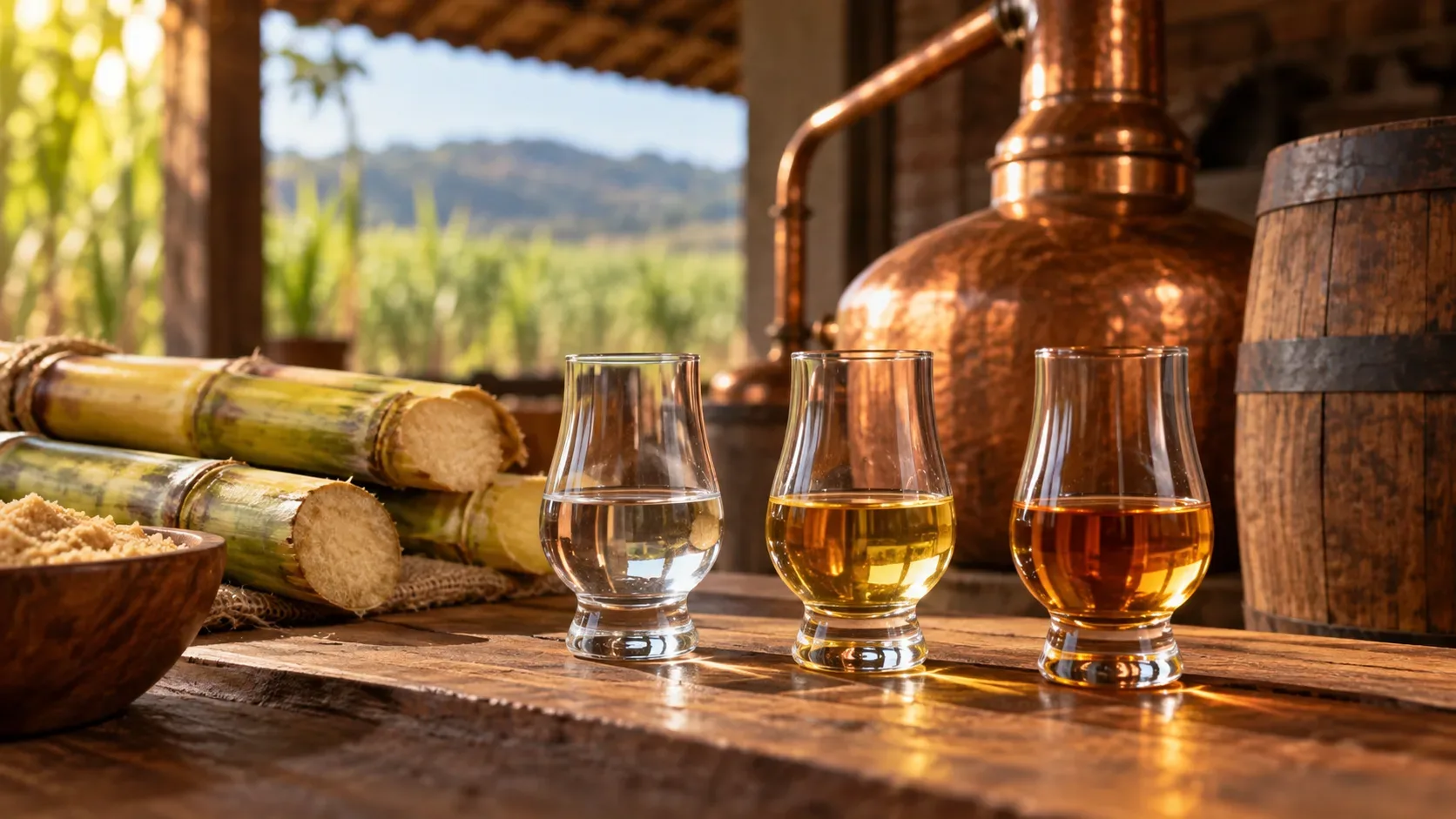
In 2026, aguardente de cana, cachaça and cachaça de alambique are not three interchangeable names for the same drink. Brazilian law establishes a broader-to-narrower relationship: aguardente de cana is the broad category; cachaça is the typical and exclusive designation for aguardente de cana produced in Brazil, with a narrower alcohol range; and cachaça de alambique adds a specific production requirement, with the entire distillation carried out in a copper pot still.
The most recent general framework is Decree No. 12,709/2025, which replaced the former Decree No. 6,871/2009 and consolidated the main definitions. For detailed identity, quality, classification and labeling rules, Brazil’s Ministry of Agriculture and Livestock still lists MAPA Ordinance No. 539/2022 in 2026 as an applicable reference for aguardente de cana and cachaça.
What may it legally be called? The difference in one table
| Designation | Alcohol by volume | Origin | Raw material and process | Copper pot still mandatory? |
|---|---|---|---|---|
| Aguardente de cana | 38% to 54% ABV at 20 °C | Article 53 does not reserve the designation exclusively for Brazil | Made from simple sugarcane alcoholic distillate or by distilling fermented sugarcane-juice must | No |
| Cachaça | 38% to 48% ABV at 20 °C | Produced in Brazil; the designation is typical and exclusive | Ordinance 539/2022 requires distillation of fermented sugarcane-juice must and distinctive sensory characteristics | No. It may be produced by another distillation method or by blending cachaças from different distillation methods |
| Cachaça de alambique | 38% to 48% ABV at 20 °C | Brazil, because it is a classification of cachaça | Distillation of fermented must from raw sugarcane juice, exclusively and entirely in a copper pot still | Yes |
What Decree No. 12,709/2025 changes in the framework used in 2026
The decree is dated October 31, 2025 and was published in Brazil’s Federal Official Gazette on November 3, 2025. For the definitions of aguardente de cana and cachaça, its effects began on the publication date. The 730-day transitional rule in Article 241 is specifically for adjustments to registration information for beverages whose designation changed; it should not be read as a general authorization to use any label name until 2027.
In practice, the decree consolidates three easy checks. First: below 38% ABV, a product does not fit these legal definitions of aguardente de cana or cachaça. Second: from 49% to 54% ABV, a sugarcane beverage may qualify as aguardente de cana but not as cachaça. Third: the term “cachaça” requires production in Brazil and 38% to 48% ABV, in addition to compliance with the applicable supplementary standards.
Aguardente de cana is the broader category
Article 53 of Decree No. 12,709/2025 defines aguardente de cana as a beverage with 38% to 54% ABV made from simple sugarcane alcoholic distillate or by distilling fermented sugarcane-juice must. This explains why the term covers a wider alcohol range and a broader production route than cachaça under Ordinance 539/2022.
Therefore, not every aguardente de cana may be called cachaça. A straightforward example is an aguardente de cana at 50% ABV: its strength is within the legal range for aguardente de cana, but above cachaça’s 48% ceiling.
Cachaça is a Brazilian aguardente de cana with its own requirements
Article 54 of the decree reserves “cachaça” for aguardente de cana produced in Brazil, at 38% to 48% ABV, with distinctive sensory characteristics. Ordinance 539/2022, which MAPA still identifies as the specific reference, adds that cachaça is obtained by distilling fermented sugarcane-juice must.
This also prevents the term from being treated as a purely commercial synonym. “Cachaça” is not simply a better-known way to say sugarcane spirit: it is a legal designation with origin and product parameters of its own. A sugarcane spirit produced outside Brazil does not become cachaça merely because it uses similar raw material.
What “cachaça de alambique” actually tells you
The sole paragraph of Article 54 of Decree No. 12,709/2025 defines cachaça de alambique as cachaça obtained by distilling fermented must from raw sugarcane juice, exclusively and entirely in a copper pot still. Ordinance 539/2022 further describes the copper still as batch-distillation equipment whose inner walls of the pot, column and head are made of copper; other parts may be made of materials suitable for their purpose.
This matters because “alambique” is not a legal synonym for “artisanal,” “premium” or “small-batch.” It is a process classification. MAPA’s technical FAQ, for example, clarifies that redistilling an aguardente de cana in a copper still is not enough to turn it into cachaça de alambique: production must start from fermented sugarcane-juice must and comply with the process required by the standard.
How to read the label without confusing designation, brand and qualifiers
Ordinance 539/2022 defines “designation” as the product name stated in the beverage’s labeling and documentation, subject to its identity and quality standard. The commercial brand is separate information. A brand may therefore be creative, but it cannot replace the legal designation or mislead consumers about identity, composition, classification, origin or process. Decree No. 12,709/2025 prohibits this type of misleading presentation.
- Start with the designation: “aguardente de cana,” “cachaça” and “cachaça de alambique” communicate different legal classifications.
- Check alcohol strength: 38% to 54% for aguardente de cana; 38% to 48% for cachaça and cachaça de alambique.
- Do not treat “alambique” as a generic adjective: in the designation “cachaça de alambique,” copper distillation is a technical requirement.
- Separate maturation from basic identity: expressions such as “armazenada,” “envelhecida,” “premium” and “extrapremium” follow additional rules in Ordinance 539/2022 and do not erase the distinction among aguardente de cana, cachaça and cachaça de alambique.
- Look for registration: until the decree’s new visual registration identifier is regulated, Article 226 requires Brazilian beverages to keep the product registration number on the label.
Four practical examples
- A sugarcane beverage at 50% ABV: it may qualify as aguardente de cana, but not as cachaça, because it exceeds 48% ABV.
- Brazilian cachaça at 42% ABV made by a method other than a copper pot still: it may be cachaça if all other requirements are met, but not “cachaça de alambique.”
- Aguardente de cana later redistilled in copper: redistillation alone does not authorize the designation “cachaça de alambique,” according to MAPA’s FAQ.
- A sugarcane distillate produced outside Brazil: it does not fit the typical and exclusive “cachaça” designation under Brazilian law.
What to check in 2026
For a fast label reading, the safest sequence is: legal designation, alcohol strength, origin, and distillation method when “de alambique” appears. Maturation qualifiers and other mandatory labeling information come next. This order helps avoid drawing conclusions from the drink’s color, an illustration of a still or the brand when the legal name itself does not support them.
In 2026, MAPA maintains a page of standardized products and regulatory references linking cachaça to Article 54 of Decree No. 12,709/2025 and MAPA Ordinance No. 539/2022. On July 31, 2026, the Ministry also published the 2026 Cachaça Yearbook, with registration and production data for 2025, reinforcing the importance of formal product classification in tracking the sector.